
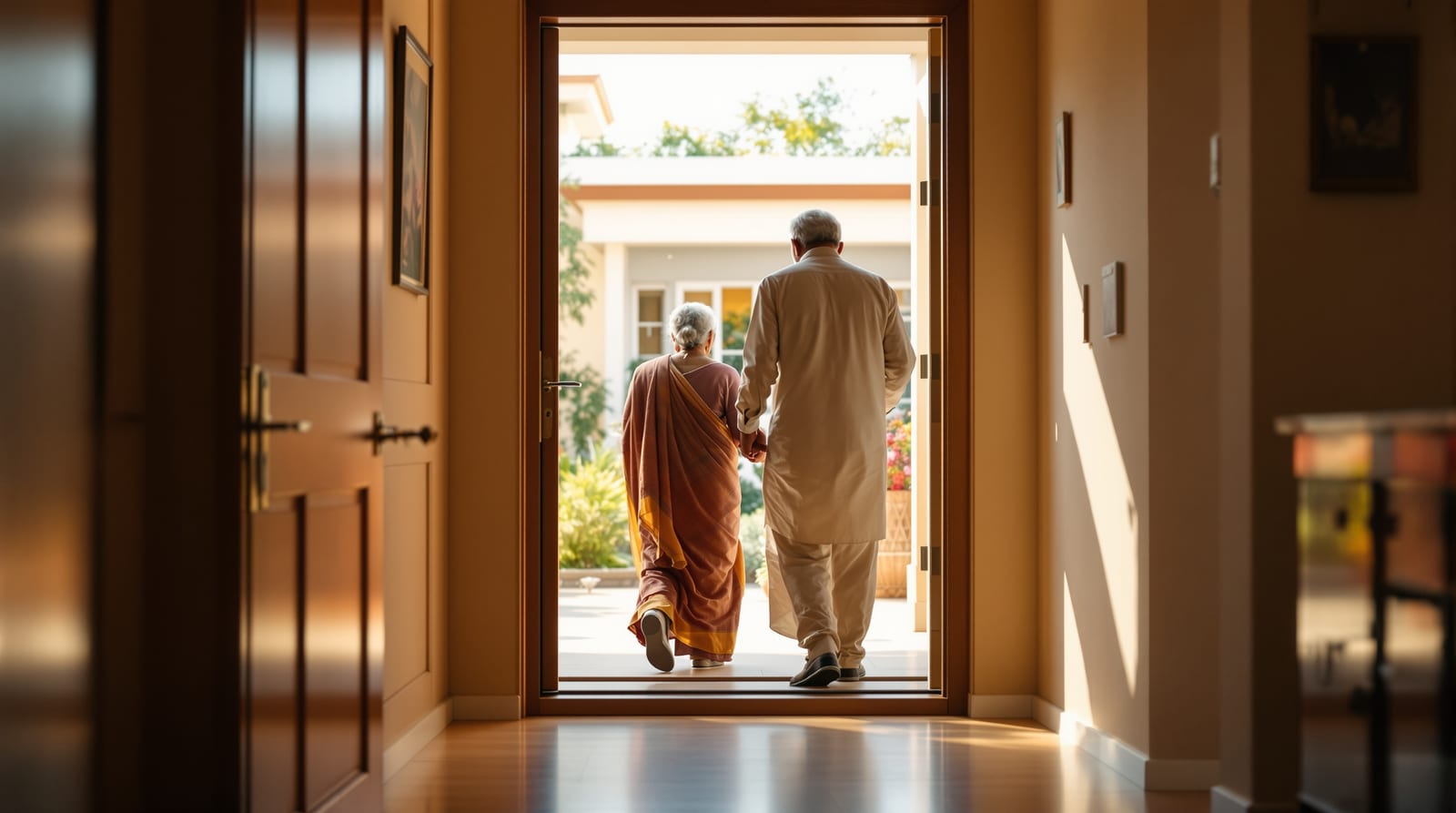
Universal Design Doors for Indian Homes: Inclusive Doors That Work for Everyone (2026)
How to design and specify doors that serve children, the elderly, pregnant women, the injured and wheelchair users by default - generous width, lever handles, near-flush thresholds, low-force closing, contrast and good lighting - without your home ever looking medical.
Most doors in an Indian home are designed for one imaginary user: a fit adult with two free hands and good eyesight, in no hurry. Real life is never that tidy. The same doorway is used by a toddler learning to walk, a grandparent with arthritic knees, a pregnant daughter-in-law, a son home with a fractured wrist, and a delivery person carrying a gas cylinder. Universal design is the simple idea that the door should just work for all of them - by default, on the first try, without anyone having to ask for help and without the house ever looking like a hospital. This guide is the design philosophy and the practical checklist; it complements the wheelchair-specific numbers in wheelchair-accessible-doors-india, the broader pillar accessible-doors-india, and the whole-home view in accessible-home-design-india.
Why universal design suits Indian homes especially
Two facts make this more relevant in India than almost anywhere. First, joint and multi-generational families are still the norm: it is common for grandparents, parents and small children to live under one roof, so a single doorway genuinely serves an 80-year-old and a 2-year-old on the same day. Second, ageing in place is the default - most Indian families care for elderly parents at home rather than in assisted-living facilities, so the home you build at 35 is the home you will navigate at 75.
The trap people fall into is treating accessibility as a separate, ugly "disabled" retrofit done in a panic after a fall or a diagnosis. Universal design flips that: you specify the inclusive version of every door from day one, it costs almost nothing extra at build time, and it looks completely normal - because a wide door with a lever handle and a flush threshold is simply a good door for everyone. The grab-bar-and-ramp aesthetic only appears when you bolt accessibility on later.
The seven design moves, and who each one helps
Universal design is easier to remember as a set of principles than a list of parts. The table below maps each principle to the concrete door feature and the everyday people it quietly helps - not just wheelchair users.
| Universal design principle | Door feature to specify | Who it helps every day |
|---|---|---|
| Generous, equitable passage | Clear opening width 810-940 mm (900-1000 mm leaf) at main entrance, one bathroom, key bedrooms | Wheelchair, walker, person carrying a child or luggage, pregnant women, two people passing |
| Operable with one hand / low force | Lever handles (not knobs), thumb-turn or smart locks, light closer or none | Arthritis, injured wrist, child, anyone with hands full, the elderly |
| Reachable controls | Handle centred 900-1100 mm above floor; bell/lock within seated reach | Children, seated users, short adults, the elderly |
| Trip-free transition | Near-flush bevelled threshold under 12 mm | Toddlers, the elderly, anyone with a walker or trolley, the visually impaired |
| Perceptible information | Tonal/colour contrast on frame, handle and edges; vision panel | Low vision, cataract, dementia, anyone in poor light |
| Tolerance for error / forgiving | Low-force or automatic closing, soft-close, hold-open, finger-guard | Children's fingers, slow movers, hands-full users |
| Lit for everyone | Even light at the threshold and approach, lit doorbell/lock | The elderly (who need 2-3x more light), everyone at night |
Notice that every row helps a large, ordinary group - not a rare edge case. That is the whole argument for doing it by default.
Generous width and a step-free threshold
Width and the threshold are the two physical decisions you cannot cheaply fix later, so get them right at the planning stage.
For width, specify enough that two people, or one person plus a child or a trolley, pass without turning sideways. A 900-1000 mm leaf (yielding roughly 810-940 mm clear opening) is the target for the main entrance, at least one ground-floor bathroom and the main bedrooms; standard 700-750 mm bathroom doors are the usual weak point. See door-width-standards-india and nbc-door-requirements-india for the full size logic.
For the threshold, the rule is a near-flush, bevelled sill no more than 12 mm high, with anything above ~6 mm chamfered so a castor, walker foot or toddler's toe rides over it instead of catching. This collides head-on with the traditional raised dehleez that carries water, dust and Vastu/cultural meaning - and the answer is not to abandon the threshold but to detail a low bevelled aluminium strip with a graded floor behind it. door-threshold-standards-india covers the monsoon and bathroom water-control detailing; entrance-vastu covers reconciling the dehleez tradition with a step-free home.
Hardware anyone can use - and read
Two things make hardware universal: it should be operable without a firm grip, and it should be easy to see.
- Lever handles, never knobs. A round knob needs a grip and a wrist twist that arthritis, a plaster cast or small hands cannot manage; a lever can be pushed with a closed fist, an elbow or a forearm. Specify a return-to-frame lever (the end curls back to the door) so sleeves and bag straps cannot catch. Brands like Godrej, Dorset, Europa, Yale and Hettich all offer compliant lever ranges - see door-handles-guide-india.
- Handle height around 900-1100 mm above finished floor - reachable from a wheelchair and by a child, and comfortable standing. Resist the instinct to mount handles high "for child safety"; that is exactly wrong for a seated or short user, and a child-proof latch placed separately solves safety better.
- Easy locks. Prefer thumb-turn or lever-action locking over fiddly small key cylinders. Better still, a wifi-smart-locks-india or keyless-entry-systems-india setup removes the key-and-grip problem entirely and lets a grandparent let in family without fumbling. Avoid locks the elderly can trap themselves behind in a bathroom; choose a privacy lock with an outside emergency release.
- Contrast you can see. People with cataracts, low vision or early dementia rely on tonal contrast, not just colour. Make the handle contrast against the door, the door contrast against the wall, and mark glass with a manifestation strip so no one walks into it. A pale wall with a dark frame, or a dark door with a brass lever, both read clearly. door-hardware-finishes-india covers finish choices.
Forgiving closing, sliding and automatic options
A door that slams, swings back hard, or needs two hands and a shove is not universal even if every dimension is right.
- Tame the closing force. If a closer is fitted, set it light - aim for an opening push under about 2.2 kg on interior doors - and choose a soft-close or delayed-action closer that holds open long enough for a slow mover or someone with a walker to pass. See door-closers-india. On many interior doors you can simply skip the closer.
- Protect small fingers. A child's hand crushed in a hinge gap is the most common door injury at home. A finger-guard strip on the hinge edge, or a soft-close that prevents a slam, makes the door forgiving.
- Sliding doors are inherently universal where space is tight: they need no swing clearance, cannot be slammed on a child, and suit bathrooms, pooja rooms and store rooms. sliding-doors-india and pocket-doors-india cover the options.
- Automatic doors are the gold standard at the main entrance for ageing-in-place homes - hands-free entry with a bag, a child or a walker. A low-energy operator on a swing door, or an automatic-sliding-doors-india sensor slider, removes both the grip and the push-force problems entirely.
Lighting and wayfinding - the cheapest upgrade
The elderly need roughly two to three times more light than a young adult to see the same detail, and the threshold is exactly where falls happen. Universal design therefore treats light as part of the door: an even, glare-free light over the threshold and along the approach, a lit doorbell or smart lock so it can be found at night, and a vision panel (glazed strip with its lower edge near 900 mm) so a child and an adult can both see who is on the other side before opening. None of this costs much, and all of it helps everyone, not only those with poor sight.
A pragmatic priority order
You do not have to do everything at once. If you are building or renovating, lock in width and a step-free threshold while the walls are open - those are the expensive-to-change ones. Then, in order: (1) lever handles at 900-1100 mm; (2) easy locks (thumb-turn or smart); (3) light closing or soft-close and finger guards; (4) tonal contrast on frame, handle and glass; (5) good lighting and a vision panel; (6) sliding or automatic doors where swing space is tight. Estimate your own doors with the /utilities/door-size-calculator and /utilities/door-cost-calculator. Done this way, your home quietly works for a newborn, a grandparent, an injured cricketer and a wheelchair user alike - and never looks like anything other than a well-designed home.
Frequently asked questions
What is universal design for doors, in simple terms?
It is designing every door so it works for the widest possible range of people - children, the elderly, pregnant women, the injured, wheelchair and walker users, and people with their hands full - without special "disabled" fittings and without the home looking medical. In practice that means generous width, lever handles at reachable height, a near-flush bevelled threshold, light or automatic closing, good contrast and good lighting, specified by default.
Will universal design make my home look like a hospital?
No - that look only appears when accessibility is bolted on in a panic later. A wide door with a brass lever handle, a flush threshold and a vision panel is simply a good-looking, well-made door. Universal design choices are invisible to anyone who does not need them, which is exactly the point.
How is this different from wheelchair accessibility?
Wheelchair accessibility is a subset focused on specific dimensions - clear width, turning circles, manoeuvring space - covered in our wheelchair-accessible-doors guide. Universal design is the broader philosophy: the same features (width, levers, flush thresholds, low-force closing, contrast, light) help wheelchair users and also toddlers, the elderly, pregnant women and anyone carrying something. Build universally and you get accessibility for free.
Does universal design cost a lot extra?
Very little if you specify it at build time. Choosing a lever over a knob, a slightly wider leaf, a flush threshold and a soft-close closer adds a small amount to a new door - far less than retrofitting after a fall. The genuinely expensive items (widening structural openings, automatic operators) are optional and reserved for the main entrance and one bathroom. Costs are indicative and vary by city and vendor; add 18% GST and fitting labour.
Which doors should I prioritise in a joint-family home?
The main entrance, one ground-floor bathroom, and the bedrooms used by elderly parents and by children. These cover the daily journeys that actually matter. Make those universal first, then extend the same standard to other doors as you renovate.
Export this guide
Related Guides — Deep-dive reading
Accessible Doors in India: Wheelchair & Senior-Friendly Door Design Guide
Clear width, lever handles, flush thresholds, swing vs sliding, lock reach and sensor doors - how to specify wheelchair- and senior-friendly doors to the RPwD Harmonised Guidelines 2021 and NBC 2016.
Home Doors & EntrancesKids Room Door in India: Safe, Non-Toxic and Cheerful Door Picks (2026)
How to choose a children's bedroom door for an Indian home - finger-pinch-guard hinges and soft-close first, then non-toxic low-VOC finishes, easy lever handles, fun colours and abuse-proof durability - with picks ranked and indicative rupee costs.
Home Doors & EntrancesWheelchair Accessible Doors for Indian Homes: Clear Width, Thresholds & Hardware (2026)
The exact specs that make a door usable from a wheelchair - clear opening width, near-flush threshold, lever hardware, approach clearance and low-force or auto operation, mapped to the RPwD Harmonised Guidelines 2021.
Home Doors & EntrancesRelated Tools — Try Free
Accessible Door Checker
Check a door against wheelchair-accessibility guidance — clear width, threshold, handle and closer force per RPwD 2021.
Compliance ToolWindow Hardware Cost Calculator
Estimate window hardware cost — hinges, handles, locks, rollers and multipoint gears.
Window CalculatorChild & Elder Home-Safety Audit
Room-by-room safety audit for households with children or seniors — 10 categories, 70+ checkpoints tagged by audience.
Safety Audit