
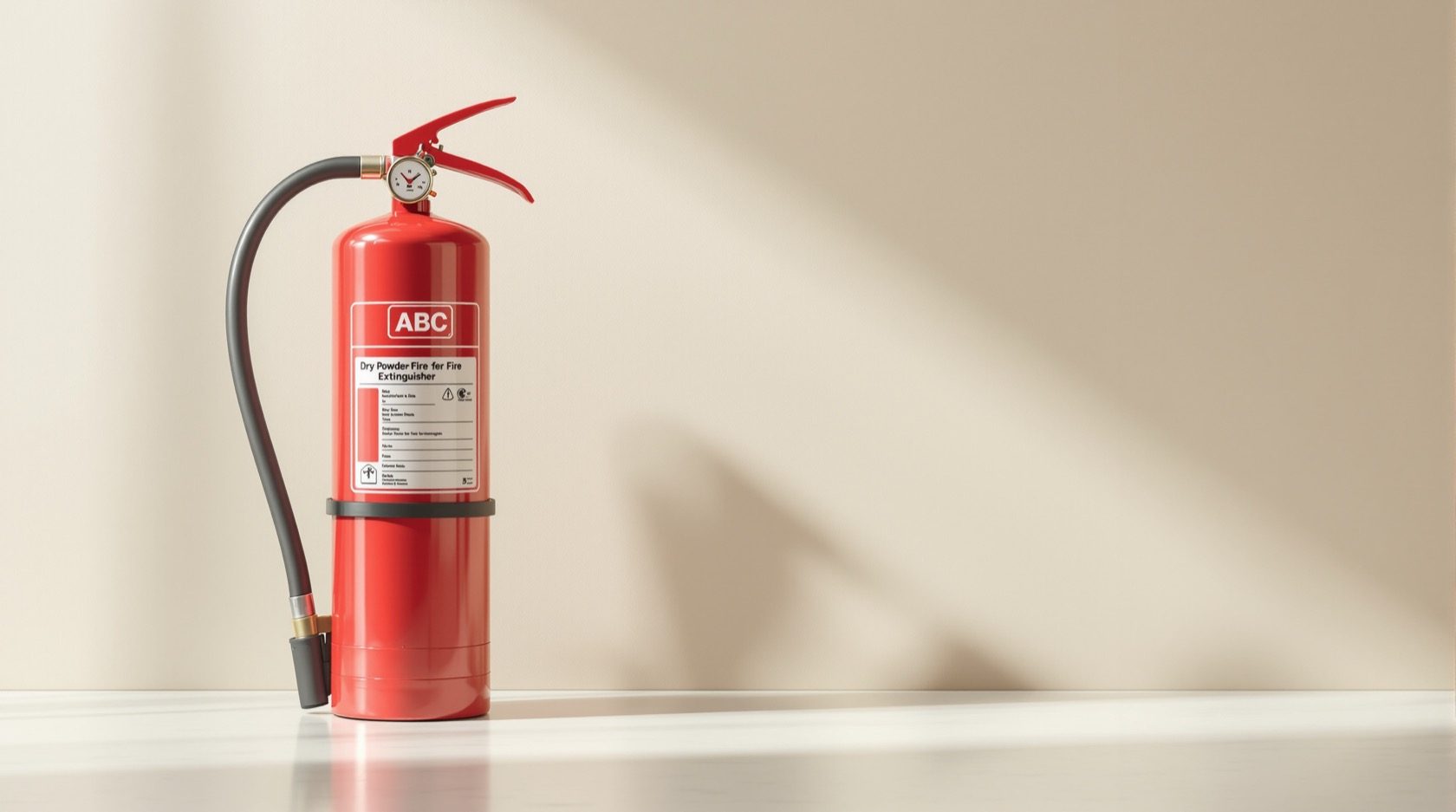
Dry Chemical Powder Extinguishers in India (2026): The ABC All-Rounder Explained
The ABC dry powder is the most common extinguisher in India and the right single one for most homes and shops - it fights solids, liquids and gas, is safe on live electrics, but makes a corrosive mess.
Walk into almost any Indian home, shop, office lobby or stairwell landing that has a fire extinguisher at all, and it is overwhelmingly likely to be a red cylinder of dry powder. Dry chemical powder extinguishers are the workhorse of Indian fire safety for a simple reason: the common ABC version fights the three fire classes an ordinary building actually starts - solids, flammable liquids and flammable gas - and it is safe to use on live electrical equipment. One affordable, widely stocked device covers most of what can go wrong. That versatility is exactly why, for most Indian homes and small shops, a single ABC dry-powder extinguisher (plus a kitchen fire blanket) is the honest, recommended baseline.
This guide is part of Studio Matrx's fire-safety library and sits under the complete guide to fire safety in India. It is the dry-powder chapter of the fire-extinguishers pillar, which explains the fire classes and how to choose between types; here we go deep on one type - what it puts out, how the powder actually works, its real trade-offs, and how to buy and keep one properly.
Scope and safety - read this first. A portable extinguisher is for a small, early fire only - something smaller than you, caught in its first seconds. It is never a substitute for getting out. If a fire has taken hold, raise the alarm, get everyone out, keep your back to a clear exit, and call the fire brigade on 101 or 112. Only tackle a fire if you have the right extinguisher for its class, it is still small, and you have a clear escape behind you - and if it does not go out fast, drop the extinguisher and leave. Never let fighting a fire trap you in a room. This is educational guidance, not legal advice.
What "dry chemical powder" actually means
Dry chemical powder (DCP) extinguishers hold a very fine, dry chemical powder held under pressure by a propellant gas (usually nitrogen). Squeeze the lever and the propellant blasts the powder out as a dense cloud that settles over the fire. There are three families of powder, and knowing which one you have matters:
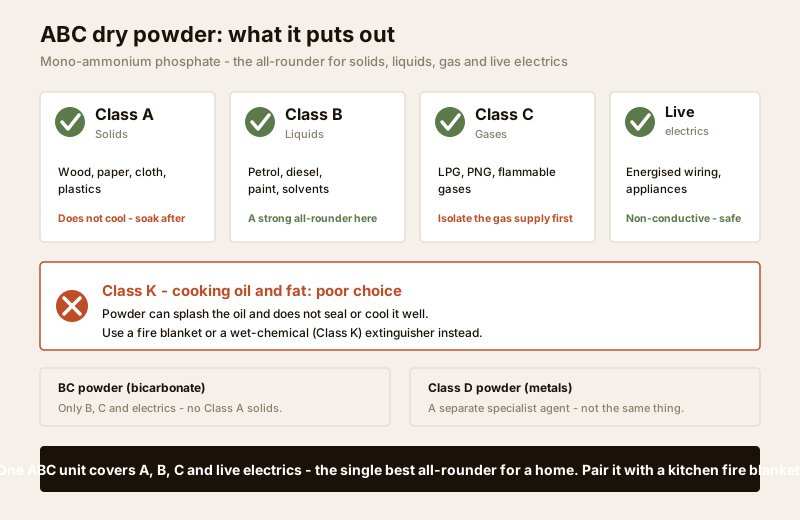
- ABC powder (mono-ammonium phosphate). The common, general-purpose powder and the one almost every home and shop extinguisher contains. It works on Class A (wood, paper, cloth, plastics), Class B (petrol, diesel, paint, solvents) and Class C (LPG, PNG and other flammable gases), and is safe on live electrical equipment. This is the true all-rounder.
- BC powder (sodium or potassium bicarbonate). An older, "regular" dry powder that works on Class B and Class C fires and live electrics - but not on Class A solids. Potassium-bicarbonate versions are more effective on liquid fires, but the lack of Class A cover makes BC the wrong choice for a general home.
- Class D powders (specialist metal-fire agents). Completely different, purpose-made powders for burning metals such as magnesium, sodium, aluminium swarf or lithium - found in laboratories, foundries and workshops. These are not interchangeable with ABC or BC powder; a metal fire needs its specific D-class agent. A home never needs one, but it is worth knowing they exist and are a separate thing.
Bold the important distinction: when people say "the powder extinguisher", they almost always mean ABC mono-ammonium phosphate. That is the one this guide is centred on, because it is the one that belongs in most Indian homes.
The fire classes, quickly
Fire classes (per Indian/BIS practice) sort fires by fuel, and matching the agent to the class is the whole game. Class A is ordinary solids. Class B is flammable liquids. Class C is flammable gases. Class D is burning metals. Class K (also written F) is cooking oils and fats. And "electrical" is not a fuel class at all - it is a hazard condition (a live-equipment fire), where the rule is never water or foam, and CO2 or dry powder instead. The fire-extinguishers pillar sets all of this out in full; the short version is below.
| Fire class | Typical fuel | ABC dry powder | Better tool if available |
|---|---|---|---|
| A | Wood, paper, cloth, plastics | Yes - knocks flame down (but does not cool - see below) | Water for deep-seated cooling; foam |
| B | Petrol, diesel, paint, solvents | Yes - a strong all-rounder here | Foam or CO2 for a clean finish |
| C | LPG, PNG, flammable gases | Yes - one of the few agents rated for gas | Isolate the gas supply first, always |
| Electrical (live) | Energised wiring, appliances | Yes - non-conductive, safe on live gear | CO2 - leaves no residue on electronics |
| K / F | Cooking oil and fat | Poor - can splash oil, does not seal or cool well | Fire blanket or a wet-chemical (Class K) unit |
| D | Burning metals | No - use only the specific Class D powder | Specialist Class D agent only |
The takeaway: ABC dry powder is a "yes" across the four things an ordinary home and shop are most likely to face - solids, liquids, gas and live electrics - which no other single agent matches. Its two weak spots are cooking-oil fires (a kitchen fire blanket is the home answer) and metal fires (not a home concern).
How the powder puts a fire out
A fire needs four things at once - fuel, heat, oxygen and an ongoing chemical chain reaction between them (the "fire tetrahedron"). Most agents attack one leg: water removes heat, foam and CO2 smother oxygen. Dry chemical powder is unusual because its main action is on the fourth leg - it chemically interrupts the combustion chain reaction itself.
At the flame front, combustion is sustained by highly reactive free radicals - fragments of molecules that keep the reaction propagating. When the fine powder is thrown into the flame, its particles absorb heat and, more importantly, react with and "mop up" those free radicals, breaking the chain. The reaction cannot sustain itself, and the flame collapses - often startlingly fast, which is why powder is prized for knocking down a big flare of burning liquid in seconds. A secondary effect is a light smothering blanket over the fuel and some cooling, but the star mechanism is chain-breaking chemistry, not cooling.
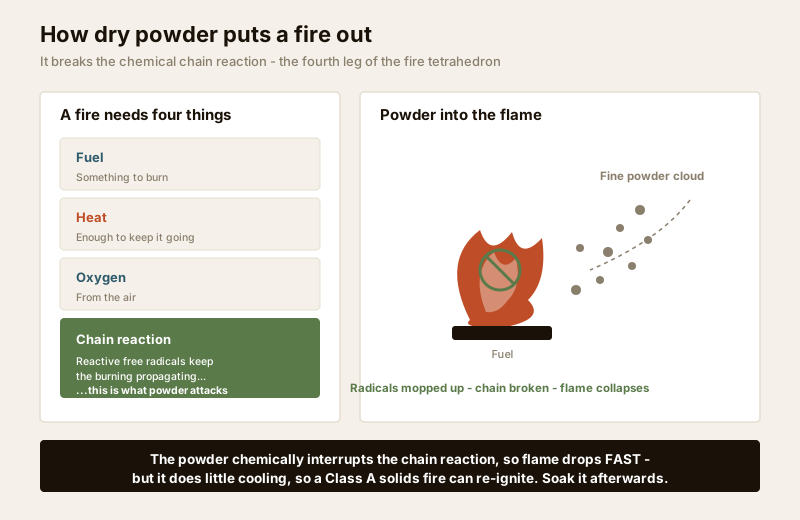
That mechanism explains both the great strength and the great weakness of powder. The strength: because it kills the reaction rather than waiting to cool the fuel, it drops flames extremely quickly and works on liquids and gases where cooling-only agents struggle. The weakness: it does not cool the fuel much. On a Class A solids fire - a smouldering mattress, a heap of paper, a wooden crate - the glowing embers stay hot after the visible flame is out, and can re-ignite once the powder cloud clears. So on solids you must soak the area with water afterwards (or use a water extinguisher) to cool it right down, or keep watching it and be ready to hit it again.
The honest trade-offs
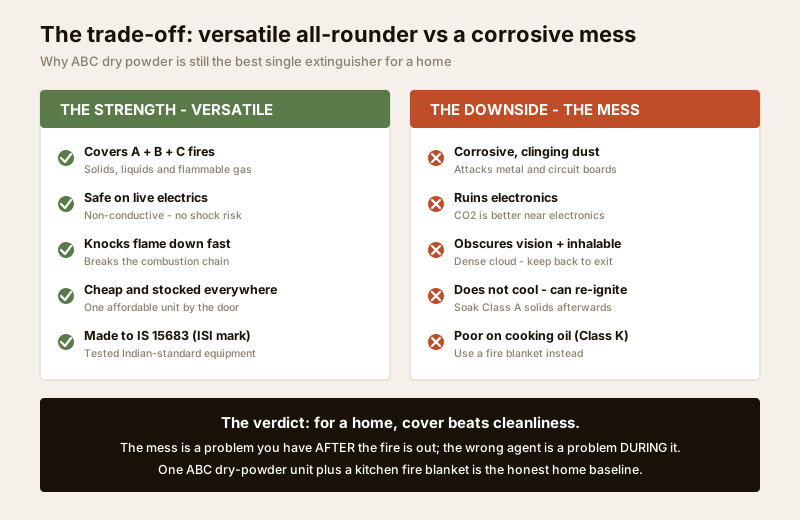
Versatility has a price, and being straight about it is the point of this guide. ABC dry powder is the best all-round choice for a home, but it is not the best at anything, and it has real downsides.
- It makes a huge, corrosive mess. A discharged powder extinguisher coats everything in the room in a fine, clinging chemical dust. Mono-ammonium phosphate is mildly acidic and corrosive - it attacks metal contacts, circuit boards and delicate mechanisms. After a discharge, electronics, appliances and machinery in the room are often written off even if the fire never touched them. Cleanup is a serious job: vacuum, wipe down, and ventilate thoroughly.
- It is bad for electronics compared with CO2. Powder is safe to use on live electrics (it does not conduct), but the residue ruins the very equipment you were protecting. In a server room, near a music or gaming setup, or a lab bench, a CO2 extinguisher is the smarter pick because it leaves no residue at all.
- It obscures vision. A powder discharge fills the room with a dense, choking cloud in an instant. In a small space you can lose sight of the fire and the exit within seconds - another reason to always keep your back to the door.
- It is an inhalation nuisance. The dust is not highly toxic, but it irritates the eyes, nose and lungs; you should ventilate and avoid breathing it, especially for anyone with asthma.
- It does not cool - Class A can re-ignite. As above: on solids, always soak afterwards.
So why is it still the right choice for most homes? Because a home fire is unpredictable - it might start in a socket, a pan of paint thinner, an LPG hose or a heap of newspapers - and only ABC powder covers that whole spread from one cylinder you can afford, buy anywhere and mount by the door. The mess is a problem you have after the fire is out; not having the right agent is a problem during it. For a home, cover beats cleanliness. Where you know the risk is specifically electronics (CO2) or cooking oil (a fire blanket or wet-chemical unit), pair the powder with the specialist tool rather than replacing it.
How to use one - the PASS technique
If, and only if, the fire is small, you have the right extinguisher and a clear exit behind you, the method is PASS:
- P - Pull the safety pin (this breaks the tamper seal).
- A - Aim the nozzle at the base of the fire, not the flames. You are trying to cut off the fuel, not the smoke.
- S - Squeeze the lever to discharge the powder.
- S - Sweep the nozzle from side to side across the base of the fire, advancing as it goes out.
Stand back about 2 to 3 metres to start - powder throws well - and keep low if the cloud is thick. After the fire is out, do not turn your back on it; watch for re-ignition, and on a solids fire, soak it with water to cool it. Then get the extinguisher refilled - it is now empty or part-empty and useless until serviced.
For a gas (Class C) fire, the first move before any extinguisher is to isolate the gas - shut the regulator or valve if you can reach it safely. Powder will knock the flame down, but if gas keeps flowing you have created an unburnt gas cloud that can re-ignite explosively. When in doubt with gas, get out. See the kitchen fire-safety guide for the LPG/PNG response in full.
Buying the right one - ISI mark and rating
A fire extinguisher is life-safety equipment, so buy to Indian standards and do not chase the cheapest cylinder online.
- Look for the ISI mark and IS 15683. Portable fire extinguishers in India are made to IS 15683 : 2018 (performance and construction). The ISI mark and this number tell you the cylinder, valve and gauge are made and tested to spec - the single most important thing to check on the label.
- Check it says ABC (and shows a fire-class rating). The label should show the A, B and C class pictograms. A higher rating number (for example a larger "A" or "B" figure) means it puts out a bigger test fire - a bigger cylinder for a bigger risk.
- Size it sensibly. For a flat, a 1 kg or 2 kg ABC unit near the exit is a reasonable minimum; a house or shop is better served by a 4 kg to 6 kg unit, which discharges for longer and covers more. Selection, placement and maintenance for any premises follow IS 2190 : 2024, the code of practice.
- Mount it where you can grab it on the way out - on a wall bracket near a doorway or exit route, roughly at hip-to-shoulder height, not buried in a cupboard or behind clutter. You want it between you and the fire's likely spot, on the escape side.
| What to check when buying | Why it matters |
|---|---|
| ISI mark + IS 15683 : 2018 | Proof the extinguisher is built and tested to the Indian standard |
| ABC (A, B, C class marks) | Confirms it covers solids, liquids and gas, and is safe on electrics |
| Pressure gauge with a green band | Lets you verify it is charged at a glance, every month |
| Manufacture / refill date + weight | So you know its age and can track the annual service |
| Rating figures (e.g. 4A, 55B) | Bigger numbers = puts out a bigger fire; match to your risk |
The fire-extinguisher selector tool walks you through matching a type to your space, and the home fire-safety scorecard turns extinguisher provision into a quick self-check.
Keeping it working - monthly check and annual service
An extinguisher that is depressurised, expired or caked is not protection - it just looks like it. Upkeep is small and mostly homeowner-doable:
- Monthly, look at the pressure gauge. The needle should sit in the green band. If it has drifted into the red (low) or over-pressure zone, the unit needs servicing - a slow leak is common and silent.
- Monthly, check access and seal. The extinguisher is reachable (nothing stacked in front of it), the safety pin and tamper seal are intact, and the body has no rust, dents or corrosion.
- Invert and gently tap it, periodically, so the powder does not cake. Dry powder can settle and compact into a solid cake at the bottom of a cylinder that has sat untouched for years, and caked powder will not discharge properly when you need it. Turning the extinguisher upside down and back a few times, and tapping the base, keeps the powder loose. (Full agitation and internal inspection is part of the professional service.)
- Annual service by a licensed refiller, and refill immediately after any use - even a one-second test blast means it must be recharged. A home owner can buy, mount and check a home extinguisher; for a shop, office, restaurant or society the provision, servicing schedule and record-keeping are the owner's statutory duty, routed through a licensed refiller under IS 2190 : 2024 and the premises Fire NOC.
When to leave it to professionals. Refilling, pressure-testing (hydrostatic testing of the cylinder) and the servicing schedule for any commercial or shared premises are licensed-professional jobs under IS 2190 : 2024 and your State Fire Services rules - never a DIY recharge. For a home, buy an ISI-marked unit, mount it, gauge-check it monthly and get it professionally serviced once a year. And the overriding rule stands: an extinguisher buys you seconds to fight a small fire or to escape a bigger one - if the fire is not going out fast, put it down and get everyone out.
Where dry powder fits among the other types
Dry powder is one tool in a set, and the fire-extinguishers pillar compares them all. In brief: a water extinguisher is the best cooler for Class A solids but is deadly on live electrics and oil; a foam extinguisher is excellent on Class B liquids and gives a cleaner finish than powder; a CO2 extinguisher is the clean, residue-free choice for electrical and electronics; a wet-chemical extinguisher is the specialist for cooking-oil (Class K) fires; and a fire blanket is the home answer for a pan fire or a burning garment. Dry powder's niche is being the one that does a bit of almost everything - which is why it is the default single home extinguisher, best paired with a kitchen fire blanket.
For the wider picture, see the home fire-safety guide for the whole-house plan, the apartment fire-safety guide for society buildings, the electrical fire-safety guide and the electrical hub for the wiring side, the office fire-safety guide and the commercial buildings security guide for premises duties, and the emergency-preparedness guide to tie it into a household plan. Detection comes first - see smoke detectors and fire alarm panels - because the extinguisher is only useful if you know about the fire while it is still small.
Key takeaways
- ABC dry chemical powder (mono-ammonium phosphate) is the most versatile single extinguisher - it fights Class A solids, Class B liquids and Class C gas, and is safe on live electrical equipment - which makes it the recommended single unit for most Indian homes and shops, paired with a kitchen fire blanket.
- BC powder (sodium/potassium bicarbonate) covers only Class B and C, not solids; Class D powders are separate specialist metal-fire agents - neither is the general home choice.
- The powder works by chemically interrupting the combustion chain reaction, which knocks flame down fast but does little cooling - so on Class A solids, soak the area with water afterwards or it can re-ignite.
- The honest trade-off is mess: the powder is corrosive, obscures vision, is an inhalation nuisance and can ruin electronics - which is why CO2 is better near electronics and a fire blanket better for oil - but for all-round home cover, cover beats cleanliness.
- Buy ISI-marked to IS 15683 : 2018, mount it near an exit, check the green-band gauge monthly, invert-and-tap so the powder does not cake, service annually per IS 2190 : 2024 and refill after any use - and use PASS only on a small fire with a clear escape behind you.
References
- IS 2190 : 2024, Bureau of Indian Standards - "Selection, Installation and Maintenance of First-Aid Fire Extinguishers (Portable and Mobile) - Code of Practice", the core code governing which extinguisher goes where, its rating, placement and servicing schedule. Verify the current edition via the BIS catalogue: https://www.services.bis.gov.in/
- IS 15683 : 2018, Bureau of Indian Standards - "Portable Fire Extinguishers - Performance and Construction - Specification", the product standard behind the ISI mark on a dry-powder extinguisher. Verify via the BIS catalogue: https://www.services.bis.gov.in/
- National Building Code of India, SP 7 : 2026 (the NBC), Part 4 "Fire and Life Safety" - the framework for fire-extinguisher provision in buildings; the older SP 7 : 2016 edition is withdrawn but still widely quoted. Verify the current edition via the BIS catalogue: https://www.services.bis.gov.in/
- The relevant State Fire Services Act and Rules and the Model Building Bye-Laws (MoHUA) - these set when a Fire NOC and a maintained extinguisher schedule are legally required for commercial and shared premises.
This is an educational overview, not legal advice, and not a substitute for a licensed fire-safety professional. A portable extinguisher is for a small, early fire only - raise the alarm and get people out first. Commercial and shared-premises extinguisher provision, servicing and pressure-testing are qualified professional tasks under IS 2190 : 2024 and your State Fire Services; verify any standard's current status via the BIS catalogue before relying on it.
Export this guide
Related Guides — Deep-dive reading
Fire Extinguishers in India (2026): Types, Fire Classes, PASS and the Right One to Buy
The umbrella guide to portable fire extinguishers in India: the fire classes, which agent kills which fire, the deadly wrong-agent mistakes, the PASS technique, and the realistic home kit that actually works.
SecurityFoam Extinguishers in India (2026): Class A & B, Where They Shine & the Electrical Caution
The AFFF foam extinguisher smothers burning solids and, crucially, flammable liquids like petrol, paint and solvent. Here is where it belongs, and the two fires it must never touch.
SecurityWater Extinguishers in India (2026): Class A Only — and the Deadly Wrong Uses
The cheapest, simplest extinguisher cools solids brilliantly but can kill on the wrong fire. Here is where a water extinguisher belongs, and why oil, flammable liquids and live electrical are absolute no-go.
SecurityRelated Tools — Try Free
Fire Extinguisher Selector
The wrong extinguisher can make a fire worse. Pick a space and get the right extinguisher type(s) to consider — ABC powder, CO2, foam, wet-chemical, water or a fire blanket — matched to the fire class, with the deadly never-use warnings.
ExtinguisherElectrical Safety & Load Audit
Home electrical audit — 10 categories, 65+ checkpoints across earthing, RCCB, MCB, wiring, switchboards, appliance circuits, DG/inverter backup.
Safety AuditHome Security Risk Scorecard
Score your home across six security layers — perimeter, entry points, lighting, detection, alarm and habits — and get a prioritised action plan.
Security Scorecard