
Water Extinguishers in India (2026): Class A Only — and the Deadly Wrong Uses
The cheapest, simplest extinguisher cools solids brilliantly but can kill on the wrong fire. Here is where a water extinguisher belongs, and why oil, flammable liquids and live electrical are absolute no-go.
The water extinguishers on the market are the cheapest, simplest and most misunderstood tool in fire safety. On the fire they are built for — burning solids like wood, paper, cloth and furniture — a jet of water is superb: it cools the fuel below the temperature at which it can keep burning, and it does so at a lower cost per litre of firefighting than anything else you can buy. But water is also the extinguisher with the most dangerous wrong uses in the building. Put it on a cooking-oil fire and it flashes into a fireball. Put it on burning petrol or solvent and it spreads the fire across the floor. Point it at a live electrical panel and it can conduct the current straight back up the jet to your hands. This guide is about respecting both halves of that truth — using a water extinguisher where it is brilliant, and never where it kills.
This is a type-guide in Studio Matrx's fire-safety library, sitting under the complete guide to fire safety in India and beside the portable fire-extinguishers pillar, which explains the fire classes and how to choose across all the types. Read this alongside its siblings on CO2 extinguishers, dry chemical powder (DCP/ABC) extinguishers, foam extinguishers and wet-chemical (Class K) extinguishers — because the whole point of knowing the water extinguisher is knowing which fires belong to the others.
Scope and safety — read this first. A portable extinguisher fights a small, early fire only. Before you reach for anything: raise the alarm, get everyone out, and keep your back to a clear exit. Only tackle a fire that is smaller than you, and only if you have the right extinguisher for that class of fire. A water extinguisher is the right tool for one class — burning solids — and a lethal wrong tool for oil, flammable liquids and live electrical equipment. If a fire does not go out in seconds, or you are unsure of the class, do not fight it — leave and call the fire brigade on 101 or 112. This is educational guidance, not legal advice or a substitute for a licensed fire-safety professional.
What a water extinguisher actually is
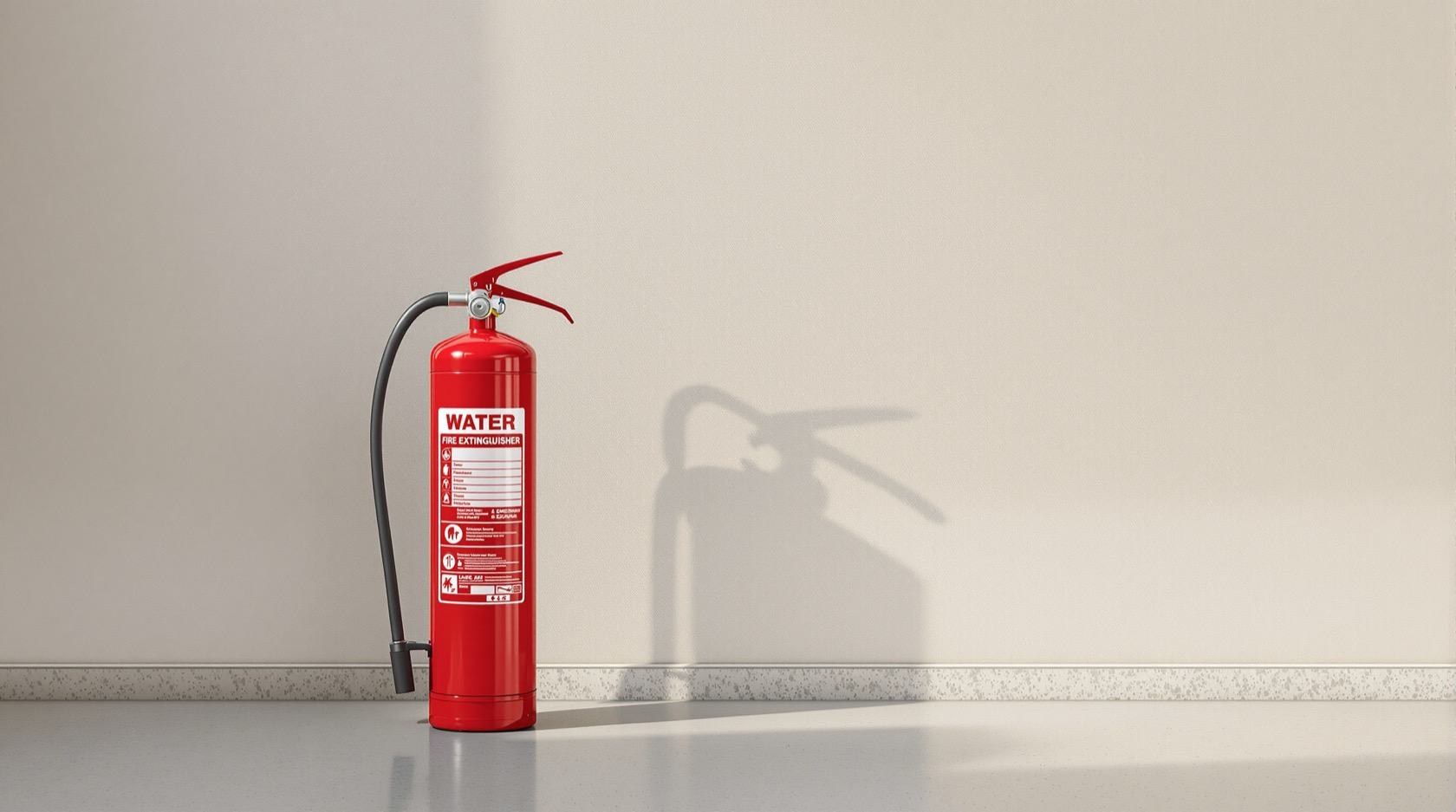
A water extinguisher is a red-bodied cylinder — under the Indian colour convention the whole body is red, with type marked on the label — charged with water and pressurised, usually by a stored gas charge, so that squeezing the lever drives the water out through a hose and nozzle. The larger portable sizes hold around six to nine litres, which is a lot of cooling capacity for the price. It is the direct descendant of the bucket of water and the fire hose, packaged into something one person can lift off a wall and carry.
There are a few important variants, and the label always tells you which one you have:
- Plain water (jet). A solid stream of water. Maximum reach and penetration into the heart of a burning stack of solids, but it can splash and scatter light debris.
- Water spray. A fine spray head breaks the water into small droplets, which cover a larger surface, cool faster per litre and produce far less splash. Most modern portable water extinguishers are spray-type.
- Water mist. A very fine mist, sometimes from a specially designed nozzle, that cools and displaces oxygen with a tiny volume of water. Some water-mist units are tested and rated for use near electrical equipment because the mist does not form a continuous conductive path — but this is only true if the unit's label explicitly carries that rating. Never assume it; read the label.
- Water with additive (sometimes labelled water-plus or with a wetting agent / AFFF additive). A chemical additive lowers the water's surface tension so it soaks into solids faster and, in some formulations, gives limited flammable-liquid capability. Even so, treat any water-based unit as a Class A tool first and follow its exact label ratings for anything else.
Whatever the variant, the mechanism underneath is the same, and it is worth understanding because it explains everything about where water works and where it is deadly.
How water puts out a Class A fire: cooling
Fire needs three things at once — fuel, heat and oxygen (the fire triangle) — plus the self-sustaining chemical reaction between them. Take any one away and the fire dies. Water works almost entirely on heat. When water lands on burning wood, paper or cloth, it absorbs a large amount of energy first as it warms up and then, far more, as it turns to steam. That heat is stripped straight out of the fuel. Cool the burning solid below the temperature at which it releases flammable vapour, and the flame has nothing left to feed on and goes out. The steam that forms also briefly displaces some oxygen at the surface, but cooling is the main event.
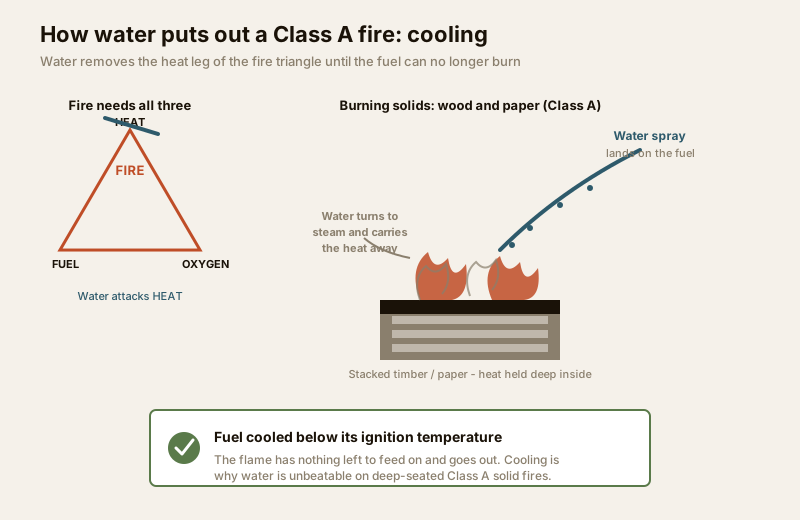
This cooling action is exactly why water is unbeatable on Class A fires — solids that char and glow, like timber, furniture, textiles, cardboard, paper and most ordinary combustible rubbish. These fuels hold heat deep inside the material, so a fire in them can smoulder and reignite unless the heat is drawn right out. Powders and gases knock the flame down but do not soak in and cool a deep-seated solid fire the way water does. For a paper store, a fabric warehouse, a timber workshop or a stack of cartons, water is the correct and most effective agent. Under the Indian fire classes — set out in full in the fire-extinguishers pillar — that is Class A, and Class A only.
The deadly wrong uses: oil, liquids and live electrical
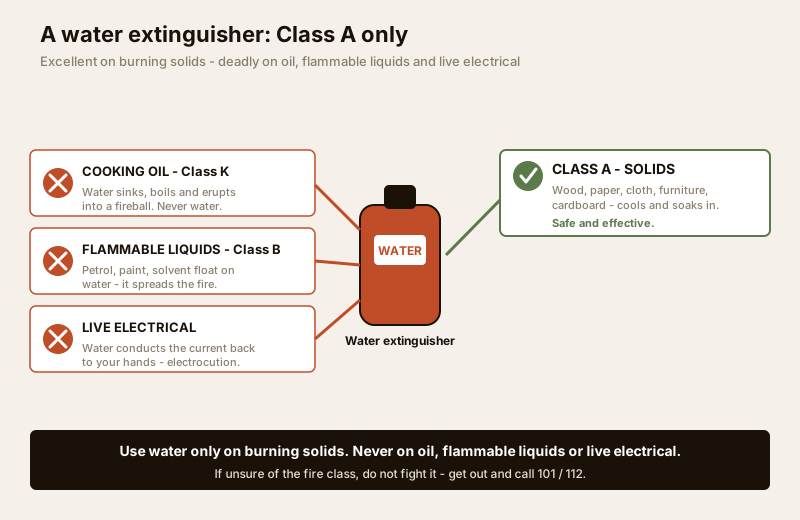
The same physics that makes water brilliant on solids makes it lethal on three other kinds of fire. This is the heart of the guide, and it is worth learning cold.
Never on a cooking-oil or fat fire (Class K)
A pan of hot oil that has caught fire is a Class K fire, and water on it is one of the most dangerous things you can do in a kitchen. Water is denser than oil, so it drops straight through the burning surface to the bottom of the pan, where it is instantly flashed into steam. That steam expands roughly seventeen-hundred-fold in a fraction of a second and erupts upward, hurling burning oil out of the pan as a fireball that can reach the ceiling and engulf whoever is standing there. A water extinguisher aimed at a chip pan does not put the fire out — it detonates it. Smother an oil fire instead (a fire blanket or a tight lid), and for a commercial kitchen use a wet-chemical Class K extinguisher. The full method is in the kitchen fire-safety guide and the wet-chemical extinguishers guide.
Never on flammable-liquid fires (Class B)
Burning petrol, diesel, kerosene, paint, thinner or solvent is a Class B fire. Most of these liquids float on water, so a jet of water simply spreads the burning liquid across the floor and carries the fire wherever the water runs — under a shelf, down a drain, toward you. Water does not cool a volatile liquid enough to stop it releasing vapour, so the flame keeps re-establishing on the fresh surface. Class B fires need something that seals the surface off from oxygen: foam, CO2 or dry chemical powder. Never water.
Never on live electrical equipment — electrocution
This is the one that kills the firefighter rather than making the fire worse. Water conducts electricity. A jet or even a spray of water onto a live switchboard, a plugged-in appliance, an inverter, a distribution board or any energised equipment can form a conductive path from the fire, up the water stream, to the metal nozzle in your hands — and electrocute you. A fire involving electrical equipment is not a separate fuel class; it is a hazard condition. The correct agents are CO2 (clean, leaves no residue on electronics) or dry powder, both non-conductive. If you can safely isolate the power first — trip the main breaker — the fire may then become an ordinary Class A fire you can treat accordingly, but until the power is off, water must never go near it. The electrical fire-safety guide and the wider electrical hub cover this in depth.
The one nuance: certain water-mist units are specifically tested and labelled for use near electrical equipment, because the discontinuous droplets do not form a conductive bridge. That rating lives on the label of that specific product. A plain-water or water-spray extinguisher carries no such rating and must be kept away from anything live.
The fire class versus water matrix
| Fire class | Typical fuel | A water extinguisher? | Use instead |
|---|---|---|---|
| Class A | Wood, paper, cloth, furniture, cardboard | YES — the correct, most effective agent | Water is first choice; ABC powder also works |
| Class B | Petrol, diesel, paint, thinner, solvent | NEVER — spreads the burning liquid | Foam, CO2 or dry powder |
| Class C | Flammable gases (LPG, PNG) | NEVER — cannot address a gas fire; isolate the supply | Shut off the gas; dry powder |
| Class K | Cooking oil and fat | NEVER — flashes into a fireball | Fire blanket / lid; wet-chemical (Class K) |
| Electrical | Any live energised equipment | NEVER (plain/spray) — conducts, electrocution risk | CO2 or dry powder; water-mist only if label-rated |
Where a water extinguisher fits — and where it does not
Because it is Class-A-only, the water extinguisher earns its place in single-hazard, solids-only environments where the risk really is just burning ordinary combustibles and there is little or no flammable liquid or exposed live electrical equipment in the protected area.
Good homes for a water extinguisher:
- Paper and record stores, stationery stores, libraries and archives — deep stacks of paper are the textbook Class A fire, and water's cooling penetration is exactly what a smouldering paper fire needs.
- Textile and garment stores, fabric warehouses and tailoring units — cloth and yarn are pure Class A.
- Timber yards, carpentry and furniture workshops (away from the finishing area, where solvents and lacquers make it Class B).
- Warehouses of cartons and packaging, corridors and general storage of ordinary combustibles.
- Assembly and school corridors, back-of-house areas designated Class-A-only in the fire plan.
Where a water extinguisher does not belong:
- Kitchens — oil is Class K.
- Garages, generator rooms, paint stores, chemical stores, fuel stores — flammable liquids are Class B.
- Electrical rooms, server rooms, near switchboards, inverters and battery banks — live electrical risk. See the battery-room and electrical fire-safety guides.
- Any mixed-hazard room where you cannot guarantee the fire will only ever be Class A.
Why for a typical Indian home the ABC powder is usually the better single choice
Most Indian homes are not single-hazard. In one flat you have furniture and curtains (Class A), the kitchen with cooking oil (Class K), an inverter or battery bank and a wall of live sockets and appliances (electrical), and perhaps a can of thinner or a two-wheeler in the parking (Class B). A water extinguisher covers only the first of these and is dangerous on the rest. A single ABC dry-chemical-powder extinguisher is rated for Class A, B and C fires and is safe to use momentarily on live electrical equipment — so for one all-round unit in a mixed home, it is the more practical, more forgiving choice. The honest home baseline that Studio Matrx recommends is one ABC extinguisher plus a kitchen fire blanket, not a water extinguisher — the water extinguisher is a specialist you add when you have a genuinely solids-only space to protect. Use the fire-extinguisher selector to match a unit to your actual rooms.
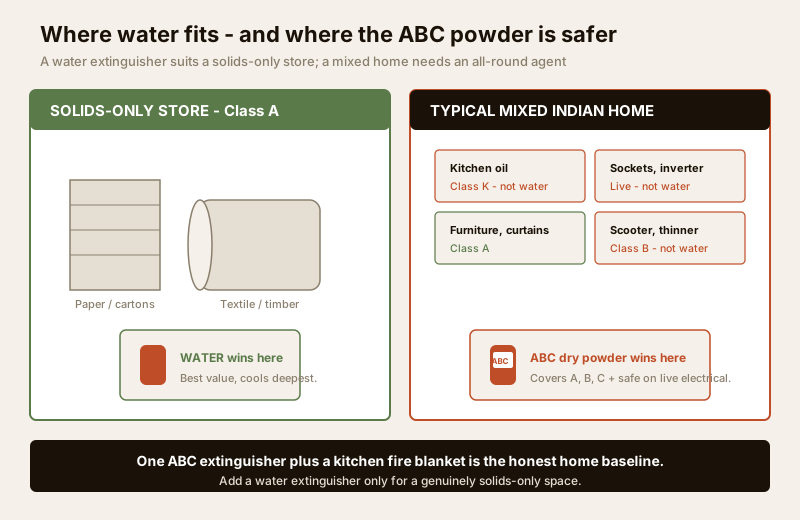
| Question | Water extinguisher | ABC dry-powder extinguisher |
|---|---|---|
| Best on deep-seated solid (Class A) fires | Yes — cools and penetrates best | Good, but does not soak in and cool like water |
| Safe on flammable liquids (Class B) | No — spreads them | Yes |
| Safe on flammable gases (Class C) | No | Yes |
| Safe on live electrical | No (plain/spray) | Yes, momentarily |
| Safe on cooking oil (Class K) | No — fireball | No — use a blanket / wet-chemical |
| Right for a mixed Indian home | No — too limited | Yes — the practical single unit |
| Right for a paper / textile / timber store | Yes — first choice | Also works |
| Residue / clean-up | Water — soaks stock but no chemical residue | Fine powder gets everywhere, corrosive to electronics |
One point in water's favour worth noting: it leaves no chemical residue. On a Class A fire in a clean environment, water simply wets things, whereas dry powder coats the whole room in a fine, mildly corrosive dust that is a serious clean-up and can damage electronics — which is one reason a solids-only store may still prefer water where the class allows.
Using it correctly: the PASS technique
If — and only if — you have confirmed the fire is Class A, it is small, you have a clear exit behind you, and you have raised the alarm, a water extinguisher is used with the standard PASS technique:
- P — Pull the safety pin, breaking the tamper seal.
- A — Aim the nozzle at the base of the fire, not the flames. You are trying to cool the burning fuel, so hit the fuel.
- S — Squeeze the lever to discharge.
- S — Sweep the jet or spray from side to side across the base of the fire, working across the burning surface and into the seat of a deep stack until it is fully out and cooled.
A six-litre water extinguisher lasts only around a minute of continuous discharge, so it is for a small, early fire. If the fire is not visibly dying within the first seconds, stop, get out and call 101 or 112. Never let firefighting put the fire between you and the door.
Standards, the ISI mark and keeping it serviced
Portable water extinguishers sold in India are covered by two standards you should look for. The product itself — its construction, performance and the fire ratings it can claim — is made to IS 15683 : 2018 (Portable Fire Extinguishers — Performance and Construction), and a compliant unit carries the ISI mark (the BIS Standard Mark). Selection, correct placement, the number and rating required, and the maintenance regime are governed by IS 2190 : 2024 (Selection, Installation and Maintenance of First-Aid Fire Extinguishers — Code of Practice). For any commercial premises, the number, type and placement of extinguishers, and the requirement for a Fire NOC, flow from the National Building Code (via SP 7 : 2026, Part 4 Fire and Life Safety), your State Fire Services Act and Rules and the local Model Building Bye-Laws.
Buying the unit is only the start. An extinguisher is only protection if it is charged, in date and reachable:
- Monthly (you can do this): check the pressure gauge needle sits in the green band, the tamper seal and safety pin are intact, the body is not corroded or dented, the hose is clear, and the unit is on its bracket, unobstructed and signed. A water extinguisher must also be protected from freezing in cold-climate locations — check the label's temperature range.
- After ANY use, even a short one: send it for refill and recharge immediately. A partly discharged extinguisher is dead weight.
- Annually (a licensed refiller's job): full service, weight/pressure check and refill as the schedule and IS 2190 require. Keep the service tag current.
For a commercial building, providing, placing and servicing extinguishers to code, and keeping the Fire NOC valid, is the owner's or occupier's statutory duty through a licensed fire-safety agency — not a one-time retail purchase. The office fire-safety guide, the apartment fire-safety guide and the guidance for a commercial building set out who is responsible for what.
Get it serviced — and know when to leave it to professionals. A homeowner can buy an ISI-marked extinguisher, mount it correctly, check the gauge monthly and use it on a small, confirmed Class A fire. But the design of the extinguisher provision for any commercial, institutional or multi-storey building — how many, which types, where, and the annual servicing and Fire NOC — is the job of a licensed fire-safety consultant and the State Fire Services under IS 2190, the NBC and your State Fire rules. If you are unsure of the fire class, the extinguisher's state, or your building's obligations, do not improvise: get everyone out, call 101 or 112, and engage a qualified professional for the compliance side.
For the whole-house picture — smoke alarms, escape planning and the fire classes in full — see the home fire-safety guide and run the home fire-safety scorecard; for choosing detectors, the fire-detector selector and the smoke-detectors guide help.
Key takeaways
- A water extinguisher is Class A only. It cools burning solids — wood, paper, cloth, furniture, cardboard — better and more cheaply than anything else, which makes it first choice for paper, textile and timber stores.
- Three deadly wrong uses: never on cooking oil (Class K — fireball), never on flammable liquids (Class B — spreads the fire), never on live electrical (conducts — electrocution). Learn these cold before you ever hold one.
- Water works by cooling — it strips the heat out of the fuel until it can no longer burn, which is exactly why it fails and endangers you on liquids and live electrical.
- For a typical mixed Indian home, an ABC dry-powder extinguisher plus a kitchen fire blanket is the safer, more practical baseline than a water extinguisher; add water only for a genuinely solids-only space. Some water-mist units are label-rated near electrical — read the label, never assume.
- Buy to standard and keep it live: ISI-marked to IS 15683 : 2018, selected and maintained per IS 2190 : 2024, gauge checked monthly, refilled after any use and serviced annually by a licensed refiller. Use PASS, aim at the base, and if it is not out in seconds — leave and call 101 / 112.
References
- IS 2190 : 2024, Selection, Installation and Maintenance of First-Aid Fire Extinguishers (Portable and Mobile) — Code of Practice, Bureau of Indian Standards — the code governing which extinguisher, how many, where and the servicing regime. Verify the current edition via the BIS catalogue: https://www.services.bis.gov.in/
- IS 15683 : 2018, Portable Fire Extinguishers — Performance and Construction — Specification, Bureau of Indian Standards — the product standard behind the ISI mark and the fire ratings a water extinguisher may claim. Verify via the BIS catalogue: https://www.services.bis.gov.in/
- National Building Code of India, SP 7 : 2026 (the NBC), Part 4 "Fire and Life Safety" — the framework setting extinguisher provision and Fire NOC requirements for buildings; the older SP 7 : 2016 edition is withdrawn but still widely quoted. Verify the current edition via the BIS catalogue: https://www.services.bis.gov.in/
- The relevant State Fire Services Act and Rules and the Model Building Bye-Laws (MoHUA) — these set when a Fire NOC and a compliant extinguisher schedule are legally required for a given premises.
This is an educational overview, not legal advice, and not a substitute for a licensed fire-safety consultant. Extinguisher selection, provision and servicing for any commercial or institutional building are qualified professional tasks governed by IS 2190, the NBC and your State Fire Services — engage licensed professionals, and verify any standard's current status via the BIS catalogue before relying on it.
Export this guide
Related Guides — Deep-dive reading
Fire Extinguishers in India (2026): Types, Fire Classes, PASS and the Right One to Buy
The umbrella guide to portable fire extinguishers in India: the fire classes, which agent kills which fire, the deadly wrong-agent mistakes, the PASS technique, and the realistic home kit that actually works.
SecurityFoam Extinguishers in India (2026): Class A & B, Where They Shine & the Electrical Caution
The AFFF foam extinguisher smothers burning solids and, crucially, flammable liquids like petrol, paint and solvent. Here is where it belongs, and the two fires it must never touch.
SecurityDry Chemical Powder Extinguishers in India (2026): The ABC All-Rounder Explained
The ABC dry powder is the most common extinguisher in India and the right single one for most homes and shops - it fights solids, liquids and gas, is safe on live electrics, but makes a corrosive mess.
SecurityRelated Tools — Try Free
Fire Extinguisher Selector
The wrong extinguisher can make a fire worse. Pick a space and get the right extinguisher type(s) to consider — ABC powder, CO2, foam, wet-chemical, water or a fire blanket — matched to the fire class, with the deadly never-use warnings.
ExtinguisherMaterial Schedule Generator
Generate a room-wise finish schedule — walls, floors, ceilings, trim, and joinery by location.
Material ScheduleApartment Interior Planning Checklist
51-item checklist across structural, ceiling, lighting, furniture, storage, electrical, kitchen, bathroom.
Checklist