
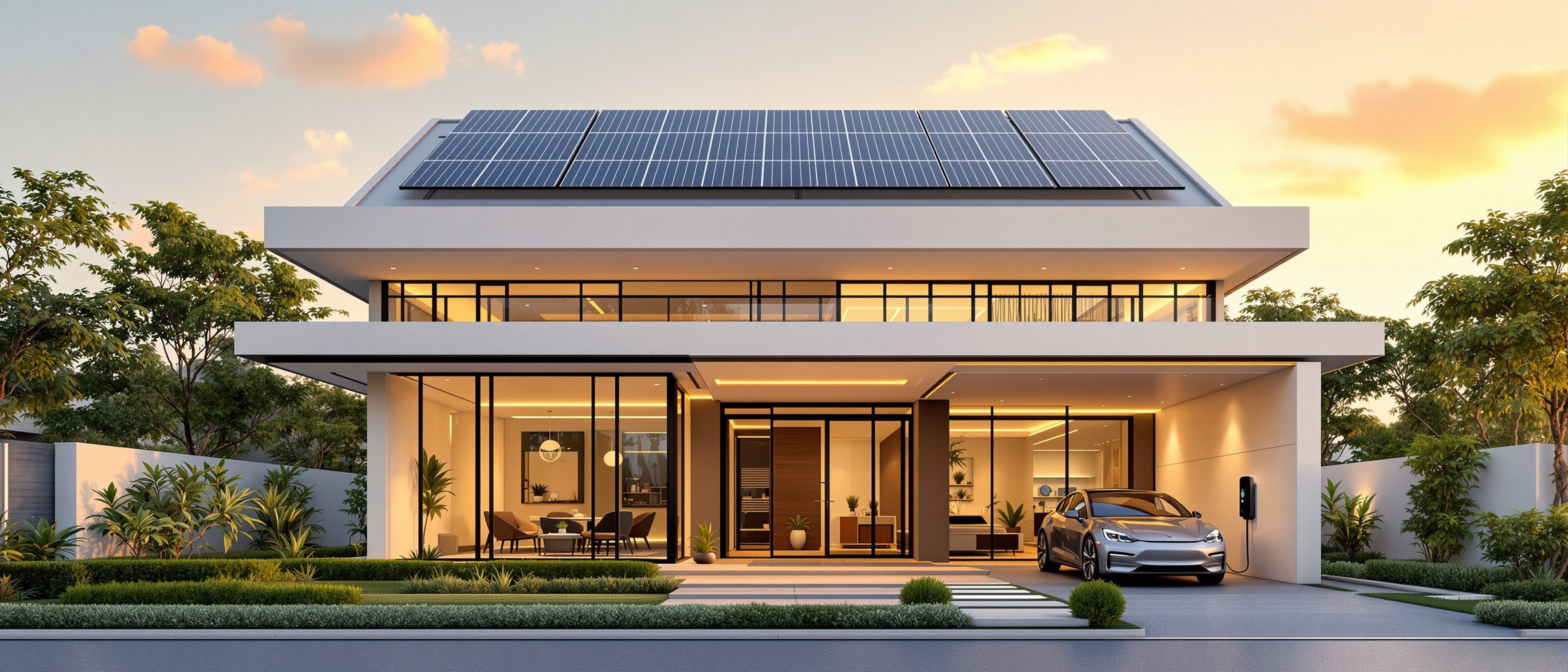
Designing Your Home for 2040
The forces reshaping the Indian home over the next 15 years — and the cheap provisioning that lets one house absorb them all.
The house you build in 2026 is not a house for 2026. If you do it properly, it is a house for 2046 — a structure your family will still be living in, arguing in, ageing in, and charging an electric car outside of, long after the paint has been redone twice. Most homeowners design for the family they are today. The ones who get it right design for the four or five different households that same house will quietly become.
And the world that house sits in is changing faster than any generation of Indian builders has had to plan for. In the fifteen years between now and 2040, the car in your parking will likely run on electricity; your roof will probably be expected to make power, not just shed rain; one bedroom will become an office that never empties on a Monday; your parents, or you, will need a bathroom you can walk into without a step; and the summers will be measurably hotter than the ones you grew up with. None of these is a maybe. They are arriving on overlapping timelines, and they are all arriving at the same address.
Here is the uncomfortable part: the cost of getting ready for all of this, if you do it while the walls are open and the slab is being poured, is almost nothing. The cost of doing it afterward — chasing channels into finished walls, breaking a tiled bathroom, fighting the society for a riser — is enormous, dusty, and sometimes simply not allowed. The single most valuable skill in building a future-ready home is not predicting the future. It is provisioning for it cheaply now.
Future-readiness is not about installing tomorrow’s technology today — it is about laying the cheap groundwork now (an empty conduit, a spare circuit, a south-facing roof, a step-free door) so that tomorrow’s upgrade is a plug-in, not a demolition.
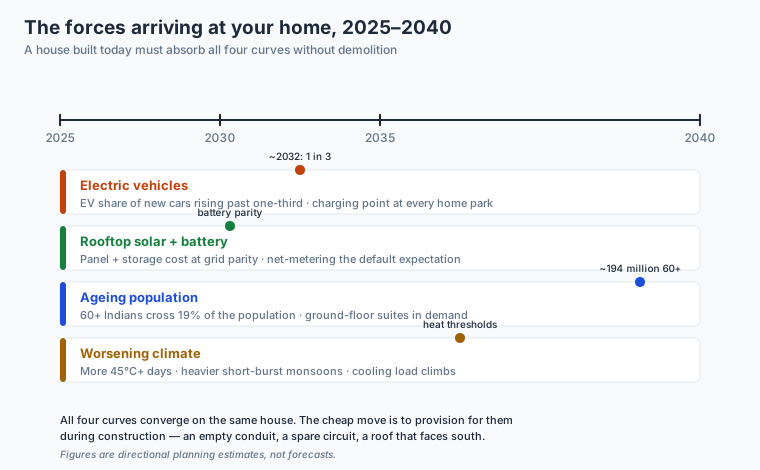
Figure 1: Four independent curves — EVs, solar-plus-battery, ageing demographics and climate stress — converge on the same house between now and 2040.
This guide is the wide-angle map of the whole Future-Ready Homes cluster. Each force below gets a survey here and a full deep-dive in its own companion guide. Think of this as the why-it-matters vision; for the room-by-room, family-by-family lifecycle view, pair it with our companion guide on designing today for the family you’ll be in 10–20 years.
1. The provision-now vs. retrofit-later framework
Everything in this guide rests on one idea, so it is worth stating it plainly before the trends. There are two moments to make almost any home upgrade. The first is during construction, when the walls are hollow, the conduits are being run, the distribution board is being wired, and the roof is bare. The second is years later, when everything is finished, tiled, painted and lived in. The same physical change costs five to fifteen times more at the second moment than the first — and that multiple does not even count the dust, the displacement, and the permissions you may not get.
A useful rule of thumb on site: an empty conduit and a labelled spare cable cost a few hundred rupees while the wall is open. The same route, chased into a finished, tiled wall later, is a half-day of two masons, a sack of cement, fresh tiles, repainting — and a week of mess.
Consider the simplest example. A 32mm PVC conduit run from your distribution board to the parking spot, capped at both ends and left empty, costs roughly ₹2,000–4,000 today — mostly the pipe and an hour of a wireman’s time. Pull a charger cable through it in 2032 and you are done in an afternoon. Skip it now, and that same EV charger installation means chiselling a channel across a finished compound wall, re-plastering, repainting, and often a fresh society NOC — ₹40,000 and up, assuming the society even permits surface wiring. The provision was 5% of the retrofit.
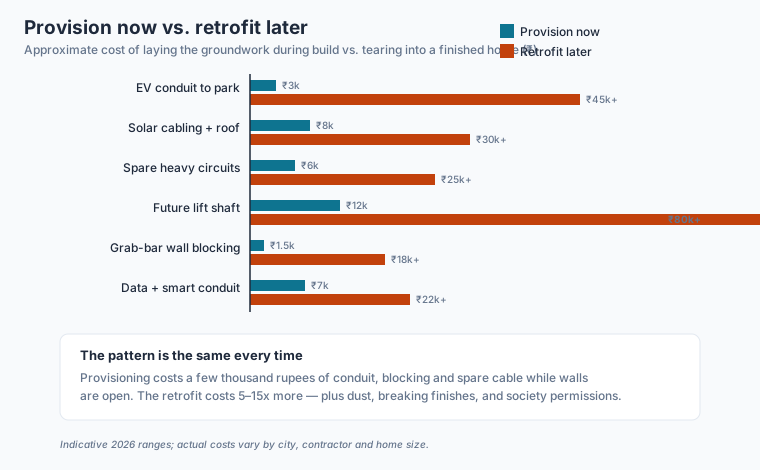
Figure 2: For every major future-ready item, provisioning during construction costs a small fraction of the later retrofit.
The table below applies the same lens across the major provisions covered in this cluster. Treat the numbers as indicative 2026 ranges for a typical urban Indian home — your contractor, city and home size will move them — but the ratio is remarkably consistent.
| Future need | Provision now | Retrofit later | Why the gap | Deep-dive |
|---|---|---|---|---|
| EV charging at the park | ₹2–4k (32mm conduit + spare 32A circuit) | ₹40k+ (wall-chasing, new run, NOC) | New cable route through finished compound | EV-ready design |
| Rooftop solar + battery | ₹6–12k (DC conduit, south roof, inverter wall) | ₹25–40k (roof penetrations, re-cabling) | Cables must reach roof to ground cleanly | Solar-ready design |
| Spare heavy-load circuits | ₹5–8k (2–3 extra circuits + DB headroom) | ₹20–30k (DB upgrade, new chases) | Panel full, walls closed | Future-proof wiring |
| Future lift / stacked stores | ₹10–15k (aligned stacked stores, slab opening detail) | ₹80k–₹5L+ (structural cut, shaft built) | Cutting slabs is structural surgery | Ageing-in-place |
| Grab-bar wall blocking | ₹1–2k (ply backing behind bathroom tiles) | ₹15–20k (break tiles, add backing, re-tile) | Tiles must come off to anchor safely | Ageing-in-place |
| Data + smart-home conduit | ₹5–8k (star-wired conduit to key points) | ₹20–25k (visible trunking or re-chasing) | Cat6/control cable needs hidden routes | Smart infrastructure |
The discipline this framework demands is small and specific: at the wiring and structural stage, you sit with your architect and decide which conduits, which spare circuits, which knock-out panels and which structural openings go in now — even though you will not use most of them for years. That conversation is the single highest-return hour in the whole project. Our smart infrastructure planning guide turns it into a room-by-room conduit map, and the future-proof wiring systems guide details exactly which circuits and what gauge.
2. Electrification and the electric car at your door
The most concrete change is the easiest to see coming: the vehicle in your parking is going electric. EV penetration in new four-wheeler sales is climbing steadily under the national EV push and the FAME framework, and well before 2040 a charging point at every home park will be an expectation, not a luxury — the way a geyser point in every bathroom is today.
The home implication is not the charger itself, which you buy when you buy the car. It is the path to it: a dedicated circuit of adequate capacity (a 7.4 kW home charger draws around 32A on a single phase), a conduit reaching the exact parking spot, and headroom in your distribution board and sanctioned load to feed it without tripping the rest of the house. A car charger is one of the heaviest continuous loads a home will ever add, and adding it to a panel and a sanctioned load that were sized only for today is the classic retrofit trap.
Provision now and the eventual charger is a screw-on box and a cable pull. Our EV-ready home design guide covers the conduit size, the circuit, the load-sanction maths and the apartment-vs-villa difference in detail.
3. The roof that earns its keep: solar and storage
Rooftop solar has crossed from idealism into arithmetic. Panel costs have fallen far enough that, with net-metering through your DISCOM and the residential subsidies under the national rooftop scheme, a home system pays back in years, not decades — and home battery storage is approaching the point where storing your own daytime solar to run the evening becomes cheaper than buying it back from the grid. By 2040, a roof that does not make power will look like a wasted asset.
The provisioning here is partly structural and partly about routing. A roof that faces broadly south (or has an unshaded south slope), that is structurally ready to carry a mounting frame, and that has a clean, hidden DC conduit running from roof to an inverter-and-battery wall near your meter — that roof is solar-ready for a few thousand rupees. Retrofit means surface conduit down an external wall and roof penetrations made after waterproofing. The solar-ready home design guide covers orientation, the conduit run and the inverter wall; for the economics and net-metering mechanics, see solar power for Indian homes.
4. Work came home and never left
Hybrid and remote work was an accident of one pandemic that turned into a permanent structural shift. A meaningful share of educated, white-collar India now works from home one to five days a week, and the home has had to absorb a function it was never designed for: a quiet, well-lit, video-call-ready, wired workspace that the rest of the household cannot walk through on the way to the kitchen.
The future-ready response is not necessarily a dedicated study — most Indian homes cannot spare the floor area — but a convertible room and the right provisions: a wired network point (Wi-Fi alone fails on the call that matters), enough power and lighting circuits, a door, and acoustic separation from the loudest room in the house. Provision the data and power now; the desk arrives later. See the home office and remote-work design guide, and for flats specifically, apartment home-office design.
5. India is ageing — and the home is where it shows first
This is the trend most homeowners under-plan for, because it feels distant. It is not. India’s 60-plus population is projected to cross roughly 194 million by 2031 and keep climbing toward 2040, and the family living in your house today is the same family that will, within this house’s life, have a grandparent who cannot manage stairs and later, very possibly, you in the same position.
The provisions are cheap and almost invisible when built in: a step-free entry, at least one full bathroom and bedroom on the ground floor (the “ground-floor grandparents” suite), doorways wide enough for a walker or wheelchair, plywood blocking behind bathroom walls so grab bars can be bolted in later without breaking tiles, and — in a multi-storey home — a stack of aligned stores or cupboards that can one day become a lift shaft. Each of these costs a rounding error during construction and is brutally expensive to add to a finished home. The ageing-in-place design guide is the full playbook, and for households where grandparents, parents and children share one roof from day one, the multi-generational home design guide and our universal and adaptable design guide go deeper.
6. The family that keeps changing shape
Closely related but distinct: the number and needs of the people in your house will change repeatedly. A couple becomes a couple-plus-baby, then a household with school children needing study desks, then teenagers needing privacy, then an empty nest, then a home with returning adult children or visiting grandchildren. One fixed layout cannot serve all of these well — but a flexible one can.
Flexibility is designed in: a large room that a future partition (provisioned with a knock-out panel and pre-run services on both sides) can split into two; a guest room that doubles as a study; plumbing stubbed out for a future second kitchen or a self-contained suite for an adult child or rented unit. The trick, again, is provisioning the services to both halves of a room before you know how it will be divided. Our flexible homes for changing families guide is the dedicated treatment; this differs from the broader lifecycle view in our family-lifecycle umbrella guide, which maps the same idea decade by decade.
7. The home that thinks: smart-home infrastructure
Smart-home technology dates fast — today’s hub is tomorrow’s e-waste — so future-readiness here is emphatically not about buying gadgets at construction. It is about laying the neutral infrastructure that every generation of smart device will need regardless of brand: neutral wires at every switch (older Indian wiring often omits them, and most smart switches require one), a star-wired data backbone to key points, conduit to camera and sensor locations, and a small low-voltage panel.
Do this and you can adopt whatever ecosystem wins in 2035 by swapping endpoints. Skip it and every smart upgrade means visible trunking or fresh chases. The smart infrastructure planning guide and the broader smart home design guide cover the backbone; estimate the spend with the smart home cost calculator, and sanity-check the basics with the electrical safety checklist.
8. A harsher climate: designing for the heat that is coming
The climate your home must survive in 2040 is not the climate of your childhood. India is seeing more days above 45°C, longer heatwaves, heavier short-burst monsoon downpours that overwhelm drains, and a relentless rise in cooling demand. A home designed only for today’s averages will be uncomfortable and expensive to run within its own lifetime.
Much of the defence is passive and free if designed in from the start: correct orientation, shaded west walls, cross-ventilation, insulation, and thermal mass — the principles the Energy Conservation Building Code for residences (Eco Niwas Samhita) is built around. Provisioning matters here too: spare circuits and structural headroom for more air-conditioning than you install today, and outdoor-unit locations planned in advance rather than bolted wherever there is room later. The climate-adaptive homes guide is the deep-dive; pair it with passive design for India’s climate zones, designing for the Indian climate and the time-tested courtyard home approach.
9. Putting it on one diagram — and one page
The striking thing, once you lay all seven forces over a single floor plan, is how little they fight each other. The solar lives on the roof. The EV provision lives at the parking. The wiring and data routes share a services shaft and a vertical conduit spine. The flexible room sits upstairs; the ageing-in-place suite sits on the ground floor; the future lift hides inside a stack of aligned stores. Climate response is baked into the orientation of the whole envelope. They coexist because each is a provision, not an installation — a reserved path or space, costing little, waiting quietly.
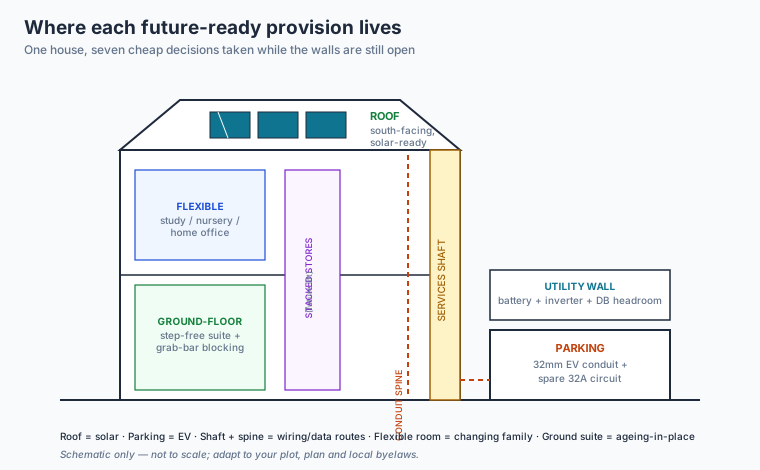
Figure 3: Seven future-ready provisions on one house — each a reserved path or space, each cheap while the walls are open.
Here is the one-page checklist to take to your architect at the wiring-and-structure stage. None of it commits you to buying anything; all of it keeps the door open.
| Provision | What to ask for now | Unlocks later |
|---|---|---|
| EV conduit | 32mm empty conduit + spare 32A circuit to the park | Home EV charger |
| Solar route | South-facing unshaded roof, DC conduit roof-to-meter, inverter/battery wall | Rooftop solar + storage |
| Spare circuits | 2–3 spare heavy circuits + free ways in the DB; adequate sanctioned load | More AC, charger, future loads |
| Data backbone | Star-wired Cat6 conduit to office, TV, key rooms; neutral at every switch | Reliable WFH + any smart ecosystem |
| Flexible room | Knock-out partition panel + services run to both halves | Splitting one room into two |
| Ground-floor suite | Step-free entry, GF bed + full bath, wide doors | Ageing parents / ageing you |
| Grab-bar blocking | Plywood backing behind bathroom and toilet walls | Bolt-on grab bars, no re-tiling |
| Future lift | Vertically aligned stores/cupboards with a clean stack | Lift without structural surgery |
| Climate envelope | Orientation, west-wall shading, cross-ventilation, insulation | Lower lifelong cooling bills |
Print that, hand it over, and ask one question of every line item: what does it cost to leave the option open now, versus to add it later? On almost every row the answer makes the decision for you. You do not have to predict 2040. You only have to refuse to wall yourself out of it.
When you are ready to put numbers to your own build, our cost calculator and layout planner will help you cost and place these provisions, and StudioMatrx’s AI design tools can show you how a future-ready layout looks for your specific plot.
Sources & further reading
- Bureau of Indian Standards — National Building Code of India (NBC 2016), Parts 8 (Building Services) and on barrier-free / universal accessibility provisions.
- Bureau of Energy Efficiency — Eco Niwas Samhita (Energy Conservation Building Code for Residential Buildings, ECBC-R), envelope and thermal-comfort requirements.
- IS 732 (Code of practice for electrical wiring installations) and IS 8061 — circuit, conductor and distribution-board guidance for spare-circuit and load provisioning.
- Ministry of Heavy Industries — FAME India scheme and the national EV policy framework for EV adoption trajectory; Central Electricity Authority (CEA) norms on EV charging infrastructure in buildings.
- Ministry of New and Renewable Energy (MNRE) — PM Surya Ghar / rooftop solar programme and DISCOM net-metering regulations.
- Ministry of Statistics & Programme Implementation / UNFPA India Ageing Report — projections of the 60-plus population toward 2031 and beyond.
- Ernst Neufert, Architects’ Data — standard clearances for accessible bathrooms, doorways, lifts and workspaces.
Pairs with: the family-by-family lifecycle view in future-proof home design for Indian families, the wiring backbone in future-proof wiring systems for Indian homes, and the room-splitting playbook in flexible homes for changing families.
Export this guide
Related Guides — Deep-dive reading
How to Plan a Home for Multi-Generational Living
Designing for grandparents, parents and children under one roof — privacy, accessibility and harmony
Home PlanningBathroom Planning for New Homes in India: Get It Right Before You Build
The bathroom decisions you cannot undo once the slab is cast — location and stacking, sunken vs non-sunken slabs, waterproofing, and the plumbing, electrical and ventilation you must coordinate with the civil work, stage by stage.
BathroomsDesigning a Naturally Energy-Efficient Indian Home
Comfort first, gadgets last — passive design, orientation, insulation, ventilation and the climate wisdom that cuts Indian energy bills
SustainabilityRelated Tools — Try Free
Cross-Ventilation Analyzer
Estimate airflow and air changes per hour (ACH) from room size, window areas, layout, and local wind — with NBC 2016 Part 8 compliance check.
Ventilation CalculatorAcoustic Privacy (STC) Visualizer
Indian healthcare acoustic visualizer — compare wall assemblies and noise sources, see received SPL after STC attenuation, and check FGI 2018 / IS 1950 / NABH speech-privacy compliance with live dual-canvas waveform.
Acoustic ToolApartment Video Door System Planner
Enter flats, entrances, floors and guard desk for a first-pass building intercom plan — door stations, indoor monitors, guard station, the right architecture and an indicative cost band.
Building Planner