
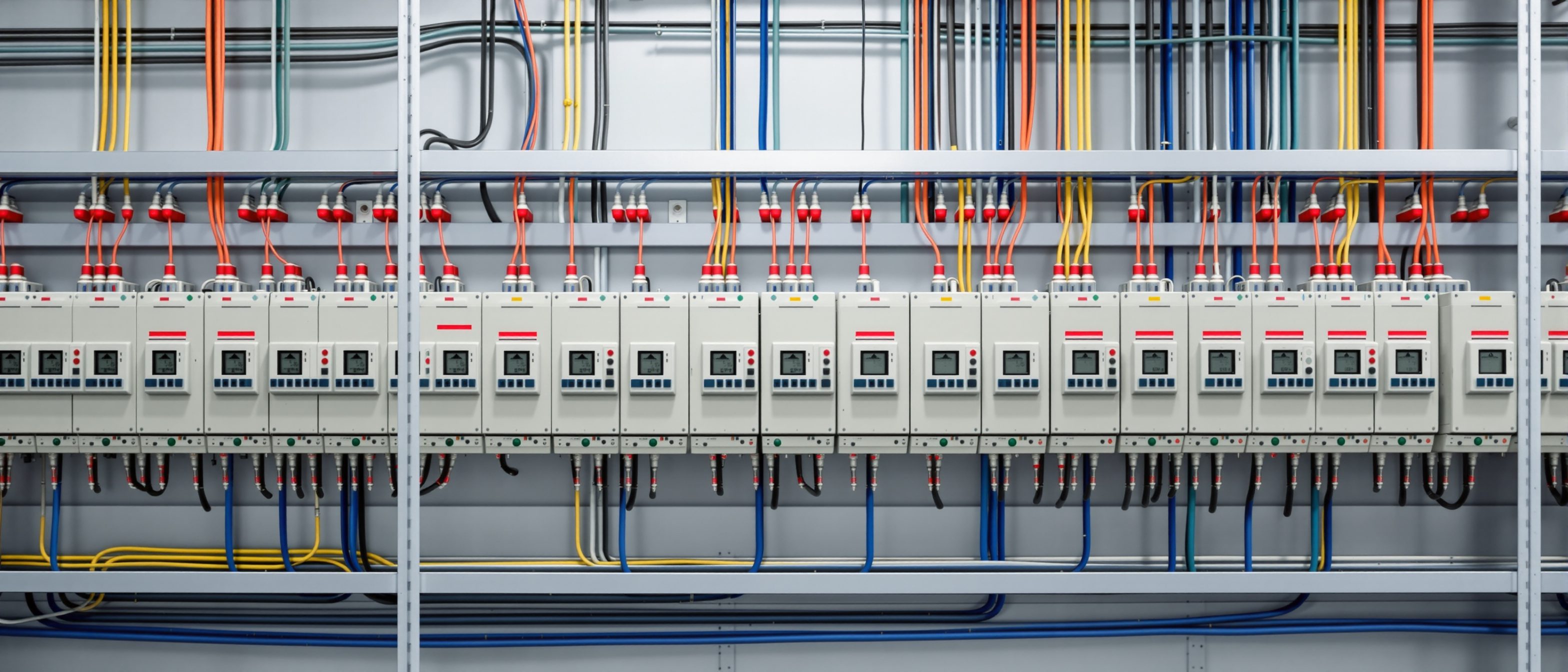
Future-Proof Wiring Systems for Indian Homes
Build electrical headroom now so tomorrow's loads are plug-and-play, not demolition.
You will never see your home's wiring again. The day the plaster goes on, every cable, conduit and junction box is sealed inside the wall for the life of the building. That single fact is why electrical work is the most unforgiving line item in a house — and the one homeowners think about least. You will argue for weeks about tile colour and kitchen shutters, then sign off the electrical layout in an afternoon because it is "the electrician's job".
Fifteen years ago a comfortable urban Indian home ran on fans, tube-lights, a fridge, a TV, one window AC and a geyser — roughly 4 kW of demand. Today the same family runs two or three split ACs, an induction hob, a microwave, a dishwasher, an inverter, two laptops on a work-from-home desk, a dozen chargers and an air purifier. By 2040 add an EV charger in the parking, a heat-pump geyser, a home battery and appliances we have not named yet. The load has roughly tripled, and it is still climbing.
Here is the trap: a house wired exactly to today's needs is already behind. When the new load arrives — and it will — you face a choice between two bad options. Run an ugly surface conduit and a trailing extension board, or break walls to pull fresh cable. The second option means chipping plaster, re-laying conduit, re-plastering, re-painting and living in dust for a fortnight, at a cost that dwarfs what the provisioning would have cost during construction.
Future-proofing your wiring is not about installing more — it is about installing headroom: a bigger sanctioned load, spare ways in every distribution board, oversized conduits with pull-strings, dedicated circuits for the heavy loads of tomorrow, and a labelled, documented system — so that the next fifteen years of new appliances are a plug-and-play upgrade, not a demolition job.
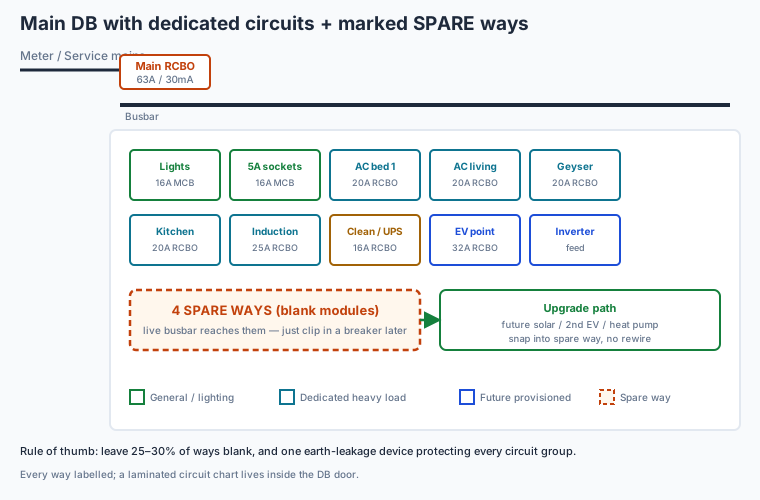
Figure 1: A future-ready DB groups general circuits, isolates heavy loads on their own RCBOs, and reserves 25 to 30 percent of ways as blank spares wired to the live busbar.
1. Size the sanctioned load for 2040, not for move-in day
Your sanctioned load is the maximum power your DISCOM (the distribution utility — BESCOM, Tata Power, Adani, MSEDCL and so on) permits you to draw. Builders and electricians routinely apply for the minimum the meter allows, because a higher sanctioned load means a marginally higher fixed charge. That false economy is the first thing to fix.
A modern 3BHK with three ACs, an induction hob, a geyser and an inverter will comfortably touch 8 kW of connected load today. Add EV charging (a typical 7.4 kW AC home charger), a heat-pump geyser and a second EV over the next decade and you are looking at 12 to 15 kW. Single-phase supply in most states tops out around 5 kW sanctioned (the exact ceiling varies by DISCOM); beyond that you move to three-phase.
A small increase in the fixed monthly charge for a higher sanctioned load is trivial against the cost — and the weeks of bureaucratic delay — of getting your load enhanced and your supply upgraded after you have moved in.
Apply for headroom. If your honest assessment is 8 kW today, sanction 10 to 12 kW. The wire from the pole, the meter and the main switch should all be sized for the sanctioned figure, not the present draw.
2. Single-phase or three-phase: when to make the jump
Single-phase delivers one live and one neutral, fine for loads up to roughly 5 to 7 kW. Three-phase delivers three lives plus a neutral and is the right call the moment your total load crosses the single-phase ceiling, or whenever you have several large simultaneous loads.
Go three-phase if any of these are true: total sanctioned load above 7 to 8 kW; an EV charger plus multiple ACs running together; a borewell or large pump motor (these strongly prefer three-phase and start more smoothly on it); or simply a large independent house where you want to balance loads evenly across three circuits.
The economics are stark. Provisioning three-phase during construction means a slightly larger main cable, a three-phase meter and a three-phase main DB — a modest premium. Converting from single to three-phase later means a new service cable from the pole, a meter change, a new main switch and often a rewire of how circuits are grouped. The table below sharpens the choice.
| Factor | Single-phase | Three-phase |
|---|---|---|
| Typical sanctioned ceiling | ~5 kW (varies by DISCOM) | 7 kW and well above |
| Best for | Small flats, modest 2BHK | 3BHK+, independent houses, EV homes |
| EV charger + 3 ACs together | Strained, trips likely | Comfortable, loads balanced |
| Borewell / large motor | Hard starts, more flicker | Smooth, motor-friendly |
| Provision now (at build) | Baseline | Modest premium on cable + meter + DB |
| Retrofit later | n/a | New service cable, meter swap, DB rework |
If you are building an independent house or a larger apartment in 2026, three-phase is the safer default. If a single-phase home, at least leave the main DB and incomer sized so an upgrade is a swap, not a rebuild.
3. Leave spare ways in every distribution board
This is the single highest-return rule in the whole guide. A distribution board has a fixed number of "ways" — slots where a breaker clips onto the busbar. Electricians fill the board exactly to the current circuit count to save the cost of a slightly larger enclosure. That is how you end up, three years later, with no slot for the EV circuit and a sparky telling you the whole board must be replaced.
Specify that every DB — the main board and each sub-board — carries 25 to 30 percent blank ways, wired to the live busbar and clearly marked SPARE. Adding a future circuit then means clipping in one breaker and pulling cable through the conduit you already left. No new enclosure, no relocating the board, no civil work.
NBC 2016 and the wiring practice in IS 732 both treat the DB and its circuit arrangement as something to be designed for the installation's needs, with safe access and clear identification — spare capacity is the natural extension of that discipline.
Pair the spare ways with spare conduits (Section 6) and you have a board that grows with the home. A practical default: a main DB with 12 to 16 ways for a 3BHK leaves four-plus genuinely empty, and each floor of an independent house gets its own sub-DB with its own spares so you never run a long heavy cable up a stairwell years later.
4. Put every heavy and every future load on its own circuit
A dedicated circuit is one breaker feeding one big appliance, with cable sized for that appliance alone. The opposite — daisy-chaining a geyser, an AC and a microwave onto one 16A socket circuit — is how Indian homes trip, overheat and, in the worst case, burn.
Give a dedicated circuit and a correctly rated point to each of these, today or as a provisioned future point:
- Each AC — one 20A circuit per indoor unit, so bedrooms are independent of the living room.
- Geyser / water heater — its own 20A circuit; provision a second point if a heat-pump geyser may replace it.
- Induction hob and oven — heavy kitchen loads on their own 20A or 25A circuits; do not share with the general kitchen sockets.
- EV charger — a dedicated point, sized generously; the specifics of cable, breaker and metering for EV are covered in the EV-ready home guide, so plan the circuit even if you buy the car later.
- Inverter / UPS — a clean feed and its own circuits for the backed-up loads, plus provisioning for a future battery (Section 8).
The provisioning logic is simple: running a dedicated cable and leaving a blank way at first-fix costs a cable and a few hundred rupees. Adding it to a finished home means breaking the wall from the DB to the appliance.
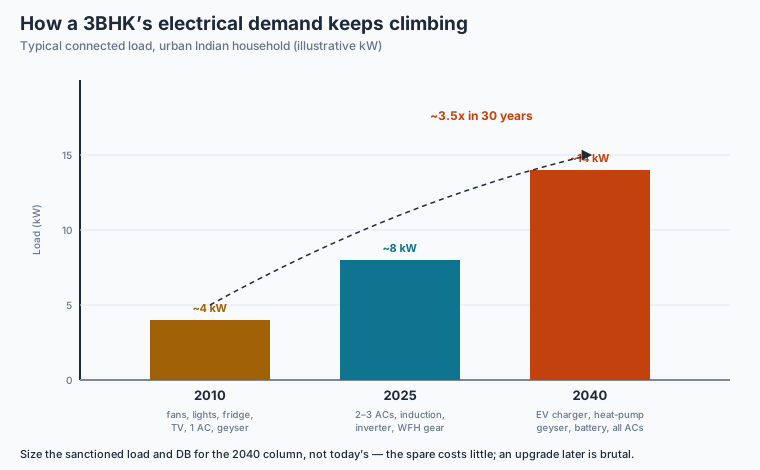
Figure 2: Household connected load has roughly tripled in a generation and is still rising — size the DB and circuits for the right-hand bar.
5. Generous sockets, USB and Type-C, and neutral at every switch
Homeowners universally under-provision sockets, then live with multi-plug boards and dangling chargers forever. Sockets are cheap at first-fix and impossible to add neatly later.
A workable density: a bedroom needs sockets at both sides of the bed (with built-in USB-A and USB-C), at the study desk, the TV/wall unit and at least one spare wall; a kitchen needs a socket roughly every 600 to 900 mm of counter plus dedicated points for each appliance; a living room needs sockets on every wall and a floor box if seating sits away from walls. Mix 6A points for electronics and 16A points where heavy appliances may go.
Two forward-looking moves matter most:
- USB-A and USB-C charging modules at the bedside, desk and kitchen counter remove the chargers that clutter every Indian socket — and Type-C is now the device standard.
- A neutral wire at every switch box. Traditional Indian switch loops carry only the live, which is fatal for retrofitting smart switches later — most need a neutral to power themselves. Specify neutral at every switch point now. This is the cheapest, highest-leverage smart-home provision you can make; the broader network-and-automation backbone is the domain of the smart-infrastructure planning guide, which pairs with this one on the data side while wiring stays on the power side.
6. Oversized conduits, spare conduits, and pull-strings
Conduit is the empty pipe that carries cable through walls and slabs. Its cost is trivial; its value compounds for decades. Three disciplines turn ordinary conduit into future-proof infrastructure.
Upsize the conduit. A conduit should never run more than about 40 percent full of cable, both for heat dissipation and to leave room to draw an extra wire. Specify one size up — 25 mm where 20 mm would do on main runs — so a future cable slips in.
Leave a pull-string in every conduit. A nylon pull-string left inside lets a future cable be drawn through without breaking a single wall. Without it, even an empty conduit is hard to use because nothing connects the two ends.
Run spare empty conduits on the major routes. From the DB to the kitchen, to the parking (for EV), to the roof (for solar — see Section 8), and along the main wall chases, leave one entirely empty conduit with a pull-string. This is the backbone for whatever the next decade demands — a heavy new circuit, a smart panel, a data run.
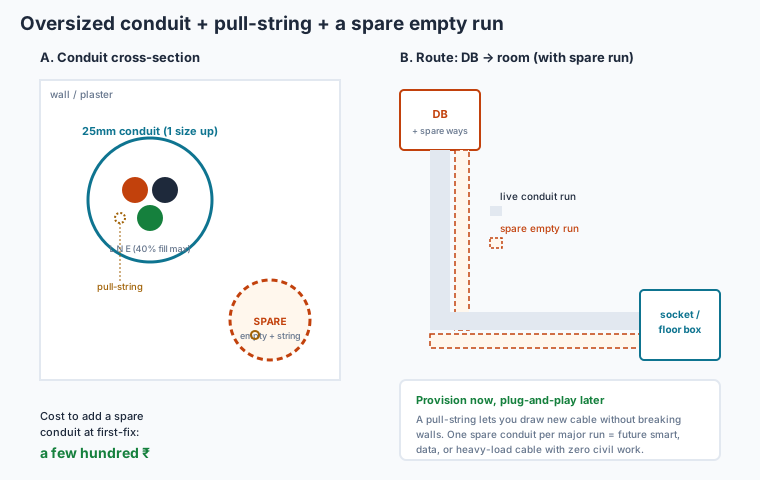
Figure 3: An oversized conduit kept under 40 percent full, plus one spare empty conduit with a pull-string per major run, turns a future cable pull into a plug-and-play job with no civil work.
7. Earthing, RCBOs and clean circuits for sensitive electronics
Headroom is worthless if the system is unsafe. Two pillars matter.
Proper earthing and earth-leakage protection. Every circuit must be earthed, and the installation must be protected against earth leakage. An RCBO combines overload protection and earth-leakage detection in one device; a 30 mA RCBO protecting socket and wet-area circuits is the standard for shock protection and is the practical successor to the old single ELCB protecting the whole house. Splitting earth-leakage protection across several RCBOs (rather than one master ELCB) means a fault in the bathroom does not plunge the whole home into darkness — and nuisance tripping is contained.
IS 732 (Code of Practice for Electrical Wiring Installations) and the NBC 2016 electrical provisions set out earthing and protection requirements; a competent licensed contractor should certify the installation against them, and you should keep that certificate.
A clean, separate circuit for sensitive electronics. Computers, networking gear, a home server or audio equipment benefit from their own circuit, ideally fed through the inverter/UPS and protected by a surge protective device (SPD) at the DB. In a country of frequent voltage swings and surges, an SPD at the main board is cheap insurance for everything downstream. Use the electrical safety checklist to confirm earthing, RCBO ratings and SPD provisioning are all in the specification before plaster goes on.
8. Wire for the inverter, the battery and the solar that is coming
Backup power and solar are no longer exotic. The future-ready move is to wire for them even if you install later.
Inverter / UPS provisioning. Decide now which circuits must stay live during a cut — selected lights, fans, the fridge, the WFH desk, the router — and wire them as a separate "backed-up" group fed from the inverter. Provision the cabling and a location for a future battery bank, sized and ventilated, so adding lithium storage later is a connection, not a rewire.
Solar readiness. Leave a spare conduit from the roof to the main DB and a marked spare way for the solar inverter and net-metering changeover. This single provision saves a wall-breaking exercise when you go solar; the full roof, structural and net-metering planning lives in the solar-ready home guide and the broader solar power for Indian homes companion.
The cost contrast, one more time, in numbers:
| Item | Provision now (at first-fix) | Retrofit into a finished home |
|---|---|---|
| Spare way in DB | A blank module, near zero | Replace DB enclosure, rewire grouping |
| Spare conduit + pull-string per run | A few hundred ₹ each | Break and re-plaster wall chases |
| Neutral at every switch | A length of extra wire | Effectively impossible without rewiring |
| EV / solar conduit to parking/roof | One conduit run | Surface conduit or wall demolition |
| Dedicated AC/geyser circuit | One cable + one breaker | Chip wall from DB to appliance |
| Three-phase main DB | Modest premium | New service cable, meter swap, DB rework |
Provisioning is a rounding error during construction. Retrofitting is a project.
9. Cable gauge: design out the voltage drop
Undersized cable is invisible until lights dim when the geyser kicks in. As current travels along a wire it loses voltage; the longer the run and the heavier the load, the bigger the drop. Indian wiring practice keeps voltage drop within a few percent of nominal, which means matching conductor cross-section to both the load and the distance.
Practically: use 1.5 sq mm for lighting, 2.5 sq mm for general 16A socket circuits, and 4 sq mm or 6 sq mm for heavy dedicated runs — geyser, induction, AC, EV — especially on long runs to a parking or rooftop. When in doubt on a long heavy run, go one size up; copper is cheap relative to the consequence of a hot, lossy cable buried in a wall. Insist on ISI-marked, FR or FRLS-grade cable throughout — the flame-retardant sheath matters in a concealed installation.
10. Label it, document it, and keep the drawing
A future-ready system that nobody can read is only half future-ready. The final discipline is documentation.
- Label every way in every DB, and fix a laminated circuit chart inside the DB door listing what each breaker controls.
- Keep the as-built electrical drawing — the actual routes, not just the design intent. Years later, when you or an electrician needs to add a circuit, this drawing tells you where conduits and spares run. If reading these drawings is unfamiliar, the electrical drawings explained guide is the companion that teaches you how to interpret the symbols and layouts.
- Record the spares — which ways are blank, which conduits are empty, where the pull-strings terminate. This list is the map of your home's upgrade headroom.
A future-ready home, in wiring terms, is one where the next upgrade is obvious, reachable and cheap — because someone, today, spent a little money and a lot of thought on headroom. That is the whole philosophy of designing a home for 2040: the pillar guide on designing homes for 2040 frames it across every system, and the future-proof home design umbrella ties wiring to the wider family-lifecycle picture.
Sources & further reading
- National Building Code of India 2016 (NBC 2016), Part 8 — Building Services, Section 2: Electrical and Allied Installations. Bureau of Indian Standards. Distribution boards, circuit design and safety provisions.
- IS 732 — Code of Practice for Electrical Wiring Installations. Bureau of Indian Standards. Conductor sizing, conduit fill, earthing and protection.
- IS 3043 — Code of Practice for Earthing. Bureau of Indian Standards.
- Central Electricity Authority (CEA) — Measures relating to Safety and Electric Supply Regulations. Service connection, sanctioned load and protection norms.
- Bureau of Energy Efficiency (BEE) — Eco Niwas Samhita / ECBC-Residential. Energy-conscious residential design context.
- Ministry of Heavy Industries — FAME-II and EV charging guidelines; Ministry of Power EV charging infrastructure guidelines. Home EV charging load and provisioning context.
- MNRE — Rooftop solar and net-metering framework. Solar-ready provisioning context.
- Manufacturer technical literature for domestic MCBs, RCBOs and SPDs (consult current product ratings before specifying).
Pairs with the pillar Designing Homes for 2040, and its siblings Smart Infrastructure Planning and EV-Ready Home Design.
Export this guide
Related Guides — Deep-dive reading
Residential Electrical Systems: The Complete Guide for Indian Homes
How the electricity in an Indian home actually works — from the utility supply and meter through the distribution board, circuits, wiring, earthing and protection, to lighting, safety, energy efficiency, smart controls, solar and backup — written so a homeowner can understand, plan and judge it, and know exactly where a licensed electrician must take over.
Electrical & WiringBathroom Electrical India: Loads, IP Zones, RCD Protection & the Complete Wiring Plan
The complete guide to bathroom electrical planning for Indian homes — the loads and points (geyser on a dedicated 16 A circuit, exhaust, mirror and lights, shaver socket, smart WC), the IP zones 0/1/2 that fix where fittings can sit near water, mandatory 30 mA RCD/RCBO earth-leakage protection, earthing, keeping switches outside the wet zone, cable sizing and getting conduits right before plastering — all per IS 732 and NBC 2016.
BathroomsSmart Home Planning Guide India: New Build & Existing Homes
The decisions that make or break a smart home are taken at the plan stage — before a wall goes up or a switch box is chased. Here is how to plan conduits, neutrals, network backbone and device points for an Indian home that stays smart for a decade.
Smart HomeRelated Tools — Try Free
Electrical Safety & Load Audit
Home electrical audit — 10 categories, 65+ checkpoints across earthing, RCCB, MCB, wiring, switchboards, appliance circuits, DG/inverter backup.
Safety AuditApartment Interior Planning Checklist
51-item checklist across structural, ceiling, lighting, furniture, storage, electrical, kitchen, bathroom.
ChecklistElectrical Load Calculator
Estimate a home's connected load and realistic maximum demand from its appliances, whether it needs single or three-phase supply, and a suggested main switch rating.
Electrical