
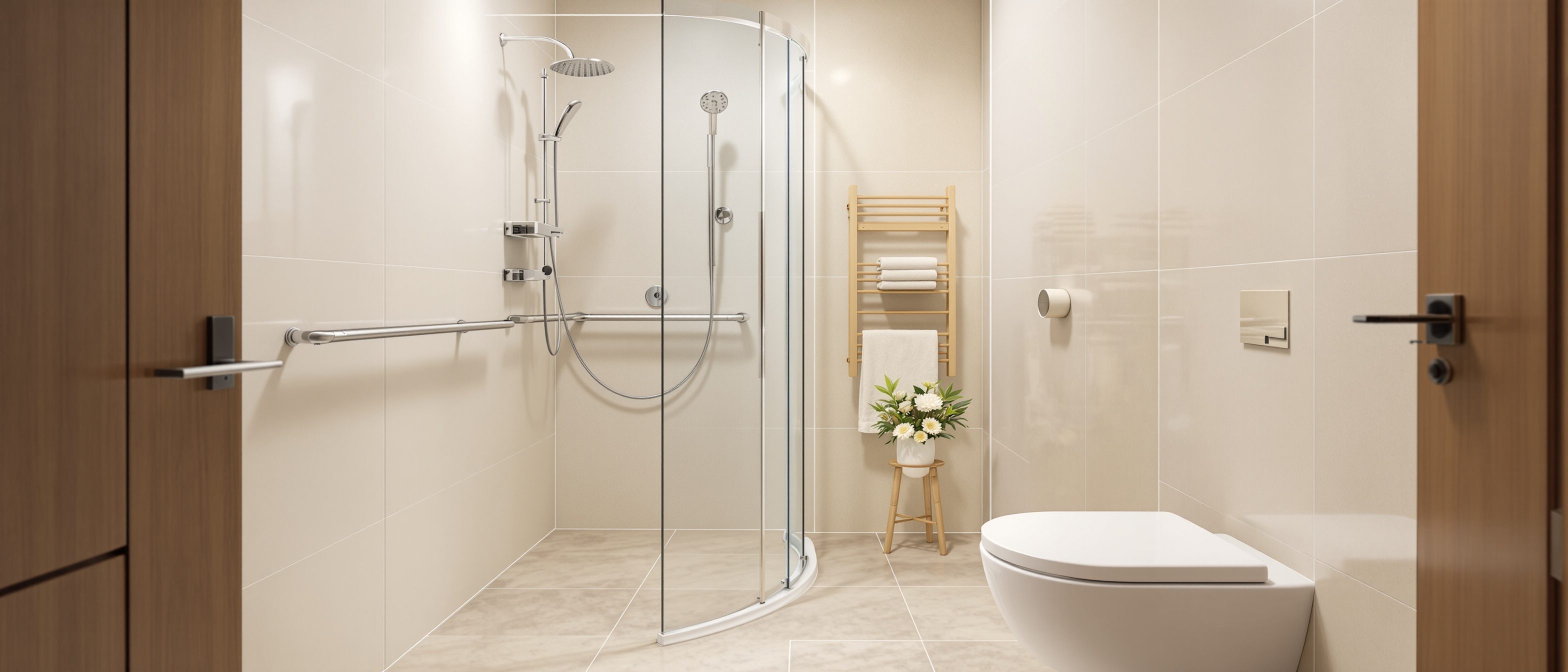
Aging-in-Place Home Design in India
Provision the bones now so your home can care for you (and your parents) for the next 30 years.
The day a parent comes home from hospital after a hip fracture is the day most Indian families discover what their house really thinks of old age. The pooja room is up half a flight. The only bathroom with a Western WC is on the first floor. The shower has a 150 mm marble kerb that a walking frame cannot cross. The bedroom door is 750 mm wide and a wheelchair is 650 mm. None of this was anybody's fault — the house was built for a young couple with two small children, and it served them beautifully for twenty years. It simply was never asked the one question that matters most over a lifetime: what happens when we are eighty?
The uncomfortable truth is that almost every Indian home is built for the body of a 35-year-old and then occupied, eventually, by the body of an 80-year-old. We plan for the wedding, the children, the car. We rarely plan for the cataract, the arthritic knee, the day the stairs become a cliff. And because retrofitting accessibility into a finished, tiled, fully-furnished house is brutally expensive and disruptive, most families don't do it — they shift the elder to a back room, or worse, the elder simply stops moving around their own home.
There is a far cheaper way, and it is the signature idea of this whole Future-Ready Homes series: you don't have to install the grab-bars, the lift or the ramp today. You have to provision for them — lay the cheap, invisible groundwork in the walls and floor slab now, while the masons are already there, so that fitting the aids later is a half-day job instead of a demolition. A piece of plywood behind the tiles costs a few hundred rupees. Hacking open a tiled wall to add it later costs tens of thousands and a week of dust.
Design your home today for the slowest, most fragile version of every person who will ever live in it — provision the bones now, fit the aids when they are needed — and the same house will carry a toddler, a pregnant mother, a parent on crutches and an eighty-year-old with equal grace.
This guide is the ageing/later-life lens within the cluster. For the broader principles of designing one home that adapts to every age and ability, read the companion universal-design guide; for laying out privacy and zones between generations under one roof, see multi-generational home design. Here we focus on the specific, provisionable moves that let people grow old in place.
1. Start at the gate: a step-free path into the house
Ageing-in-place fails at the very first obstacle, and in most Indian homes that obstacle is the entrance. We habitually raise the plinth 450–600 mm above the road for flood and dignity, then bridge it with a flight of four or five steps and no handrail. For a person with a frame, a wheelchair, or even a recently operated knee, that flight is a wall.
The fix is not to lower the plinth — you still want it for monsoon. The fix is to make sure at least one route into the house is, or can become, a ramp. A wheelchair ramp at the comfortable 1:12 gradient (one unit of rise for every twelve of run) needs a long run: a 600 mm plinth needs about 7.2 m of ramp plus landings. Few sites have that to spare on day one, and most families don't want a ramp dominating the entrance while everyone is still sprightly.
So provision it. Keep one side of the approach — often the car porch or a side utility path — clear of planters, meter boxes and steps, with enough length banked for a future ramp. Cast the porch slab and the threshold at the same level as the interior floor so the door has a flush, level threshold (a maximum 12–15 mm upstand, weathered, not a kerb). A level threshold at the front door is the single most important accessibility move in the house and it costs nothing extra — it is purely a question of telling the contractor before the floor is poured.
A threshold is not a small thing. The National Building Code of India (NBC 2016, Part 3) and the Harmonised Guidelines for accessibility both treat level or ramped entry, not steps, as the baseline for an accessible building. Steps are the exception you add for everyone else; the level route is the rule.
2. The ground-floor suite: one level is everything
The second great principle of ageing in place is brutally simple: an old person should be able to live their entire day without climbing a single stair. Sleep, bathe, use the toilet, eat, sit in daylight, receive visitors — all on the ground floor, all reachable on the level.
In the Indian joint family this aligns naturally with how we already live: the eldest generation traditionally takes the ground floor. The mistake is to give them the leftover north-east box room and a shared bathroom up the stairs. Instead, design a proper elders' suite on the ground floor from day one: a generous bedroom with morning light, an attached bathroom (the accessible one — see section 4), and a direct, step-free path from the entry to the bed to the bath.
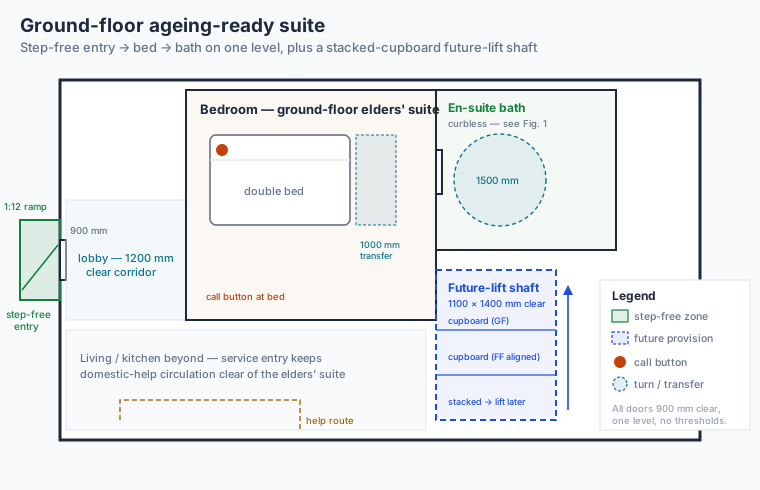
Figure 1: The ageing-ready suite — step-free entry → bed → bath on one level, with 900 mm clear doors, 1000 mm transfer space beside the bed, an emergency call button, and a stacked-cupboard shaft positioned to become a lift later.
Even if the parents are healthy and prefer their first-floor room today, building the ground-floor suite as a flexible guest-cum-elder room costs nothing extra and means the house never has to be re-planned in a crisis. This is the same flexible-bones thinking explored across the cluster — see flexible homes for changing families and the family-lifecycle umbrella, future-proofing a home for Indian families.
3. Doors, corridors and turning space: design for the wheelchair
The whole house should let a wheelchair or walker move through it without a three-point turn. Three numbers do most of the work:
- Doors: 900 mm leaf (giving roughly 820–850 mm clear opening). A standard 750 mm Indian internal door leaves only ~680 mm clear — too tight for many wheelchairs and impossible for a carer walking alongside. Going to 900 mm costs a slightly wider frame and a marginally bigger door; the structural opening is set at masonry stage, so this is a now-or-never decision.
- Corridors: 1200 mm clear so a wheelchair and a person can pass, and so a 90-degree turn into a doorway is possible.
- Turning circle: 1500 mm clear diameter in the bedroom, the bathroom, and the kitchen — the space a wheelchair needs to spin a full 360 degrees.
These numbers come straight from accessibility standards (the Harmonised Guidelines and NBC Part 3 use 900 mm doors and a 1500 mm turning space as the accessible baseline; Neufert's Architects' Data gives the same wheelchair envelopes). You can sketch and check these clearances in our layout planner and room-measurement tool before you sign off drawings.
None of this requires huge rooms — it requires thoughtful rooms. A 1500 mm circle often already exists in the middle of a normally-furnished bedroom; the job is to make sure it survives the wardrobe and the bedside tables.
4. The bathroom: where ageing in place is won or lost
More elderly Indians are hospitalised by bathroom falls than by almost anything else in the home. The wet floor, the kerb, the cramped turn, the nothing-to-hold-on-to — the bathroom is the most dangerous room for an old body, and the most expensive to fix after the fact. Get it right, on the ground floor, once.
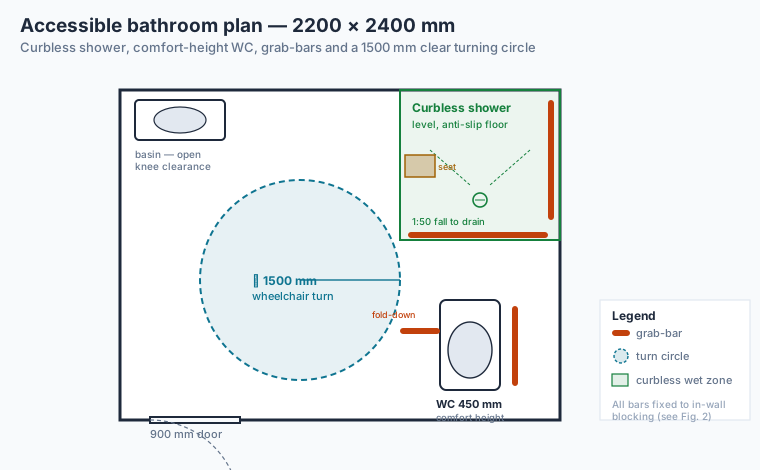
Figure 2: An accessible bathroom — curbless (level) shower with anti-slip floor and a 1:50 fall to the drain, comfort-height WC at 450 mm, fold-down and fixed grab-bars, and a 1500 mm turning circle that clears the door swing.
The non-negotiables:
- A curbless, walk-in shower. No kerb, no step, no tray. The whole bathroom floor is gently graded (about 1:50, a 20 mm fall per metre) to a linear or point drain in the wet zone, so a wheelchair or walker can roll straight in. This must be set when the floor screed and waterproofing are done — provisioning the drain position and the fall now is trivial; recutting falls into a finished floor means demolishing it.
- Anti-slip flooring (matt, textured tiles rated for wet barefoot use, not glossy vitrified) throughout the bathroom.
- A comfort-height WC, with the seat around 450 mm off the floor rather than the usual ~400 mm, so it is easier to sit and rise. On the Indian-vs-Western question: an ageing body cannot squat, so the elders' bathroom should have a Western WC, full stop. If the household still prefers an Indian squat pan elsewhere, keep one in another bathroom — but the accessible suite must be Western, comfort-height, with grab-bars beside it.
- A 1500 mm turning circle clear of the door swing and fixtures.
- A basin with open knee clearance so a seated user can roll under it, and a single lever (not two taps) mixer.
And the one move that defines this whole guide — grab-bar blocking — gets its own section.
5. Grab-bar blocking: the cheapest provision you will ever make
A grab-bar screwed into plain tile-on-plaster will rip out the first time real weight comes onto it — which is exactly the moment someone is falling. A grab-bar must be anchored into something solid behind the tiles. You can't add that something later without demolishing the wall. So you add it now.
While the bathroom walls are being built, run a continuous band of structural backing — an 18 mm marine-ply sheet, or a solid brick/concrete band — inside the wall, behind the eventual tiling, from roughly 200 mm to 1000 mm above the finished floor, all around the WC, the shower and the basin. Then tile over it as normal. The wall looks identical to any other. But anywhere in that band, on any day in the next thirty years, a plumber can drill and bolt a 100+ kg-rated grab-bar in twenty minutes with total confidence.
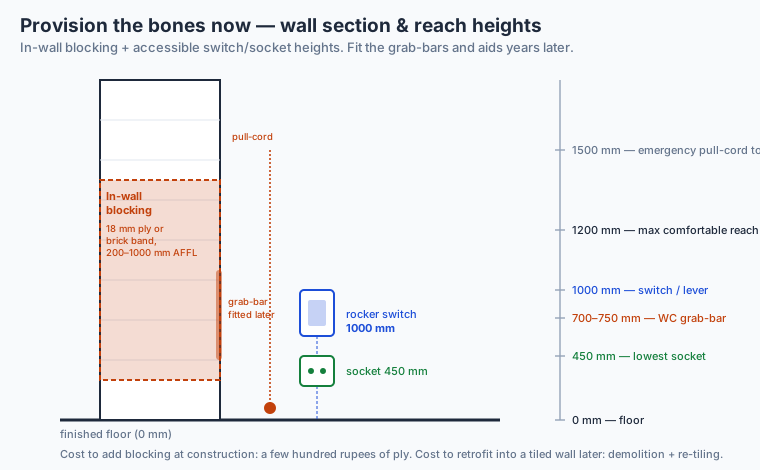
Figure 3: Provision the bones now — a continuous in-wall blocking band (200–1000 mm) lets a grab-bar be bolted on years later, while switches at 1000 mm, sockets at 450 mm and an emergency pull-cord put controls within an ageing person's reach.
This is the purest expression of the cluster's economics. The table below puts numbers on the provision now vs. retrofit later gap for the moves in this guide. Figures are indicative 2026 ranges for a single Indian home and vary by city and finish — treat them as the shape of the argument, not a quote; use the interior cost calculator for your own estimate.
| Ageing-in-place move | Cost to PROVISION at construction | Cost to RETROFIT into a finished home | Why the gap |
|---|---|---|---|
| Grab-bar blocking in 3 bathrooms | ₹3,000–8,000 (ply + labour) | ₹40,000–90,000 | Demolish + re-tile + re-waterproof each wall |
| Curbless shower (drain + floor fall) | ₹0 extra (design decision) | ₹60,000–1,50,000 | Break floor, redo waterproofing, re-tile |
| Level / ramp-able entry threshold | ₹0–5,000 | ₹50,000–2,00,000 | Re-cast plinth, rebuild approach |
| Future-lift shaft (stacked cupboards) | ₹0 extra (just stacked storage) | ₹3,00,000–8,00,000+ | Cut through two floor slabs, structural works |
| 900 mm doors instead of 750 mm | ₹1,000–3,000 per door | ₹15,000–40,000 per door | Break and widen structural opening, redo lintel |
| Recessed conduit for emergency call | ₹500–1,500 per room | ₹10,000–25,000 | Chase walls, repair, repaint |
6. Switches, sockets and lever handles: design for the reach
Ageing hands lose grip and ageing bodies lose reach, especially when seated. Three quiet decisions, all free if made early, transform daily usability:
- Lever handles, not knobs, on every door and tap. A round knob needs a firm grip and a twisting wrist — exactly what arthritis takes away. A lever can be worked with a closed fist, an elbow or a forearm.
- Rocker switches (big, flat plates) instead of small toggles, mounted at about 1000 mm above floor — reachable from a wheelchair and findable by a fumbling hand at night.
- Sockets raised to 400–450 mm off the floor (instead of the usual 200–300 mm) so a seated or stooping person isn't bending to the skirting. And put plenty of them — an old person's room fills with chargers, a BP monitor, an oxygen concentrator, a reading lamp.
These heights pair with the wider future-proof wiring and smart-infrastructure planning thinking in this cluster; if you want to understand the drawings your electrician works from, see electrical drawings explained.
7. Lighting for ageing eyes
A 60-year-old's retina receives roughly a third of the light a 20-year-old's does, and ageing eyes are far more disabled by glare. Bright, even, glare-free light is not a luxury for an elder — it is a fall-prevention measure.
| Space | Younger-eye lux (typical) | Ageing-eye target lux | Notes |
|---|---|---|---|
| General living / bedroom | 100–150 | 200–300 | Even, layered; avoid single harsh source |
| Kitchen counter / reading | 300 | 500–750 | Task light under cabinets, at the chair |
| Bathroom | 150 | 300+ | Shadow-free at the basin mirror |
| Stairs & corridors | 100 | 200, plus night-path | Light every tread; no dark landings |
The practical moves: more fittings at lower brightness rather than one glaring source; diffused, indirect light to kill glare off floors and mirrors; and a night-path lighting circuit — low-level, motion-triggered LED strips along the route from the bed to the bathroom, so a 3 a.m. trip never happens in the dark. Provision the wiring for these on the lighting circuit now even if you fit warm dim strips later.
8. The future lift: a shaft hiding in your cupboards
If the home is two or more storeys, the day may come when the elder simply cannot use the stairs and the ground-floor suite is the entire world. A home lift restores the whole house to them — but cutting a lift shaft through finished floor slabs is a structural nightmare costing several lakhs.
The elegant provision is the stacked-cupboard shaft. On every floor, align a tall, full-height storage cupboard — say 1100 mm by 1400 mm internally — vertically, one directly above the other. Build the floor slab over that footprint so it can be opened later (a knock-out panel, or simply detailed so the cut is clean and away from main beams — your structural engineer should be told the intent at design stage). For decades the family enjoys generous stacked storage. The day a lift is needed, the cupboards come out and a compact home lift drops in, with no demolition of living space. The shaft was always there, working as a wardrobe.
This is provisioning at its most satisfying: the future capability earns its keep as something useful every single day until it is needed.
9. The stairs you keep, and the helpers in the wall
Most residents will still use the stairs for years, so make them safe for ageing knees too. Handrails on both sides of every flight (most Indian homes have one, or none) — a person with a weak side needs the wall they can actually reach. Even, generous treads with a clear nosing line, no open risers, and a light on every step. A continuous handrail that turns the corner of the landing rather than stopping and restarting.
And provision two more helpers in the walls now:
- Stair-lift power: a spare socket and a clear, obstruction-free wall along one side of the staircase, so a stair-lift rail can be bolted on later without rewiring.
- Emergency call / alert points: recessed conduit and a junction box beside the elder's bed, inside the accessible bathroom (with a pull-cord reachable from the floor — because falls happen low) and near their favourite chair. Run the cabling now even if the actual call system or smart sensor is added later. This dovetails with a smart home setup; a basic provision is cheap insurance, and you can scope a fuller system with the smart-home cost calculator.
10. The household around the elder: help, privacy and dignity
Ageing in place in India is rarely a solo affair — there is family, and often domestic help and visiting carers. Two design considerations close the loop.
First, circulation for help. The elders' suite should be reachable by a carer or domestic help on the level, ideally without routing them through the most private family spaces — but the elder should also not be cut off in a back annexe. Position the suite so a daughter-in-law or attendant can look in easily, while a service entry keeps help-circulation from constantly crossing the elder's private zone. The privacy and zoning craft here is the heart of multi-generational home design.
Second, dignity over institution. None of these provisions should make the house look like a hospital. The blocking is invisible behind tiles. The future-lift is a wardrobe. The grab-bars, when fitted, now come in finishes that read as towel rails. The point of provisioning is precisely this: the home stays a beautiful, normal home for everyone for as long as possible, and the accessibility appears, quietly and quickly, only when it is actually needed. An ageing-ready home is not a sad home. It is the most confident kind of home there is — one that has already decided it will never abandon the people who built it.
Sources & further reading
- National Building Code of India (NBC) 2016, Bureau of Indian Standards — Part 3 (Development, Built Environment) and provisions on accessibility, ramps, level entry, door widths and turning spaces.
- Harmonised Guidelines and Standards for Universal Accessibility in India (2021), CPWD / Ministry of Housing and Urban Affairs, Government of India — ramp gradients (1:12), 900 mm clear doors, 1500 mm wheelchair turning space, grab-bar and WC heights.
- IS 4963 / Rights of Persons with Disabilities Act, 2016 (RPwD) — the legal and standards basis for barrier-free design in India.
- Ernst Neufert, Architects' Data — anthropometric and wheelchair-clearance envelopes used in the dimensional figures above.
- WHO, Falls and ageing-and-health guidance — evidence on home falls, lighting and bathroom risk among older adults.
- General Indian construction-cost ranges are indicative 2026 figures and vary widely by city, finish and contractor; verify locally.
Pairs with the pillar Designing Homes for 2040, and with Flexible Homes for Changing Families and Universal Design & Adaptable Homes.
Export this guide
Related Guides — Deep-dive reading
Designing Adaptable & Universal-Design Homes
Accessibility, Aging-in-Place, and the Multi-Stage Family — Code, Anthropometrics, and Plan-Stage Discipline for Indian Residential Architects
Room PlanningHow to Plan a Home for Multi-Generational Living
Designing for grandparents, parents and children under one roof — privacy, accessibility and harmony
Home PlanningBarrier Free Shower India: Curbless Zero-Threshold Roll-In Showers (2026)
The curbless, zero-threshold shower with no kerb to step or wheel over: the recessed slab and linear drain that contain water without a lip, whole-wet-area waterproofing, fold-down seat and grab bars, wheelchair transfer and turning space, anti-slip floors, aging-in-place logic and real rupee costs — planned before the slab is cast.
BathroomsRelated Tools — Try Free
Home Building & Interior Cost Calculator — 20 Cities
Construction + interior costs for 20 Indian cities across kitchen, wardrobes, flooring, painting, ceiling.
Cost CalculatorAccessibility Compliance Calculator
Check a planned lift against the CPWD and RPwD accessible-lift benchmarks for a score.
Lift CheckerHome Accessibility Planner
Integrate lift, ramp, stairlift and wheelchair circulation into one accessibility plan.
Planner