
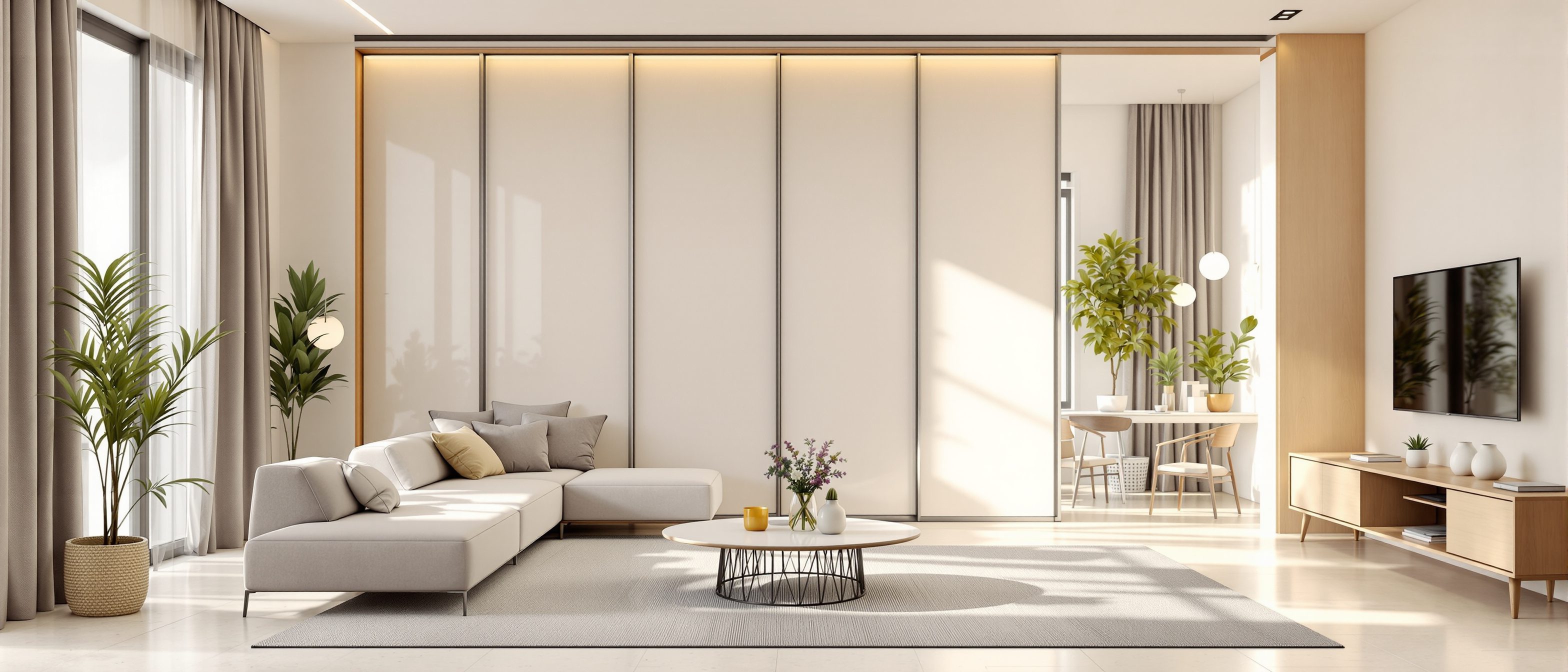
Flexible Homes for Changing Families
Design rooms and a plan that change use over a lifetime — without rebuilding.
The family that moves into a new home in India is rarely the family that lives there twenty years on. The couple who plan a two-bedroom flat in 2026 may be three people by 2029, four by 2034, and back to two by 2050 — with an ageing parent moving in somewhere in between. Yet the walls poured in concrete on day one almost never move. Most Indian homes are designed for the family of the photograph: a snapshot, fixed forever in brick.
That rigidity is expensive. When the nursery has to become a study, when the parents' bedroom has to become a ground-floor suite for a grandparent who can no longer climb stairs, when the formal dining room nobody uses has to become a home office — the typical answer is a contractor, a fortnight of dust, broken tiles, a re-run of wiring, and a bill that runs into lakhs. None of it was inevitable. A home designed with a little structural foresight absorbs the same changes with a screwdriver and a weekend.
This is the quiet craft of spatial flexibility: not predicting exactly how your family will change, but leaving the building loose enough that it can. It is the most under-used idea in Indian residential design, and one of the cheapest to build in.
A flexible home is not a home with more rooms — it is a home where the same rooms can do different jobs over time, because the structure, the partitions and the services were planned to let them.
This guide is the spatial-technique companion in our Future-Ready Homes cluster. The pillar surveys every force pushing on the Indian home of 2040; the family-lifecycle overview, future-proofing a home for changing Indian families, maps the stages a household passes through. Here we go one level deeper into the architecture itself — the walls, doors, grids and provisions that make change cheap.
1. Why Indian homes lock up — and what "loose-fit" means
The phrase architects use is loose-fit — a building shell sized and structured so its internal use can shift without touching the bones. The opposite, a tight-fit home, is shaped so precisely around one way of living that any change means demolition. Most Indian homes are tight-fit by accident: rooms are sized to the millimetre around the furniture the owner bought that year, services are buried in every wall, and the structural grid is set as tight (and as cheap) as the engineer can make it.
Loose-fit is a design decision, not a bigger budget. It rests on three moves, and the rest of this guide unpacks each:
- Make most internal walls non-structural and serviceless, so they can be removed or moved.
- Keep doors and openings adaptable with sliders, pocket doors and a standard wide clear width.
- Choose a structural grid with enough clear span that partitions can land anywhere later.
"A building should be conceived as a loose-fit framework that accommodates change, rather than a tight skin moulded to one moment's use." — a paraphrase of the 'long life, loose fit, low energy' principle articulated by architect Alex Gordon (RIBA), which has guided adaptable-building design since the 1970s.
Flexibility overlaps with three siblings that go deeper on their own ground, so route there rather than expecting full coverage here: ageing-specific accessibility lives in ageing-in-place design; the privacy and zoning of a shared multi-generation household lives in multi-generational home design; and converting a room into a serious workspace lives in home-office design for remote work. This guide is about the spatial machinery that makes all of those conversions possible.
2. The convertible room: one shell, many lives
The single most valuable flexible element is the convertible room — a normal-sized room, near the social part of the home, designed so its use can change every few years with no structural work. Picture one 3.0 m × 3.6 m room (about 10.8 sq m, a standard second bedroom) tracking a family through three decades.
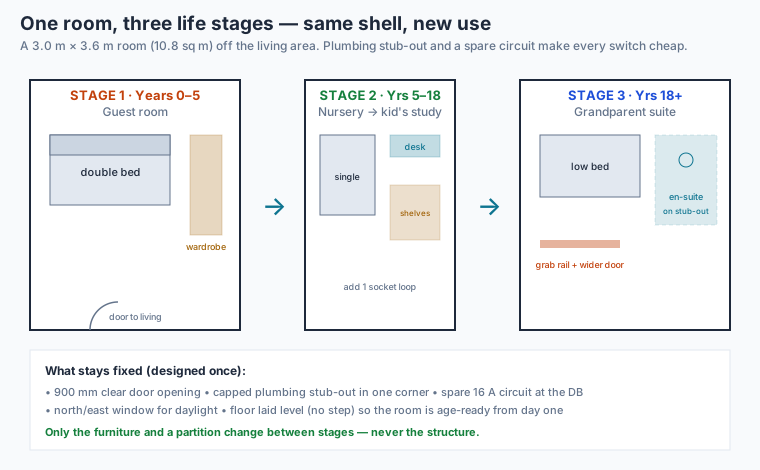
Figure 1: The same shell — fixed door width, capped plumbing stub-out, spare circuit, level floor — carries a guest room, a nursery-then-study, and finally an en-suite grandparent room. Only furniture and one partition ever change.
What makes this work is a short list of things you design once, on day one, and never touch again:
- A 900 mm clear door opening. It reads as generous now and becomes wheelchair- and walker-friendly later without widening a single wall. (More on accessibility-grade widths in ageing-in-place design.)
- A capped plumbing stub-out in one corner — a water supply and a drain line brought to the room and sealed off behind the finish. The day the room needs an attached toilet for a grandparent, the plumber breaks open 0.5 sq m of wall, not the slab.
- A spare 16 A circuit run to the room from the distribution board, coiled and capped. A study, a treatment room or a mini-kitchenette can be powered without pulling a new line across the house. Provisioning spare circuits is the backbone of our future-proof wiring systems guide.
- A level floor with no threshold step and a north or east window for daylight — neutral conditions that suit any use, and that quietly make the room age-ready from the start.
Provision all four and the room costs perhaps ₹15,000–30,000 more to build than a plain bedroom. Skip them and the first conversion that needs water or a wider door starts at ₹1.5–2.5 lakh of breaking and rebuilding. That gap — cheap provision now versus costly retrofit later — is the thread running through this whole cluster.
3. Knock-out partitions: walls designed to be removed
In a framed (RCC column-and-beam) home — which is how most Indian houses and almost all apartments are built — the load travels down columns and through beams, not through your internal walls. Those internal walls are infill: half-brick or block partitions that hold nothing up. They can come out. The trouble is that nobody marks which is which, and owners are (rightly) terrified of touching a wall in case it is structural.
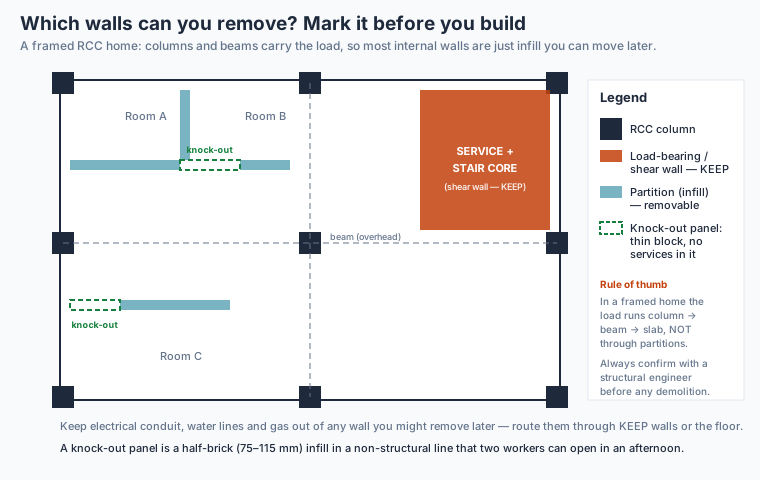
Figure 2: In a framed home the load runs column to beam to slab. Most internal partitions are removable infill; the staircase or service core is the shear wall you keep. A knock-out panel is a thin, serviceless segment you can open in an afternoon.
A knock-out panel takes this one step further. Instead of leaving a full partition to be demolished, you deliberately build one stretch of a non-structural wall as a thin (75–115 mm) block infill with no electrical conduit, no plumbing and no gas line inside it. It looks identical to the wall around it, but it is engineered to be the easy opening — two workers can knock it through in an afternoon to join two rooms, create a doorway between a future grandparent suite and a bathroom, or merge two kids' rooms into one teenage room.
The golden rule of flexible partitions: keep services out of any wall you might one day remove. Route electrical conduit, water lines and gas through walls you intend to keep — ideally the staircase or service core — or through the floor. The moment a wall carries the only path for a water line, removing it stops being a weekend job. If you want to understand how circuits and conduit are laid out so they avoid the removable walls, read electrical drawings explained.
One caution: in old load-bearing masonry homes and in many tier-2 independent houses where the brick walls genuinely hold up the roof, none of this applies — those walls are structural and removing them needs a beam to take the load. Always get a structural engineer to confirm before any demolition, framed home or not.
4. Sliding and pocket doors: flexibility you use every day
A swing door eats a 900 mm quarter-circle of floor it can never share. A sliding door gives that floor back, and a pocket door — one that slides into a slot inside the wall — disappears entirely. For flexible homes they do something more: they let two spaces be either one or two rooms at will.
A wide pocket or sliding partition between a living room and the convertible room means the home reads as open and generous for everyday life, then closes into a private bedroom when a guest, a new baby or a recovering parent needs it. This is the cheapest form of "a room that is sometimes there" — far cheaper than a folding wall and far more flexible than a fixed one.
Practical notes for India:
- A pocket door needs a stud cavity of about 100–125 mm built into the wall on day one. Retrofitting one means opening the wall, so decide early.
- Specify good-quality top-hung roller gear (the door hangs from a track, nothing runs on the floor) so the floor stays flush — important for both cleaning and future wheelchair use.
- For the openings between social spaces, a 2.4–2.7 m wide sliding partition turns two rooms into one large gathering space for festivals and back into two for daily privacy.
- Avoid pocket doors on walls that carry plumbing or heavy conduit — the same serviceless-wall logic as knock-out panels.
A quick reference for the openings that matter most in a flexible plan:
| Opening | Recommended clear width | Why it matters for flexibility |
|---|---|---|
| Main internal room doors | 900 mm | Reads generous now; walker/wheelchair-ready later with no rebuild |
| Bathroom door (convertible room) | 800–900 mm | Lets an en-suite serve an ageing user without widening later |
| Living-to-convertible-room partition | 2.4–2.7 m sliding/pocket | Merges two spaces for festivals, splits them for privacy |
| Pocket-door wall cavity (built on day one) | 100–125 mm stud | Cannot be retrofitted without opening the wall |
5. Dual-function rooms and modular furniture
Not every change needs a partition. The most fluid Indian homes get extra mileage from rooms that quietly do two jobs and furniture that reconfigures.
The classic dual-function move is the guest-room-cum-study: a wall-mounted folding bed (a modern, well-engineered version of the Murphy bed) or a daybed turns a daily-use study into an occasional bedroom when relatives visit, without a permanent bed dominating a room used 360 days a year. A dining space that doubles as a work or homework table, a landing or wide corridor sized for a desk, and a living room with a sofa-cum-bed all add a room's worth of function without a room's worth of floor.
Modular and built-in furniture is the soft layer of flexibility — the layer you can change without a contractor:
- Modular wardrobes and storage on a standard carcass module (typically 600 mm deep, in 450/600/900 mm widths) can be re-laid out, added to or moved between rooms as needs change.
- Loose, light furniture beats heavy built-ins in any room you expect to repurpose — a freestanding study table can leave; a wall of masonry cannot.
- A deep window sill (450–600 mm) becomes a seat, a child's reading nook or a plant shelf depending on the year.
The principle: put the things that change often (furniture) on the loose, movable layer, and reserve the fixed, expensive layer (structure, services) for the things that should never change. This layered thinking — what designers call shearing layers, where structure lasts decades and furnishing changes yearly — is what keeps a flexible home from becoming a renovation every five years.
6. The loose-fit structural grid
Everything above depends on one decision made before a single wall goes up: the structural grid — the spacing of columns and the span of beams. A tight grid with closely spaced columns is cheaper to build but freezes your plan, because internal walls and columns end up in fixed positions you can never escape. A loose-fit grid with wider clear spans costs a little more in deeper beams and more steel, but it hands you an open floor that can be partitioned almost any way, now or in twenty years.
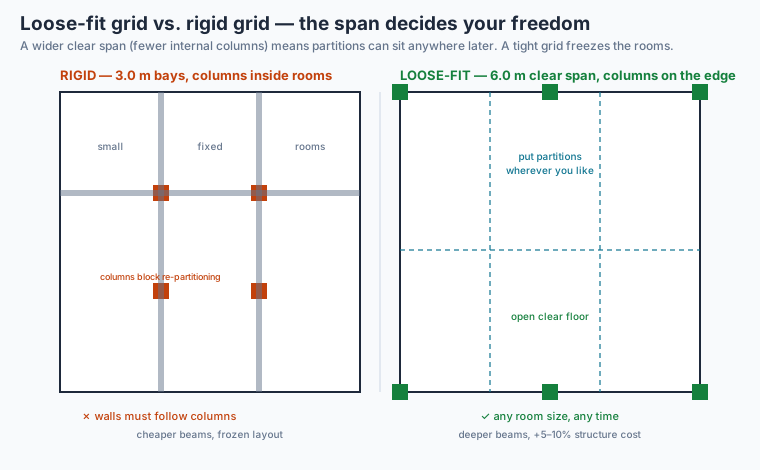
Figure 3: A rigid 3.0 m grid forces walls to follow columns and freezes the room sizes. A loose-fit 6.0 m clear span puts columns on the edges and leaves an open floor that partitions can divide any way you choose later.
For a typical Indian residential frame, the trade-off looks like this. A clear span of around 6 m (versus a tight 3–3.6 m bay) lets you place full-width rooms and re-partition freely; it usually means a deeper beam (say 450–600 mm) and somewhat more steel, adding roughly 5–10% to the bare structural cost — a small fraction of the whole project, and a one-time payment that buys decades of layout freedom.
A few realities to hold:
- In an apartment you do not control the grid — the builder set it. There, flexibility comes almost entirely from non-structural partitions and pocket doors (Sections 3–5), so identify which walls are removable before you buy or renovate.
- In your own independent house or plot, the grid is yours to choose, and this is the single highest-leverage flexibility decision you will make. Discuss clear spans with your structural engineer at the very first design meeting, not after the plan is frozen.
- Wider spans pair naturally with flat slabs or beam layouts that keep ceilings clean, which also helps if you later want to run new services across the floor.
7. Plan for a future wall — and a future floor
Flexibility runs in two directions: you may want to divide a space later, or extend the home upward. Both are cheap to provision and brutally expensive to retrofit.
Plan-for-a-future-wall. Where you can foresee a partition going up one day — splitting a large child's room into two as a second child grows, or carving a study out of a wide bedroom — drop the groundwork now. That means a power point and a switch loop, plus a lighting point, positioned where the future wall will land, and a note on the drawing. When the wall goes up, it already has a light and a socket on each side; without provisioning, you are chasing conduit across a finished room.
Vertical expansion provisioning. For independent houses, the costliest future change is adding a floor — and it is the one most worth provisioning. Designed in from the start, it costs little. Retrofitted, it can mean strengthening foundations and columns that were never sized for the extra load.
- Foundation and column design for the future floor: ask your engineer to size the footings and column steel for the floor you might add, even if you build only the lower floors now. This is the big-ticket provision and the one you cannot fake later.
- A staircase that already reaches the roof, or at least a planned, unobstructed location for it, plus a roof access point. Stairs squeezed in after the fact eat usable area and rarely sit well.
- A terrace slab cast to take a future floor, with starter bars (dowels) left projecting from the columns and protected, so the next floor ties in structurally.
- Spare capacity in the riser — water, drainage and an electrical sub-main run up to roof level, capped, so the future floor plugs in.
Before you bank on adding a floor, check your local FSI/FAR and building byelaws and any society or RWA rules — provisioning the structure is pointless if regulations cap your height. Confirm the permissible built-up area first, then provision to it.
8. Cost: design flexibility in now vs. retrofit it later
The entire case for flexible design is economic. Almost every flexible feature is cheap as a provision and expensive as a retrofit, because retrofit means breaking finished surfaces, re-routing services and living through the dust. The table below uses representative 2026 figures for a mid-spec home in an Indian metro or large tier-2 city; treat them as order-of-magnitude, not quotations.
| Flexible feature | Cost to provision now | Cost to retrofit later | Why the gap |
|---|---|---|---|
| Capped plumbing stub-out for a future bathroom | ₹8,000–20,000 | ₹1.5–2.5 lakh | Retrofit breaks the slab/wall and re-runs drainage |
| Spare 16 A circuit to a convertible room | ₹3,000–6,000 | ₹25,000–60,000 | Retrofit chases conduit across finished walls |
| 900 mm clear doors (vs 750 mm) throughout | ₹0–8,000 | ₹40,000–90,000 per door | Widening means rebuilding the wall and lintel |
| Pocket-door cavity (per opening) | ₹6,000–15,000 | ₹50,000–1.2 lakh | Retrofit means opening the wall and re-finishing |
| Knock-out panel (serviceless) in a partition | ₹0 (just routing) | n/a (the saving is at demolition time) | Removing a normal partition with services in it can cost 5–10× a clean knock-out |
| Future-wall power + light point | ₹2,000–5,000 | ₹20,000–45,000 | Retrofit re-runs conduit through a finished room |
| Foundation/columns sized for a future floor | 2–5% of structure cost | 30–60% of a new floor's cost, if possible at all | Strengthening existing footings is invasive and sometimes impossible |
The pattern is consistent: provisioning costs are in the thousands; retrofits are in the lakhs, plus weeks of disruption. A useful planning discipline is to list every change your family might plausibly face over twenty years, mark each as provision now or accept the retrofit risk, and price the provisions — they almost always total a small, comfortable fraction of the build. Our interior cost calculator and the smart-home cost calculator help you sanity-check those numbers against your own city and finish level.
9. A flexibility checklist for your design meeting
Flexibility is decided in the first few design conversations, while the plan is still on paper and everything is free to move. Take this list to your architect and engineer:
- Grid first. Ask for the widest clear span your budget allows (target ~6 m in an independent house) and confirm which walls in the plan are non-structural.
- Mark the removable walls and the knock-out panels on the drawing, and keep services out of every one of them.
- Pick one convertible room near the social zone and give it the full kit: 900 mm door, capped plumbing stub-out, spare circuit, level floor, daylight.
- Decide pocket/sliding-door locations now so the wall cavities are built in.
- Drop future-wall power and lighting points wherever a partition might rise later.
- Provision for the future floor — foundation and column steel, stair location, terrace dowels, capped riser — after confirming FSI and society rules.
- Keep the expensive layer fixed and the cheap layer loose: structure and services planned for permanence; furniture and partitions chosen for change.
Do this, and your home stops being a snapshot of the family you are today. It becomes a frame that fits the family you will be — at every stage, without the dust.
Sources & further reading
- National Building Code of India 2016 (NBC), Bureau of Indian Standards — Part 3 (Development, Open Spaces) and Part 4/8 for partitions, openings and means of access; basis for door widths and circulation.
- IS 456:2000, Plain and Reinforced Concrete — Code of Practice (BIS) — design of RCC frames, columns and beams; the basis for sizing structure for future loads.
- IS 1893 (Part 1):2016, Criteria for Earthquake Resistant Design of Structures (BIS) — why structural changes (including removing walls or adding floors) need engineering review.
- Ernst Neufert, Architects' Data — standard human dimensions and room/furniture clearances behind the convertible-room sizing.
- Alex Gordon / RIBA, "Long Life, Loose Fit, Low Energy" (1972) — the founding articulation of loose-fit, adaptable building design.
- Stewart Brand, How Buildings Learn (1994) — the "shearing layers" idea (structure, services, space plan, stuff change at different rates).
- Local municipal building byelaws and state FSI/FAR regulations — always confirm permissible height and built-up area before provisioning a future floor.
Pairs with the pillar designing homes for 2040 in India, the family-lifecycle overview future-proofing a home for changing Indian families, and multi-generational home design.
Export this guide
Related Guides — Deep-dive reading
Future-Proof Home Design for Indian Families
Designing today for the family you will be in 10–20 years — flexibility, services and adaptability
Home PlanningDesigning Adaptable & Universal-Design Homes
Accessibility, Aging-in-Place, and the Multi-Stage Family — Code, Anthropometrics, and Plan-Stage Discipline for Indian Residential Architects
Room PlanningSpace-Efficient Homes — A 2026 Working Reference for Compact Indian Apartments
Five spatial multipliers · Floor plan tricks · Dual-purpose furniture
Room PlanningRelated Tools — Try Free
Apartment Interior Planning Checklist
51-item checklist across structural, ceiling, lighting, furniture, storage, electrical, kitchen, bathroom.
ChecklistCross-Ventilation Analyzer
Estimate airflow and air changes per hour (ACH) from room size, window areas, layout, and local wind — with NBC 2016 Part 8 compliance check.
Ventilation CalculatorApartment Furniture Size Chart
Standard furniture dimensions for Indian apartments — sofas, beds, tables, dining, storage.
Reference Chart