
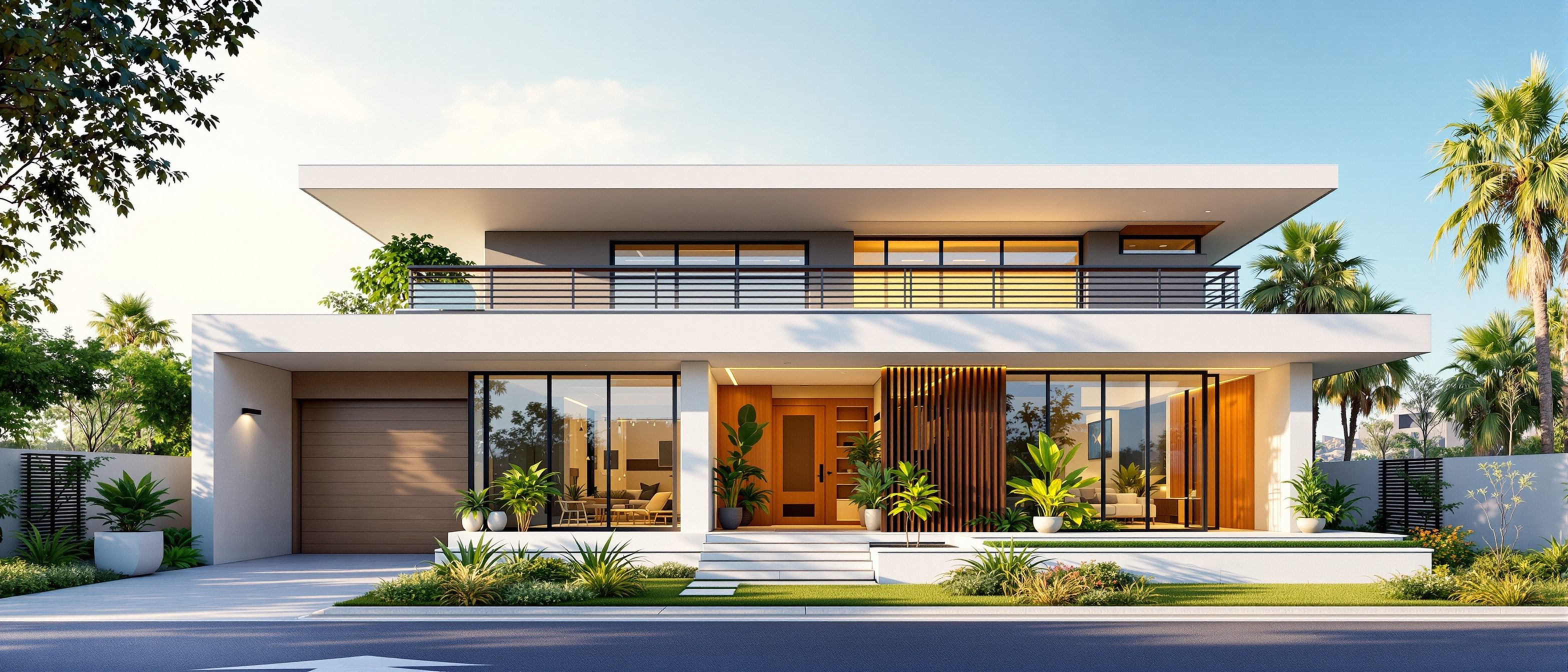
Climate-Adaptive Homes for India
Designing a home that stays liveable as the climate worsens over its lifespan
The home you pour your savings into in 2026 is a 40-year decision. The walls, the slab, the plinth level, the orientation of the windows — none of these get cheaper or easier to change once they exist. And the climate those walls will stand against is not the climate of your childhood. India's mean temperature has already risen about 0.7 degrees C since 1900, the India Meteorological Department logs more frequent and longer heatwaves almost every year, and the monsoon is delivering the same annual rainfall in fewer, fiercer bursts — the cloudburst that floods a colony in two hours rather than the steady three-day drizzle.
So when an engineer sizes your rainwater downpipe for "average Pune rainfall," or a contractor pours a plinth 150 mm above the road because that is what the neighbours did, they are designing for the past. The question this guide answers is different: what does it cost to design your home for the heatwave of 2040 and the cloudburst of 2035, rather than the gentle averages of 2010?
The good news is that most climate-resilience moves are cheap when poured into the original design and ruinously expensive — or impossible — to retrofit. Adding 50 mm of roof insulation during construction costs a few thousand rupees; air-conditioning a top floor that bakes every May costs that much every single summer, forever. This is the cluster's core idea applied to weather: provision for the extreme now, because you cannot raise a plinth, thicken a wall, or re-orient a window after the house is built.
A climate-adaptive Indian home is one engineered to stay safe and liveable through the worst week of its 2040 weather — a multi-day heatwave during a power cut, a cloudburst that floods the street, a summer when the municipal tap runs dry — using passive design first and machines only as backup.
This builds directly on present-day passive comfort. If you have not yet read Passive Design for India's Climate Zones, Designing for the Indian Climate and Climate-Responsive Courtyard Homes, start there — they teach you to keep a house comfortable in today's average year. This guide takes those same principles and dials them up for the worsening extreme.
1. Design for the heatwave of 2040, not the average of 2010
The single biggest comfort failure in new Indian homes is a top floor or west room that becomes uninhabitable in peak summer, forcing a permanent AC habit. As peak temperatures climb past 45 degrees C in more cities — Delhi, Nagpur, Ahmedabad, Jaipur and increasingly the Deccan towns — that failure compounds. The fix is not a bigger AC; it is a building envelope that resists heat so well the AC barely runs.
Three envelope moves do most of the work, and all three are far cheaper at construction than as retrofits:
- A cool or reflective roof. A high-SRI (Solar Reflectance Index) white coating or china-mosaic finish reflects sunlight before it becomes heat. The Bureau of Energy Efficiency's Eco Niwas Samhita (the residential energy code, ECBC-R) treats roof performance as the highest-leverage element because the roof takes the most direct sun. A reflective roof can cut top-floor surface temperatures by 5 to 8 degrees C.
- Roof and wall insulation plus thermal mass. 50 mm of extruded polystyrene or rockwool under the roof slab, and walls with real mass (230 mm brick, AAC block, or a cavity), slow heat to a crawl. Thermal mass is what lets a house coast through a power cut: the structure stays cool for hours after the grid drops.
- Deeper shading and smaller west glazing. Push chajjas and overhangs deeper, and shrink west-facing glass — the west sun is the cruellest in an Indian summer. Glazing you can shade today will be glazing you bless in 2040.
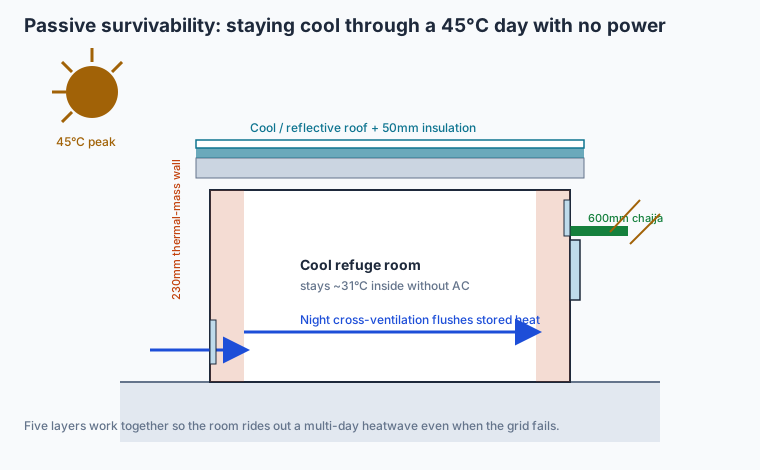
Figure 1: Five envelope layers — cool roof, insulation, thermal-mass walls, deep shade, and night cross-ventilation — let a room ride out a multi-day heatwave even when the grid fails.
Eco Niwas Samhita sets a Residential Envelope Transmittance Value (RETV) cap of 15 W/m² for most of India's hot climate zones. Designing comfortably under it is the simplest objective benchmark for a heat-resilient envelope — ask your architect to compute it.
2. Passive survivability: stay safe for days without power
Climate extremes and grid stress arrive together. The week your city hits 46 degrees C is exactly the week the overloaded DISCOM sheds load and the transformer trips. A climate-adaptive home must therefore offer passive survivability — the ability to keep a room safe for occupants for several days with no electricity at all.
This is a resilience concept borrowed from building codes in heat-prone regions abroad, and it matters acutely in India where the elderly and the very young die in heatwaves. The ingredients are the same envelope layers from Section 1, plus two design choices:
1. A designated cool refuge room. One ground-floor or north-side room with maximum thermal mass, minimum west glazing, a ceiling fan on the inverter circuit, and good cross-ventilation. In a multi-day outage the household retreats here. It should stay below roughly 31 to 32 degrees C even when it is 45 outside — survivable, where an un-shaded top room could exceed 40.
2. Night cross-ventilation by design. Operable openings positioned low on the cool side and high on the warm side flush the day's stored heat out overnight, so the thermal mass starts each morning cool. This only works if the windows are placed for airflow, not just for the view — another thing you cannot fix later.
A ceiling fan draws 50 to 75 W; a single inverter battery can run two fans and some lights for the whole hottest part of a power cut. The pairing of a heat-resistant envelope with a small backup is what turns a dangerous outage into a merely uncomfortable one. (For sizing that backup off solar, see Section 6.)
3. Flood and intense-rain resilience
The monsoon's character has shifted from steady to spiky. The same total rainfall now arrives in violent cloudbursts that overwhelm civic drains and flood streets that "never used to flood." Chennai 2015, Bengaluru 2022, and the near-annual waterlogging of Gurugram and Mumbai are the new baseline, not freak events. Your home has to shed water it was never historically asked to handle.
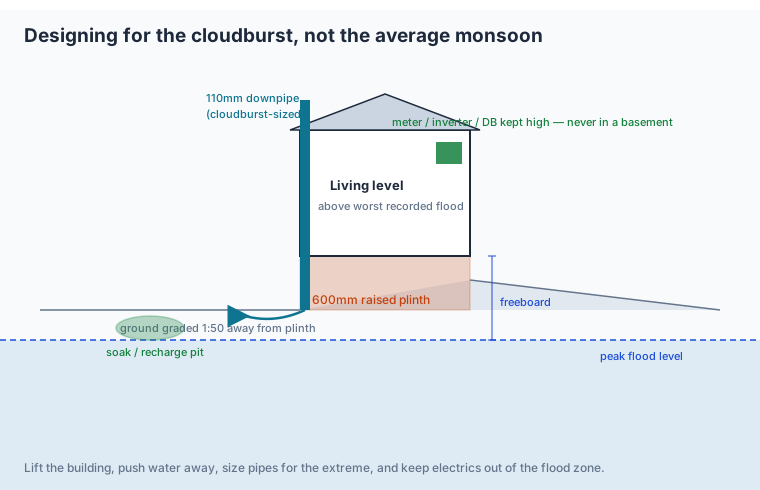
Figure 2: Lift the building on a generous plinth, grade the ground to push water away, size downpipes for the cloudburst, and keep every electrical service above the worst recorded flood level.
Five moves, in rough order of importance:
- A generous raised plinth. Set the finished floor at least 450 to 600 mm above the highest point of the abutting road, and above the worst flood level your locality has recorded. The National Building Code treats plinth height as a basic safeguard; in flood-prone wards, go higher. Raising a plinth after the slab is poured is effectively impossible.
- Grade the plot to drain away from the house. A 1:50 fall on paving and soil around the building, leading to a drain or a soak pit, keeps sheet water moving away rather than ponding against the walls.
- No critical services in basements or at ground level. Never put the inverter, main DB, gas geyser, or pump in a basement. Mount the meter, distribution board and inverter battery on a wall above the flood line. A flooded basement is the single most expensive monsoon failure.
- Cloudburst-sized downpipes and waterproofing. Size rainwater downpipes for a short, intense burst, not the seasonal average — 110 mm pipes where a builder would default to 75 mm cost a few hundred rupees more and prevent roof ponding. Pair this with proper terrace and sunken-area waterproofing (a 7 to 10 year membrane, not just a cement coat).
- Flood-tolerant ground-floor finishes. In genuinely flood-exposed plots, choose tile and concrete over wood and gypsum at ground level, so a one-day inundation cleans up instead of writing off the floor.
4. Water resilience: harvest, store, recharge, reuse
The flip side of too much water in two hours is no water for two weeks. Erratic monsoons and falling water tables mean municipal and borewell supply is increasingly unreliable — Bengaluru's 2024 water crisis is the warning every Indian city is heading toward. A climate-adaptive home treats every drop of rain as an asset to be used four times.
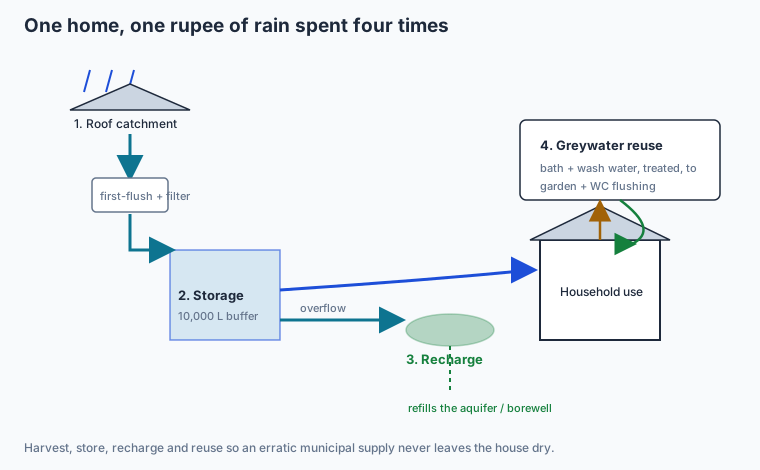
Figure 3: Harvest from the roof, store a buffer, recharge the aquifer with the overflow, and reuse treated greywater — so an erratic supply never leaves the house dry.
The cycle has four stages, each cheap to build in and disruptive to add later:
1. Rainwater harvesting. Roof catchment through a first-flush diverter and filter. Most metros (Bengaluru, Chennai, Delhi) already mandate it above a plot-size threshold under their building bye-laws — so build it well rather than tokenistically.
2. Storage buffer. An underground or overhead tank sized to bridge a supply gap — even 10,000 litres turns a multi-day municipal failure into a non-event.
3. Aquifer recharge. Direct overflow into a recharge pit or shaft so it refills the groundwater your borewell depends on, rather than running into the street.
4. Greywater reuse. Bath and wash water, lightly treated, reused for the garden and WC flushing — this alone can cut fresh-water demand by 30 to 40 percent. The plumbing for it (a separate greywater line) costs almost nothing in a new build and means re-piping later.
For the plumbing and tank-sizing logic alongside other services, the broader provisioning argument is laid out in Future-Proof Home Design for Indian Families.
5. Material and finish durability against humidity and heat
A resilient envelope is wasted if its finishes rot in five years. Worsening heat-humidity swings — hotter dry seasons, more intense wet seasons — punish the wrong materials hard. Choose for the 2040 climate:
- Exterior: mineral or silicone-based exterior paints that breathe and resist UV over cheap acrylic; treated or naturally durable wood, or fibre-cement and aluminium for exposed elements, over untreated timber that warps in humidity.
- Roof and terrace: a UV-stable, elastomeric waterproofing membrane with a 7 to 10 year warranty, not a one-season cement-based coat.
- Interior in humid zones: rust-resistant SS-316 hardware near the coast, anti-fungal paints in bathrooms, and full-body vitrified tile or stone over moisture-sensitive engineered wood at ground level.
The cost gap between a budget finish and a climate-durable one is usually 15 to 30 percent at purchase — and the durable choice routinely lasts two to three times longer, so it is cheaper per year of service in the climate that is coming.
6. Backup power and a solar-plus-battery spine for grid stress
Grid stress is a climate problem: every extra degree drives air-conditioning demand, which strains the DISCOM exactly when generation is also stressed, so the longest power cuts now coincide with the hottest days. The resilient answer is on-site generation plus storage.
You do not have to install solar and batteries on day one. You have to provision for them so that adding them later is plug-and-play: a clear, unshaded, correctly-oriented south-facing roof area; a conduit run from roof to the electrical room; space and a mounting point for an inverter and a battery bank above flood level; and a few essential circuits (fans, lights, the fridge, the cool-refuge room) wired to a separate backup distribution board.
The full design of that roof and wiring spine is covered in Solar-Ready Home Design for India and Future-Proof Wiring Systems for Indian Homes; the smart-controls layer that lets you shed non-essential loads during an outage is in Smart Infrastructure Planning for Indian Homes. You can estimate the backup electronics spend with the smart-home cost calculator and sanity-check the circuit safety with the electrical safety checklist.
7. The provision-now versus retrofit-later ledger
The whole climate-resilience case rests on one asymmetry: nearly every move is an order of magnitude cheaper poured into the original build than bolted on after. The numbers below are indicative all-India ranges for a mid-sized independent home (2026 rupees) — treat them as ratios, not quotes.
| Resilience measure | Cost to provision now | Cost to retrofit later | Why later is worse |
|---|---|---|---|
| 50 mm roof insulation + cool coating | ₹25,000–₹60,000 | ₹1,20,000+ (false ceiling / re-coat) | Reworking a finished roof; lifetime AC bills meanwhile |
| 600 mm raised plinth | A few thousand (design choice) | Effectively impossible | Cannot lift a built slab |
| Cloudburst-sized 110 mm downpipes | ₹2,000–₹6,000 extra | ₹20,000+ + chasing walls | Breaking finished walls to re-run pipe |
| Rainwater harvest + recharge pit | ₹40,000–₹90,000 | ₹1,00,000–₹1,80,000 | Digging up finished landscape |
| Separate greywater line | ₹10,000–₹25,000 | ₹80,000+ (re-plumb) | Opening floors and walls |
| Solar + battery conduit and space | ₹8,000–₹20,000 | ₹40,000+ in chasing + a worse layout | No clean cable path; shaded or wrong-facing roof locked in |
A few lakh of foresight at construction routinely prevents ten to twenty lakh of retrofit and a lifetime of running cost. That is the entire argument for building climate-adaptive from the start.
8. Climate-zone framing: tune the priorities to where you build
India's five NBC climate zones do not face the same threats, and a resilient design weights its budget toward the local extreme. Read this alongside the zone-by-zone comfort logic in Passive Design for India's Climate Zones.
| Climate zone (example cities) | Sharpest worsening threat | Where to spend resilience budget first |
|---|---|---|
| Hot & Dry (Jaipur, Ahmedabad, Nagpur) | Extreme dry-heat peaks, water stress | Cool roof, heavy thermal mass, deep shade, water storage |
| Warm & Humid (Chennai, Mumbai, Kochi) | Cloudburst flooding, humidity, cyclones | Raised plinth, drainage, durable finishes, cross-ventilation |
| Composite (Delhi, Lucknow, Bhopal) | Both heat extremes and urban flooding | Balanced envelope plus full flood + water package |
| Temperate (Bengaluru, Pune) | Erratic supply, sudden urban floods | Rainwater harvest, recharge, plinth, modest insulation |
| Cold (Shimla, Leh) | Wider temperature swings, freeze events | Insulation, solar gain, frost-proof plumbing |
The home that survives its zone's worst week in 2040 is not built from exotic technology. It is built from a generous plinth, a reflective insulated roof, real thermal mass, deep shade, water that is caught and reused, electrics kept high and dry, and a small solar-backed spine to ride out the dark hours — every one of them a decision made before the foundation is poured.
Sources & further reading
- Bureau of Energy Efficiency, Eco Niwas Samhita (Energy Conservation Building Code for Residential Buildings, ECBC-R) — RETV and roof performance limits.
- Bureau of Indian Standards / National Building Code of India (NBC 2016) — plinth, drainage, and rainwater provisions.
- India Meteorological Department (IMD) — heatwave frequency and monsoon variability bulletins.
- Ministry of New and Renewable Energy (MNRE) — rooftop solar and net-metering guidance.
- Central Water Commission and CGWB — groundwater status and rainwater-recharge norms.
- State and municipal building bye-laws (BBMP, CMDA, DDA) — mandatory rainwater-harvesting thresholds.
Pairs with the pillar Designing Homes for 2040 in India, and the siblings Solar-Ready Home Design for India and Future-Proof Home Design for Indian Families.
Export this guide
Related Guides — Deep-dive reading
Designing a Naturally Energy-Efficient Indian Home
Comfort first, gadgets last — passive design, orientation, insulation, ventilation and the climate wisdom that cuts Indian energy bills
SustainabilityEnergy-Efficient Facades in India: How the Building Skin Cuts Your Cooling, Heating & Lighting Bills
How a building facade drives cooling, heating and lighting energy in India, the three levers of solar-heat-gain control, insulation and daylighting, U-value, SHGC, VLT and WWR in plain terms, ECBC and Eco-Niwas expectations, and real Indian green buildings.
Building FacadesPassive Cooling Strategies for Indian Homes
How to keep a home cool without (much) air-conditioning — the climate-smart design that cuts bills and heat
Design EducationRelated Tools — Try Free
Rainwater Tank Sizer
How big should your rainwater tank be? Computes annual harvest, recommended tank capacity in litres, water-bill savings, and payback — for 10 Indian cities.
RWH CalculatorCross-Ventilation Analyzer
Estimate airflow and air changes per hour (ACH) from room size, window areas, layout, and local wind — with NBC 2016 Part 8 compliance check.
Ventilation CalculatorBrise-Soleil Visualizer
Interactive horizontal-louvre cut-off angle calculator — sun altitude, louvre depth, and spacing inputs with a live shadow preview. Computes θ = arctan(spacing/depth) for façade shading, ECBC envelope compliance, hospital daylight design, and tropical sun-control detailing.
Sun Shading Tool