
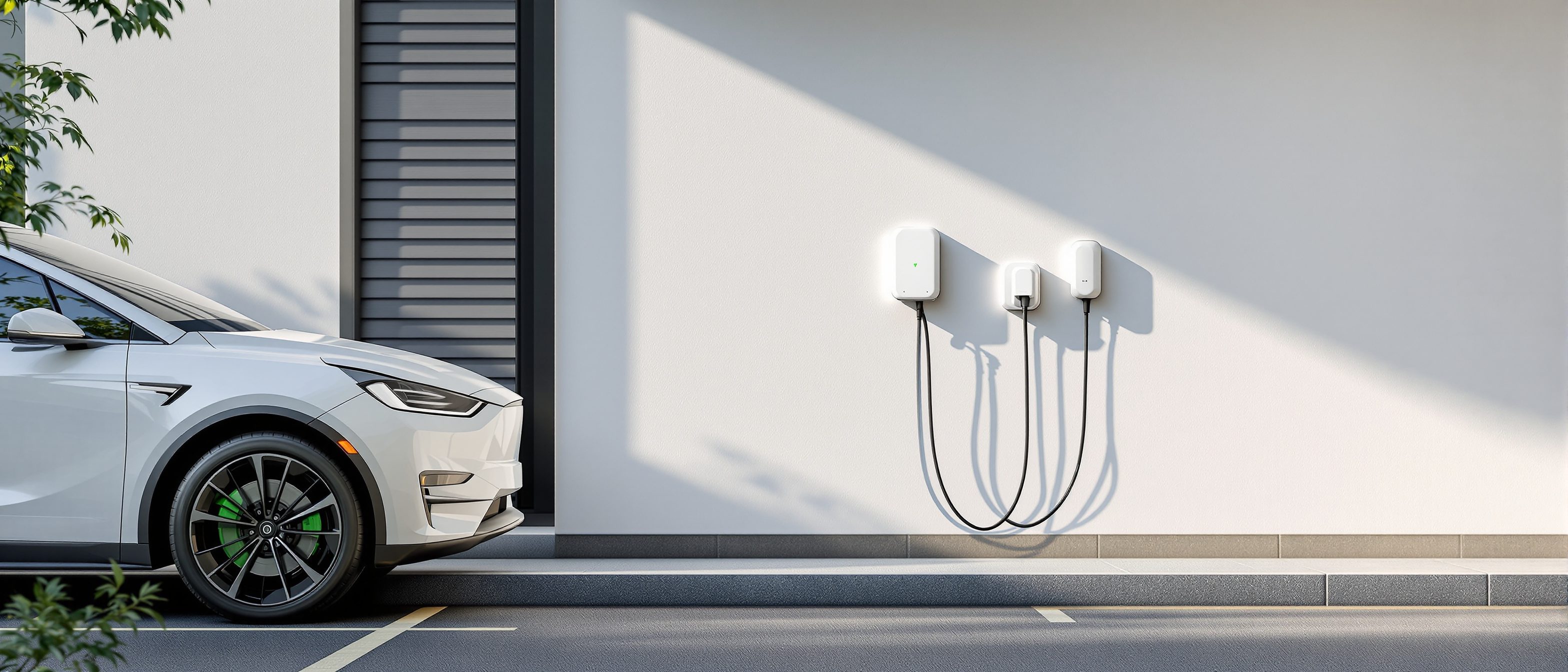
EV-Ready Home Design in India
Wire your home today to charge an electric car tomorrow, without breaking a single wall.
Walk into almost any new home being built in India in 2026 and you will find a parking bay that was designed for a petrol car. There is a tap for washing it, a point for a tube-light, perhaps a 5-amp socket near the gate for a pressure washer. What is almost never there is the one thing that bay will need within the next decade: a way to charge a car overnight.
The shift is not hypothetical. India crossed two million electric vehicle sales in a single year, the FAME-II scheme and state subsidies pulled prices down, and every major carmaker now sells a battery model. The honest question for anyone building or renovating a home today is not if an EV will park here, but when. And the cruel arithmetic of construction is that the groundwork costs a few thousand rupees while the slab is open, and ten times that once the home is finished and you are chasing finished walls to lay a cable.
This guide is about getting ahead of that. Not about which car to buy, and not about turning your garage into a forecourt of fast chargers, but about the small, cheap, invisible electrical decisions that make your home ready — so that the day you sign for an EV, charging it is a clean afternoon installation instead of a demolition project.
An EV-ready home is one where the wiring path, the spare circuit, and the electrical headroom are already in place, so adding a charger means pulling a cable and mounting a box — never breaking a wall.
1. The only three charger speeds you need to understand
Forget the marketing. For a home, there are effectively three things you can plug a car into, and the difference between them is simply how many kilowatts they push.
A Level-1 portable charger is the cable that comes in the boot of the car. It plugs into an ordinary 15-amp wall socket — the round-pin three-pin point you use for an air conditioner — and delivers about 2.3 to 3.3 kW. That is slow: a typical 40 kWh car battery takes ten to fourteen hours to fill, which means it only works if the car sits all night. It needs no special installation, but a portable charger drawing 12-15 amps continuously for half a day is exactly the kind of load an old, loose socket was never built for. More on that in the safety section.
A Level-2 wallbox is the proper home charger: a fixed unit on the wall with a Type 2 socket, fed by its own circuit. On a normal single-phase home supply it delivers 7.4 kW (32 amps at 230 volts) and refills that same battery in roughly five to six hours — comfortably overnight, with margin. This is the sweet spot for an Indian home, and it is what "EV-ready" should be designed around. If you have a three-phase connection (common in larger villas), a wallbox can go to 11 kW or 22 kW and charge in two to three hours.
DC fast charging — the 25 kW to 60-plus kW units you see at highway stops and malls — is not a home product. It needs an industrial supply and costs lakhs. You will use it on a road trip; you will not install it at home. Plan your house around the wallbox and ignore the fast-charger noise.
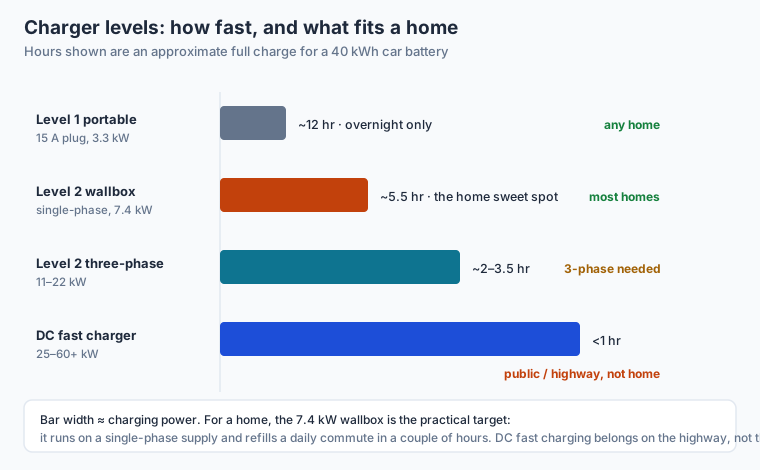
Figure 1: The practical home target is the 7.4 kW single-phase wallbox; DC fast charging belongs on the highway, not the wall.
| Charger | Power | Supply | Full charge (40 kWh) | Home verdict |
|---|---|---|---|---|
| Level-1 portable | 2.3-3.3 kW | 15 A socket | 10-14 hr | Backup only; stresses old sockets |
| Level-2 single-phase | 7.4 kW | dedicated 32 A | 5-6 hr | The home target |
| Level-2 three-phase | 11-22 kW | three-phase | 2-3.5 hr | Villas with 3-phase supply |
| DC fast | 25-60+ kW | industrial | under 1 hr | Public only, not home |
2. Why a dedicated circuit is non-negotiable
The single most important idea in home EV charging is this: a charger gets its own circuit, running unbroken from the distribution board (DB) to the parking, shared with nothing else.
This is not fussiness. A 7.4 kW wallbox draws 32 amps for hours at a stretch — a sustained load unlike anything else in a house. A geyser pulls more, but for fifteen minutes. An air conditioner cycles on and off. The EV charger sits at full draw for five hours straight. Run it on a circuit shared with the bedroom plug points and you get nuisance trips, warm cables, and a breaker that ages fast. Give it a dedicated breaker and a correctly sized cable, and it simply works, night after night.
IS 732, the national wiring code, and the National Building Code both require that a fixed appliance of this size has its own protected final circuit. An EV charger is a fixed appliance. Treat it like the geyser circuit it resembles — only bigger and longer-running.
Dedicating the circuit also future-proofs metering. If you ever want to track EV consumption separately — useful in a society, useful if your DISCOM offers a special EV tariff — a separate circuit is the only clean way to put a sub-meter on it.
3. The cable run: from meter to parking
Here is where the physical home design matters. The charger lives at the parking; the power comes from the DB inside the house. The cable between them is the EV circuit, and two things govern it: the conduit it runs through and the gauge (thickness) of the copper.
The conduit is just a pipe — typically 25 mm PVC — cast into the wall or slab during construction. The cable is pulled through it. If the conduit is laid now, adding or upgrading the cable later is trivial. If it is not, you are cutting channels into finished walls.
Gauge is set by two things: the current (32 amps for a 7.4 kW charger) and, crucially, the distance. Electricity loses voltage over a long run, and IS 732 limits the total drop to about 5%. A villa with the DB ten metres from the parking is fine on 4 sq mm copper. A flat where the board is on the third floor and the parking is a basement bay forty metres away needs a much heavier 10 sq mm cable to keep the voltage up at the car. Get this wrong and the charger throttles itself or trips.
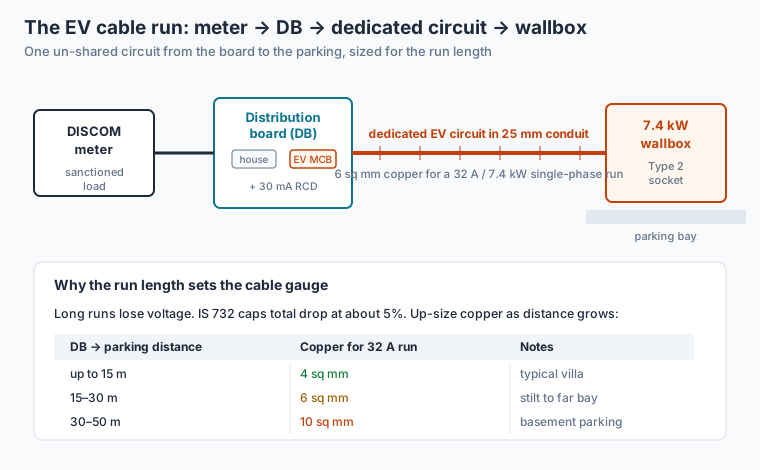
Figure 2: One unbroken circuit from the board to the parking, with copper gauge sized to the run length to hold voltage at the car.
The practical lesson: measure the real cable route from your DB to your parking bay before construction, and tell your electrician it is for a 32-amp EV charger. That single instruction sizes the conduit and reserves the right gauge — and costs almost nothing to honour while the walls are open.
4. Sanctioned load: what a 7.4 kW charger does to your connection
Your electricity connection has a sanctioned load — the maximum the DISCOM has agreed to supply, written on your bill in kW. A typical 2-3 BHK home runs on a sanctioned load of 4 to 7 kW. Now add a 7.4 kW charger.
The charger alone can equal or exceed your entire existing sanctioned load. If your home is sanctioned for 5 kW and you switch on a 7.4 kW charger while the ACs and geyser are running, you will trip the main — or, worse, draw more than your contract and invite a penalty. So an EV almost always means a sanctioned-load enhancement: an application to your DISCOM to raise the agreed load.
This is also where the single-phase vs three-phase question lands. A single-phase connection in India is generally enough for a 7.4 kW wallbox plus a normal home, if your sanctioned load is raised to roughly 10-12 kW. But if you want an 11 kW or 22 kW charger, or you simply have a large house with heavy loads, you will need a three-phase connection — three live wires instead of one, which the DISCOM provides for larger sanctioned loads. Converting single-phase to three-phase later means new service cable, a new meter, and a new DB arrangement. If you are building a villa and there is any chance of a future second EV or a high-power charger, ask for three-phase from the start; the incremental cost during construction is far smaller than the conversion later.
| Scenario | Connection | Sensible sanctioned load | Charger it supports |
|---|---|---|---|
| Small flat, one EV | single-phase | 8-10 kW | 3.3 kW, or 7.4 kW with care |
| Standard home, one EV | single-phase | 10-12 kW | 7.4 kW wallbox |
| Large villa, one-two EVs | three-phase | 15-20 kW | 11-22 kW wallbox |
The enhancement application itself is routine — a form, a small fee, often a revised security deposit. The point is to plan for it, not be ambushed by it. This is the same headroom argument made across the cluster's electrical guides; for the wider picture of building spare capacity into every circuit, see future-proof wiring systems for Indian homes.
5. The empty conduit: the cheapest insurance in the house
This is the centrepiece of EV-readiness, and it is almost absurdly cheap.
If you are building or doing major renovation, ask for three things even if you have no EV today: an empty 25 mm conduit running from the DB to the parking bay, a spare way in the distribution board (a reserved slot for an EV breaker), and a capped backbox at the parking where the wallbox will eventually go. Pull a nylon pilot string through the conduit so the future cable can be drawn in without effort. That is the whole provision.
The cost of doing this while the slab and walls are open is roughly six to twelve thousand rupees — mostly the conduit and a little labour, because the team is already chasing walls for everything else. The cost of doing the same circuit later, in a finished home, is twenty-five to sixty thousand rupees or more: chasing channels into plastered walls, surface trunking if you cannot, re-plastering, repainting, and the dust and disruption of days of work in a lived-in house. Same finished result, four to six times the price, and a fight with your spouse about the mess.
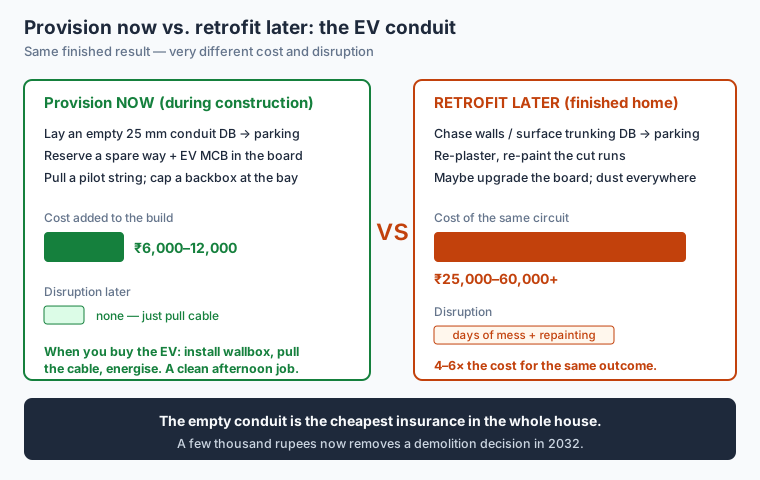
Figure 3: The empty conduit converts an expensive demolition decision in 2032 into a clean afternoon installation.
This is the cluster's signature move — provision the cheap groundwork now so the expensive upgrade later is plug-and-play. Of all the provisions you can make in a home, the EV conduit has the best ratio of trivial cost to enormous future saving. If you do only one future-proofing thing in your build, do this.
6. Earthing, RCD and the safety layer
An EV charger is the heaviest sustained load most homes will ever run, sitting outdoors near water, touched by people and a metal car. Safety is not optional.
Three things protect it. First, a proper earth — a dedicated earthing connection at the charger, bonded back to the home's earth pit. Indian earthing is often weak or shared; an EV charger demands a solid, low-resistance earth, and many wallboxes will refuse to charge if they sense a poor one. Second, an MCB (the breaker on the dedicated circuit) sized to the charger and cable — typically a 40-amp curve-C breaker for a 32-amp charger. Third, and most important, an RCD (residual current device) — the device that cuts power in milliseconds if current leaks to earth, the difference between a tingle and an electrocution. For EV charging the code calls for a Type A 30 mA RCD at minimum, and many wallboxes also need protection against DC fault current, which good chargers provide internally (a built-in Type B or RDC-DD feature). Confirm your charger's manual on this point.
Do not, as a long-term habit, charge a 7.4 kW car through a household 15-amp socket. The portable cable is fine as an occasional backup, but a domestic socket and its wiring were never rated for hours of near-full load; loose connections heat up, and overheated sockets are a real cause of fires. Run through your home's full electrical safety the same way you would for any heavy appliance — our electrical safety checklist covers the earthing, RCD and circuit-rating checks an EV circuit needs.
7. The apartment and society problem
Everything above is straightforward in a villa with your own parking and your own meter. In an apartment, the EV charger collides with the hardest part of Indian housing: shared infrastructure and the RWA.
The knot is that your car parks in common parking, but charging draws your power, and the cable has to cross common areas to get there. So three questions arise. Whose meter does the charger run on — yours, or the building's common supply (and if common, how is your usage billed)? Who approves running a cable from your flat's DB or a basement panel to your bay? And who pays for any upgrade to the building's incoming supply if many residents start charging at once?
The good news is that policy now backs the resident. The Ministry of Power's charging-infrastructure guidelines establish a right to charge — a resident may install a charging point in their allotted parking, and the RWA cannot unreasonably refuse. The cleanest technical solution is a dedicated sub-meter for each charger, wired so the resident is billed for exactly what they draw, on the DISCOM's domestic or special EV tariff. Many DISCOMs now offer single-window EV connections precisely for this.
Practically, this means: get the EV provision written into the society's electrical plan, push for a sub-metered charging point in your bay rather than an informal extension lead, and raise the question of the building's spare capacity before a dozen residents are competing for it. A planned society installs a small managed charging hub — staggered, load-balanced, sub-metered — and avoids the chaos of cables snaking across the basement. The infrastructure thinking here overlaps with the wider smart infrastructure planning for Indian homes, and the cluster's pillar on designing homes for 2040 frames why the building, not just the flat, has to be future-ready.
8. Pairing the charger with solar
The most satisfying version of home EV charging is when the sun fills the car. A rooftop solar system that already powers the home can, with the right inverter and a little scheduling, divert surplus daytime generation into the car battery — turning sunlight directly into kilometres.
This works best when the car is home in the day (work-from-home households, second cars, weekends) or when a small home battery time-shifts solar into the night. Even without that, net-metering means the units you export by day offset the units you import to charge at night, so your effective fuel cost can fall to a fraction of petrol. Some inverters and smart wallboxes now do solar-aware charging — modulating the charge rate to match the surplus so you draw nothing from the grid.
The design overlap matters: if you are sizing a solar array, account for the EV's appetite — a car driven 40 km a day needs roughly 6-8 kWh, which is one to two extra solar panels' worth of generation. Plan the two together rather than bolting the EV on afterwards. The solar-ready home design guide covers the roof, inverter and net-metering side; read it alongside this one if you intend to charge from the sun.
9. Future-proofing for a second EV and the two-wheeler
Families do not stop at one EV. The car comes first, then the electric two-wheeler, then a second car as a child starts working. The EV-ready home should leave room for all of it without a second round of demolition.
This is mostly about headroom and a slightly larger conduit. When you size the sanctioned-load enhancement, think about whether a second charger or a scooter point will follow, and ask the DISCOM and electrician whether the service and DB can carry it — often a three-phase connection is the cleaner answer for any home expecting two vehicles. When you lay the conduit, run a slightly larger one (or a second empty conduit) so a future cable for a second bay can be pulled without breaking ground again. And reserve two spare ways in the board, not one. The electric two-wheeler is the easy case — it charges happily on a normal 15-amp socket — so all it needs is a properly earthed, RCD-protected socket at the parking, which you should provide anyway.
The through-line of this whole cluster is that families and their needs change while concrete does not. The same logic that future-proofs a home for changing families applies to the garage: leave the cheap room now. An empty conduit, a spare breaker way, and an honest sanctioned-load conversation are the difference between a home that grows with you and one you have to tear into every few years.
Sources & further reading
- IS 732: Code of Practice for Electrical Wiring Installations — Bureau of Indian Standards. Final circuits, cable sizing, and the ~5% voltage-drop limit.
- National Building Code of India (NBC) 2016, Part 8 — Building Services, electrical installations. Bureau of Indian Standards.
- Charging Infrastructure for Electric Vehicles — Revised Consolidated Guidelines & Standards — Ministry of Power, Government of India. "Right to charge" in residential parking and DISCOM single-window connections.
- IS 17017 / IEC 61851 series — EV conductive charging system standards (connectors, RCD/RDC-DD protection).
- FAME-II scheme — Department of Heavy Industry, Government of India. EV adoption and charging-infrastructure support.
- Central Electricity Authority (CEA) Safety Regulations — earthing and protection requirements for installations.
- Eco Niwas Samhita (ENS) / Bureau of Energy Efficiency — for the wider context of energy-efficient, future-ready home design.
Pairs with the Designing Homes for 2040 pillar, the solar-ready home design guide for charging from the sun, and future-proof wiring systems for Indian homes for the electrical headroom behind it all.
Export this guide
Related Guides — Deep-dive reading
Future-Proof Wiring Systems for Indian Homes
Build electrical headroom now so tomorrow's loads are plug-and-play, not demolition.
Future-Ready HomesResidential Electrical Systems: The Complete Guide for Indian Homes
How the electricity in an Indian home actually works — from the utility supply and meter through the distribution board, circuits, wiring, earthing and protection, to lighting, safety, energy efficiency, smart controls, solar and backup — written so a homeowner can understand, plan and judge it, and know exactly where a licensed electrician must take over.
Electrical & WiringElectrical Fire Safety in India (2026): Overloads, Wiring and the Right Protection
Why electrical faults cause so many Indian building fires, and the fix: correct cable sizing and a properly designed board by a licensed electrician, MCB plus RCCB protection, no overloading, and never water on a live fire.
SecurityRelated Tools — Try Free
Electrical Safety & Load Audit
Home electrical audit — 10 categories, 65+ checkpoints across earthing, RCCB, MCB, wiring, switchboards, appliance circuits, DG/inverter backup.
Safety AuditRainwater Tank Sizer
How big should your rainwater tank be? Computes annual harvest, recommended tank capacity in litres, water-bill savings, and payback — for 10 Indian cities.
RWH CalculatorApartment Video Door System Planner
Enter flats, entrances, floors and guard desk for a first-pass building intercom plan — door stations, indoor monitors, guard station, the right architecture and an indicative cost band.
Building Planner