
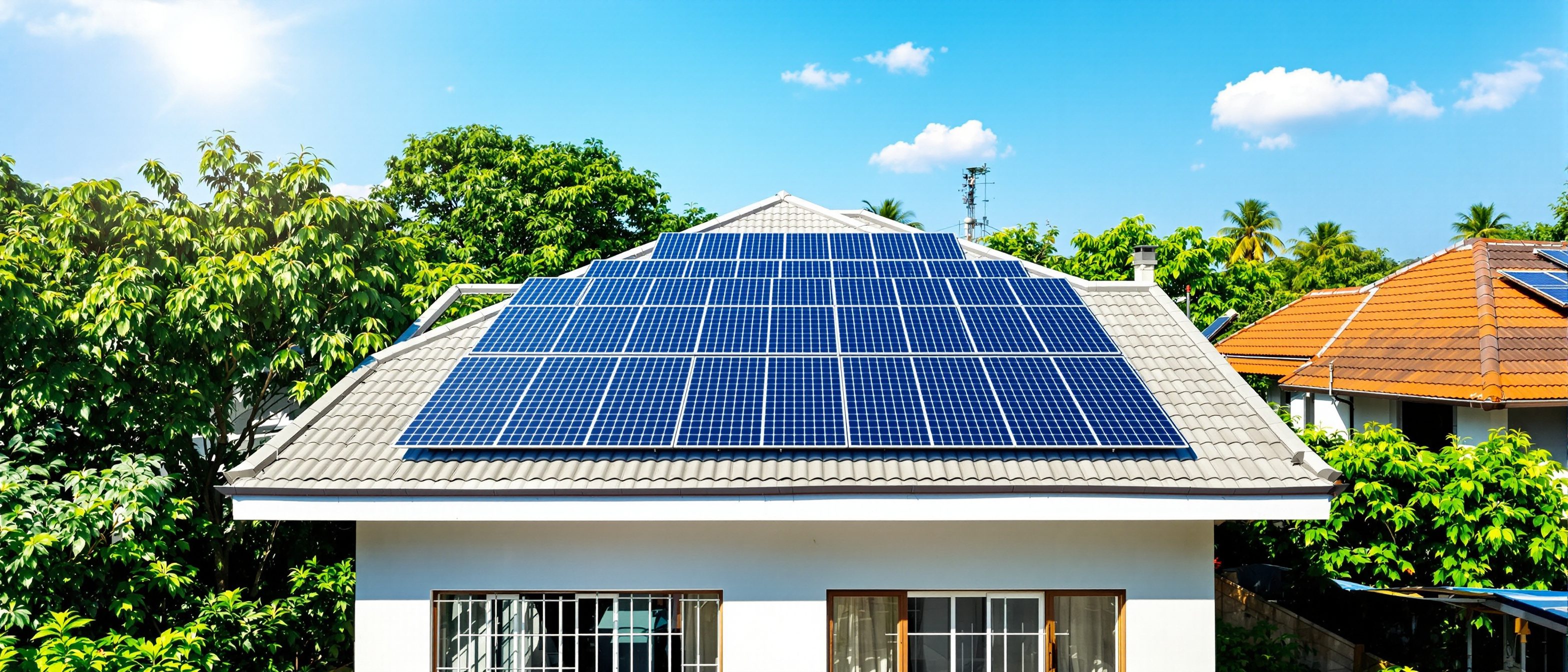
Solar-Ready Home Design for Indian Homes
Design the roof, structure and risers now so rooftop solar is a weekend job later.
Most Indian families do not put solar on the roof the day they move in. They do it three, five, sometimes ten years later, once the electricity bill has stung enough times and the subsidy paperwork feels worth the effort. By then the roof is already a parking lot of decisions: the overhead tank sits dead centre in the best sun, the stair mumty throws a shadow across the south slope, the plumber's vent pipes poke up exactly where a panel row wanted to go, and the only place to mount the inverter is a baking west wall with no spare conduit reaching it.
None of that is a solar problem. It is a design problem that was quietly locked in years earlier, when nobody at the drawing-board stage asked one question: if we ever go solar, where does it all go? A rooftop array is not fussy. It wants a clear patch of unshaded roof facing roughly south, a slab that can carry its weight, a pipe to run cables down, and a cool corner for the electronics. Every one of those is nearly free to arrange while the building is still on paper. Every one of them is expensive, dusty and compromised to fix after the house is finished.
This is the difference between a solar-installed home and a solar-ready home. You may not buy a single panel for a decade — but if the architecture is ready, that future install is a one-weekend, plug-and-play job instead of a demolition.
Solar-readiness is an architectural decision you make today — orientation, a clear roof, a load-rated slab, a cast-in cable riser and a meter cupboard — so that the solar install itself, whenever you choose it, is fast, cheap and optimal instead of a compromise bolted onto a roof that was never planned for it.
This guide is about that provisioning. If what you actually want is the should I install, and what's the payback question — system sizing, ROI, subsidies, the economics of the install itself — read its companion, Solar power for Indian homes. Here we stay upstream of that, on the drawings, where readiness costs almost nothing.
1. Why solar-readiness is an architecture problem, not a wiring afterthought
A solar array has four needs, and three of them are decided by the building, not the electrician. It needs sun on the roof (orientation and shading — set by how you place the house, the tank and the upper floors). It needs a roof that can hold it (structure — set by your slab design). It needs a path for cables and a home for the electronics (risers and a wall — set by your services layout). Only the fourth need, the panels and inverter themselves, is a pure electrical install.
So three of the four are baked in at design stage and become near-impossible to change later. This is the cluster's recurring lesson, the one we hammer in Designing homes for 2040: the cheapest version of any future upgrade is the version you left room for. Solar is the cleanest example. The provisioning costs are trivial — a conduit, a structural margin, a square metre of cupboard. The retrofit costs are not.
Provisioning principle: spend at the slab and conduit stage, not at the chasing-and-rework stage. A 50 mm pipe cast into a column costs a few hundred rupees; cutting one through a finished home later costs tens of thousands and a week of dust.
2. Orientation and tilt: aim the roof at the sun
India sits almost entirely in the northern hemisphere, so the sun tracks across the southern sky. A rooftop array delivers the most annual energy when it faces true south (not magnetic south — there is a small declination, but for homeowners, true south is the target) and is tilted up at an angle roughly equal to your latitude. Chennai (~13°N) wants a gentle tilt of about 13°; Delhi (~28°N) wants closer to 28°; Srinagar steeper still. A panel laid dead flat still works in India's strong sun, but it collects dust and standing monsoon water and loses several percent a year.
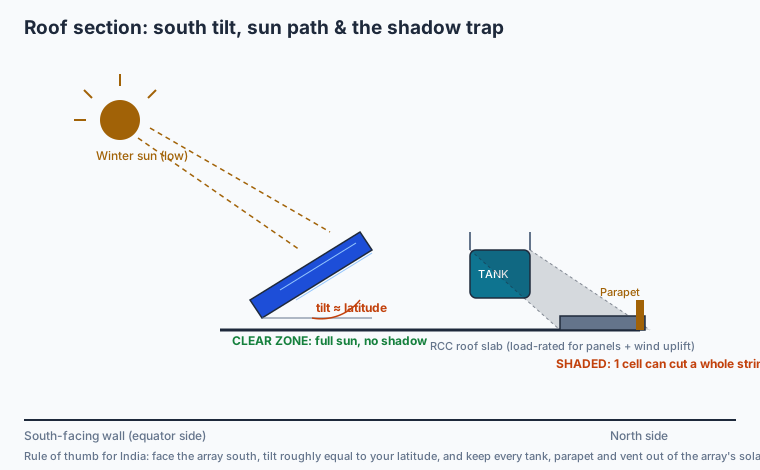
Figure 1: Face the array south, tilt it roughly to your latitude, and keep tanks and parapets out of its sun window — one shaded cell can throttle a whole string.
What this means for the design:
- On a flat RCC roof (the common Indian terrace), orientation is free — the panels sit on tilted mounting frames and you simply point the frames south. The architecture's job is only to leave the south-facing patch of terrace clear and structurally sound.
- On a sloping/pitched roof (more common in hill states, some bungalows, and pitched-tile elevations), the building itself decides the tilt and aspect. If you are designing a sloped roof and there is any chance of solar, orient the longer, lower-pitch slope toward the south. A north-facing main slope is a permanent handicap — you would be mounting panels against the grain of the roof.
If a perfect south face is impossible on your plot, do not panic: south-east and south-west faces lose only a modest single-digit percentage of annual yield. East or west costs more. North is the one to avoid.
3. Solar access: keep the roof clear and unshaded
Shading is the silent killer of rooftop solar, and it is almost entirely an architectural failure. Panels are wired in strings, and in a basic system a single shadow falling on one cell can drag down the output of every panel in that string — far out of proportion to the shaded area. This is why a casually placed tank or parapet does more damage than its size suggests.
"Solar access" is the planning idea that a roof deserves an unobstructed view of the sun across the productive part of the day (roughly 9 am to 3 pm). To protect it at design stage:
- Move the overhead tank to the north edge of the roof, or onto a dedicated low plinth on the north side, so its shadow falls away from the panel zone, never across it. The tank is the single most common shading mistake on Indian terraces.
- Push the stair mumty, lift machine room and any service block to the north as well. Their shadows then point north, away from the array.
- Plan for the neighbour's — and your own — future upper floors. If your society or plot allows an extra floor later (yours or the adjoining building's), a south-side wall going up will shade your roof. Reserve the south as low and open; build vertical mass on the north.
- Site tall trees away from the south. A sapling on the south boundary becomes a shading canopy in fifteen years. Lovely for the courtyard, ruinous for the array.
The roof plan below shows how this resolves: a reserved, unshaded solar zone on the south, every shade-casting object banished to the north as a keep-out area, and a clear path for cables.
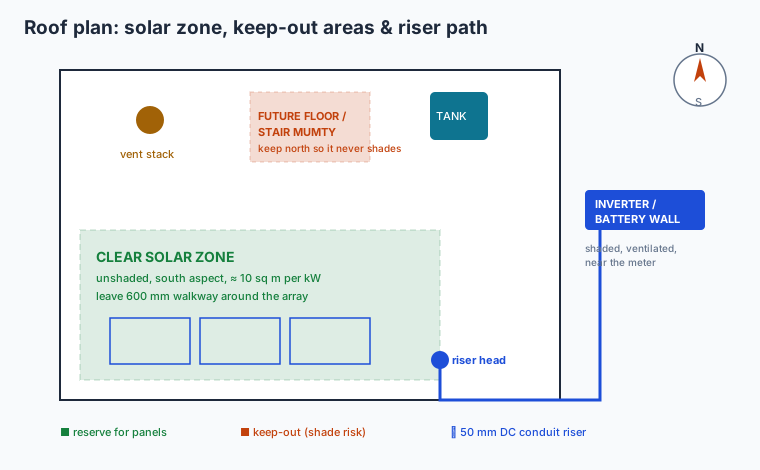
Figure 2: Reserve the unshaded south for panels, exile tanks, vents and future floors to the north, and pre-route a 50 mm cable riser to a cool inverter wall.
4. How much roof do you actually need?
A useful planning number: a standard rooftop array needs roughly 10 square metres of clear, unshaded roof per kilowatt (kW) installed, once you allow walkway and inter-row spacing. Modern panels are a little denser than that, but 10 sq m/kW is the safe figure to reserve at design stage. Add a 600 mm walkway around and through the array for installation and cleaning, and inter-row gaps on a tilted flat-roof layout so one row never shades the next.
| Array size | Clear roof to reserve | Typical home fit | Rough daily generation* |
|---|---|---|---|
| 1 kW | ~10 sq m (~110 sq ft) | Small 1-2 BHK, top-up | 4-5 units |
| 3 kW | ~30 sq m (~325 sq ft) | Typical 2-3 BHK | 12-15 units |
| 5 kW | ~50 sq m (~540 sq ft) | Large home, some AC | 20-25 units |
| 10 kW | ~100 sq m (~1,075 sq ft) | Big bungalow / EV + AC | 40-50 units |
\Indicative for a sunny Indian location; varies by city, season, tilt and shading. Use the solar power feasibility companion for proper sizing and payback.*
The design takeaway: decide the maximum array you might ever want — a number that should account for future air-conditioning, an EV, and a battery — and reserve that much clear south roof now. It is far easier to leave a terrace open than to clear it later.
5. Structure: a slab that can carry panels and resist uplift
Panels and their mounting frames are not heavy in the way a water tank is, but they add a real, permanent load the slab must be designed for. A tilted rooftop array typically adds in the order of 15-25 kg per square metre of dead load, spread across the mounting feet. On a flat roof that is mild; the bigger structural issue in India is wind uplift — tilted panels act like wings, and during a storm or cyclone the wind tries to lift the array (and whatever it is bolted to) off the roof.
Two provisioning moves at structural-design stage:
- Tell your structural engineer that solar is intended, even if the install is years away. Designing the slab and parapet anchorage to the National Building Code wind-load provisions for your zone, with the extra array dead load, costs essentially nothing extra in steel at design stage but is very hard to add later.
- Provide proper anchorage, not roof penetrations into a waterproofed slab. Ballasted (weighted) mounts or pre-planned cast-in anchor points avoid drilling through a finished, waterproofed terrace — a frequent cause of leaks when solar is retrofitted carelessly.
NBC / IS note: rooftop solar mounting in India should be designed for the wind loads in IS 875 (Part 3) for your wind zone, and the structure checked under the National Building Code 2016. Coastal and cyclone-prone zones (much of the east and west coast) need particular attention to uplift anchorage.
6. The cable riser and the inverter wall
This is the most-skipped, cheapest, highest-value piece of solar-readiness — and it is pure architecture-of-services. The DC cables from the roof array have to get down to an inverter somewhere inside or on a wall of the house, and the AC output then has to reach your main distribution board and meter.
Provision it like this:
- Cast a dedicated 50 mm (or larger) empty conduit from the roof, through the slab and down a service shaft or column, ending near where the inverter will live. An empty pipe costs a few hundred rupees at slab stage. Chasing a finished wall to run armoured solar cable later costs tens of thousands and wrecks the finishes.
- Reserve an inverter/battery wall that is shaded, ventilated and reasonably close to the meter. Inverters and batteries hate heat — a west wall in full Indian afternoon sun shortens their life. A north or internal utility-wall location, with airflow, is ideal. Leave roughly a metre of clear wall.
- Make that wall battery-ready too. A home battery (for backup during power cuts, or to store surplus solar) wants the same cool, ventilated, accessible spot. Reserving the wall now means a future battery is a mount-and-wire job. This dovetails with the inverter/UPS planning in future-proof wiring systems.
For how this conduit and DB strategy connects to the rest of the home's services, see smart infrastructure planning, and for reading the electrical drawings that should show all of this, electrical drawings explained.
7. Net-metering, the meter cupboard and PM Surya Ghar
Going solar in India almost always means net-metering: your DISCOM swaps your ordinary meter for a bidirectional meter that counts both the units you draw and the surplus units your panels export to the grid, and bills you on the net. That meter, plus the additional protection gear, needs physical space — and a cramped meter board that was sized for a plain single-phase connection becomes the bottleneck.
The architectural provisioning is simple but real:
- Leave a generous meter cupboard / board space near the entrance or boundary, with room for a bidirectional meter and a small solar AC distribution board beside the main DB. An extra 300-400 mm of board width now saves rebuilding the panel later.
- Plan for the supply phase you'll end up on. Larger arrays and EV charging often push homes to a three-phase connection; leaving conduit and board space for three-phase avoids a second upheaval. (More on this in future-proof wiring systems.)
- Know the policy backdrop. The national PM Surya Ghar: Muft Bijli Yojana scheme offers a central subsidy on residential rooftop solar, on top of net-metering, administered through your DISCOM. The exact slabs and the application portal change over time — confirm current figures before you install — but the design point is unchanged: none of the subsidy or net-metering benefit reaches you if the physical readiness (clear roof, riser, meter space) was never provided.
The DISCOM and meter side is install-stage work; your job at design stage is only to leave the room and the conduit for it.
8. Provision now vs. retrofit later: the real cost gap
Here is the contrast that should settle the argument. The solar-ready provisioning items are cheap line-items on a construction budget; their retrofitted equivalents are expensive, disruptive standalone jobs.
| Provisioning item | Do it now (at build) | Retrofit later | Why later costs more |
|---|---|---|---|
| Clear south roof zone | ₹0 — a planning decision | Shift tank + mumty: ₹40,000-1,00,000+ | Demolition, replumbing, re-waterproofing |
| 50 mm DC cable riser | ₹500-2,000 (conduit in slab) | ₹20,000-50,000 | Chasing walls/slab, redoing finishes |
| Slab load + uplift margin | ~₹0 (designed in, minimal steel) | Often not feasible | Cannot re-engineer a cast slab |
| Inverter/battery wall | ₹0 — reserve the wall | ₹10,000-30,000 | Relocate fittings, run new circuits |
| Meter / DB space | ₹2,000-6,000 (bigger board space) | ₹15,000-40,000 | Rebuild board, rewire, DISCOM rework |
| Typical total | ~₹8,000-20,000 | ~₹85,000-2,20,000 | plus dust, downtime, compromise |
The provisioning bundle costs roughly what a mid-range sofa costs, folded invisibly into a construction budget. The retrofit bundle costs several times that, arrives years later as a disruptive project, and still leaves you with a compromised layout. Provisioning is not a luxury; it is the cheapest insurance in the build.
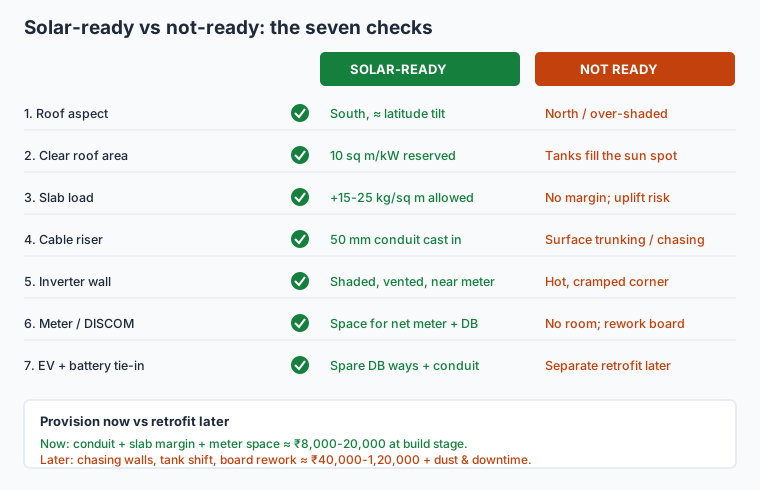
Figure 3: Seven checks separate a solar-ready home from one that will fight you later — and the provisioning bundle costs a fraction of the retrofit.
9. Pair solar-readiness with EV and the rest of the future-ready home
Solar and the electric car are natural partners: a daytime array charges an EV parked at home, and the same beefed-up electrical backbone — three-phase supply, spare distribution-board ways, fat conduits, a battery wall — serves both. If you are provisioning for one, provision for both in the same breath. The detail of charger circuits, dedicated DB ways and parking conduit is covered in the sibling guide, EV-ready home design; treat its electrical backbone and this guide's roof-and-riser work as one project.
The roof decisions also ripple into comfort and climate. A roof planned for solar is, helpfully, a roof you are already thinking about as a thermal surface — and the array itself shades the slab, cutting heat gain into the top floor. Coordinate this with passive design for India's climate zones and climate-adaptive homes, so the same roof works hard for both energy and comfort. For a sense of how all these future systems sit inside one coherent home, the umbrella view is future-proofing the Indian family home, and the integrated smart-home layer is in smart home design for India.
Run the rough numbers as you plan: a layout planner helps you check the clear roof area against the table above, and the smart home cost calculator sketches the wider electrical-upgrade budget.
A solar-ready home does not look any different from an ordinary one on handover day. The tank is just on the north side instead of the middle; there is an extra empty pipe in a shaft; the meter cupboard is a hand-width wider; the structural drawing has a line about array loads. Nothing on display, nothing wasted. But the day you decide to go solar — next year or in 2040 — the roof is waiting, clear and ready, and the install is a weekend instead of a war.
Sources & further reading
- National Building Code of India 2016 (NBC), Bureau of Indian Standards — building structure, services and rooftop installations.
- IS 875 (Part 3): Code of Practice for Design Loads — Wind Loads, Bureau of Indian Standards — basis for rooftop array uplift and anchorage design.
- Ministry of New and Renewable Energy (MNRE) — rooftop solar programme guidelines and the PM Surya Ghar: Muft Bijli Yojana residential subsidy scheme (confirm current slabs on the official portal).
- Central Electricity Authority (CEA) — grid-connected rooftop solar and net-metering technical standards and safety regulations.
- Bureau of Energy Efficiency (BEE) — Eco Niwas Samhita (ENS / ECBC-R), the residential energy conservation code, for roof thermal performance alongside solar.
- Your state DISCOM net-metering policy — meter type, sanctioned-load and phase rules vary by state; confirm before sizing.
Pairs with the pillar Designing homes for 2040, the install-economics companion Solar power for Indian homes, and the sibling EV-ready home design.
Export this guide
Related Guides — Deep-dive reading
Designing a Naturally Energy-Efficient Indian Home
Comfort first, gadgets last — passive design, orientation, insulation, ventilation and the climate wisdom that cuts Indian energy bills
SustainabilityFuture-Proof Wiring Systems for Indian Homes
Build electrical headroom now so tomorrow's loads are plug-and-play, not demolition.
Future-Ready HomesBathroom Planning for New Homes in India: Get It Right Before You Build
The bathroom decisions you cannot undo once the slab is cast — location and stacking, sunken vs non-sunken slabs, waterproofing, and the plumbing, electrical and ventilation you must coordinate with the civil work, stage by stage.
BathroomsRelated Tools — Try Free
Cross-Ventilation Analyzer
Estimate airflow and air changes per hour (ACH) from room size, window areas, layout, and local wind — with NBC 2016 Part 8 compliance check.
Ventilation CalculatorRainwater Tank Sizer
How big should your rainwater tank be? Computes annual harvest, recommended tank capacity in litres, water-bill savings, and payback — for 10 Indian cities.
RWH CalculatorWindow Orientation Planner
Pick the best window type, glass and shading by wall direction — north, east, south and west.
Window Tool