
Delivery Zone Security in India (2026): Handling Couriers Without Opening the Front Door
The everyday breach that closes the perimeter library — how a designated delivery zone at the gate handles the flood of e-commerce, food and grocery couriers without walking a stranger to your flat door, and defeats fake-delivery ruses and porch theft.
Count the people who reach your door in a week. For most Indian households in 2026 it is not burglars or strangers casing the street — it is couriers. An e-commerce parcel, two food orders, a ten-minute grocery drop, a medicine delivery, a returns pickup. The delivery has quietly become the single most frequent way an unknown person crosses your perimeter, and it is the layer almost nobody has designed for. This guide closes the Studio Matrx Perimeter Security library on exactly that note: the last, most everyday breach vector.
Delivery zone security is the discipline of receiving that flood of couriers at a designated drop-point at or near the gate, verifying the delivery with the resident before anyone goes further, and collecting the parcel without a stranger ever walking to your flat door. Done well, it removes a whole category of risk while keeping deliveries as convenient as residents now expect. Done badly, every order is a small, self-invited hole in an otherwise sound perimeter.
Scope & safety. This guide helps you plan, decide and coordinate how deliveries are received — a procedure-and-layout problem, not a hardware-heavy one. A delivery zone, parcel lockers or a drop counter must never obstruct a fire-tender lane, a gate meant for emergency egress, or the escape route from a block. Treat couriers with dignity: they are workers doing a hard job, not suspects. Nothing here replaces a site-specific assessment or legal advice on your visitor and delivery records.
Why deliveries are now the weakest link
Every other perimeter layer has hardened. Walls got taller (see compound wall security), gates got boom barriers and RFID (see gate security), boundaries got cameras (see perimeter CCTV). Meanwhile the number of legitimate strangers a household actively invites through all of it, every single day, has multiplied. The perimeter is only as strong as its most-used opening — and the most-used opening is now "I am here with your delivery."
The honest threats to manage are these, and they are not exotic:
- The fake-delivery ruse. An intruder poses as a courier — a cap, a bag, a package, a name read off a screen — to get waved through the gate or to your door. "Delivery" is the most socially frictionless reason to be somewhere. It lowers a guard's guard and a resident's guard at once.
- Unvetted staff walked deep into the core. Even genuine couriers are unknown individuals with high turnover. When they are allowed to roam corridors to each flat door, a stranger is standing in the residential core, at the threshold, several times a day, learning the building.
- Package theft (porch piracy). Parcels left unattended at a door, a gate, or a mailbox get stolen — by a passing opportunist, a following courier, or someone who watched it arrive. It is low-effort, low-risk theft that the volume of deliveries makes routine.
- Delivery-data exposure. The name, flat number, phone number, order contents and timing on labels and in apps are personal data. A shared photo of a label, an over-shared visitor log, or a casual "customer is at X, orders Y at Z" pattern is a small intelligence leak.
None of these is solved by a taller wall. All of them are solved by a designated place to receive deliveries, a verify-before-admit rule, and a collect-don't-deliver-to-the-door default.
The core idea: a delivery zone, not a delivery to the door
The single most useful move a community can make is to give deliveries a destination that is not the residential core. A designated delivery zone at or near the gate means the courier's journey ends at the boundary; the parcel's journey continues, but the person does not. This is straight CPTED: natural access control that guides an outsider to a controlled point instead of leaving the whole layout open to them.
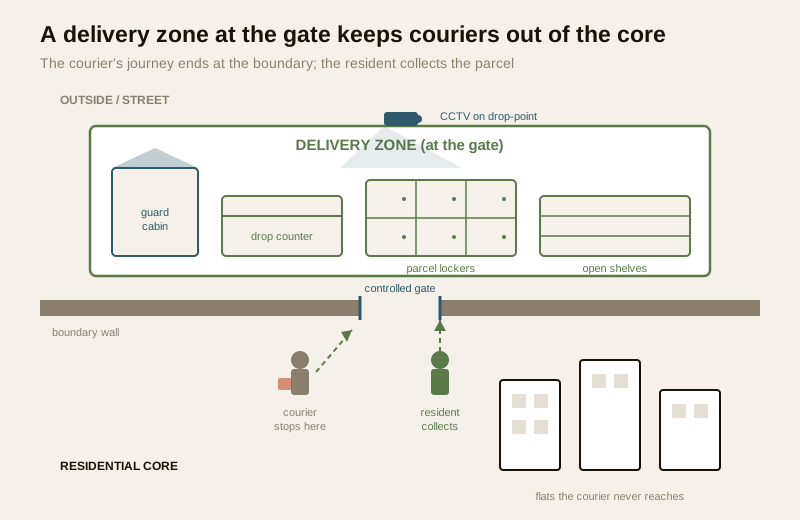
A delivery zone can be as modest or as built-out as the community warrants:
| Delivery-zone element | What it is | Best for | Keeps the courier out of the core because |
|---|---|---|---|
| Drop counter / collection window | A manned or shelved counter at the gate/guard post | Any complex; the default | Handover happens at the boundary; guard or resident receives |
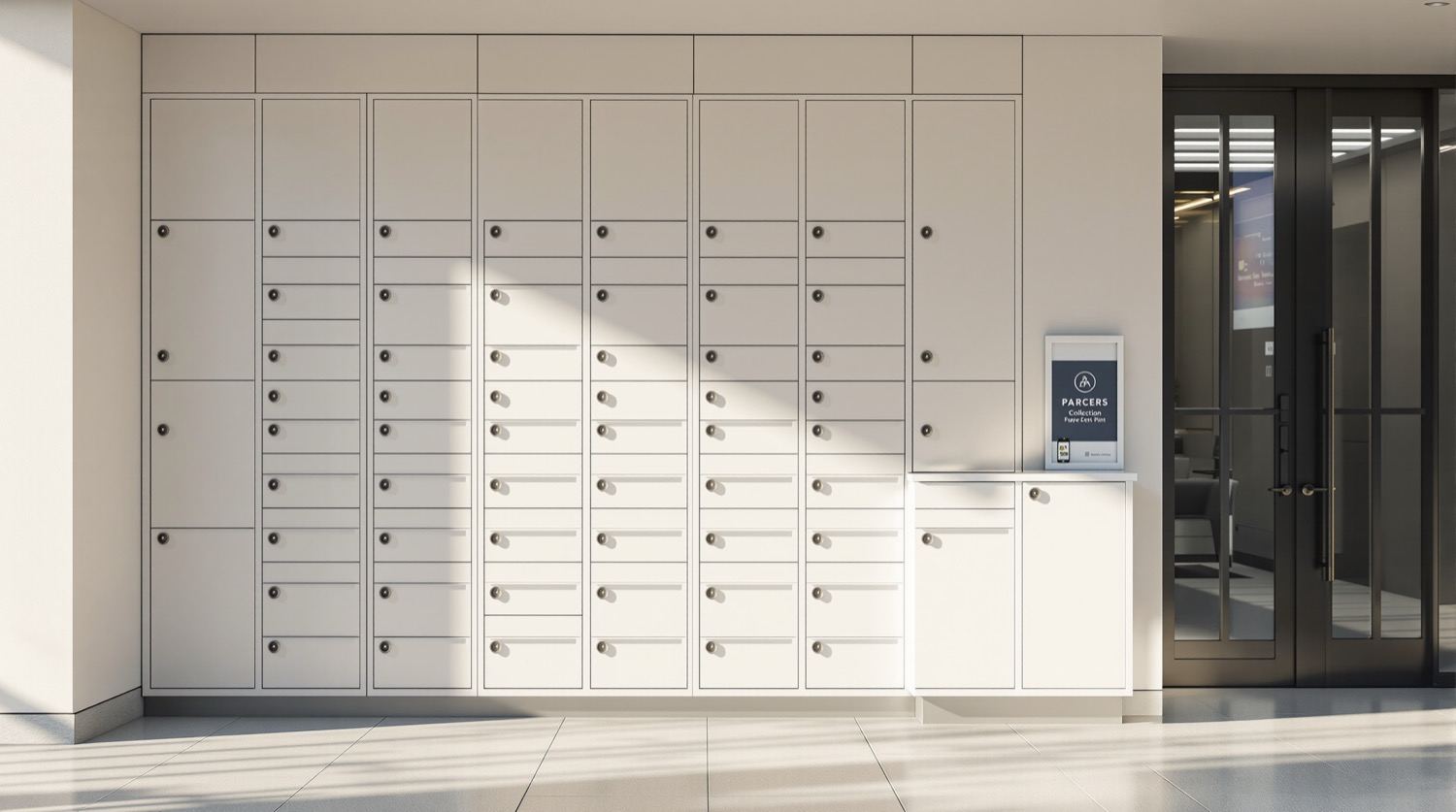
| Parcel lockers (smart or keyed) | A bank of lockable compartments; app or code to open | High-volume urban complexes | Courier deposits, resident collects on their own time |
| Open parcel shelves / pigeon-holes | Numbered shelves by block or flat | Smaller societies, low-value parcels | Contactless drop; but needs CCTV, less theft-proof |
| Mail-room / package room | A small staffed or access-controlled room | Large communities, offices | Everything routes to one watched, logged point |
| Cold-storage nook | A shaded shelf or small fridge for groceries/food | Complexes with heavy quick-commerce | Perishables wait safely without a door delivery |
The rule the zone enforces is simple and worth stating on the notice board: couriers deliver to the gate; residents collect from the gate. Doorstep delivery is the exception a resident specifically approves, not the default. That one line removes the great majority of stranger-at-your-door moments. For the fuller community picture see the gated communities security guide and the gated society access control guide.
Verify before you admit: defeating the fake-delivery ruse
A delivery zone handles where. Verification handles whether. The fake-delivery ruse works on trust in a uniform and a story; it is defeated by moving the decision from the guard's judgement to the resident's confirmation — before anyone goes past the gate.
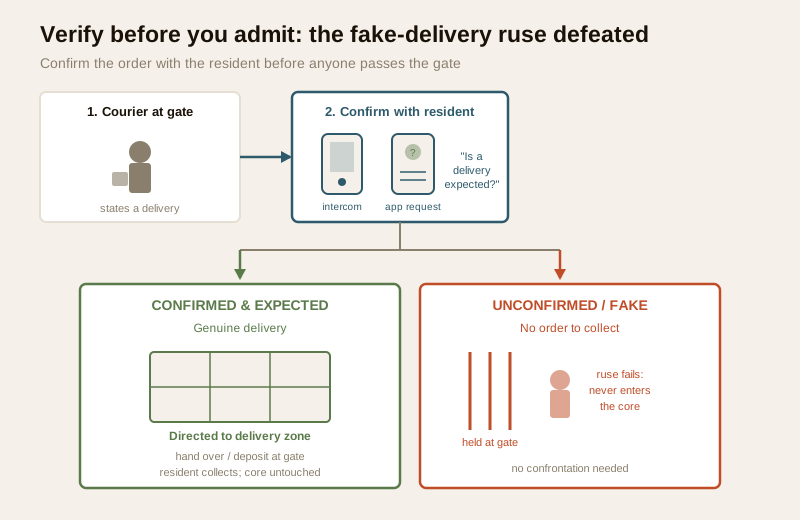
The verification chain, in order:
1. Courier arrives and states a delivery for a flat. The guard does not open on the story alone.
2. Confirm with the resident — via the community app entry request, or an intercom / phone call. Is a delivery expected? From whom? See the guard-to-resident intercom guide for the link that makes this instant.
3. Genuine and expected — direct the courier to the delivery zone to hand over or deposit; the resident collects. No corridor walk needed.
4. Genuine but resident wants doorstep delivery — resident explicitly approves; guard logs it; ideally the courier is escorted or time-bound, not free to roam.
5. Unconfirmed or refused — hold at the gate. A real courier can wait, redeliver, or drop at the zone; a fake one has nothing to collect and leaves. Nobody enters the core on an unverified claim.
The elegance of this is that it treats every courier the same and humiliates none. The genuine delivery person is not accused of anything — they are simply directed to the drop-point, which is faster for them too. The fake one is defeated not by confrontation but by the absence of a confirmation. That is the whole point of a visitor screening area: decisions get made in a controlled space before entry, and the guardhouse gives the guard the sightline and the tools to make them.
| Situation | Weak handling (breach) | Verified handling (secure) |
|---|---|---|
| Unexpected "delivery" at gate | Guard waves through on the uniform | Confirm order with resident; hold if unconfirmed |
| Courier wants to reach the flat | Walked to the door unescorted | Directed to delivery zone; resident collects |
| App entry request | Resident auto-approves everything | Resident approves only actually-expected orders |
| No resident contact possible | Sent up anyway "to save time" | Held at gate / dropped at zone until contactable |
| Repeat daily staff (tiffin, milk) | Unregistered, waved in daily | Pre-registered pass / QR; scanned each entry |
A note on the app: community management apps make this verification near-frictionless, but only if residents use them honestly. Auto-approving every request, or leaving a delivery partner permanently pre-approved, turns the tool back into a rubber stamp. The gated society access control guide covers running these apps well.
The home answer: a lockbox, a VDP, and never opening to an unexpected knock
Not everyone lives behind a manned gate. For an independent house, a flat without a delivery zone, or any door that a courier can still reach, the same principles scale down to three habits and one small piece of hardware.
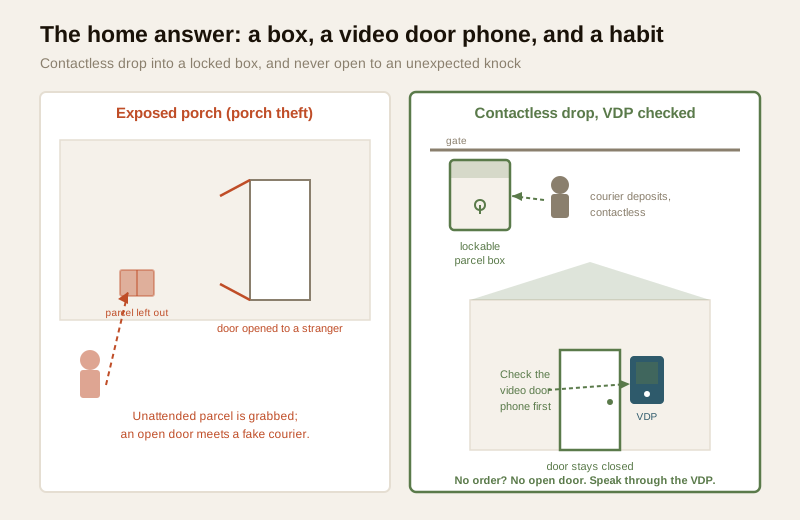
A parcel box or lockbox at the gate. A weatherproof, lockable box near your entrance gives couriers a place to leave parcels that is neither your open porch nor your hand. You instruct couriers (in the app's delivery notes, or with a small sign) to deposit there. It is the single most effective anti-porch-theft measure for a home: the parcel is delivered, contactless, but not left exposed. This pairs naturally with the door delivery storage thinking for how parcels are received and held.
The video door phone is your gate, so use it. The most important home rule is behavioural: never open the door to an unexpected delivery without checking through the video door phone or intercom. If you did not order it, if the person or the story does not add up, you do not need to open the door to deal with it — speak through the VDP, ask them to leave it in the box or at the gate, or decline. An unopened door is not rude; it is the whole defence. The ultimate guide to home security covers the VDP and door-hardening in depth.
Contactless-drop instructions. Use the delivery app's notes to specify the drop — the box, the gate, a neighbour, a security desk — so the default is not "hand it to me at an open door." This keeps the convenience of home delivery while removing the face-to-face-at-the-threshold moment that both porch theft and the fake-delivery ruse rely on.
| Home delivery habit | Why it protects | Cost / effort |
|---|---|---|
| Lockable parcel box at the gate | Contactless drop; parcel not left exposed | One-time, low-moderate |
| Always check VDP before opening | Defeats fake-delivery-at-the-door | Free; a habit |
| Contactless-drop app instructions | Removes the doorstep handover | Free; per order |
| A camera on the drop-point | Deters and records porch theft | Moderate; see below |
| Track deliveries; collect promptly | Less time for a parcel to sit and be stolen | Free; attention |
Watch the drop-point, and log what arrives
Two supports make a delivery zone actually work: it must be watched, and deliveries should be logged — proportionately.
CCTV on the drop-point. A camera covering the delivery zone, drop counter or parcel lockers does the classic double job: it deters casual parcel theft and it records who deposited and who collected if something goes missing. This is the most valuable camera after the main gate itself. Position and specify it as part of the perimeter CCTV plan and coordinate any power and cabling with a licensed electrician via the electrical hub; do not run it as an afterthought stuck on a pole.
A delivery log — but only what security needs. Recording deliveries (time, courier/company, flat, purpose) creates the audit trail that resolves a "my parcel never arrived" dispute and flags the courier who keeps appearing without a real order. But a delivery log is personal data under the DPDP Act 2023, and it accumulates fast. Collect the minimum that serves security, restrict who can see it, set a retention period and actually purge it, and never let labels or logs circulate in a resident WhatsApp group. A leaked pattern of who orders what, when, and lives where is itself a security exposure. The same discipline applies to the visitor screening and gate registers.
Balancing security with the reality that deliveries must be convenient
A delivery-zone regime that residents find slow, they will bypass — propping a gate, sharing an access code, telling couriers to "just come up." The design goal is not to make deliveries hard; it is to make the secure path the easy path.
- Make collection frictionless. Smart lockers with an app code, a well-lit sheltered counter near the resident lifts, an SMS when a parcel arrives — these make gate collection faster than waiting for a corridor delivery, not slower.
- Handle perishables gracefully. A shaded shelf or small cold nook for groceries and food means quick-commerce does not force a door delivery just to keep the ice cream frozen.
- Keep the exception open. Doorstep delivery on the resident's explicit approval must stay available — for the elderly, for the heavy or bulky item, for the resident who genuinely wants it. Security that has no exceptions gets defeated by the first inconvenient case.
- Never trap anyone. A parcel room, locker bank or drop counter must not sit in a fire-escape route or narrow an emergency exit. Convenience and life-safety point the same way here: keep the zone clear and accessible.
Run your own layout through the site perimeter security assessment and, for a home, the home security risk scorecard to see where deliveries are quietly undoing the rest of your perimeter.
Dignity, data & when to bring in a professional. Couriers are workers, and the great majority of deliveries are exactly what they claim to be — design the zone so genuine couriers are served quickly and treated with respect, never humiliated or profiled. Delivery and visitor logs are personal data under the DPDP Act 2023: collect the minimum, protect it, retain briefly, purge it. For a community of scale, have a security consultant integrate the delivery zone into the wider access-control and CCTV design, and a licensed electrician handle any mains work — and confirm with your fire authority that no drop-point, locker bank or parcel room obstructs a fire lane or escape route.
Key takeaways
- Deliveries are the new weakest link. The sheer daily volume of couriers is now the most-used way an unknown person crosses your perimeter — design for it deliberately, not by accident.
- Give deliveries a zone, not your door. A drop counter, parcel lockers or a mail-room at the gate means the courier stops at the boundary and the resident collects; doorstep delivery becomes the approved exception, not the default.
- Verify before you admit. Confirm the order with the resident by intercom or app before anyone passes the gate — this defeats the fake-delivery ruse without accusing or humiliating any genuine courier.
- The home answer is a box, a VDP and a habit. A lockable parcel box, checking the video door phone before opening, and contactless-drop instructions stop porch theft and doorstep ruses while keeping delivery convenient.
- Watch it and log it lightly. Put CCTV on the drop-point and keep a minimal delivery log — but treat that log as personal data under the DPDP Act 2023: least collection, restricted access, short retention.
Where to go next
- Close the loop on people at the perimeter: Visitor Screening Areas, Guardhouse Design and the Guard-to-Resident Intercom.
- Harden the boundary the deliveries cross: Gate Security, Perimeter CCTV and Security Lighting.
- Zoom out: the Complete Guide to Perimeter Security in India and the Perimeter Security sub-hub.
- For your own home or society: the Ultimate Guide to Home Security, the Apartment Security Guide and the Building Security Systems Guide.
- Or browse the Security Knowledge Hub.
References
- CPTED (Crime Prevention Through Environmental Design) — an internationally recognised design approach whose natural-access-control and natural-surveillance principles underpin routing deliveries to a controlled, watched drop-point rather than into the residential core.
- National Building Code of India (SP 7), Bureau of Indian Standards — fire and life-safety provisions relevant to keeping a delivery zone, locker bank or parcel room clear of fire-tender access and escape routes; verify the current edition via the BIS catalogue at https://www.services.bis.gov.in/.
- Digital Personal Data Protection Act, 2023 — governs delivery and visitor logs and drop-point CCTV as personal data; apply data-minimisation, access control and retention limits.
- Private Security Agencies (Regulation) Act, 2005 (PSARA) and your local municipal and housing-society bye-laws — for licensed guard deployment at the gate and society rules on visitor and delivery records.
This is an educational overview for planning and decision-making, not legal, security or fire-safety advice. Integrate any delivery zone with your wider access-control, CCTV and life-safety design through qualified professionals, treat couriers and their data with dignity, ensure no drop-point obstructs fire egress, and verify any standard's current status via the BIS catalogue before relying on it.
Export this guide
Related Guides — Deep-dive reading
Visitor Vehicle Management in India: A Professional Guide
The everyday weak point of every society and office gate is not the resident's car — it is the visitor, the cab, the delivery rider and the contractor who must be let in without opening the whole park to anyone. This is the process, not just the hardware: verify at the gate before the boom lifts, park visitors away from resident bays, and never jam the gate a fire tender needs.
SecuritySecurity for People Living Alone in India (2026): Calm, Practical Habits When There Is No Second Person to Notice
Living alone is an ordinary and growing part of Indian life - the student in a new city, the working single, the elder whose children are abroad, the person after a separation. It does not call for fear. It calls for a few deliberate habits, because there is no second person in the home to notice trouble, raise the alarm, or catch an accident. This is calm self-reliance, layer by layer.
SecurityVisitor Screening Areas in India (2026): Verifying People at the Gate, With Dignity
How to design the space and procedure where visitors are identified, verified and admitted or turned away — a controlled airlock that verifies before the gate opens, respects DPDP privacy, and never humiliates the people it screens.
SecurityRelated Tools — Try Free
Apartment Video Door System Planner
Enter flats, entrances, floors and guard desk for a first-pass building intercom plan — door stations, indoor monitors, guard station, the right architecture and an indicative cost band.
Building PlannerCCTV Camera Coverage & Count Calculator
Estimate how many CCTV cameras you need, the NVR channels, storage in TB for your retention period, and an indicative all-in cost with GST.
CCTV CalculatorHome Security Risk Scorecard
Score your home across six security layers — perimeter, entry points, lighting, detection, alarm and habits — and get a prioritised action plan.
Security Scorecard