
Door Delivery & Storage on Site: A Fitter's Guide (India 2026)
Receive, check and store doors flat, dry and acclimatised on an Indian site so leaves never warp, swell or arrive damaged before fitting.
Good door delivery and storage is the quiet difference between a fit-out that snags clean and one that fights the fitter at every reveal. A door is a precision component the size of a person, and timber, MDF and flush leaves all move with the moisture in the air around them. On an Indian site — high monsoon humidity one month, dry dusty heat the next, plaster and screed still giving off water — a leaf left standing against a wall for a fortnight can bow, swell or pick up edge damage that no amount of planing will cure. This guide is the trade craft of receiving doors, checking them against the schedule, storing them flat, dry and acclimatised, and releasing them to the fitter only when the building is ready. Get this right and your carpenter hangs four to six doors a day to a clean snag list; get it wrong and you are replacing leaves at your own cost.
Receiving the delivery: check before you sign
The delivery note is not the schedule. Before anyone signs for a load, the site engineer or carpenter should reconcile what arrived against the door schedule and ironmongery schedule — every leaf by reference number, size, leaf type, material, fire rating, handing, glazing and finish. Cross-check with the door schedule guide and the ironmongery schedule so the right leaf and the right hardware set land at the right opening; see door numbering and tagging for keeping each leaf identified after the wrapping comes off.
Inspect each leaf as it is unloaded. Look for transit damage — crushed corners, punctured wrapping, water staining, chipped lippings, gouged faces, bowed leaves. Reject and document on the spot; a defect signed for is a defect you own. Photograph anything marginal. Confirm fire-door sets arrive as a tested set (leaf, frame and ironmongery as certified) with their labels intact — never accept a fire leaf stripped of its certification mark.
| Delivery check | What to verify | Action if wrong |
|---|---|---|
| Quantity & references | Every door number on the schedule present | Note shortfall on delivery note, do not sign for missing items |
| Size & leaf type | Width, height, thickness, flush/panelled match schedule | Quarantine mismatches, flag to PM |
| Handing | Left/right hand, swing matches door handing schedule | Tag clearly; wrong handing is a common defect |
| Fire rating | FD30/FD60 label and certified set intact | Reject any unlabelled fire leaf |
| Transit condition | No bow, chips, water marks, crushed corners | Photograph, reject, log on note |
| Finish | Veneer/laminate/primer as specified, no scratches | Document; pre-finished leaves are unforgiving |
Where and how to store: flat, off the floor, dry
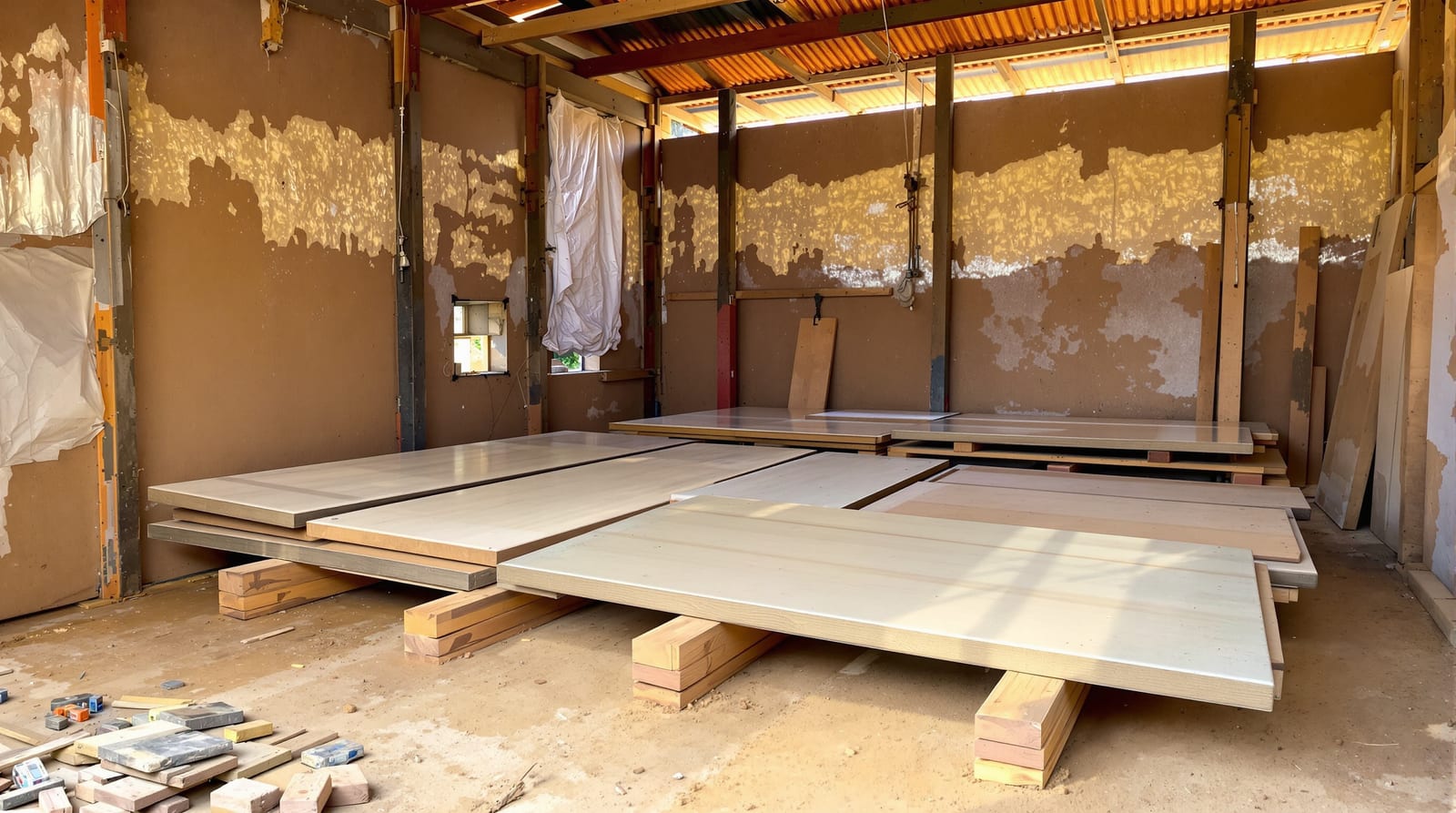
The single rule that saves the most leaves is store flat, not on edge. A door stood on its long edge against a wall is unsupported across its length and will take a set — a permanent bow — within days, especially a hollow-core flush leaf or an unsealed timber one. Lay leaves horizontally in a stack on level bearers.
The flat-stack method
- Lay three or more level timber bearers (50mm or thicker) on the floor, spaced evenly so no leaf sags between them — one near each end, one or more in the middle.
- Keep the whole stack clear of the floor so ground moisture and screed damp cannot wick into the bottom leaf.
- Stack leaves face to face and back to back to balance any movement, heaviest at the bottom.
- Place full-width spacer battens between every few leaves if you must restrict pile height, and keep stacks below shoulder height so the lower leaves are not crushed and handling stays safe.
- Cover the stack loosely with a dust sheet or breathable cover — not sealed polythene that traps condensation against the faces in monsoon humidity.
The right environment
Store doors in a dry, weather-tight, well-ventilated area inside the building, away from open windows, leaking roofs, and the splash zone of wet trades. Avoid storing against external walls that sweat, near drying plaster, or in a room being screeded. Keep leaves out of direct sun, which dries one face faster than the other and bows the leaf. Dust is the enemy of pre-finished and veneered faces — a settled dust film scratches when wiped, so covers stay on until fitting.
Acclimatisation: let the door reach the building's moisture
Timber and engineered leaves are hygroscopic — they take up and give off moisture until they reach equilibrium with the surrounding air. A leaf delivered straight from a dry warehouse into a humid, freshly plastered Indian flat will swell; one from a damp store into an air-conditioned interior will shrink and the joints may open. Acclimatise every leaf by laying it flat in its final environment, unwrapped enough to breathe, for a few days before fitting so it settles to the in-service moisture content before you cut hinges and locks into it.
| Door type | Acclimatise (rule of thumb) | Main risk if skipped |
|---|---|---|
| Internal flush / hollow-core | 2–4 days flat in the space | Bow, sticking at top corner |
| Solid timber / panelled | 5–7 days flat, faces breathing | Swelling, shrinkage cracks at joints |
| Engineered / pre-finished | 3–5 days, keep covered | Edge swell, lipping movement |
| Fire-door set (FD30/FD60) | Per maker; keep set together | Gap creep affecting ≤3mm tolerance |
Never site-condition a fire leaf by trimming or planing beyond the maker's certified allowance — moisture-driven gap changes still have to land inside the ≤3mm (4mm max) leaf gaps the set was tested at. When in doubt, hold delivery until the building is closer to its in-service condition rather than acclimatise a leaf in a still-wet room.
Edge and face protection
Most storage damage is to the long edges (lippings) and corners — the parts the fitter relies on for a straight reference and clean reveal. Keep the manufacturer's corner and edge protectors on as long as possible. Where they are stripped for inspection, refit temporary edge battens or foam corner guards before re-stacking. Do not drag leaves across the floor (grit gouges the bottom edge), do not write on faces, and do not lean tools or sheet materials against a stored stack. Two people carry a heavy or fire leaf; a foot-operated door lifter and a door stand make single-leaf handling safer and keep edges off the ground.
Fit only after the wet trades have dried
The correct trade sequence releases doors late. Frames go in early and are protected; leaves are hung after plastering, screeding and the first paint primer have dried, so the leaf is not absorbing water from green plaster or being splashed by wet work. Hanging a timber leaf into a room still drying is the textbook cause of doors that swell, stick and then shrink loose months later. Coordinate the hand-off with the wider programme — carpenter, electrician (for smart locks and closer wiring) and painter all touch the opening in turn; the door trades coordination guide sets out who does what and when. The release-to-fit sequence below keeps it clean.
| Stage | Door status | Why |
|---|---|---|
| Frame fixing | Frames in, leaves still stored | Frame must be plumb and dry before hanging |
| Plaster / screed | Leaves stored flat, covered | Wet trades give off most moisture now |
| Primer / first paint | Acclimatise leaves in space | Leaf settles to in-service humidity |
| Hang leaf & ironmongery | Release from store | Building dry, finishes started |
| Final paint / polish | Protect hung leaves | Avoid runs and dust on faces |
| Snag & handover | Inspect against tolerances | Even 2–4mm gaps, latches first time |
Workmanship and storage of joinery on contract work sit under CPWD specifications and IS 1200 (methods of measurement) and the general good-practice expectations of NBC 2016; protecting materials until fixed is the contractor's duty, so document your storage method as part of QA. For what happens once leaves are released, see the setting out doors pillar; for the final inspection, the door snagging guide catalogues the defects poor storage causes — bowed leaves, edge chips and gaps that will not close.
When leaves are ready to fit, the door fitting tools guide covers the kit, and you can size the programme with the door fitting time estimator or scope the full set with the door ironmongery schedule builder. The whole sequence connects back to the complete door guide.
Frequently asked questions
Why do doors warp if stored standing on edge?
A leaf stood on its long edge is unsupported across its 2-metre span, so its own weight plus uneven moisture takes a permanent bow within days. Stored flat on level bearers, the whole face is supported and movement stays balanced. Always lay leaves horizontally, face to face, off the floor.
How long should doors acclimatise before fitting?
As a rule of thumb, internal flush leaves want 2–4 days flat in their final space, solid timber and panelled doors 5–7 days, and engineered or pre-finished leaves 3–5 days. The point is to let the leaf reach the room's in-service humidity before you cut hinges and locks, so it does not swell or shrink afterwards.
Can I store doors in a freshly plastered room?
No. Green plaster and screed give off large amounts of moisture, and an unwrapped leaf will swell and bow. Store in a dry, ventilated area away from wet trades, and only acclimatise leaves in a room once its plaster and primer have dried.
Should I wrap stored doors in polythene?
Use a loose, breathable dust sheet rather than sealed polythene. In Indian monsoon humidity, tight polythene traps condensation against the faces and can stain veneers or swell edges. Keep the original corner and edge protectors on, and the cover loose enough to let air move.
When in the build should leaves be fitted?
After the wet trades have dried — frames go in early, but leaves are hung only once plastering, screeding and the first paint primer are complete and dry. Hanging into a still-wet room is the most common cause of doors that swell, stick, then shrink loose later.
Export this guide
Related Guides — Deep-dive reading
Door Trades Coordination: Fitting Sequence on Site (India 2026)
How carpenter, mason, electrician and painter hand off work in the right order so doors fit without rework on an Indian site.
Home Doors & EntrancesDoor Acceptance Criteria: Tolerances & Tests India 2026
What 'acceptable' means for a fitted door: even gaps, frame plumb, flat leaf, one-hand operation, latches first time, clean finish — and the accept/snag/reject thresholds.
Home Doors & EntrancesDoor Snagging Guide: Inspect & Fix Defects India 2026
How to build a door snag list, inspect a fitted door systematically and clear binding, gap, latch, finish and hardware defects before handover.
Home Doors & EntrancesRelated Tools — Try Free
Material Schedule Generator
Generate a room-wise finish schedule — walls, floors, ceilings, trim, and joinery by location.
Material ScheduleWindow Hardware Cost Calculator
Estimate window hardware cost — hinges, handles, locks, rollers and multipoint gears.
Window CalculatorCross-Ventilation Analyzer
Estimate airflow and air changes per hour (ACH) from room size, window areas, layout, and local wind — with NBC 2016 Part 8 compliance check.
Ventilation Calculator