
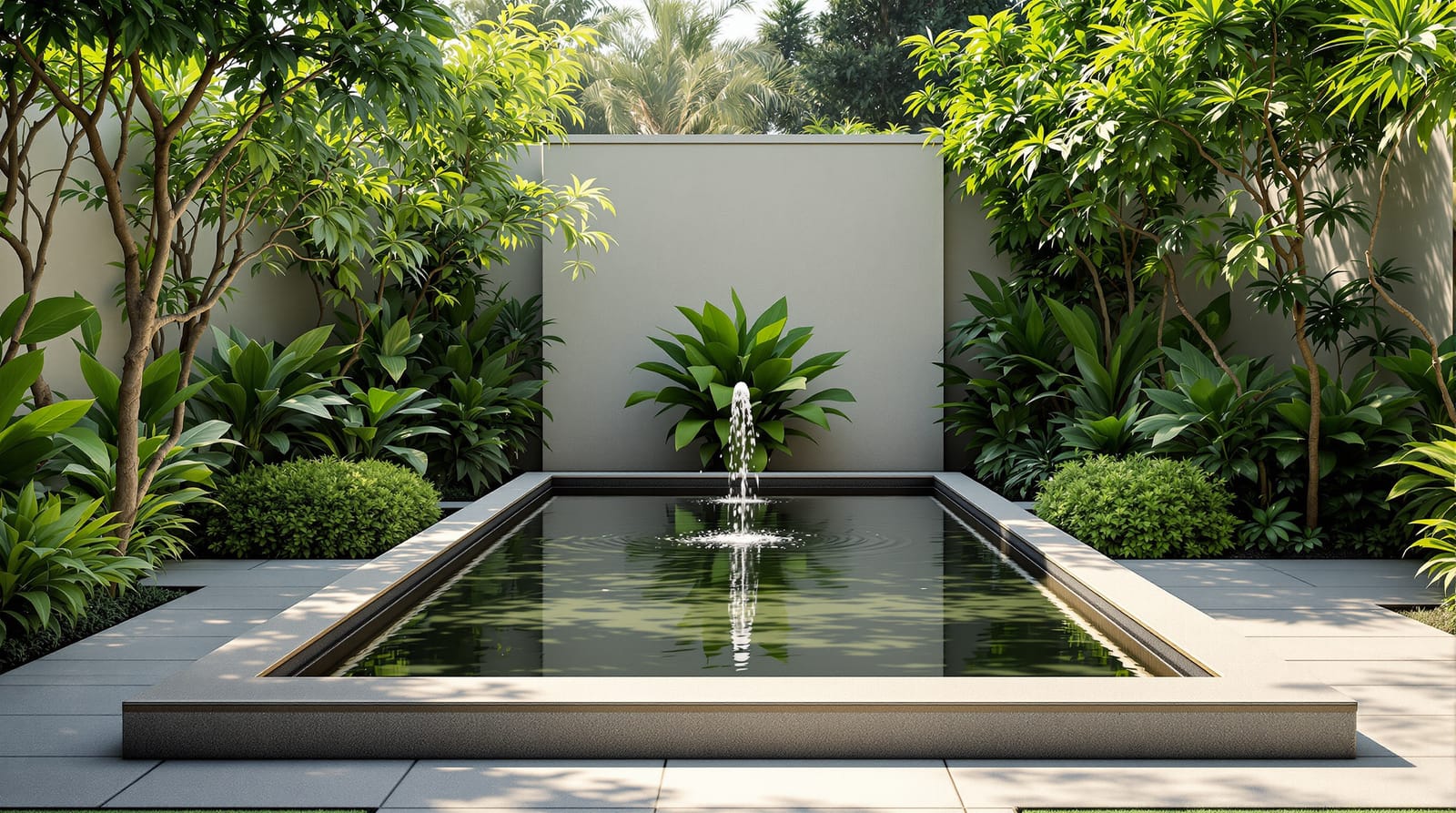
Water Features in Landscape Design — A Complete Guide for Indian Homes
Why water, the full family of features (fountains, ponds, waterfalls, reflecting pools, rills), how to choose, site, cost and maintain one — with safety and mosquito control
A well-chosen water feature is the single most rewarding element you can add to an Indian garden — it cools the air, masks city noise, draws birds and butterflies, and gives the eye a place to rest — but only if you match its type, siting and upkeep honestly to your space, your climate and your appetite for maintenance.
This is the overview map of the whole subject. We will look at why water belongs in a home landscape, the main types you can choose from, how to pick the right one, where to put it, what it actually costs to run, and — most importantly in our climate — how to keep it safe and mosquito-free. Each type is kept deliberately short here; follow the links to the dedicated spoke guides for depth.
Why put water in a garden at all?
Water earns its keep in several distinct ways, and being clear about which one you want is the first step to choosing well.
- Cooling. A moving or evaporating water surface lowers the temperature of the air immediately around it through evaporative cooling — genuinely useful in a Delhi or Ahmedabad summer courtyard, though the effect is local (a few metres), not a substitute for shade or trees.
- Sound masking. Falling or trickling water produces broadband "white" sound that masks traffic, neighbours and generator hum. This is the single most underrated benefit for urban Indian homes.
- Wildlife. Clean fresh water is the scarcest resource in a city garden. A shallow dish or a planted pond brings sunbirds, bulbuls, oriental magpie-robins, dragonflies and frogs within weeks. See Wildlife-Friendly Home Landscapes.
- Focal point and calm. Still water reflects the sky and slows the eye. It is a core device in Biophilic Landscape Design and a natural anchor for Outdoor Wellness Spaces.
- Value and character. A tasteful feature lifts the perceived quality of a villa landscape or courtyard far more than its cost.
Be honest with yourself about which of these you are really after — the cooling-and-sound person wants moving water; the wildlife-and-calm person wants still water. They lead to very different decisions.
The main types of water feature
Water features split cleanly into still water (calm, reflective, wildlife-friendly, quiet) and moving water (sound, cooling, oxygenation, more equipment). The chart below summarises the trade-offs; the paragraphs after keep each type short and point you to the spoke guide.
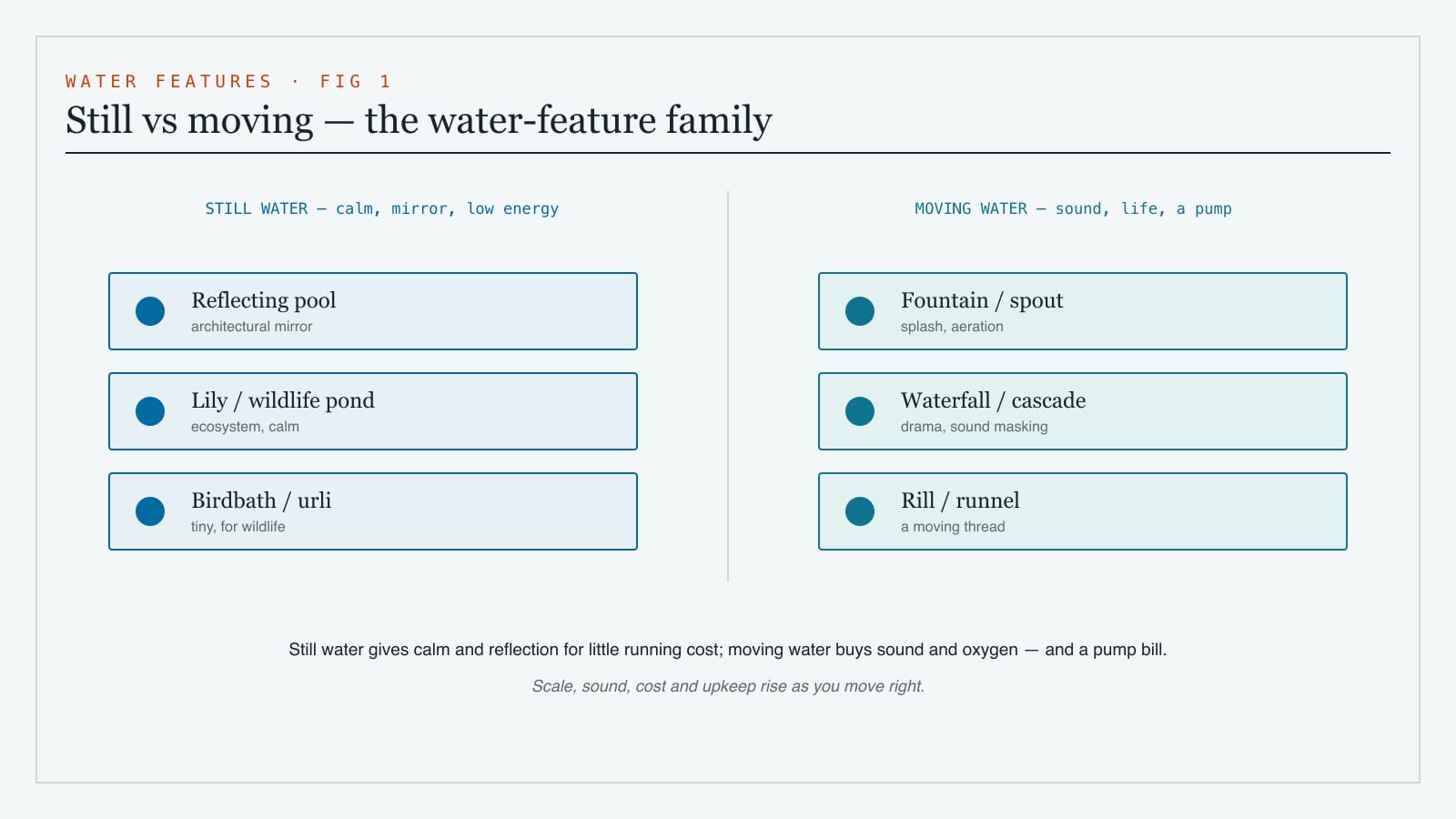
Still water
- Garden ponds. A planted, ideally wildlife-stocked pool — the richest ecological choice and the most forgiving if you let plants do the filtering. Depth, edge profile and planting matter enormously. Full detail in the Pond Design Guide.
- Reflecting pools. Shallow, still, architectural sheets of water that mirror the sky, a tree or a façade. Crisp-edged and formal; the calmest device in the catalogue. See Reflecting Pools in Architecture.
- Birdbaths and shallow dishes. The cheapest, safest entry point — a terracotta saucer on a plinth, refilled daily. Surprisingly powerful for wildlife and almost zero risk.
- Natural swimming pools. A swimmable pool filtered biologically by a regeneration zone of plants rather than chlorine — beautiful and chemical-free, but a serious build. See Natural Swimming Pools.
Moving water
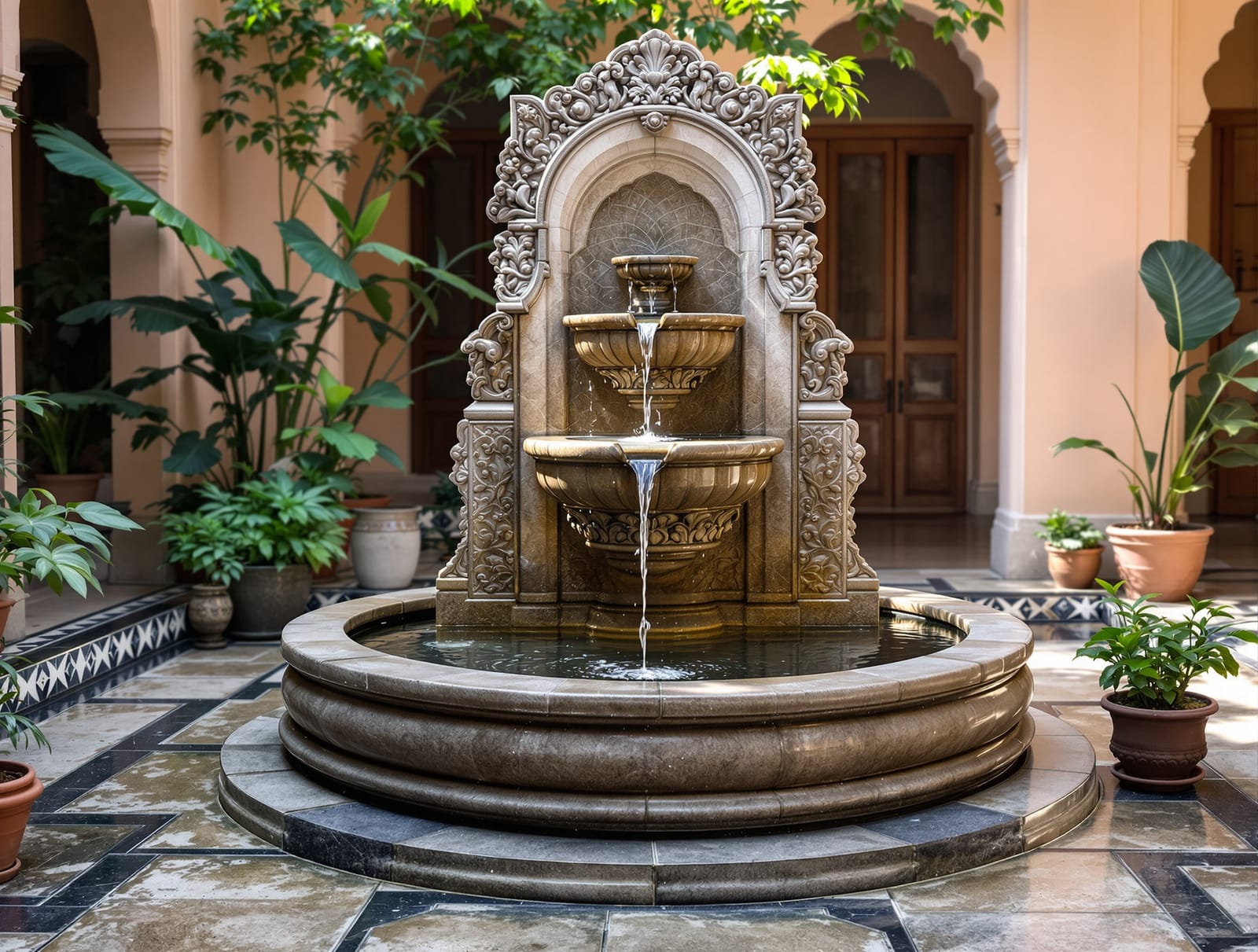
- Fountains and spouts. From a single bubbling urn to a tiered stone centrepiece — the easiest way to add sound and movement, and the easiest to scale to a small space.
- Wall spouts and water walls. A spout or sheet of water over a wall into a narrow trough; ideal where floor space is tight (balconies, narrow courtyards).
- Waterfalls and cascades. Water stepping down rock or masonry into a pond below — the strongest sound and the most dramatic, but the most pump-hungry. See Waterfalls for Home Landscapes.
- Rills and runnels. A narrow, shallow channel of slow-moving water threading through paving or a courtyard — a Mughal-garden idiom (think Charbagh) that is elegant, child-safe and low-volume.
- Plunge pools. A compact dip pool for cooling off; smaller and shallower than a swimming pool but still a substantial, contained body of water.
A separate category worth naming: a rain garden is not an ornamental feature at all but a planted depression that catches and infiltrates monsoon runoff — useful, but a different brief. See Rain Gardens Explained and Sustainable Water Management in the Landscape.
| Type | Sound | Wildlife value | Relative cost | Maintenance | Best for |
|---|---|---|---|---|---|
| Birdbath / dish | None | High | ₹ | Very low (daily refill) | Tiny spaces, beginners |
| Wildlife pond | Low–none | Very high | ₹₹ | Low–medium | Naturalistic gardens |
| Reflecting pool | None | Low–medium | ₹₹₹ | Medium | Formal, architectural |
| Fountain / urn | Medium | Medium | ₹–₹₹ | Medium | Sound in small spaces |
| Wall spout | Medium | Low | ₹₹ | Medium | Balconies, narrow courts |
| Waterfall / cascade | High | Medium | ₹₹₹ | Higher (big pump) | Drama, noise masking |
| Rill / runnel | Low | Low–medium | ₹₹ | Medium | Courtyards, formal axes |
| Plunge pool | Low | Low | ₹₹₹₹ | High | Cooling off, luxury |
How to choose: a decision path
There is no "best" water feature — only the one that fits your space, budget, the sound you want, whether you are after wildlife or architecture, and how much maintenance you will genuinely accept. Work through the questions below honestly.
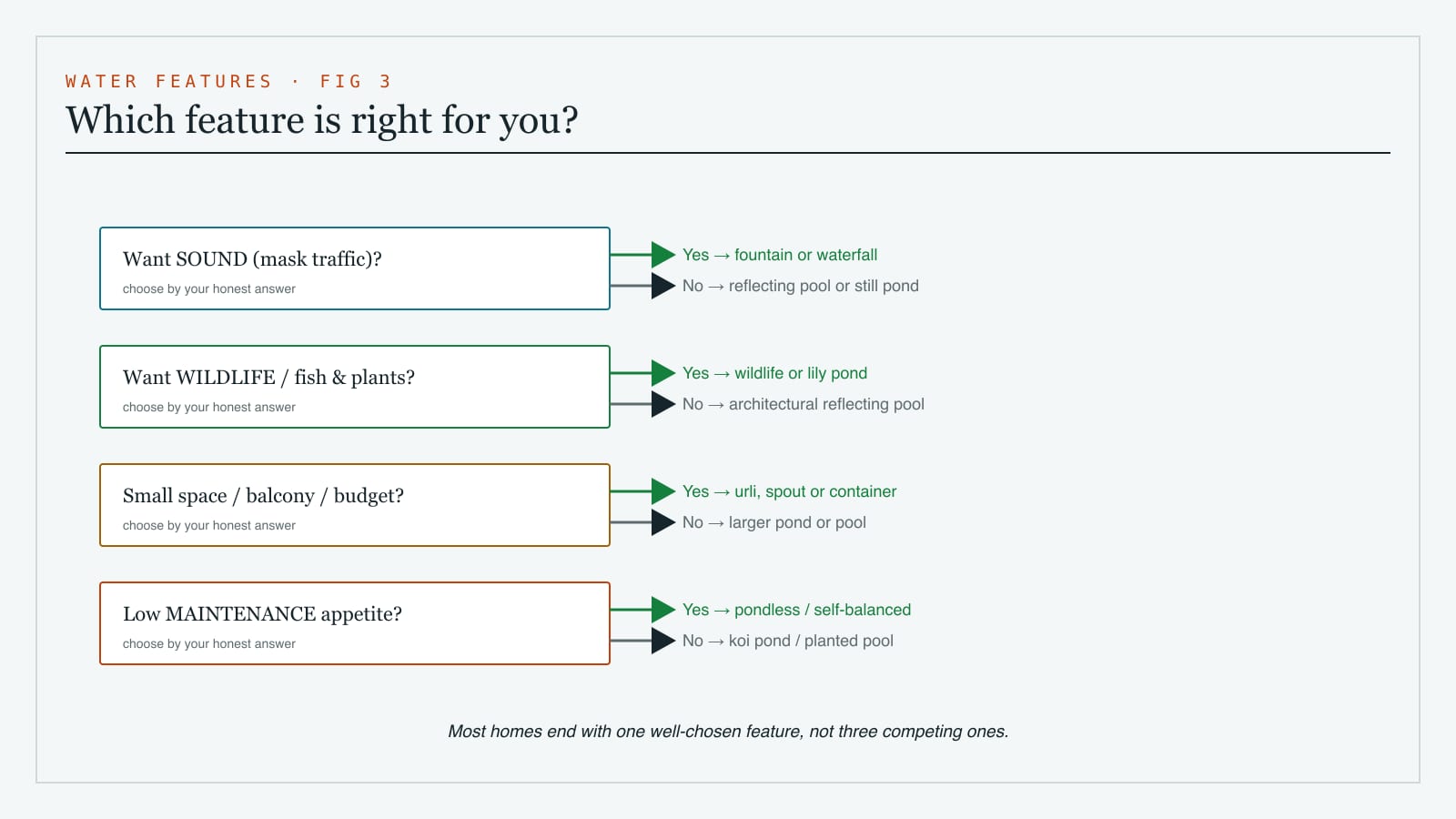
1. How much space and budget? A balcony or tiny courtyard points to a wall spout, urn fountain or birdbath. A real garden opens up ponds, reflecting pools and cascades.
2. Do you want sound? If masking traffic is the goal, you need moving water — a spout, fountain or cascade. If you want stillness and reflection, choose a pond or reflecting pool and skip the pump-noise trade-offs.
3. Wildlife or architecture? A wildlife pond is irregular, planted, with gently shelving "beach" edges and no chlorine. An architectural pool is crisp, hard-edged, often dyed dark, and kept clear. These are almost opposite design languages — decide early.
4. What maintenance will you really do? Be brutally honest. A birdbath needs a daily rinse; a balanced wildlife pond needs seasonal attention; a reflecting pool or fountain needs weekly skimming, pump checks and algae management. If nobody will tend it, choose the simplest option, not the grandest.
5. Children or elderly at home? This can override everything above — see the safety section.
| Your situation | Sensible first choice |
|---|---|
| Balcony, low effort, want sound | Recirculating wall spout or urn fountain |
| Small courtyard, want calm | Reflecting pool or rill/runnel |
| Garden, love birds and frogs | Planted wildlife pond |
| Garden, formal architectural look | Reflecting pool with a single fountain jet |
| Hot-dry climate, want cooling | Fountain or cascade (movement + evaporation) |
| Young children at home | Birdbath, bubbling-rock, or grilled/shallow feature only |
Placement and siting
Where you put the feature decides half its success. Get sun, leaves, views, power and overflow right before you dig.
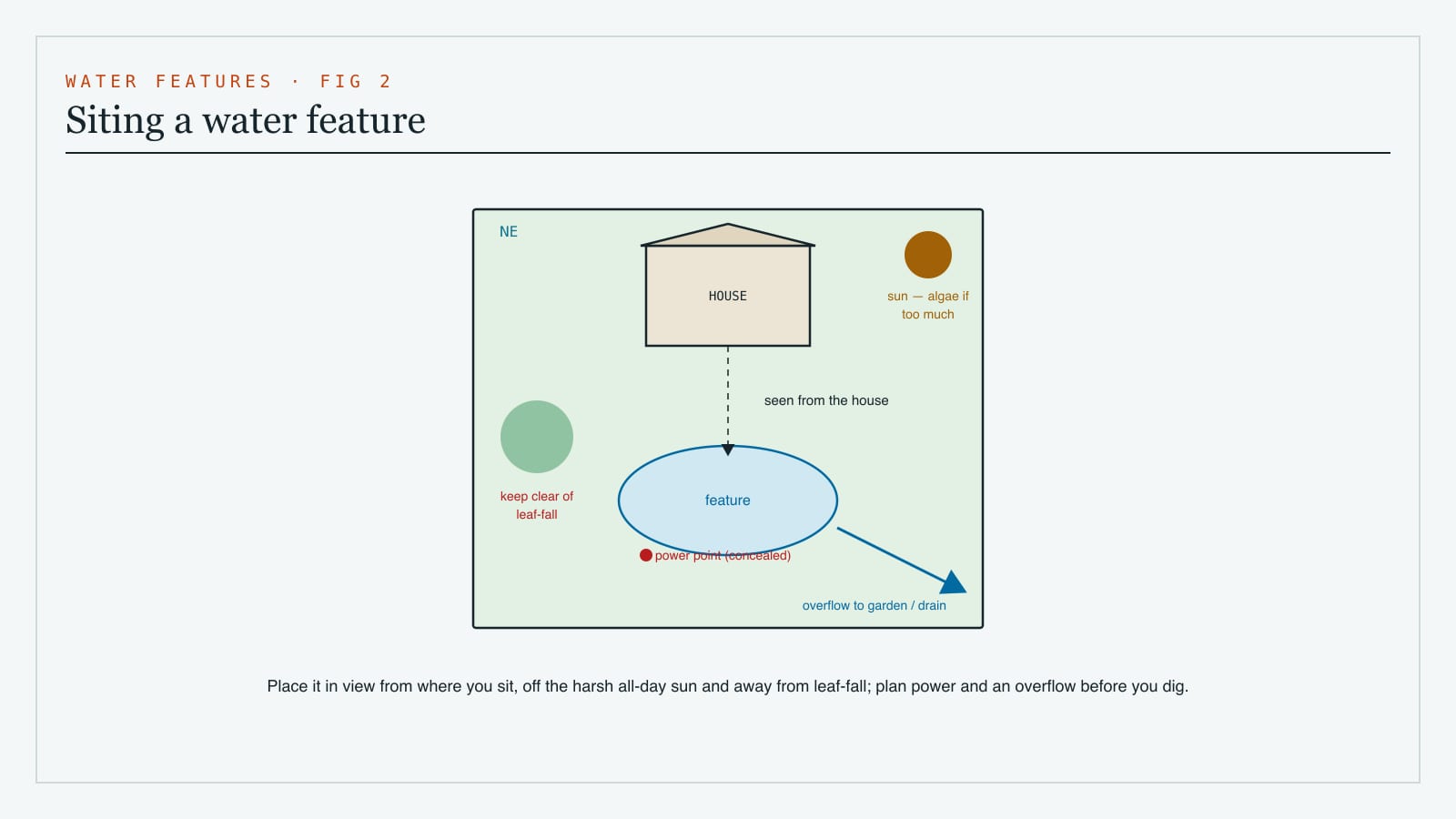
- Sun. Aquatic plants and a healthy pond want roughly 4–6 hours of sun; too much sun in our summers, though, accelerates evaporation and algae. Dappled or part-shade is often the sweet spot. A reflecting pool reads best with open sky above it.
- Wind and leaf-fall. Avoid siting directly under deciduous or messy trees — gulmohar, neem and many natives drop leaves, flowers and pods that foul the water and clog pumps. A little leaf litter is manageable; a constant rain of it is not.
- Views. Place the feature where it is seen and heard from where you actually sit — the verandah, the dining window, the favourite chair. A beautiful feature around a blind corner is wasted.
- Power. Almost every moving feature needs a pump, so a feature needs a weatherproof outdoor power point nearby, ideally on an RCD/ELCB-protected circuit. Plan the cable route before you build, not after.
- Overflow and monsoon. This is the most-missed point in India. During heavy rain a pond or pool will overtop — design a deliberate overflow that leads excess water to a drain, a soak pit or a rain garden, not into your foundations or a neighbour's plot.
- Vastu, honestly. Traditional Vastu Shastra associates water with the north-east (Ishanya) and advises against water in the south-west. If this matters to your household, the north-east is a perfectly good, low-conflict place to site a feature, and there is no harm in honouring it. Treat it as a placement preference to accommodate where you reasonably can — not as an engineering rule that should override sun, drainage, safety or where the feature is actually enjoyed.
What it costs to run
The build cost is one thing; the running cost and effort are what people underestimate. The recurring realities:
- The pump. A small recirculating spout runs on a 15–40 W pump; a fountain or modest cascade typically 60–150 W; a tall waterfall or a natural pool can need several hundred watts running for hours daily. At roughly ₹7–9 per unit, a 100 W pump running 8 hours a day costs on the order of ₹150–250 a month — modest, but a 400 W pump run continuously is several times that. Size the pump to the job; oversizing wastes power and money for life.
- Electricity and a quiet pump. A noisy, cheap pump will annoy you daily — budget for a decent submersible pump and check its decibel and flow rating, not just its price.
- Evaporation top-up. In a hot-dry Indian summer an open water surface can lose well over a centimetre of depth a day. A small feature may need topping up every couple of days; factor this into your water budget, especially in scarcity-prone cities. Pair it with rainwater harvesting where you can.
- Algae. Green water is the default outcome of sun plus nutrients plus still warm water. The cure is balance, not chemicals: shade part of the surface, add submerged oxygenating and floating plants, avoid overfeeding fish, and keep leaf litter out. A planted pond largely self-regulates; a bare ornamental pool will need more intervention.
Safety — read this before you build
This section is non-negotiable. A young child can drown in as little as a few centimetres of water, silently and in under a minute — open water and toddlers are a genuinely dangerous combination, and most garden-pond drownings involve a child under five.
If there are, or may be, young children using the garden:
- Prefer features with no standing open water at child height — a bubbling rock or pebble fountain where water disappears into a hidden, grilled reservoir is the gold standard. So is a birdbath on a tall plinth.
- If you want a pond or pool, fit a rigid steel mesh or grille just below the water surface so it stays invisible but bears a child's weight, or fence the feature with a self-closing, self-latching gate.
- Keep edges non-slip and avoid steep, sudden drops; shelving "beach" edges are both safer and better for wildlife.
- Never rely on supervision alone — barriers and shallow design are what actually save lives.
Elderly residents and slips matter too: wet stone around a feature gets dangerously slick, so specify textured, non-polished paving at the margins.
Mosquitoes — the honest answer
Standing water and dengue/malaria fears are the first objection most Indian families raise, and it deserves a straight answer rather than reassurance. Mosquitoes breed in still, stagnant water; they cannot complete their cycle in water that moves or is actively predated. You control them by design, not by spraying:
- Keep water moving — even a small pump and a gentle surface ripple prevents Aedes and Culex from laying.
- Stock fish in still ponds — guppies (Poecilia) and the native larvivorous fish are voracious larvae-eaters and are the standard biological control; a balanced pond with fish and dragonflies effectively eliminates the problem.
- No dead, stagnant pockets — eliminate saucers, blocked gutters and forgotten buckets near the feature, which are far worse breeders than a well-run pond.
- Empty and refresh birdbaths and shallow dishes every day or two — this both serves wildlife and breaks the breeding cycle.
A well-designed, moving or fish-stocked water feature is not a mosquito hazard; a neglected, stagnant one is. The difference is entirely in the design and the upkeep.
Bringing it together
Start small if you are unsure — a bubbling urn or a birdbath teaches you the rhythms of topping up, cleaning and seasonal change at low cost and low risk, and you can always graduate to a pond or cascade later. Match the feature to the benefit you actually want, side it for sun, leaves, views, power and overflow, design out the drowning and mosquito risks from the first sketch, and be honest about the upkeep. Do that, and water becomes the most loved corner of the garden. For the deep specifics of each type, follow the spoke guides linked throughout, and read Climate-Responsive Landscape Design and Water-Secure Homes to set your feature in the wider context of a thirsty climate.
References & further reading
- Central Ground Water Board (CGWB), Ministry of Jal Shakti — guidance on groundwater, recharge and rainwater harvesting in India.
- Central Public Health and Environmental Engineering Organisation (CPHEEO), Ministry of Housing and Urban Affairs — Manual on Storm Water Drainage Systems.
- Indian Green Building Council (IGBC) and GRIHA — rating-system criteria on water efficiency and sustainable site/landscape water management.
- Rainwater Club / S. Vishwanath (Bengaluru) — practical writing on urban water, ponds, recharge and reuse in the Indian context.
- National Vector Borne Disease Control Programme (NVBDCP), Ministry of Health & Family Welfare — guidance on source reduction and larvivorous-fish use for mosquito control.
- Melbourne Water — Water Sensitive Urban Design (WSUD) guidelines, for principles on ponds, rain gardens and stormwater features.
Export this guide
Related Guides — Deep-dive reading
The Best Trees for Indian Homes
A research-grade guide to choosing and placing trees around an Indian home — the real cooling and clean-air numbers, the right species for shade, flowers, fragrance and fruit, and the placement science that keeps roots out of your walls and drains.
LandscapeHow to Choose a CCTV Camera (2026): The Homeowner's Decision Guide for India
Cut through the spec-sheet noise and choose the right CCTV camera for each spot around an Indian home. What actually matters — sensor and low-light performance, lens and field of view, form factor, IP and IK ratings, honest smart features — and the marketing claims to ignore.
SecurityHow Buildings Can Give Back: Biodiversity and Environmental Health
How an Indian home and its plot can actively improve the ecology and environment around it, not just reduce harm
SustainabilityRelated Tools — Try Free
Rainwater Tank Sizer
How big should your rainwater tank be? Computes annual harvest, recommended tank capacity in litres, water-bill savings, and payback — for 10 Indian cities.
RWH CalculatorCross-Ventilation Analyzer
Estimate airflow and air changes per hour (ACH) from room size, window areas, layout, and local wind — with NBC 2016 Part 8 compliance check.
Ventilation CalculatorAcoustic Privacy (STC) Visualizer
Indian healthcare acoustic visualizer — compare wall assemblies and noise sources, see received SPL after STC attenuation, and check FGI 2018 / IS 1950 / NABH speech-privacy compliance with live dual-canvas waveform.
Acoustic Tool