
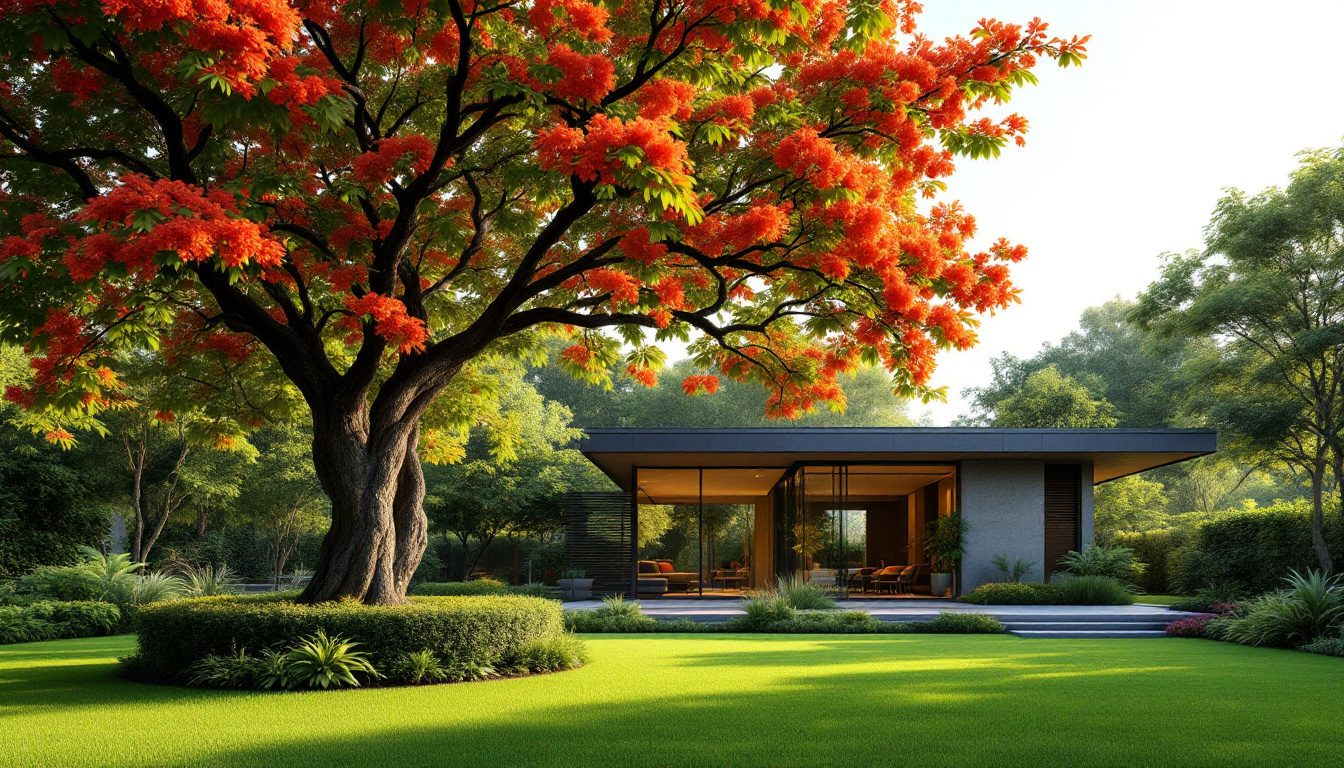
The Best Trees for Indian Homes
A research-grade guide to choosing and placing trees around an Indian home — the real cooling and clean-air numbers, the right species for shade, flowers, fragrance and fruit, and the placement science that keeps roots out of your walls and drains.
There is a test you can run on any street in India. Stand under a mature neem at two in the afternoon in May, then step out onto the open road three metres away, then step back. The difference is not a mood — it is degrees. The air under the canopy is measurably cooler, the glare is gone, the tar smell is replaced by leaf-smell, and a koel you did not know was there starts up again. A tree is not decoration that happens to be alive. It is the single most powerful, lowest-energy climate machine you can install on a plot, and unlike an air-conditioner it gets stronger every year and sends you no bill.
This guide is about choosing and placing that machine well. We will look at what a tree actually does for an Indian home — the real cooling numbers, the dust and PM it strips from the air, the carbon, the birds, the privacy, the resale value — and then at the harder craft: which species suits which purpose and climate, and the placement science almost nobody gets right, where a tree planted two metres too close to a wall becomes a thirty-year liability instead of an asset.
A tree is the highest-return element you will ever add to a home — but only if it is the right species in the right place; the wrong tree, or the right tree too near the wall, costs more in cracked plinths, blocked drains and lost winter sun than it ever gives back in shade.
Why a tree is the best thing you can add to a plot
We treat trees as the soft, optional, last-line-item part of building a home — the thing you plant if budget survives the kitchen. That ordering is exactly backwards. Of everything you can do to a small Indian plot, a single well-placed shade tree returns more comfort, health and money per rupee than almost any built element.
Cooling. This is the headline, and it is large. A mature tree shading a wall or roof both blocks direct solar gain and actively cools the surrounding air through evapotranspiration — a single large tree can transpire hundreds of litres on a hot day, and every litre that evaporates carries away heat, the physics that makes a wet earthen pot cool. The US Forest Service and urban-heat studies put the air-temperature reduction near a canopy at roughly 1 to 5 °C versus open ground, while the surface temperature of a shaded wall or pavement can be 11 to 25 °C lower than one in full sun. For an Indian home this is money: well-placed shade trees on the hot west and south-west faces can cut a building's summer cooling energy by 20 to 35 % in studies across hot climates. Your grandmother knew this; she planted the neem before she built the verandah.
Air quality. Urban India has a particulate problem, and trees are working filters. Leaves trap PM10 and PM2.5 and absorb gaseous pollutants; the i-Tree research programme has quantified urban-tree pollution removal at the city scale in the thousands of tonnes per year. Rough-leaved, hairy and waxy-leaved species — neem, peepal, banyan — are better dust-catchers than smooth glossy ones. A screen of trees between your home and an arterial road is a measurable health intervention, not a green gesture.
Carbon, birds and the living plot. A growing tree is a slow carbon store, and i-Tree values the bundle of services — carbon, stormwater interception, air cleaning, energy saving — at tens of dollars per large tree per year. Just as important, native trees are food and shelter: a flowering peepal or a fruiting jamun turns a sterile plot into a place of barbets, bulbuls, sunbirds and squirrels, which is the difference between a garden you maintain and one that feels alive. Our pillar guide on why some gardens feel peaceful traces why that aliveness lands on the nervous system the way it does.
Privacy and value. A tree screens an overlooking neighbour faster and more beautifully than any compound wall, and the property data is consistent worldwide: mature, well-placed trees add measurably to home value — commonly cited in the range of a few per cent of sale price. In Indian terms, a shaded, tree-lined frontage simply reads as a more cared-for, more liveable address.
How to choose a tree by purpose
Before climate, before vastu, before anything, ask the most basic question: what is this tree for? A tree planted for deep summer shade is a different animal from one planted for fragrance by the bedroom window, and the commonest mistake is planting a 20-metre giant where a 6-metre flowering tree belonged. Purpose first.
| Purpose | What you want | Strong Indian choices |
|---|---|---|
| Deep shade / cooling | Large dense canopy, fast-ish, deciduous or evergreen | Neem, rain tree (large plots only), Indian cork, kadamba |
| Flowering spectacle | Seasonal mass bloom, manageable size | Gulmohar, amaltas (laburnum), kadamba, tabebuia |
| Fragrance near windows | Scented flowers, small to medium | Champa (frangipani), parijat, kadamba, curry leaf |
| Fruit / edible | Productive, family-friendly | Mango, jamun, guava, curry leaf, moringa, lemon |
| Screening / privacy | Dense, columnar or low-branching, evergreen | Ashoka (true Polyalthia), Indian cork, bamboo clumping |
| Small garden / courtyard | Compact crown, non-invasive roots | Champa, curry leaf, lemon, parijat, Indian cork (pruned) |
| Sacred / wildlife | Native keystone species, ample space | Peepal, banyan, jamun, neem |
A second discipline is matching size to space. The single most useful number when buying a tree is not its flower colour but its mature spread — and that number is almost never on the nursery tag. A rain tree (Samanea saman) is glorious and will shade a courtyard completely; it will also throw a 20-metre crown that has no business on a 30-by-40 plot. The species selector below sorts the common trees by mature size and use, so you can rule out the giants before you fall in love with one.

The cooling numbers: what shade actually buys
Because cooling is the strongest single reason to plant, it is worth seeing the data rather than taking it on faith. The chart below gathers temperature and energy findings from urban-forestry and building-science research; the pattern is remarkably consistent across studies and climates.
The practical reading is that where the tree sits matters as much as whether you have one. Shade on a wall or roof that would otherwise bake in afternoon sun saves real cooling energy; shade thrown onto the street does nothing for your bill. This is why the placement section that follows is the most important part of the guide, and why the sun-path analyzer is worth ten minutes before you dig a single pit — it shows exactly where the summer afternoon sun lands on your walls, which is precisely where the canopy needs to fall.
A second subtlety: a deciduous tree on the south or south-west of a home is the climate-responsive ideal because it shades in summer when in full leaf, then drops its leaves in winter to let the low winter sun warm the wall — free cooling and free heating from one tree. This deciduous-summer-shade, bare-winter-sun logic is the same passive strategy our climate-responsive landscape design guide builds an entire planting plan around.
Placement science: the part nobody gets right
Here is where good intentions cause damage. A tree is a structure that grows in two directions — a crown overhead and a root plate underground that is typically as wide as, or wider than, the canopy. Plant it too close to the building and the same tree that cools your wall will, over twenty years, lift your plinth, crack your boundary wall, block your drains and dim your rooms. The rules are simple and worth obeying.
Distance from the wall and foundation. As a working rule, keep a large tree at least its mature canopy radius from the building — for a big shade tree that is commonly 5 to 8 metres or more; medium trees, 3 to 5 metres; small ornamentals, 2 to 3 metres. The danger is not usually the trunk pushing the wall; it is roots seeking water under a shallow foundation, and on shrink-swell black-cotton soils (much of the Deccan and central India) thirsty trees too close to a footing can cause differential settlement and cracking. On such soils, push the setback further still and favour less aggressively rooted species.
Distance from drains, sewers and septic. Tree roots follow moisture, and a leaking joint in an old earthenware drain is an invitation. Keep trees — especially vigorous, water-loving ones — well clear of underground drainage, sewer lines and septic tanks; a few metres of separation and modern jointed PVC lines reduce the risk enormously.
Solar orientation. Place for summer shade where it counts: the west and south-west walls take the brutal afternoon sun in most of India, so a canopy there earns its keep, while a deciduous tree there gives the summer-shade-winter-sun bonus. Keep large evergreens off the south if you want winter warmth and daylight, and off the path of cooling breezes you want to keep. The orientation and site guide and the sun-path analyzer together let you see exactly where the canopy should fall.
Overhead and root-zone clearances. Mind power lines (never plant a future giant under an 11 kV line), and leave the root zone unpaved — a tree throttled by concrete stresses, drops limbs and dies young, while a mulched, permeable root zone lets monsoon water recharge instead of running off.
| Tree size class | Mature height (approx) | Min. distance from wall | Min. distance from drains/septic | Notes |
|---|---|---|---|---|
| Small / ornamental | up to 6 m | 2–3 m | 2–3 m | Champa, curry leaf, lemon, parijat |
| Medium | 6–12 m | 3–5 m | 4–5 m | Gulmohar, amaltas, jamun, ashoka |
| Large shade | 12–20 m | 5–8 m+ | 6 m+ | Neem, Indian cork, kadamba, mango |
| Very large / sacred | 20 m+ | avoid near homes | avoid | Peepal, banyan, rain tree — open space only |
Plant trees for your grandchildren — but plant them where your grandchildren will bless you, not curse the cracked wall you left them. The right tree in the wrong place is still the wrong tree.
The vastu question, handled even-handedly
Many Indian homeowners arrive at tree-planting with a list of vastu directions in hand, and it deserves an honest, non-dismissive answer. Vastu shastra carries genuinely sound climatic intuitions wrapped in ritual language. Its common counsel — keep tall, heavy trees to the south and west, keep the north and east open and lightly planted, and favour species like tulsi, neem, amla, ashoka and coconut near the home — maps almost exactly onto good solar design in the northern hemisphere: shading the hot south and west, keeping the gentle north-east light and morning sun unobstructed. Read that way, the advice is useful.
Where it pays to think rather than obey blindly is the species taboos. Some traditions discourage particular trees near the house on symbolic grounds; treat those as cultural preference, and let horticulture decide the hard questions — root aggression, brittleness, allergenicity, mature size. If a vastu direction and a sound climatic placement agree, plant with confidence. If they conflict, the climate and the soil should win, because they are the forces that will actually crack a wall or cool a room. Our biophilic landscape design guide takes the same even-handed line: honour the cultural meaning, anchor the decision in evidence.
A working species table for Indian homes
This is the heart of the guide: a shortlist of trees worth considering, with the attributes that actually drive the decision. Common and regional names vary widely across India, so botanical names are given as the anchor.
| Tree (botanical) | Common names | Mature size | Habit | Bloom | Root behaviour | Best use |
|---|---|---|---|---|---|---|
| Azadirachta indica | Neem, vepa, limdo | 12–18 m | Evergreen-ish | Cream, fragrant | Deep, well-behaved | Shade, dust capture, all-rounder |
| Millingtonia hortensis | Indian cork tree, akash neem | 12–18 m | Evergreen | White, fragrant nights | Non-aggressive | Tall screen, fragrance, avenue |
| Delonix regia | Gulmohar, krishnachura | 8–12 m | Deciduous | Scarlet, May–June | Shallow, can be wide | Flowering shade, large plots |
| Cassia fistula | Amaltas, golden shower | 8–10 m | Deciduous | Gold, summer | Moderate | Flowering accent, street |
| Plumeria sp. | Champa, frangipani, chafa | 4–6 m | Deciduous | Fragrant, long season | Compact | Small garden, fragrance, courtyard |
| Neolamarckia cadamba | Kadamba, kadam | 12–18 m | Deciduous | Orange globes, fragrant | Fairly deep | Fast shade, sacred, wildlife |
| Syzygium cumini | Jamun, jambul, naval | 12–15 m | Evergreen | Inconspicuous; fruit | Deep | Fruit, shade, birds |
| Mangifera indica | Mango, aam | 10–20 m | Evergreen | Spring; fruit | Deep, needs space | Fruit, dense shade (large plots) |
| Murraya koenigii | Curry leaf, kadi patta | 3–5 m | Evergreen | Small white | Compact | Kitchen garden, small space |
| Moringa oleifera | Moringa, drumstick, sahjan | 8–10 m | Deciduous | Cream; pods | Moderate, brittle | Edible, fast, but weak-wooded |
| Saraca asoca | Ashoka (TRUE), sita-ashok | 6–9 m | Evergreen | Orange-red clusters | Non-aggressive | Sacred, shade, screening |
| Nyctanthes arbor-tristis | Parijat, harsingar, shiuli | 4–8 m | Deciduous | Fragrant, night-falling | Compact | Fragrance, small garden, sacred |
| Ficus religiosa / benghalensis | Peepal / banyan | 20–30 m | Large | Inconspicuous | VERY aggressive | Open ground / temples ONLY — never near walls |
Two caveats are worth flagging in bold. First, the true ashoka is Saraca asoca, a lovely shade tree; the tall columnar "ashoka" sold everywhere is usually the false ashoka (Polyalthia longifolia), fine as a fast screen but not the same plant. Second, peepal and banyan (Ficus religiosa and Ficus benghalensis) are magnificent, sacred, ecologically priceless — and have roots that will destroy any nearby structure and seedlings that colonise wall cracks and terraces. Plant them in open ground or honour the temple ones; never plant a Ficus within striking distance of your building.
Trees to avoid near homes
Choosing well is half avoiding badly. Some trees are simply wrong for a home plot — too thirsty, too brittle, too invasive, or too hostile to everything around them. Pradip Krishen's field classic Trees of Delhi is unsparing about several of these, and the ecological case against the exotics is well documented.
| Avoid near homes | Why | What to plant instead |
|---|---|---|
| Eucalyptus (Nilgiri / safeda) | Extremely thirsty, lowers water table, brittle limbs, little wildlife value | Neem, Indian cork |
| Silver oak (Grevillea robusta) | Shallow-rooted, storm-prone, brittle, exotic | Kadamba, gulmohar |
| Peepal / banyan near walls | Aggressive roots crack foundations, walls, drains | Plant in open ground only |
| Rain tree on small plots | Beautiful but vast 18–20 m crown; overwhelms small plots | Gulmohar (smaller) |
| Subabul (Leucaena), Prosopis juliflora (vilayati kikar) | Invasive exotics, allelopathic, weed aggressively | Native acacia / khejri in dry zones |
| Ailanthus, mulberry near paving | Suckering, weak wood, staining/heaving | Jamun, curry leaf |
| Conocarpus | Heavily planted, but allergenic pollen concerns and invasive habit; banned/discouraged in some Indian cities | Neem, Indian cork |
The through-line is consistency: prefer native or naturalised species suited to your rainfall, with non-aggressive roots and sound wood, over fast exotics that look like a quick fix and become a long problem. The Foundation for Revitalisation of Local Health Traditions (FRLHT) and state forest-department native-species lists are excellent regional guides to what genuinely belongs where you are.
Matching trees to your climate zone
A species that thrives in humid Kerala may sulk in arid Rajasthan. India spans several broad climate zones, and the palette shifts with each. This is a starting shortlist — local nurseries and forest departments know the cultivars for your micro-climate.
| Climate zone | Conditions | Well-suited trees |
|---|---|---|
| Hot-dry (Rajasthan, parts of Gujarat, Deccan) | Extreme heat, low rain, water-scarce | Neem, khejri (Prosopis cineraria — the native), jamun, amaltas, ber |
| Warm-humid (coastal, Kerala, coastal TN/AP, Goa) | High humidity, heavy rain | Mango, jamun, champa, coconut, jackfruit, Indian cork |
| Composite (Delhi-NCR, much of north India) | Hot summers, cool winters, monsoon | Neem, amaltas, gulmohar, kadamba, jamun (deciduous for winter sun) |
| Temperate / hill (Himalayan foothills, Nilgiris) | Cool, higher rainfall | Deodar, oak, rhododendron, fruit trees (apple, plum) — local species |
In every zone, the climate-responsive instinct is the same: deciduous shade on the hot faces for summer cooling and winter sun, native species matched to your rainfall so they need little irrigation once established, and root-and-mature-size discipline near the building. The climate-responsive landscape design guide develops this into a full planting strategy zone by zone.
What this means for your home
1. Start with purpose, then size. Decide whether you want shade, flowers, fragrance, fruit or a screen — then choose a species whose mature spread fits your plot. Look up mature size before you buy; the nursery tag will not tell you.
2. Put shade where the sun is brutal. West and south-west walls earn a canopy; run the sun-path analyzer to see exactly where the summer afternoon sun lands.
3. Respect the setback. Keep large trees at least their canopy radius (5–8 m+) from walls, foundations, drains and septic — more on black-cotton soils. The right tree too close is still a liability.
4. Favour deciduous on the hot faces. Summer shade plus winter sun from one tree is the climate-responsive sweet spot.
5. Choose native, sound-wooded, non-aggressive species. Neem, Indian cork, jamun, kadamba, champa over eucalyptus, silver oak, conocarpus and other thirsty or brittle exotics.
6. Keep Ficus away from buildings. Peepal and banyan are priceless in open ground and ruinous near walls.
7. Leave the root zone open. A mulched, permeable, unpaved root zone keeps the tree healthy and recharges monsoon water.
8. Read vastu through a climatic lens. Where tradition and good solar placement agree, plant happily; where they conflict, let soil and sun decide.
How Studio Matrx helps
Choosing and placing trees is a spatial problem, and spatial problems are easier to solve when you can see them. DesignAI can visualise your plot with different planting layouts — where a canopy falls across a west wall, how a screen of Indian cork closes off an overlooking neighbour, what a champa by the bedroom window or a gulmohar over the gate will look like once grown — so you can test the placement before you plant a tree that will outlive the decision. Paired with the sun-path analyzer for shade orientation and our biophilic and climate-responsive landscape guides for the planting strategy, it turns the most consequential green decision you will make into one you can actually picture first.
References
1. McPherson, E. G., Simpson, J. R., et al. — US Forest Service Center for Urban Forest Research; studies on tree shade, building energy use and air-temperature reduction (summer cooling-energy savings of ~20–35 % from well-placed shade trees).
2. Nowak, D. J., Crane, D. E. & Stevens, J. C. (2006). "Air pollution removal by urban trees and shrubs in the United States." Urban Forestry & Urban Greening — basis of the i-Tree pollution-removal estimates.
3. i-Tree (US Forest Service and partners). i-Tree Eco / i-Tree Streets — peer-reviewed tools quantifying urban-tree ecosystem services (carbon, stormwater, air quality, energy).
4. Akbari, H., Pomerantz, M. & Taha, H. (2001). "Cool surfaces and shade trees to reduce energy use and improve air quality in urban areas." Solar Energy, 70(3), 295–310.
5. Krishen, P. (2006). Trees of Delhi: A Field Guide. Dorling Kindersley / Penguin — authoritative on native vs exotic urban trees and their behaviour.
6. Foundation for Revitalisation of Local Health Traditions (FRLHT) / ENVIS Centre on Medicinal Plants — regional native-species and ethnobotanical references.
7. Bowler, D. E., Buyung-Ali, L., Knight, T. M. & Pullin, A. S. (2010). "Urban greening to cool towns and cities: A systematic review of the empirical evidence." Landscape and Urban Planning, 97(3), 147–155.
8. US Environmental Protection Agency. "Reducing Urban Heat Islands: Compendium of Strategies — Trees and Vegetation" (surface vs air temperature reductions under canopy).
9. Indian Meteorological Department (IMD) climate-zone data; Bureau of Indian Standards SP 41 (climate-responsive building design) — Indian climate zones for planting.
10. Wolf, K. L. — research on urban trees and property value, University of Washington (Green Cities: Good Health programme).
Part of the Studio Matrx Landscape series. Continue with why some gardens feel peaceful, biophilic landscape design for Indian homes, and climate-responsive landscape design.
Export this guide
Related Guides — Deep-dive reading
How Buildings Can Give Back: Biodiversity and Environmental Health
How an Indian home and its plot can actively improve the ecology and environment around it, not just reduce harm
SustainabilityUnderstanding Sun Path Analysis for Your Home
How the sun actually moves over an Indian site through the day and the year — and why that single fact quietly decides where your kitchen, bedroom and living room should sit.
Site PlanningDesigning for Views and Privacy
The site-level craft of capturing the good view while screening the neighbour's window three metres away — tuned for dense Indian plots.
Site PlanningRelated Tools — Try Free
Cross-Ventilation Analyzer
Estimate airflow and air changes per hour (ACH) from room size, window areas, layout, and local wind — with NBC 2016 Part 8 compliance check.
Ventilation CalculatorWindow Orientation Planner
Pick the best window type, glass and shading by wall direction — north, east, south and west.
Window ToolGarden Planning Toolkit
Get a tailored garden plan — planting layers, Indian species, features and a checklist — from your climate, space, sun and goals.
Planner