
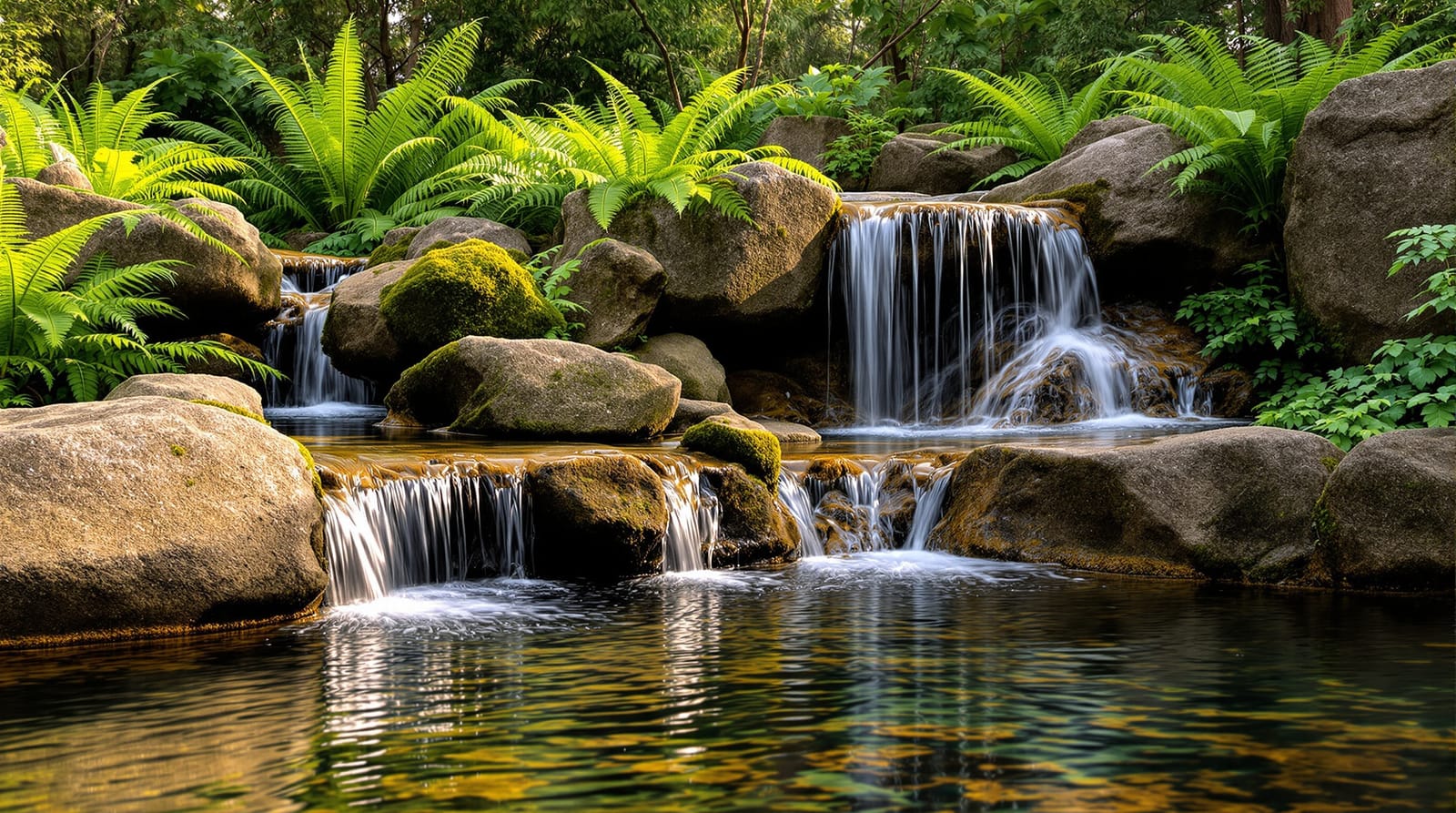
Waterfalls for Home Landscapes — Design, Pumps & Sound
The anatomy of a recirculating waterfall, sizing the pump and flow, the four waterfall types, designing the sound, pondless options and maintenance
A home waterfall is not a pond with a splash on top — it is a piece of small-scale hydraulic engineering, where pump power, weir width and drop height together decide whether you get a soothing trickle, a roaring cascade, or a puddle of disappointment. Get the flow sizing right and you buy yourself years of cool, moving, sound-masking water on a few hundred rupees of electricity a month. Get it wrong and you either starve the fall to a dribble or burn money pushing water uphill against losses you never accounted for. This guide is about the falling-water part specifically: how a recirculating waterfall actually works, how to size the pump, how to design the sound you want, and how to keep it running through an Indian summer and monsoon.
This is the moving-water companion to our pillar on Water Features in Landscape Design, and a close sibling to the Pond Design Guide, since a waterfall very often feeds a pond. Here we stay strictly in our lane: the cascade itself.
Why a waterfall, really
People say they want a waterfall because it "looks nice", but the genuine reasons are more concrete, and worth being honest about before you spend.
- Sound masking. This is the single best argument for a waterfall in an Indian home. Urban India is loud — horns, generators, the neighbour's invertor AC, street vendors. Falling water produces broadband "white" noise that masks intermittent traffic noise remarkably well. A modest 30–40 cm fall placed near a sit-out can lift a garden from stressful to restful. This is the same principle behind the calm of an outdoor wellness space.
- Movement. Still water is pretty; moving water is alive. Glints, ripples and the constant change pull the eye and add the sense of liveliness that underpins biophilic landscape design.
- Aeration for a pond. A waterfall is the cheapest, most beautiful aerator you can build. Tumbling water absorbs oxygen, which keeps fish healthy and helps beneficial bacteria break down waste — directly relevant if your fall empties into a stocked pond.
- Cooling and drama. Evaporative cooling near the fall is real, if local. And a well-lit cascade is simply the most dramatic thing a small garden can own.
If all you want is the sound and the movement without open water to worry about, skip to the pondless option below — the safest and increasingly the most popular choice for Indian family homes.
The anatomy of a recirculating waterfall
Almost every home waterfall is a closed loop: the same water is lifted to the top and falls again, with only top-up to cover losses. Understanding the parts is what lets you brief a contractor sensibly instead of being sold a kit.
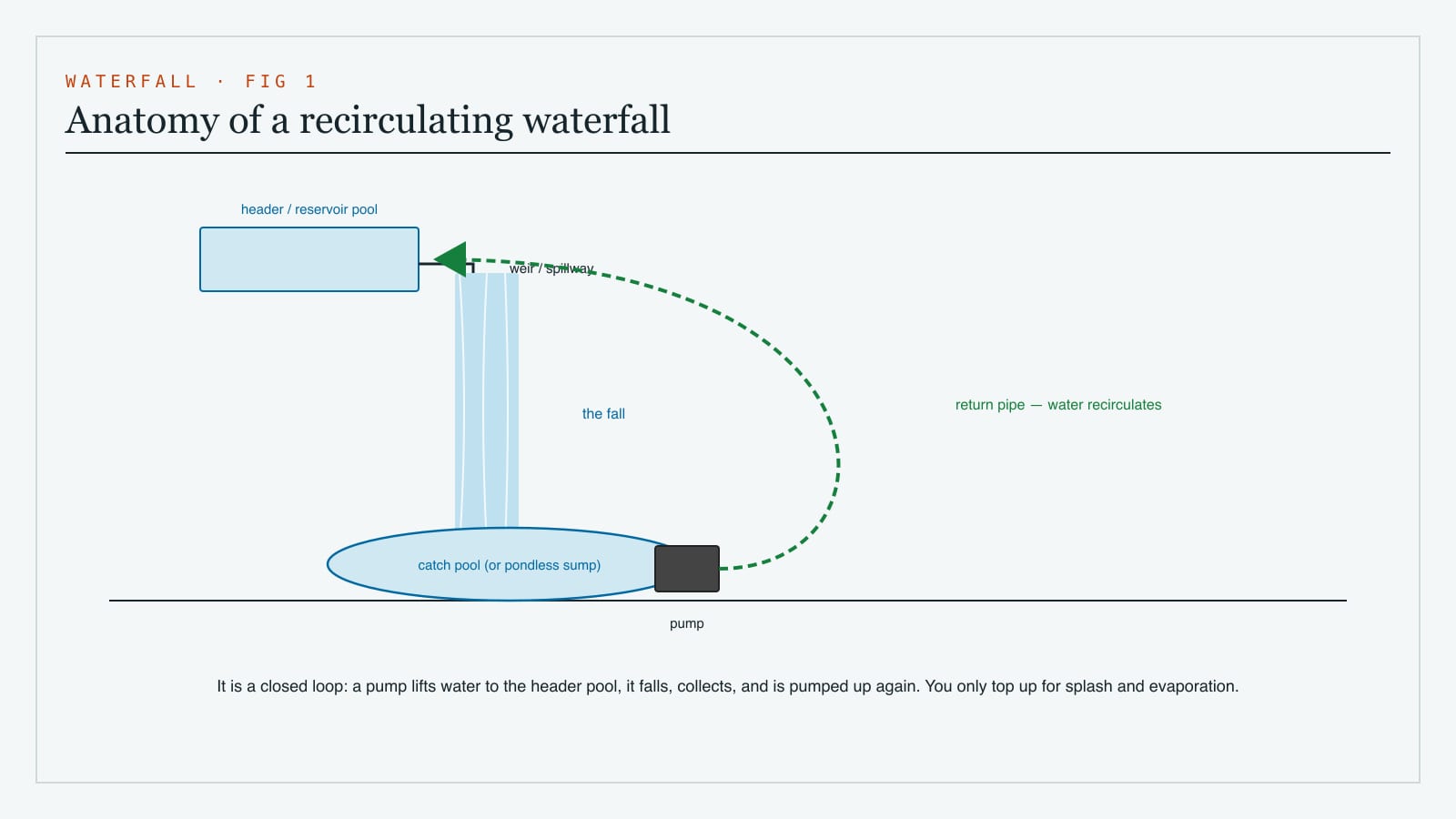
- Header pool (reservoir): a small pool or chamber at the top that holds a settled body of water. Its job is to calm turbulence so water arrives at the lip evenly, not in spurts.
- Weir / spillway: the lip the water flows over. Its width is the most important single number in the whole design — it sets how much flow you need. A wide weir gives a sheet; a narrow notch concentrates the flow.
- The fall: the visible drop. Its height and the surface it falls onto (smooth lip, broken rock, stepped ledges) decide the look and, crucially, the sound.
- Catch pool / lower pool: the pond or basin the water lands in. In a pondless system this is replaced by a hidden sump — a buried reservoir filled with gravel or milk-crate matrix blocks, with no open water on top.
- Pump: the heart of the loop, sitting in the lower pool or sump, lifting water back to the top.
- Return pipe: carries water from the pump up to the header pool. Pipe diameter matters — too narrow and you throttle your own flow.
The whole system is essentially a sustainable, closed water loop: you are not consuming water continuously, only replacing what splashes out and evaporates.
Pump and flow sizing — the number that matters
This is where most DIY waterfalls fail. The flow you need is driven by weir width, and the pump you must buy is driven by that flow plus the total height it has to lift against — the "head".
Step 1 — flow from weir width
The industry rule of thumb is roughly 1,500 litres per hour (LPH) for every 25 mm (1 inch) of weir width to get a respectable, continuous sheet. You can run thinner for a delicate veil (down to ~750 LPH/inch) or fatter for a powerful cascade (2,500+ LPH/inch).
| Weir width | Delicate veil (~750 LPH/in) | Standard sheet (~1,500 LPH/in) | Strong cascade (~2,500 LPH/in) |
|---|---|---|---|
| 15 cm (6 in) | ~4,500 LPH | ~9,000 LPH | ~15,000 LPH |
| 30 cm (12 in) | ~9,000 LPH | ~18,000 LPH | ~30,000 LPH |
| 45 cm (18 in) | ~13,500 LPH | ~27,000 LPH | ~45,000 LPH |
| 60 cm (24 in) | ~18,000 LPH | ~36,000 LPH | ~60,000 LPH |
The jump is sobering: doubling the weir width doubles the pump you need. For most home falls, a weir of 20–35 cm at the "standard sheet" rate is the sweet spot — handsome without demanding an industrial pump.
Step 2 — account for head (lift losses)
A pump rated "10,000 LPH" delivers that only at zero height. The higher it must push, and the longer/narrower the pipe, the less you actually get. You must add up the total dynamic head:
- Static lift: the vertical distance from water surface in the sump to the weir lip.
- Pipe friction: add roughly 0.3–0.5 m of "equivalent head" for every 3 m of pipe run, more if the pipe is narrow or has many bends.
- Fittings: each sharp elbow or valve adds a little.
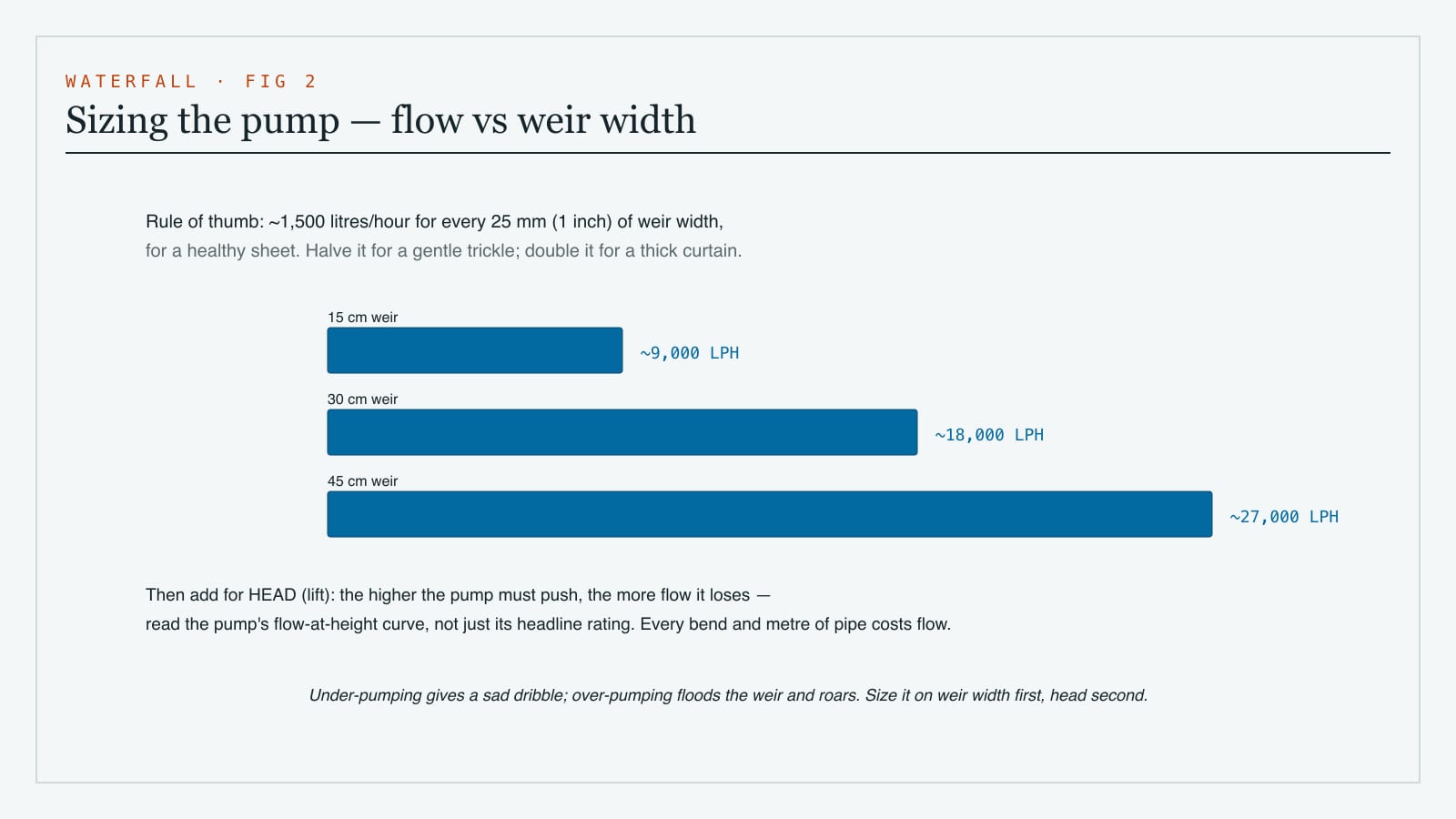
Then read the pump's flow-vs-head curve (every reputable pump has one) at your total head — not the headline figure. A simple worked example: you want an 18 cm weir as a standard sheet (~11,000 LPH at the lip), lifting 1.2 m with a 4 m pipe run. Total head ≈ 1.2 m + ~0.6 m friction ≈ 1.8 m. So you need a pump that delivers ~11,000 LPH at 1.8 m head — which often means buying a pump whose zero-head rating is 14,000–16,000 LPH. Always size up.
Indian pump options and reality
- Brands: Sobo, RS Electrical, Boyu, Venus and Sunsun dominate the affordable Indian aquarium/pond market; Pedrollo, Crompton and Kirloskar make more serious external pumps for larger falls.
- Type: submersible pumps are simplest for home use (sit them in the sump, single cable out). External pumps are more efficient and quieter for big systems but need a dry, sheltered housing.
- Always fit a flow-control valve on the return line so you can dial the fall down — you will almost always run it lower than maximum once you hear it.
| Fall scale | Typical pump (zero-head LPH) | Indicative power | Pump cost (₹) |
|---|---|---|---|
| Small wall spout / veil | 2,000–4,000 | 25–45 W | 1,200–3,500 |
| Standard 20–30 cm sheet | 5,000–10,000 | 60–120 W | 3,000–8,000 |
| Wide / tall cascade | 12,000–25,000 | 150–400 W | 9,000–25,000 |
Types of waterfall
The four common forms differ a lot in look, sound and effort. Match the type to the wall or slope you actually have.
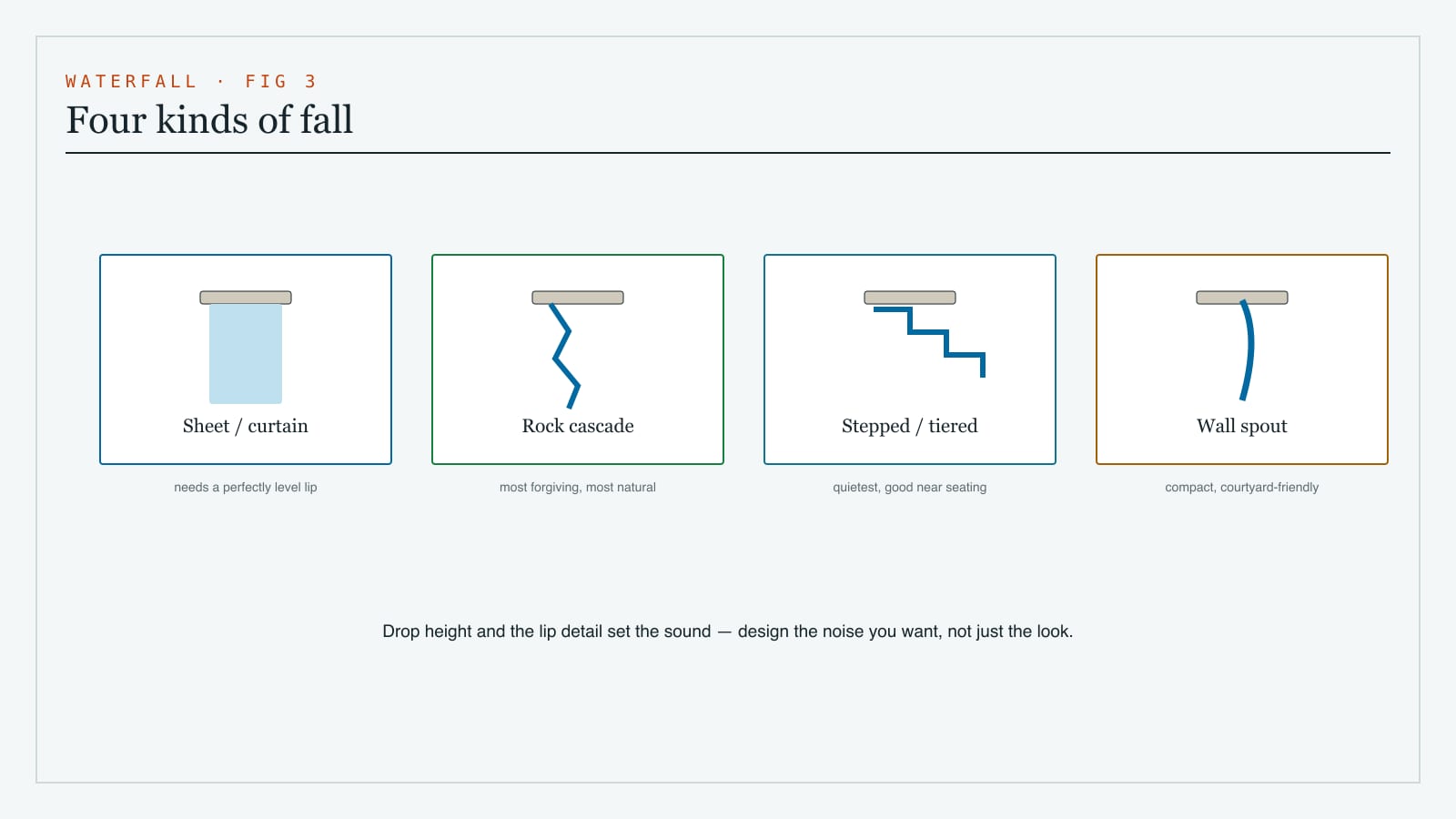
- Sheet / curtain fall: water flows over a clean, level lip (metal, acrylic or stone) into a single glassy sheet. Modern and architectural, brilliant against a feature wall. The lip must be dead level or you get an ugly broken curtain — the hardest detail to get right.
- Rock cascade: water tumbles over an informal arrangement of boulders into a planted pond. The most natural look, the most forgiving of small level errors, and the easiest to integrate into a villa landscape or a naturalistic garden. Sound is busy and bright.
- Stepped fall: a series of small ledges, each a mini-fall. Layered, musical sound; suits a sloping site beautifully and uses less total flow per metre of drama.
- Wall spout: water issues from a spout, bamboo, or lion's-head fitting against a wall, falling into a trough or bowl. The classic small-courtyard solution — perfect where you have a wall but no slope, and a natural fit for a courtyard landscape.
Sound design — engineering the sound you want
The biggest mistake is assuming a waterfall sounds "nice" by default. Two levers control the character of the sound, and you should design them deliberately.
- Drop height: a taller fall makes a louder, deeper, more "roaring" sound; a shorter fall is gentler and higher-pitched. For a relaxing trickle near a seating area, keep the drop to 20–40 cm. For a cascade meant to mask real traffic noise from a busy road, 50–80 cm with more volume does the work.
- What it lands on: falling onto a hard rock or directly into a deep pool gives a sharp "plop/slap"; falling onto a submerged splash rock or a shallow ledge breaks the stream into a softer, broader hiss.
- Volume of flow: more flow over the same lip means more sound. This is exactly why the flow-control valve matters — commission the fall at full flow, then turn it down until the sound is right. Most people end up running at 60–75 % of maximum.
A practical method: build, fill and listen at different times of day. The sound that is pleasant at noon can feel intrusive at 11 pm when the garden is silent. If a bedroom window overlooks the fall, lean towards the gentler end.
Water loss, recirculation and top-up
A recirculating fall does not consume much water, but it does lose some, and in India the rates are higher than in temperate climates. Two losses:
- Splash-out: turbulent falls throw droplets beyond the catch pool, especially wide cascades and windy sites. Good rockwork and a generous catch basin minimise this.
- Evaporation: in a hot, dry summer (think Delhi, Jaipur, Nagpur in May), an exposed moving water surface can lose a striking amount — a small feature may need topping up by several litres a day; a larger one considerably more. Monsoon humidity slashes this, and the rains may even over-fill the system.
So plan for both directions. Fit a discreet top-up arrangement — ideally tied to your rainwater harvesting at home system so the make-up water is free and soft, which also reduces scale and algae compared with hard borewell water. And critically, fit an overflow/weep outlet sized for the monsoon: when a downpour fills the pond, the excess must drain away to a soak pit or storm drain, not flood the pump housing or the garden. This monsoon overflow detail is non-negotiable in India and is the inverse of the worry homes in cold countries have about freezing — frost is a non-issue across nearly all of India, but a 100 mm cloudburst is very real.
Filtration, algae and mosquitoes — the honest bit
Moving water is your friend here, but it is not magic.
- Algae: sunlight plus nutrients equals green water and slimy rocks. A waterfall's aeration helps, but you will still want a biological filter (often a header-pool filter box with foam and bio-media) for any fall feeding a pond, plus shade and aquatic plants to outcompete algae. Avoid hard borewell top-up where you can.
- Mosquitoes and dengue: this is the question every Indian family asks, and the honest answer is reassuring — continuously moving water does not breed mosquitoes, because Aedes and Anopheles need still water to lay and for larvae to survive. The risk is the catch pool's still margins and any stagnant header pool if the pump is off for days. Keep the pump running, keep margins moving or stocked with larvae-eating fish (guppies, native Aplocheilus killifish), and never leave the system off and full during monsoon. A pondless waterfall has essentially zero open standing water and so essentially zero mosquito risk — a major reason for its popularity.
Pondless waterfalls — the child-safe choice
A pondless (or "disappearing") waterfall has all the cascade and sound, but the water vanishes into a hidden gravel-filled sump at the base instead of an open pool. There is no open water for a small child or pet to fall into — which, for families with toddlers, is decisive. It also means no mosquito-prone open surface, less evaporation (the sump is mostly covered), and lower maintenance (no fish, no large water body to balance).
The trade-offs: no pond means no fish, no waterlilies, and a slightly larger excavation for the sump and its matrix blocks or gravel. For most urban Indian homes prioritising safety and low fuss, it is the right default. If you do want open water and aquatic planting, treat the pond design separately via the Pond Design Guide.
Electricity, running cost and maintenance
A waterfall's main running cost is the pump, which ideally runs continuously (intermittent running invites algae and mosquitoes). A 100 W pump running 24×7 uses about 2.4 units (kWh) a day, ~72 units a month — roughly ₹575/month at ₹8 per unit; a small 45 W veil costs nearer ₹260/month, while a big 300 W cascade can cross ₹1,700/month. Energy-efficient DC/ECO pumps and right-sizing are the levers. Many homeowners run the fall on a daytime timer — fine for a pondless system, riskier for a stocked pond that needs constant aeration.
| Task | Frequency | Notes |
|---|---|---|
| Clear leaves/debris from header pool & filter | Weekly | More often under trees |
| Top up water | As needed (daily in peak summer) | Use rainwater/soft water if possible |
| Clean pump intake screen | Fortnightly | Prevents flow drop |
| Check & adjust flow-control valve | Monthly | Retune sound after rain/refill |
| Deep-clean pump & filter media | Quarterly | Don't over-clean bio-media |
| Pre-monsoon: test overflow, secure cabling | Annually (May/June) | Critical safety check |
Always run the pump on an RCD/ELCB-protected, weatherproof outdoor circuit with the cable routed safely — water and electricity demand a proper electrician, not a jugaad extension lead.
A sensible starting recipe
For a typical urban Indian home wanting calm sound and safety: a pondless rock or stepped fall, 25–30 cm weir, 30–40 cm drop, ~8,000 LPH pump (~90 W) with a flow-control valve, fed by a header filter box and topped up from the rainwater tank, with a monsoon overflow to a soak pit. Budget roughly ₹40,000–1,20,000 installed depending on rockwork and size — the stone and labour, not the pump, dominate the cost.
References & further reading
- CPHEEO, Ministry of Housing & Urban Affairs — Manual on Water Supply and Treatment / Sewerage, for water quality and recirculation principles.
- Central Ground Water Board (CGWB) — guidance on groundwater, recharge and the case for using rainwater rather than borewell water for features.
- Rainwater Club / S. Vishwanath (Bengaluru) — practical Indian writing on rainwater harvesting and reuse for landscape water.
- IGBC / GRIHA rating manuals — water-efficiency and sustainable site-water credits relevant to garden water features.
- Melbourne Water — Water Sensitive Urban Design (WSUD) guidelines — sound engineering principles for managing flow, overflow and recirculation in landscape water systems.
- National Vector Borne Disease Control Programme (NVBDCP), India — authoritative guidance confirming that continuously moving water does not support mosquito breeding.
Export this guide
Related Guides — Deep-dive reading
How Buildings Can Give Back: Biodiversity and Environmental Health
How an Indian home and its plot can actively improve the ecology and environment around it, not just reduce harm
SustainabilityWater Features in Landscape Design — A Complete Guide for Indian Homes
Why water, the full family of features (fountains, ponds, waterfalls, reflecting pools, rills), how to choose, site, cost and maintain one — with safety and mosquito control
LandscapeBody Jets Shower India: Body Spray Massage Systems, the Flow & Pressure They Really Need, and What It Costs (2026)
Wall-mounted horizontal body jets turn a shower into a spa massage — but every jet is a thirsty extra outlet. How many jets, at what heights, the big pump and geyser they force, the pipe sizing and concealed valves you must plan before tiling, the water and running cost, and exactly who it is worth it for.
BathroomsRelated Tools — Try Free
Rainwater Tank Sizer
How big should your rainwater tank be? Computes annual harvest, recommended tank capacity in litres, water-bill savings, and payback — for 10 Indian cities.
RWH CalculatorCross-Ventilation Analyzer
Estimate airflow and air changes per hour (ACH) from room size, window areas, layout, and local wind — with NBC 2016 Part 8 compliance check.
Ventilation CalculatorAcoustic Privacy (STC) Visualizer
Indian healthcare acoustic visualizer — compare wall assemblies and noise sources, see received SPL after STC attenuation, and check FGI 2018 / IS 1950 / NABH speech-privacy compliance with live dual-canvas waveform.
Acoustic Tool