
How to Choose a CCTV Camera (2026): The Homeowner's Decision Guide for India
Cut through the spec-sheet noise and choose the right CCTV camera for each spot around an Indian home. What actually matters — sensor and low-light performance, lens and field of view, form factor, IP and IK ratings, honest smart features — and the marketing claims to ignore.
Walk into any electronics market in India — or scroll any online listing — and the CCTV camera you are shown is described almost entirely in one number: megapixels. "5MP!" "8MP 4K Ultra HD!" The number is big, the price is small, and the assumption you are meant to make is that bigger equals better. It rarely does. A cheap 8MP camera can produce a mushier, noisier, less usable picture at night than a well-built 4MP one — because resolution is only one ingredient, and at the moment you most need footage (after dark, at your gate), it is not even the most important one.
Choosing a camera well is not about buying the highest number. It is about matching a camera to the specific job of the specific spot it will watch — and knowing which line on the spec sheet actually changes what you will see, versus which line is there to close a sale. A gate camera has a completely different job from a camera over the front door, which has a different job again from one covering the back yard. Buy the wrong type for the spot and no amount of megapixels will save the footage.
This guide walks you through the real decision, spot by spot, spec by spec — the honest ones and the fluff — so that when you brief an installer or click "add to cart", you are choosing on the things that matter.
Scope and how to use this. This is a selection and specification guide for a homeowner, not an installation manual and not a price list. It helps you decide what to buy and why; for the money, and how the whole system fits together, see the linked cost guides and the how to choose a security system pillar. Cameras record people, so they hold personal data under the DPDP Act 2023 — where a camera can see is a buying criterion, not an afterthought. For anything that affects entry, fire escape or a shared boundary, specify carefully and hand the wiring and mounting to a licensed installer; do not compromise placement or safety to save money.
Start from the job, not the camera
The single most useful shift in thinking is this: do not choose a camera, choose what you need to see. Every position around a home has one of three jobs, and the job dictates every other decision.
- Identify — you need to recognise a face or read a number plate. This is a narrow, close, detailed view: the gate, the front door, a single choke-point.
- Overview — you need to know what is happening across an area: someone is in the yard, a vehicle pulled into the drive. Detail matters less than coverage.
- Deter and observe — a visible camera that makes an intruder think twice and gives you a general record.
A face that fills a good chunk of the frame can be identified; a face that is twelve pixels across in a wide "overview" shot cannot, no matter the megapixel count. Decide the job first, and the rest of this guide tells you which specs and which camera type deliver it.
The specs that actually matter (and the ones that do not)
Resolution — real, but oversold
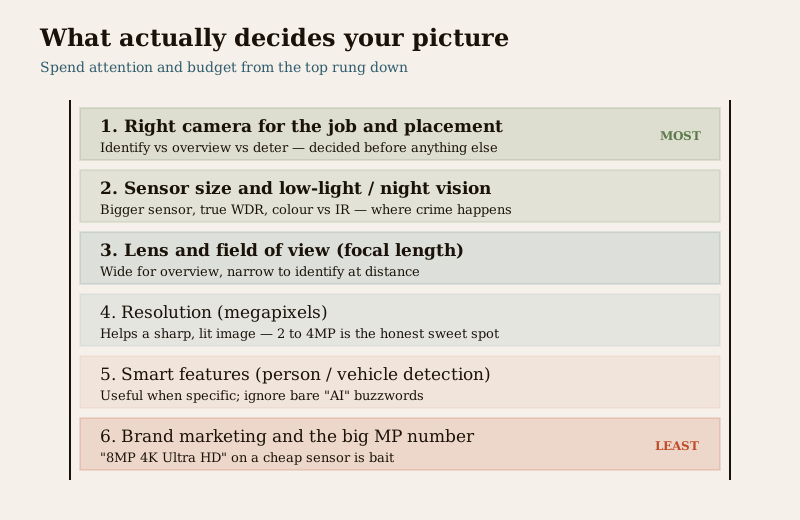
Resolution (measured in megapixels, or as 2MP/1080p, 4MP, 5MP, 8MP/4K) sets how much fine detail a sharp, well-lit image can hold. More pixels genuinely help when you need to read a plate or crop into a face. But three cautions:
- More megapixels on a small, cheap sensor makes night footage worse, not better. Cramming 8 million pixels onto a tiny sensor means each pixel is smaller and collects less light, so in low light you get more noise and smear. This is the central trap of the market.
- Your recorder and storage have to keep up. Higher resolution means far bigger files — more storage, or footage overwritten sooner. That trade-off is real money and lives in the cost guides.
- 2MP to 4MP is the honest sweet spot for most home spots. Go higher only where you truly need to identify at distance and you have paid for a good sensor to back it.
Sensor and low-light — the spec they hide
Almost every crime you care about happens at night, so how a camera sees in the dark is the most important thing about it — and it is the spec least advertised. Two things drive it:
- Sensor size. A physically larger sensor (you will see figures like 1/2.8" versus a smaller 1/3" or 1/4") gathers more light. Bigger is better, and it matters far more than megapixels for usable night footage.
- The kind of night vision. There are two families, and the difference is stark:
| Night-vision type | What you get | Best for |
|---|---|---|
| Infrared (IR) | Black-and-white image using invisible IR light. Standard, reliable, works in total darkness. | Most spots; anywhere with no ambient light. |
| Colour night vision | Keeps colour at night using a large sensor plus a warm spotlight or a very sensitive sensor. Colour helps identify clothing, vehicles. | Gate, driveway, entry — where some light exists and detail matters. |
| True dual / hybrid | IR when it is pitch dark, colour when there is a little light. The most flexible. | The one identify-critical camera you care most about. |
Also look for genuine WDR (Wide Dynamic Range) — "true WDR", not "digital WDR" — which handles scenes with both bright and dark areas, like a doorway against glare or a gate lit by a streetlight. Without it, a backlit face becomes a black silhouette.
Lens and field of view — the quiet decider
A camera's lens (its focal length, in mm) sets the trade-off between how wide it sees and how much detail it captures at distance. You cannot have both from one camera.
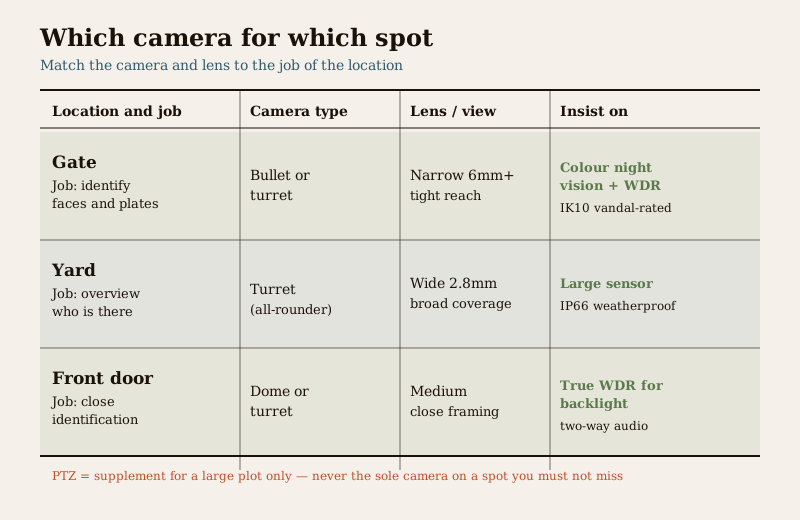
- Wide angle (short focal length, e.g. 2.8mm, ~90–110 degrees) — sees a broad area up close; ideal for overview of a yard, hall or drive. Detail falls off with distance.
- Narrow / longer (e.g. 6mm and up) — a tighter, longer reach; ideal to identify a face or plate at a specific point like a gate.
A wide camera pointed at a distant gate gives you a tiny, unreadable figure. This mismatch — wrong lens for the distance — ruins more home footage than any resolution shortfall.
Form factor — pick the body to the mount
The camera's shape is not cosmetic; each form suits certain spots.
| Type | Looks like | Strengths | Best placement |
|---|---|---|---|
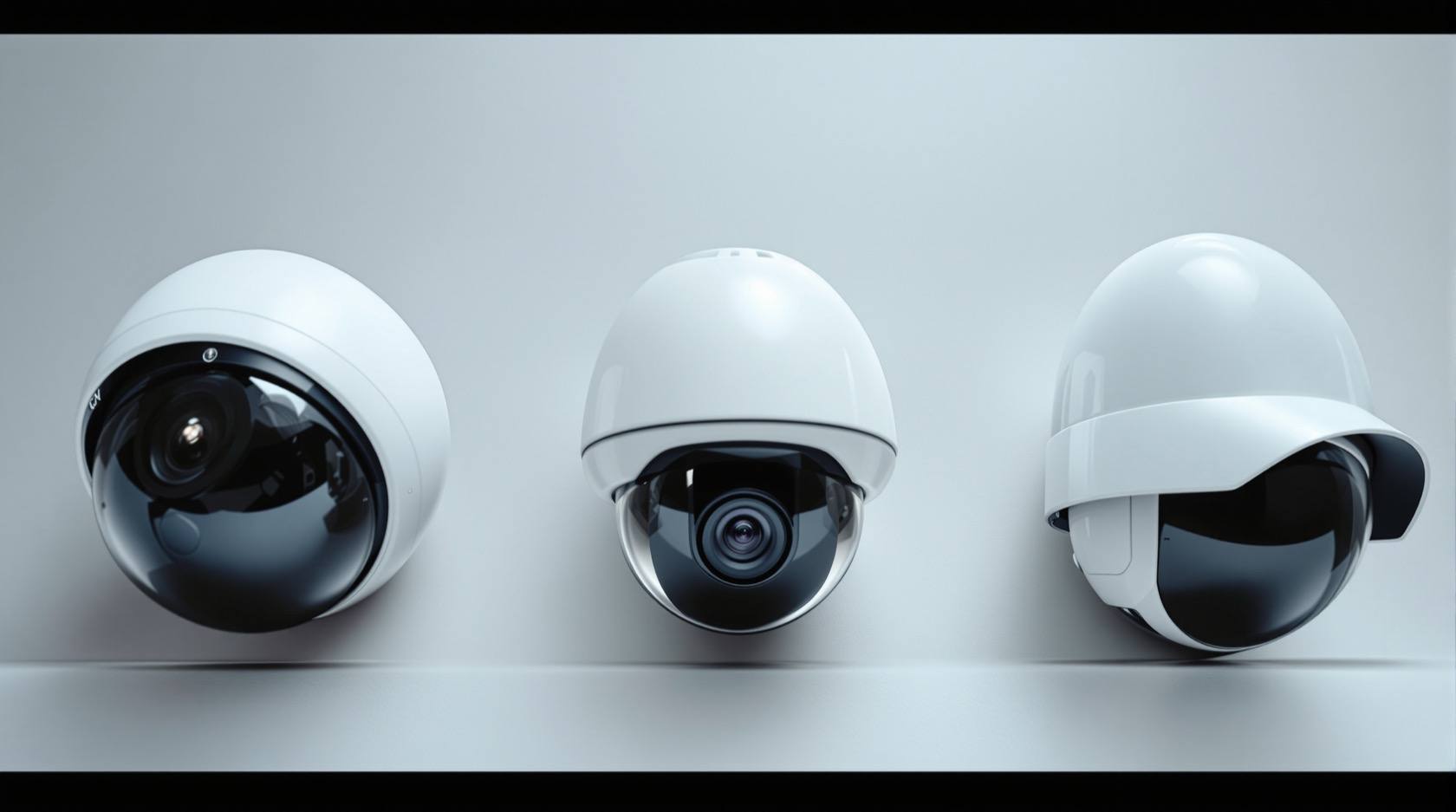
| Dome | Half-sphere, often ceiling/soffit | Discreet, hard to tell where it points, tidy | Under a porch, in a hall, entrance ceiling |
| Bullet | Cylindrical, clearly aimed | Visible deterrent, longer reach, easy to aim | Gate, driveway, along a boundary wall |
| Turret / eyeball | Ball in a socket | Great IR (less glare/reflection than dome), easy to aim, weather-hardy | The everyday all-rounder for most outdoor spots |
| PTZ (pan-tilt-zoom) | Motorised, moves and zooms | Covers a large area, can zoom in on demand | Large plots — usually a supplement, not the only camera |
For most Indian homes, a turret is the sensible default outdoors: it gives cleaner night footage than a dome (whose bubble can reflect the IR back and fog the image) and is less of a target than a protruding bullet. A PTZ is tempting but it is only ever looking one way at a time — never make it your only camera on an area you must not miss.
IP and analog — a wiring decision, not a quality verdict
You will be pushed to choose between IP cameras (digital, networked, recorded on an NVR) and analog/HD-over-coax cameras (recorded on a DVR). Both can be good; it is mainly a question of cabling, scale and features:
- IP — sharper high-resolution options, richer smart analytics, single-cable PoE wiring, easier to expand. Costs more per camera. See the IP CCTV cost guide.
- Analog — cheaper, simpler, perfectly adequate for a small home, reuses existing coax. See the analog CCTV cost guide.
The recorder side of this choice — how footage is stored and for how long — is a decision of its own; the NVR vs DVR guide covers it, and installation realities live in the installation cost guide.
Weatherproofing (IP rating) and vandal resistance (IK rating)
Two ratings on the box, two different things — do not confuse them:
- IP rating — protection against dust and water. Any outdoor camera in India, facing monsoon and dust, should be at least IP66. Indoor-only cameras need not be.
- IK rating — impact/vandal resistance. Worth having (e.g. IK10) on any camera within arm's reach — at a gate, low on a wall — where someone could smash or twist it.
Power — PoE vs adaptor
- PoE (Power over Ethernet) — one network cable carries both data and power. Neat, reliable, easy runs. The default for IP cameras.
- DC adaptor — a separate power supply per camera. Fine, but more wires and more points of failure. Common with analog.
Wireless/battery cameras exist and suit a spot with no cabling, but weigh the recurring battery/charging chore and Wi-Fi reliability before making them your main line.
Audio and smart features — useful vs gimmick
- Two-way audio — genuinely useful at a door or gate (challenge a visitor, deter a lurker). Note it is legally sensitive; recording audio of people has stricter footing than video.
- Person / vehicle detection — the smart feature worth having. Filtering alerts to people and vehicles cuts the flood of false alarms from cats, shadows and swaying trees, so you actually read your notifications instead of muting them.
- The gimmicks — "AI" as a bare buzzword, "colour night vision" with no large sensor to back it, "4K" on a cheap sensor, auto-tracking on a PTZ you will rarely use. Pay for the analytics you will use daily; ignore the rest.
Match it to your situation
Right-size the system to your home and your real risk — the most expensive camera is rarely necessary, and the cheapest is often a false economy.
- A small flat or compact house. Two or three cameras — front door, main entry, one overview — a good 2–4MP turret each, one on identify duty at the door. Analog is often plenty.
- An independent house with a gate and yard. A gate camera set to identify (narrow lens, colour night vision, WDR, vandal-rated), turrets for yard overview, a dome at the door. IP with PoE pays off as the count grows.
- A larger plot or corner property. Add a PTZ or a long-lens bullet to reach the far boundary, but keep fixed cameras on the spots you cannot afford to miss.
Whatever the size: put your best camera and your budget on the one or two identify-critical spots (the gate, the main door). It is better to have two excellent cameras where identification matters than eight cheap ones that all give unusable night footage.
Certification, standards and privacy — a buyer's checks
- BIS / ISI where it applies. Look for genuine BIS certification and honest compliance marks; CCTV sold in India is increasingly expected to meet BIS and cyber-safety norms. Treat a missing or vague certification claim as a warning.
- DPDP Act 2023. Because cameras capture identifiable people, where a camera can see is a purchase criterion. Choose lenses and mounts that cover your property, not a neighbour's window or the shared stair of an apartment — over-wide "sees everything" cameras create a privacy liability. This is where megapixel-chasing quietly points: a camera that can read a face 30m away can also read your neighbour's.
- Warranty and support. A real warranty (2–3 years is common on reputable gear), an Indian service presence and firmware updates matter more than one extra megapixel. No-name gear with no warranty is a false economy.
Red flags — when to walk away
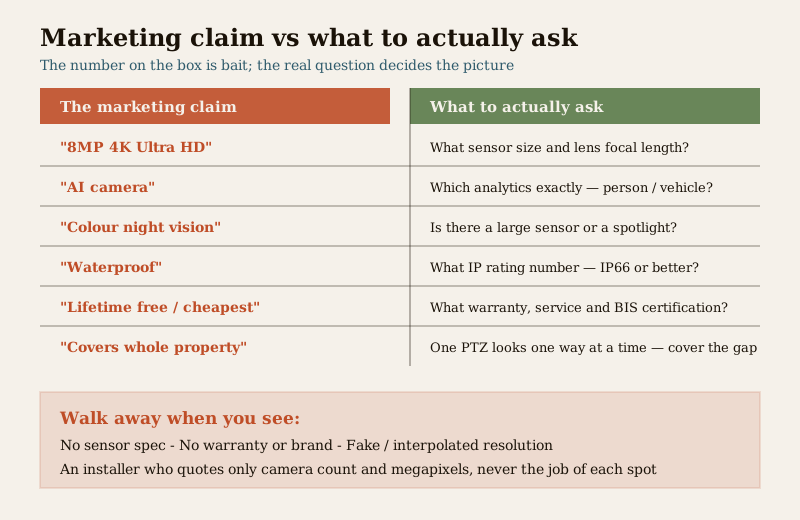
Walk away from a "spec" that is only a number. A listing that shouts "8MP 4K" but will not tell you the sensor size, the lens focal length, the night-vision type or the true-WDR support is hiding the things that decide picture quality. The number is bait.
Other clear warning signs:
- Fake or inflated resolution. Software "interpolated" megapixels, or a resolution the sensor cannot actually deliver.
- No brand, no warranty, no service. Unbranded gear that fails in a year with no recourse.
- "Colour night vision" with a tiny sensor and no spotlight — the colour will collapse into noise the moment it is genuinely dark.
- An installer who quotes only camera count and megapixels and never asks what each spot needs to do. That is a red flag about the whole job, not just the camera.
- A single PTZ sold as covering "the whole property" — it only ever looks one way at a time.
The buying checklist
Before you commit, run each camera and each spot through this:
- The job is decided. Every position is set to identify, overview, or deter — and the camera suits it.
- Night performance is checked. You know the sensor size and the night-vision type; identify-critical spots have colour night vision or true dual mode, plus true WDR.
- The lens matches the distance. Wide for overview, narrow/longer to identify at the gate. No wide lens pointed at a far target.
- Form factor fits the mount. Turret as the outdoor default; dome for discreet ceilings; bullet or long lens for reach; PTZ only as a supplement.
- Ratings are right for the place. IP66-plus outdoors; IK10 where a camera is within reach.
- Power and wiring are planned. PoE for IP; sensible adaptor runs otherwise.
- Smart features are the useful ones. Person/vehicle detection yes; unspecified "AI" no.
- Certification, warranty and privacy pass. BIS where applicable, a real multi-year warranty and Indian service, and no lens that overlooks a neighbour or shared space (DPDP).
- Budget is placed where it counts. Your best cameras on the identify-critical spots, not spread thin.
Choose this way and the camera stops being a number on a box and becomes a tool that does a defined job — which is the only test that matters at 2am when you finally need the footage.
For the wider picture — how cameras sit inside a whole home security scheme, and how much it all costs — start from the security system selection guide and the security hub.
Export this guide
Related Guides — Deep-dive reading
PoE vs Wi-Fi CCTV: Which Home Security Cameras Are Better?
One camera type runs power and video down a single Cat6 cable to an NVR and almost never drops out; the other clips to a wall in minutes and streams over your home Wi-Fi. This guide settles PoE vs Wi-Fi CCTV for Indian homes — reliability, video quality and bandwidth, cabling and power, retrofit versus new-build effort, NVR versus SD and cloud storage, hacking risk, real rupee costs, scalability and outdoor use — and gives a clear verdict for each kind of home.
Smart HomeThermal Cameras for CCTV in India: See Heat, Not Light, Explained
How a thermal camera images the warmth of people, animals and vehicles to detect an intruder across a large dark plot, why it cannot show a face or a number plate, and where it fits on an Indian property.
SecurityInfrared vs Colour Night Vision CCTV in India (2026): Which Sees Better in the Dark?
A homeowner's head-to-head between traditional infrared (IR) night vision, which lights the scene invisibly and shows a black-and-white image, and colour night vision, which keeps the picture in colour at night using a very sensitive sensor and a little white light — with an honest verdict on when each wins and why a hybrid camera is usually the smartest buy.
SecurityRelated Tools — Try Free
CCTV Camera Coverage & Count Calculator
Estimate how many CCTV cameras you need, the NVR channels, storage in TB for your retention period, and an indicative all-in cost with GST.
CCTV CalculatorCCTV Placement Compliance Checker
A quick DPDP-grounded privacy and safety self-check for where a camera is pointed — flags the items to fix.
ComplianceCCTV Camera Type Selector
Answer five questions and get the right camera form factor — dome, vandal dome, bullet, turret or PTZ — with reasons.
Camera Selector