

Water-Secure Homes: Designing for India's Dry Future
Build a home that stays wet when the supply runs dry — sized storage, rainwater, recharge and the dual plumbing you can only provision once.
In the summer of 2024, Bengaluru — a city built on lakes — ran so short of water that apartment complexes rationed flushing, schools shifted online, and the going rate for a tanker doubled, then tripled. It was not a freak event. It was a preview. Across India the story rhymes: Chennai's "Day Zero" in 2019, the falling water tables of Punjab and Haryana, the saline creep into Gujarat's coastal aquifers, the tanker economy that quietly governs how hundreds of new layouts actually live. The municipal pipe, where it exists, arrives for an hour or two a day, on a good day.
Most of us respond to this the way we respond to a power cut: we buy our way out. A bigger sump, a deeper borewell, a tanker on speed-dial. These are bailing buckets, not a boat. The home that will be comfortable in 2040 is not the one with the biggest tank — it is the one designed, from the foundation up, to need less water, to catch the water that falls on it, to use the same litre more than once, and to put the surplus back into the ground beneath it.
And here is the catch that makes water different from almost every other system in your house: the single most powerful move — a second plumbing line so that bath water can flush your toilets and water your garden — is something you can lay for a few tens of thousands of rupees while the walls are open, and which costs lakhs and weeks of demolition to add later. Water security is overwhelmingly a provisioning problem, decided at construction, not at occupancy.
A water-secure home is one designed to cut demand, harvest its own rainfall, recycle every litre it can, and recharge the rest into the ground — with the dual plumbing and storage stubbed in now, because the lines you skip today cannot be added cheaply tomorrow.
1. Start with the home water balance
Everything downstream depends on one honest number: how much water your household actually uses in a day. Indian planning norms (the CPHEEO manual that municipal engineers work to) assume roughly 135 litres per person per day for a home with full plumbing and flushing — and metro households with multiple bathrooms, a garden and a washing machine routinely exceed it. A family of four at 135 litres is 540 litres a day, around 16,000 litres a month; many comfortable urban homes touch double that.
Break that number down and the design moves announce themselves, because not all of it needs to be fresh, treated water:
| End use | Share of household water | Quality needed | Can be greywater / rainwater? |
|---|---|---|---|
| Toilet flushing | 25–30% | Low | Yes — greywater or rainwater |
| Bathing & showering | 25–30% | High (clean) | No (but produces greywater) |
| Laundry | 15–20% | Medium | Partly (rainwater) |
| Kitchen & drinking | 10–15% | Highest (potable) | No |
| Garden, washing, cleaning | 10–20% | Low | Yes — greywater or rainwater |
The punchline is stark: roughly 40–50% of a typical home's water demand does not need fresh supply at all. Flushing and gardening alone — a quarter to a half of everything you use — can run on recycled or harvested water. That is the prize the rest of this guide is built around. A water-secure home is not about hoarding fresh water; it is about routing the right grade of water to the right tap.
If you are also thinking about heat, passive cooling and the broader 2040 picture, our climate-adaptive homes guide sets the wider frame; water is the twin of the energy story told in net-zero energy homes, and both sit under the cluster pillar, designing homes for 2040.
2. Cut demand first — fixtures and metering
The cheapest litre is the one you never draw. Before any tank or recharge pit, fix the leaks in your demand. Modern water-efficient fixtures cut consumption with no change to how the home feels:
- Dual-flush cisterns (3/6 litre, or the newer 2.5/4 litre) instead of the old 10–13 litre single flush — this alone can halve flushing water, your single biggest indoor use.
- Aerated taps and low-flow showerheads mix air into the stream; a 6–8 litre/minute shower head feels as full as a 15-litre one.
- Front-loading washing machines use roughly 40–50% of the water of a top-loader per load.
- A pressure-reducing valve on the inlet, because high pressure simply pushes more water out of every open tap.
Demand management is not deprivation. A well-specified efficient home delivers the same showers, the same clean clothes and the same full glass of water on 30–40% less supply — you simply stop wasting what you never noticed.
The other half of demand control is visibility. You cannot manage what you cannot see. A simple inline water meter on the main inlet (and ideally a second on the borewell) turns an invisible flow into a number you watch — the same logic behind energy monitoring in our smart infrastructure planning guide. A sudden jump usually means a hidden leak or a stuck float valve overflowing a tank at 3 a.m.; metered homes catch in days what unmetered homes pay for over months. Provision a short straight run of accessible pipe near the inlet now so a meter (or a smart leak sensor) drops in without cutting into a wall.
3. The dual plumbing line — the one thing you must provision now
This is the heart of a water-secure home, and the reason this guide exists. A conventional home has one water system: fresh water in, sewage and waste out, mixed together. A water-secure home has two clean-water lines:
1. The fresh (potable) line — drinking, kitchen, bathing, laundry.
2. The greywater / non-potable line — recycled bath and wash water (and harvested rainwater) feeding toilet flushing, the garden, floor and car washing.
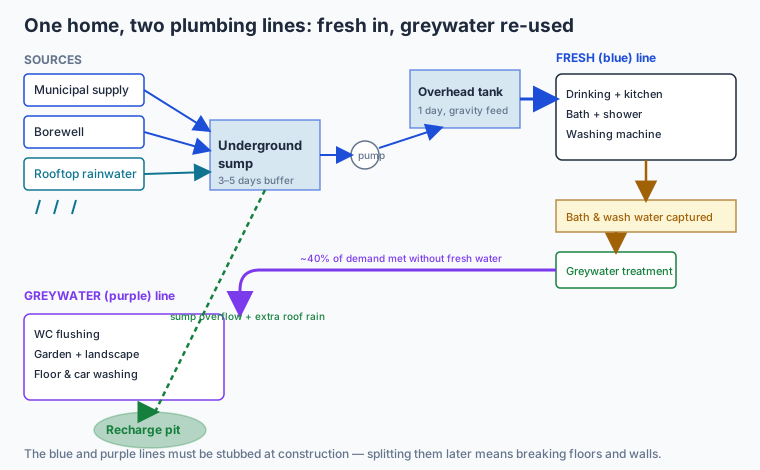
Figure 1: The fresh (blue) line and the greywater (purple) line run as two separate networks. Roughly 40% of demand — flushing and gardening — can be met without drawing fresh water, but only if the second line is stubbed in before the floors are cast.
The critical word is separate. The greywater line is a physically distinct set of pipes, conventionally marked in a different colour, that must never cross-connect with the drinking line. Running it means a parallel pipe network buried in your floors and walls — which is trivially cheap to add while the slab is being cast and walls are unplastered, and brutally expensive to add afterwards, because retrofitting means breaking finished floors, chasing tiled walls, and redoing the work room by room.
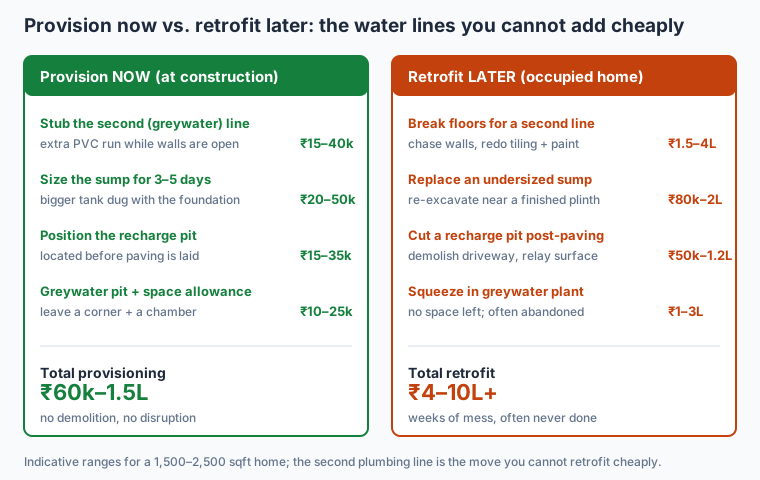
Figure 2: The provisioning maths. The second plumbing line is the single move you genuinely cannot retrofit cheaply — stub it now even if you commission the greywater plant years later.
| Provision now (at construction) | Retrofit later (occupied home) | Why the gap is so large |
|---|---|---|
| Stub a second greywater line: ₹15,000–40,000 | Break floors & chase walls for it: ₹1.5–4 lakh | Demolition, re-tiling, repainting, displacement |
| Size the sump for 3–5 days: ₹20,000–50,000 extra | Re-excavate a bigger sump: ₹80,000–2 lakh | Digging beside a finished plinth, restoring paving |
| Position the recharge pit pre-paving: ₹15,000–35,000 | Cut a pit after paving: ₹50,000–1.2 lakh | Demolish & relay the driveway |
| Leave space + a chamber for greywater: ₹10,000–25,000 | Squeeze a plant into a finished plot: ₹1–3 lakh | Usually no space left; often abandoned |
Even if you are not ready to install the greywater treatment unit on day one, stub the line and cap it. A capped pipe behind the wall waiting for a future plant is the textbook provisioning move — the same philosophy that runs through our future-proof wiring guide for electrical conduits. Provision the pipe; commission the plant when you choose.
4. Greywater recycling — using the same litre twice
Greywater is the relatively clean wastewater from your baths, showers, washbasins and washing machine — everything except toilet waste (that is blackwater) and the grease-heavy kitchen sink, which most simple systems exclude. It is typically 50–60% of the wastewater a home produces, and after basic treatment it is perfectly good for flushing and irrigation.
The treatment can be as simple or as engineered as you like:
- Basic gravity systems — a settling and filtration chamber (sand, gravel, sometimes a planted reed bed) that cleans bath and wash water enough for garden use. Low cost, low maintenance, ideal where you have a little outdoor space.
- Packaged greywater treatment units — compact tanks with filtration and disinfection (often UV or low-dose chlorine) that produce water clean enough to send back to toilet cisterns. Higher cost, but the system that closes the loop on flushing.
A home recycling its greywater for flushing and the garden routinely cuts fresh-water demand by 30–45% — the difference between a borewell that lasts the summer and one that runs dry in April. The constraint is almost never the technology; it is whether you provisioned the second line and left space for the plant. Greywater that also irrigates the garden ties directly into site-level water design — our companion guide on sustainable water management in the landscape covers the planting, soak-pits and rain gardens that absorb it.
5. Rainwater harvesting and recharge — catch what falls on you
Every monsoon, an astonishing volume of water lands on your roof and runs straight into the storm drain. The arithmetic is simple and worth doing on the back of an envelope:
Harvestable litres = roof area (sqm) × annual rainfall (mm) × 0.8 (runoff factor)
A modest 100 sqm roof in a city with 900 mm of annual rain yields about 72,000 litres a year — enough to cover a small family's flushing and gardening for months. In high-rainfall coastal and Western Ghat cities the number is far larger. Our rainwater tank sizer turns your roof area and local rainfall into a recommended tank volume in seconds.
There are two things to do with that water, and a water-secure home does both:
1. Store some for direct use. Route roof runoff through a first-flush diverter (which dumps the dirty initial wash) and a filter into a dedicated tank, then into your greywater/non-potable line.
2. Recharge the surplus into the ground. Once your storage is full, the overflow should go to a recharge pit — a gravel-and-sand-filled pit that lets water percolate down to the aquifer instead of running off. This is how you refill the borewell you depend on.
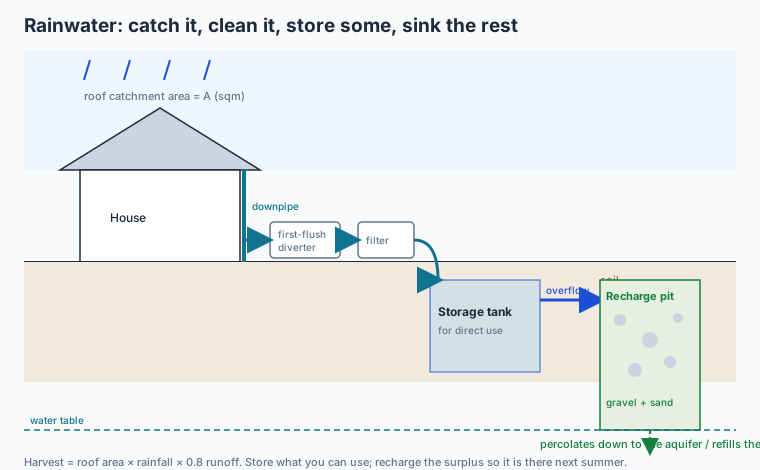
Figure 3: Catch it, clean it, store what you can use, and sink the rest. The recharge pit is what turns a single monsoon into water that is still in the ground the following summer.
The Central Ground Water Board (CGWB) has long pushed artificial recharge precisely because India over-draws its aquifers; a recharge pit on every plot is, at scale, the cheapest aquifer-restoration programme the country has. Many city building bye-laws and RERA-approved layouts now mandate rainwater harvesting above a plot threshold — so this is often a compliance item as well as a smart one. The position of the recharge pit is a site-planning decision best made before paving is laid; this guide gives the whole-home view, while the dedicated rainwater harvesting guide is the deep how-to on first-flush diverters, pit sizing and filter media.
6. Sizing storage — sump and overhead tank
Storage is your buffer against an erratic supply, and Indian homes almost universally use a two-tank system: an underground sump that fills when the supply (municipal, borewell or tanker) is available, and an overhead tank that the sump pumps up to, feeding the house by gravity.
The design question is: how many days of buffer do you want? In a city with daily supply, a small buffer is fine. In a tanker-dependent layout or a borewell that you ration in summer, you want more. A practical rule:
| Buffer target | Sump sizing (family of 4, ~540 L/day) | Best for |
|---|---|---|
| 1 day | ~600–800 litres | Reliable daily municipal supply |
| 3 days | ~1,800–2,500 litres | Most homes — covers a missed delivery |
| 5 days | ~3,000–4,000 litres | Tanker-dependent, erratic supply, weekend gaps |
The overhead tank is usually sized for about one day of use (500–1,000 litres for a small family) — enough to ride out the daily pumping cycle and a short power cut, without loading the roof slab with tonnes of water. The sump is where the real buffer lives, because it is structurally easy to make large when it is dug with the foundation. Oversizing a sump at construction adds a little excavation and concrete; enlarging it later means excavating beside a finished house. Size for your worst supply month, not your average one. Keeping these tanks scrupulously sealed against light and mosquitoes — a covered, vented sump — is a quiet but real health provision.
7. Borewell, municipal and tanker — reducing dependence
Most Indian homes juggle two or three sources, each with its own failure mode. The water-secure goal is not to pick one but to reduce dependence on all of them by feeding in your own harvested and recycled water.
| Source | Reliability | Cost trend | The catch |
|---|---|---|---|
| Municipal piped | Intermittent (1–2 hrs/day common) | Cheapest, but rising | Coverage gaps; pressure and timing unpredictable |
| Borewell | Good until the table falls | Pumping electricity + falling yield | Over-extraction drops the table; can run dry or turn saline |
| Tanker | On-demand but volatile | Most expensive; spikes in summer | Price triples in a shortage; quality varies |
The borewell deserves a special caution: it feels like independence, but a borewell only works as long as the shared aquifer beneath your neighbourhood holds water. When every house draws and none recharges, the table falls for everyone and the deepest pocket wins the deepest bore — a losing race. This is exactly why the recharge pit in Section 5 is not optional: the borewell you rely on is only as secure as the water you put back. A home that harvests, recycles and recharges can cut its purchased water by half or more, turning the tanker from a lifeline into an occasional top-up.
8. Treatment basics — and the RO reject trap
Clean water for drinking is the one use you should never compromise, and in much of India that means a point-of-use reverse-osmosis (RO) purifier in the kitchen. RO works, but it has a wasteful secret: it discards a large share of its input as concentrated "reject" water — often 2 to 3 litres rejected for every litre purified. In a water-scarce home, pouring that down the drain is exactly the wrong instinct.
The reject is not sewage; it is simply water with a higher mineral concentration, and it is perfectly usable for the low-grade jobs your greywater line already serves — mopping floors, flushing toilets, washing the car, watering salt-tolerant plants. Plumb the RO reject into a small collection container or, better, into the greywater line itself, and you recover thousands of litres a year that most homes throw away. For the rest of the house, a sediment-and-carbon filter on the inlet protects fixtures and appliances from the silt that erratic supply often carries.
Match the treatment to the use: RO for the glass you drink, simple filtration for the bath and wash, and recovered reject and greywater for everything that just needs to be wet. Over-treating water you only use to flush is its own kind of waste.
9. A provisioning checklist for the build
If you take nothing else from this guide, take this: water security is won or lost at the slab stage. Hand your contractor and plumber a short, non-negotiable list before the floors are cast:
- Stub a second (greywater) plumbing line to every toilet and at least one garden tap — cap it if the treatment plant comes later. This is the irreplaceable one.
- Size the sump for your worst supply month, not your average — 3 days minimum, 5 for tanker-dependent areas.
- Position and dig the recharge pit before paving and driveways are laid.
- Leave a corner and a chamber for a future greywater treatment unit so it is never "there's no space" later.
- Route every roof downpipe to a first-flush diverter and harvesting tank, with a defined overflow path to the recharge pit.
- Provision an accessible meter run on the inlet (and borewell) for monitoring and leak detection.
- Specify dual-flush cisterns, aerated taps and low-flow showers in the fittings schedule from day one.
None of these are exotic. Together they are perhaps 1–2% of a home's build cost, and they are the difference between a house that needs a tanker every dry week and one that quietly looks after itself. To put real rupee figures against your own build, run the numbers through our cost calculator; to size the harvesting tank to your roof and city, use the rainwater tank sizer. When the next Bengaluru summer arrives — and it will — the homes that stay wet will be the ones whose owners thought about water while the cement was still wet.
Sources & further reading
- CPHEEO, Ministry of Housing & Urban Affairs — Manual on Water Supply and Treatment (per-capita demand norms, including the ~135 litres per person per day benchmark for fully plumbed homes).
- Central Ground Water Board (CGWB) — guidelines and master plan for artificial recharge to groundwater; rainwater harvesting structures and recharge-pit design.
- Central Pollution Control Board (CPCB) — guidance on greywater reuse and decentralised wastewater treatment for households and group housing.
- National Building Code of India (NBC 2016), Part 9 — plumbing services; water supply, drainage and on-site water management provisions.
- Bureau of Indian Standards — IS 1172 (water requirements for buildings) and related plumbing standards.
- Bureau of Energy Efficiency (BEE) / Eco Niwas Samhita — residential energy code; relevant where pumping and water-heating energy intersect water design.
- Municipal building bye-laws and RERA-approved layout norms — many cities now mandate rainwater harvesting above a plot-size threshold; confirm your local rule.
Pairs with: the cluster pillar Designing Homes for 2040, Net-Zero Energy Homes, and Climate-Adaptive Homes.
Export this guide
Related Guides — Deep-dive reading
Rooftop Water Recycling Integration in Homes: One Non-Potable System from Rain and Greywater
How to combine rooftop rainwater harvesting with greywater and STP reuse into a single non-potable water system — the storage, dual plumbing, controls and seasonal logic that make two sources behave like one reliable supply.
Sewage Treatment PlantsGreywater Recycling India: Reusing Bathroom Water for Flushing & Gardens
How to recycle the basin and shower greywater from an Indian bathroom — simple diversion versus filtered and disinfected systems, the separate drainage you must plan at construction, storage, dual-plumbing to the WC cistern, and honest numbers on cost, payback and health.
BathroomsBathroom Planning for New Homes in India: Get It Right Before You Build
The bathroom decisions you cannot undo once the slab is cast — location and stacking, sunken vs non-sunken slabs, waterproofing, and the plumbing, electrical and ventilation you must coordinate with the civil work, stage by stage.
BathroomsRelated Tools — Try Free
Rainwater Tank Sizer
How big should your rainwater tank be? Computes annual harvest, recommended tank capacity in litres, water-bill savings, and payback — for 10 Indian cities.
RWH CalculatorMonsoon-Readiness Checklist
Pre-rain home audit across 9 categories — terrace, drains, waterproofing, electrical, HVAC, pest, vehicles, documents.
Seasonal AuditCross-Ventilation Analyzer
Estimate airflow and air changes per hour (ACH) from room size, window areas, layout, and local wind — with NBC 2016 Part 8 compliance check.
Ventilation Calculator