
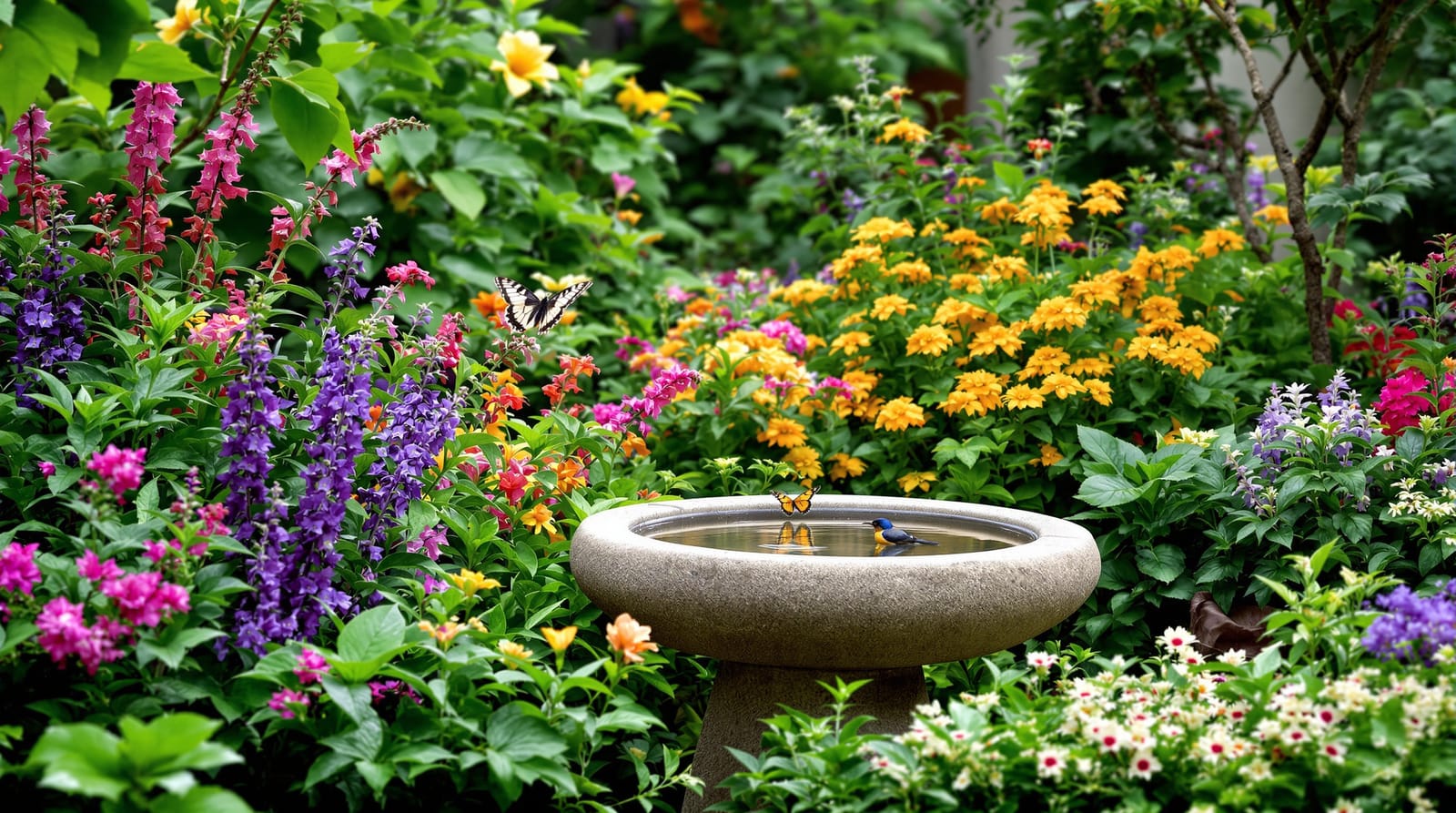
Wildlife-Friendly Home Landscapes — Gardening for Birds, Bees & Butterflies
Designing a home garden as habitat — native plants, habitat layers, water, host and nectar plants, year-round bloom and wildlife corridors, India's realities included
A home garden does not have to be mere decoration around the building — designed with even a little ecological intent, it can become living habitat: a place where sunbirds nest in the hedge, where butterflies complete their life cycle, and where the soil hums with the insects that quietly keep everything else alive. Most Indian gardens are designed as a stage set — clipped lawn, a row of exotic ornamentals, a colour scheme to admire from the verandah. That kind of garden is, ecologically speaking, almost empty. This guide is about the opposite ambition: making your plot earn its keep as part of the neighbourhood's living web, supporting the birds, butterflies, bees and beneficial insects that belong to the Indian landscape.
This is a different lens from our companion guide on Biophilic Landscape Design, which is about how greenery serves human health and psychology. Here the subject is the wildlife itself — what feeds it, what shelters it, and how a single garden plugs into something larger.
A garden can be a habitat, not just a backdrop
The instinct to "tidy" a garden is the single biggest obstacle to wildlife. A swept, mulched, manicured plot with a velvet lawn and three flowering exotics looks cared-for, but to a bird or a butterfly it is close to a desert. There is nothing to eat, nowhere to nest, no leaf litter for the insects that feed the chicks, and no continuity of bloom.
The shift in thinking is simple but profound: stop asking "what looks neat?" and start asking "what lives here, and what does it need to complete its life?" A wildlife-friendly garden is not untidy — it is differently ordered. It has structure, layers, and deliberate messiness in the right places. Crucially, it does not require a large plot. A balcony with the right three potted plants and a shallow water dish will draw sunbirds and skippers; a 30-by-40 site planted with intent can support dozens of species.
Why native plants matter: the food web
The most important decision you will make is what you plant — and specifically, whether you plant native species or the imported ornamentals that dominate Indian nurseries.
Native plants and native wildlife evolved together over millennia. The leaves of an Indian native are recognised food by native caterpillars; its flowers are shaped and timed for native pollinators; its fruit ripens when native birds need it. Exotic ornamentals — many of the most-sold nursery plants are South American, African or Australian in origin — are often beautiful but ecologically inert here. A common roadside example is the showy but largely sterile hybrid that no local insect can eat.
This matters because of the food web. The base of almost every terrestrial food chain is insects, and most insects — especially caterpillars — are fussy specialists that can only eat the plants they co-evolved with. Birds, in turn, depend on those insects: even seed-eating and nectar-feeding birds feed their nestlings on soft caterpillars and insects. No native plants, few native caterpillars; few caterpillars, no baby birds. A garden of exotics can be green and flowering and still raise almost no wildlife.
A useful rule of thumb: aim for a backbone of native and indigenous species, then add a few well-chosen exotics for colour or scent if you wish. Trees do the heaviest lifting; for choosing them well see Best Trees for Indian Homes.
| Plant type | Wildlife value | Examples for Indian gardens |
|---|---|---|
| Native nectar shrubs | Feed butterflies, sunbirds, bees | Lantana (native-type), Ixora, Hamelia, Pentas, Tecoma |
| Native flowering trees | Mass nectar + perches + nest sites | Indian coral tree (Erythrina), silk cotton (Bombax), kachnar (Bauhinia), Pongamia |
| Larval host plants | Let butterflies breed, not just visit | Curry leaf (host for lime butterfly), citrus, Aristolochia, Cassia, grasses |
| Fruiting natives | Feed bulbuls, barbets, koels | Jamun, neem, banyan/peepal (where space allows), Singapore cherry, mulberry |
| Seed and grass plants | Feed munias, sparrows | Native grasses, sunflower, amaranth, foxtail millet |
The wildlife you can actually attract
It helps to know your likely guests. In most Indian towns and cities, a thoughtfully planted garden will draw a familiar and rewarding cast.
Birds. The purple sunbird and purple-rumped sunbird are the showpieces — tiny, iridescent, and devoted to tubular flowers; plant Hamelia, Russelia or Hibiscus and they will arrive. Red-vented and red-whiskered bulbuls take fruit and insects and nest readily in dense shrubs. The tailorbird, which famously stitches leaves into a cradle, will breed in a leafy hedge. Add coppersmith and white-cheeked barbets (drawn to figs and fruit), tits, white-eyes, prinias, and the oriental magpie-robin, and most gardens can host fifteen to thirty species over a year.
Butterflies. Common, gorgeous, and a brilliant teaching tool for children. Expect the common mormon and lime butterfly (whose caterpillars eat citrus and curry leaf), the lemon pansy and blue pansy, the common jezebel, tigers and crows (which use milkweeds and Aristolochia), and a flurry of small grass blues and skippers. Butterflies are the clearest proof of an ecological garden, because — as we will see — they need you to grow both nectar and the right leaves.
Bees and beneficial insects. Beyond the domestic honeybee you will host the small, peaceable stingless bees (Tetragonula), leafcutter and carpenter bees, and a host of solitary bees that are superb pollinators. Just as important are the unglamorous beneficials: ladybird beetles, lacewings, hoverflies, mantises, and predatory wasps that keep pest numbers down for free — the heart of the pesticide-free approach below.
Habitat layers: canopy to ground
Natural habitats are vertically layered, and so should a wildlife garden be. Each layer suits different species, and the more layers you stack, the more niches you create on the same footprint of land.
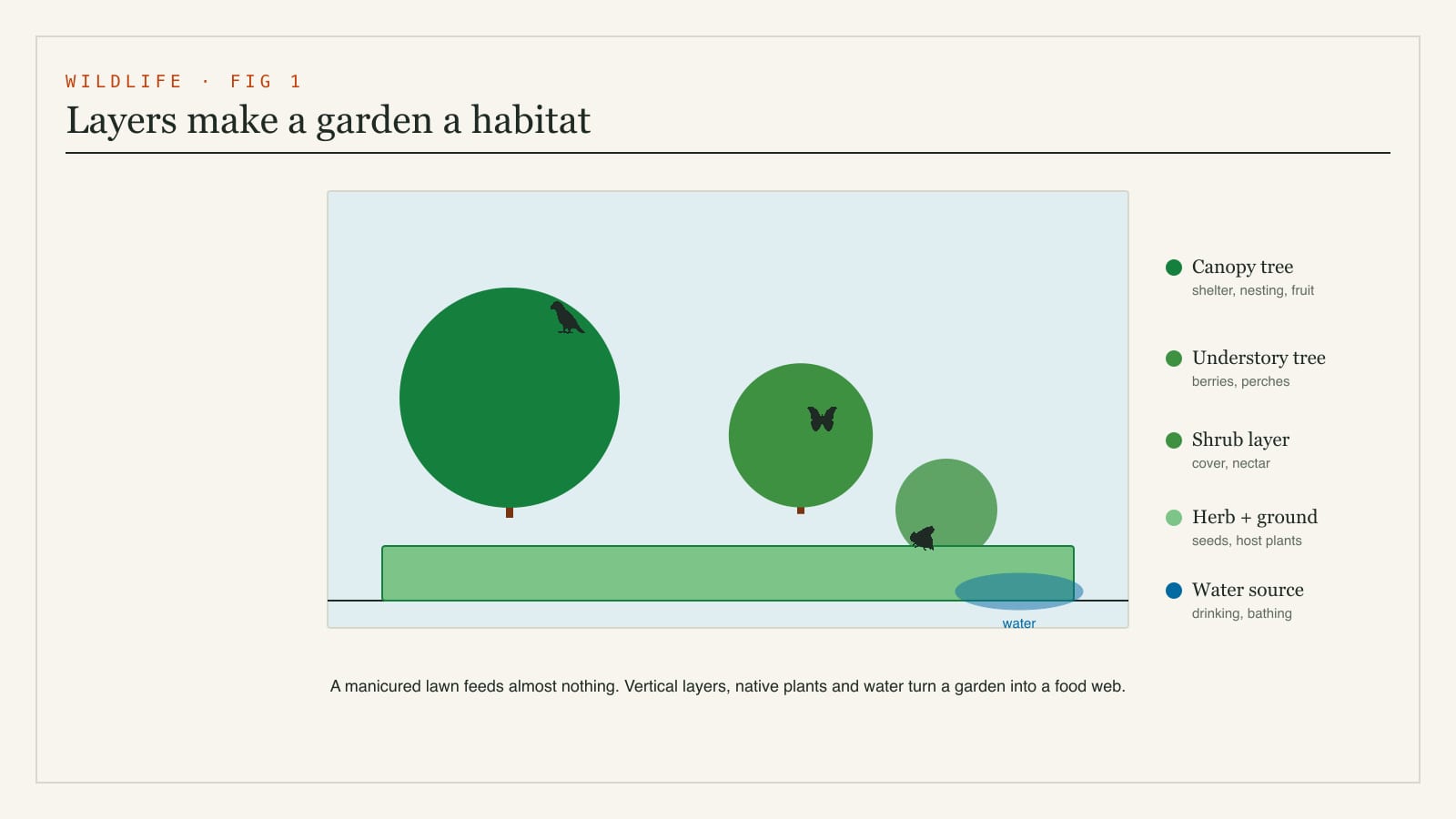
- Canopy (tall trees): Nesting sites, perches, mass nectar and fruit. Even one well-placed native tree transforms a plot — on small sites use Pongamia, Bauhinia or a compact fruiting tree rather than a giant peepal.
- Understory (small trees and tall shrubs): Songbird territory; barbets, bulbuls and tailorbirds operate here. Curry leaf, Singapore cherry, hibiscus, Ixora.
- Shrub layer: Dense cover for nesting and refuge from predators and hawks. Mixed, slightly informal shrubbery beats a single clipped hedge.
- Herbaceous and ground layer: Nectar borders, grasses, groundcovers; the realm of butterflies, bees and ground-feeding birds. Resist the urge to pave or lawn everything.
- Soil and litter: The forgotten layer — leaf litter, mulch and a little deadwood host the decomposers and insects that feed everything above.
- Water: A layer in its own right (see below).
This is also why a layered planted edge is worth more than a wall: it does the screening job while doing ecological work. The structural thinking overlaps with Residential Site Planning, where you decide early where mass planting can go.
Host plants versus nectar plants: the butterfly secret
Here is the single most useful idea in this guide, and the one most gardeners miss. Butterflies need two completely different kinds of plant:
- Nectar plants feed the adult butterfly — the flowers it sips from. These get all the attention.
- Larval host plants are the specific plants on which the female lays eggs and the caterpillars feed. Without these, butterflies visit but never breed, and your garden is a restaurant with no nursery.
The caterpillars will eat the leaves of the host plant — that is the point. A curry leaf plant chewed ragged by lime-butterfly caterpillars is not damaged; it is working. Tolerating that is the price of admission. Plant a few extra host plants so there is enough to share.
| Butterfly | Larval host plant | Good nectar plants |
|---|---|---|
| Lime butterfly, common mormon | Curry leaf, citrus (lemon, lime) | Lantana, Ixora, Pentas |
| Common / plain tiger | Calotropis (milkweed), Asclepias | Lantana, Tridax, marigold |
| Common rose, crimson rose | Aristolochia (Indian birthwort) | Pentas, Ixora, Clerodendrum |
| Lemon / blue pansy | Native grasses, Justicia | Lantana, Zinnia |
| Grass blues, skippers | Native lawn grasses, legumes | Small herbaceous flowers |
The lesson generalises: a wildlife garden plans for the whole life cycle, not just the photogenic adult.
Water for wildlife
After food, water is the fastest way to bring a garden alive — often quicker, because in the long dry Indian summer water is scarce and a reliable source is magnetic.
- Bird bath: A shallow stone or terracotta dish, 2–5 cm deep, with a rough surface for grip. Birds will not use deep, slippery water. Place it near (but not under) cover so birds can bolt to safety, and add a stone in the middle as a landing perch. A simple terracotta saucer costs ₹150–400; a carved stone bath ₹1,500–4,000.
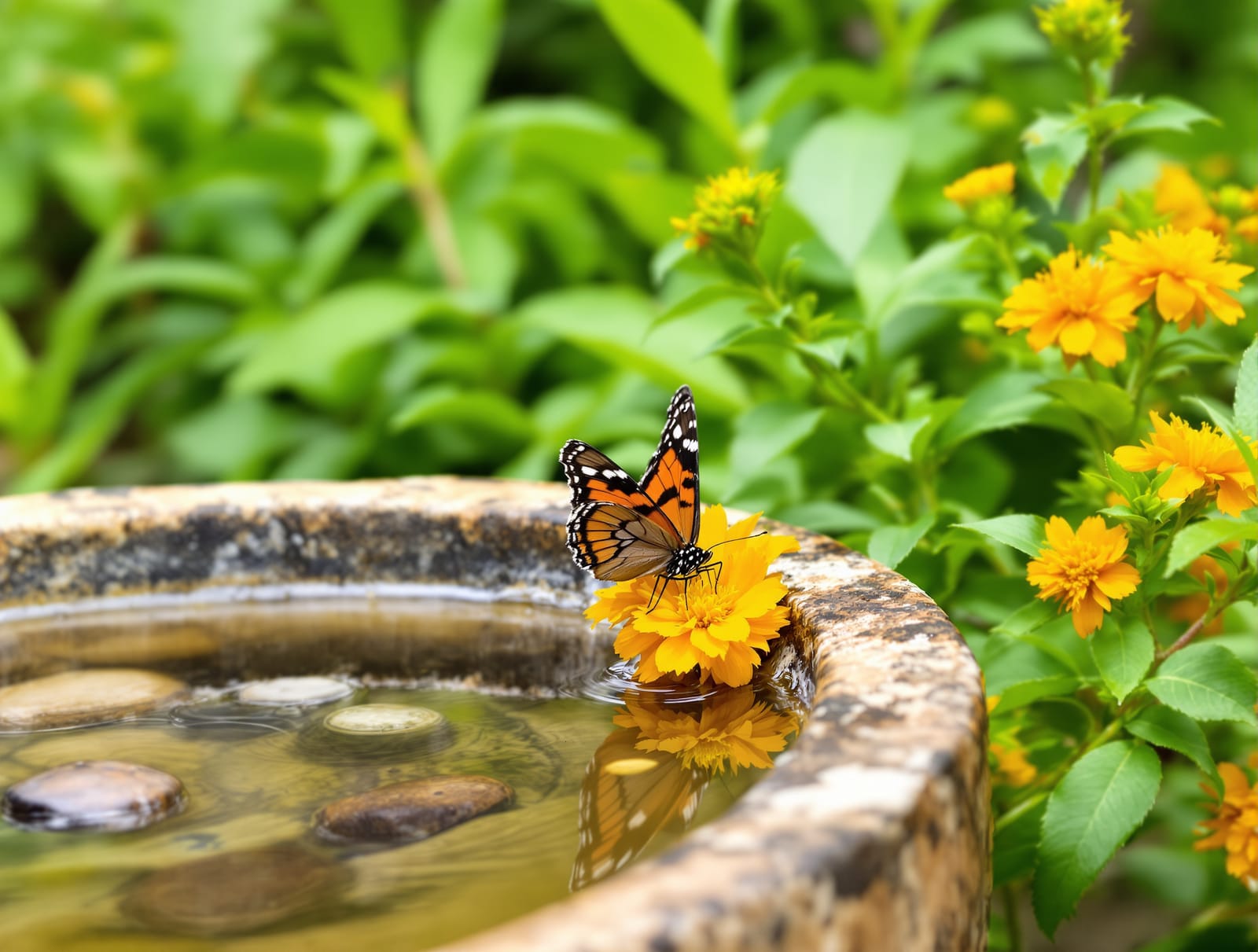
- Shallow dishes for butterflies and bees: Insects drown easily. Use a saucer with pebbles or marbles that break the surface, kept damp — butterflies "puddle" on wet mud and sand for minerals.
- A small pond: Even a half-buried tub with native aquatic plants and sloping sides (or a ramp stone so creatures can climb out) draws dragonflies, frogs and a different class of visitor.
The cardinal rule is hygiene and mosquito control: change or top up the water every day or two, scrub bird baths weekly, and never let any container hold still water for more than a few days. This is non-negotiable in dengue-prone India — covered in the realities section. For rainwater capture and overall water strategy see Sustainable Water Management in the Landscape.
Nesting, shelter and the value of a little mess
Wildlife needs somewhere to hide, breed and overwinter — and this is where the "tidy garden" instinct does the most damage.
- Dense shrubs and hedges are prime nesting habitat. A mixed, informally shaped hedge beats a single clipped wall of one species.
- Deadwood and log piles in a quiet corner host beetles, fungi, solitary bees and the geckos and skinks that eat mosquitoes.
- Leaf litter left under shrubs (not on lawns) shelters pupating insects and feeds the soil; raking it all away each week removes next year's butterflies.
- Standing seed heads left through winter feed munias and finches and look quietly beautiful.
- Nest boxes suit cavity-nesters where natural holes are scarce — sparrows and tits will use simple wooden boxes; sunbirds prefer to build their own hanging nests in sheltered shrubs and creepers.
Confine the "wild" zones to corners and edges if neatness matters to you; you can keep a crisp front and a productive, slightly shaggy back. Much of this thinking carries into a Villa Landscape Design, where larger plots can dedicate a genuine wild belt along a boundary.
Year-round bloom for pollinators
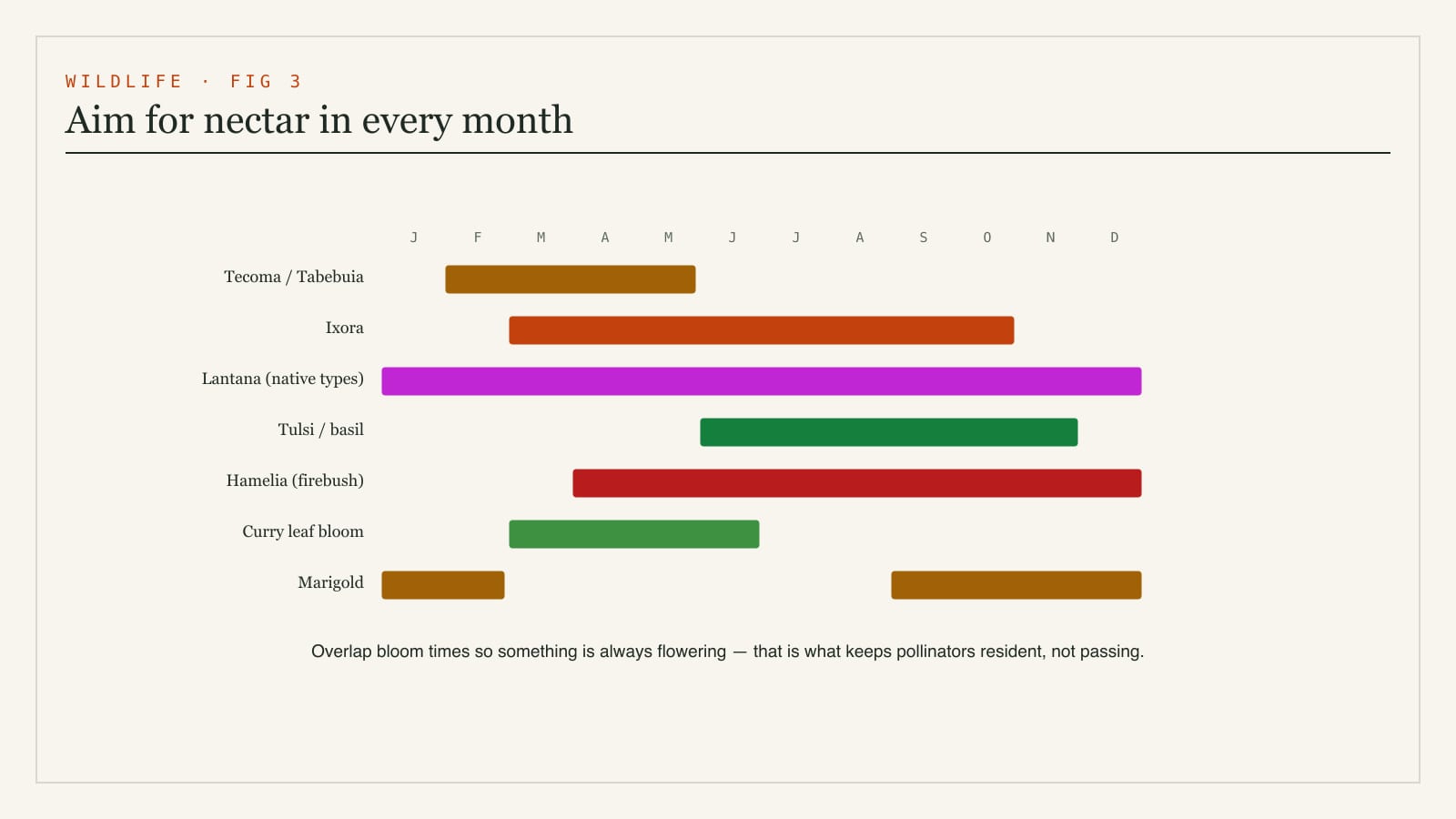
A pollinator needs food every month it is active, not a single spring flush. The commonest failure in Indian gardens is a burst of bloom in one season and a long hungry gap. Plan for continuity, choosing species that overlap across the year, with special attention to the lean late-summer and post-monsoon windows.
| Season | Reliable nectar / pollen plants |
|---|---|
| Winter (Dec–Feb) | Marigold, Salvia, Tecoma, Bauhinia, Cassia |
| Spring (Mar–Apr) | Erythrina (coral tree), silk cotton, Lantana, Ixora |
| Summer (May–Jun) | Hamelia, Pentas, Hibiscus, Tabebuia, Caesalpinia |
| Monsoon (Jul–Sep) | Clerodendrum, Turnera, native creepers, ground flora |
| Post-monsoon (Oct–Nov) | Duranta, Pentas, Lantana, late marigold, Tridax |
Layering several species per season — and including some that flower for months, such as Pentas, Hamelia and native-type Lantana — keeps the table set all year. Matching plant choices to your local climate is its own discipline; see Climate-Responsive Landscape Design.
Wildlife corridors: your garden is not an island
A single wildlife garden is good; a connected one is far better. Birds and insects move across the landscape, and isolated green patches separated by concrete behave like islands — small, fragile, easily emptied. Connectivity is what makes populations resilient.
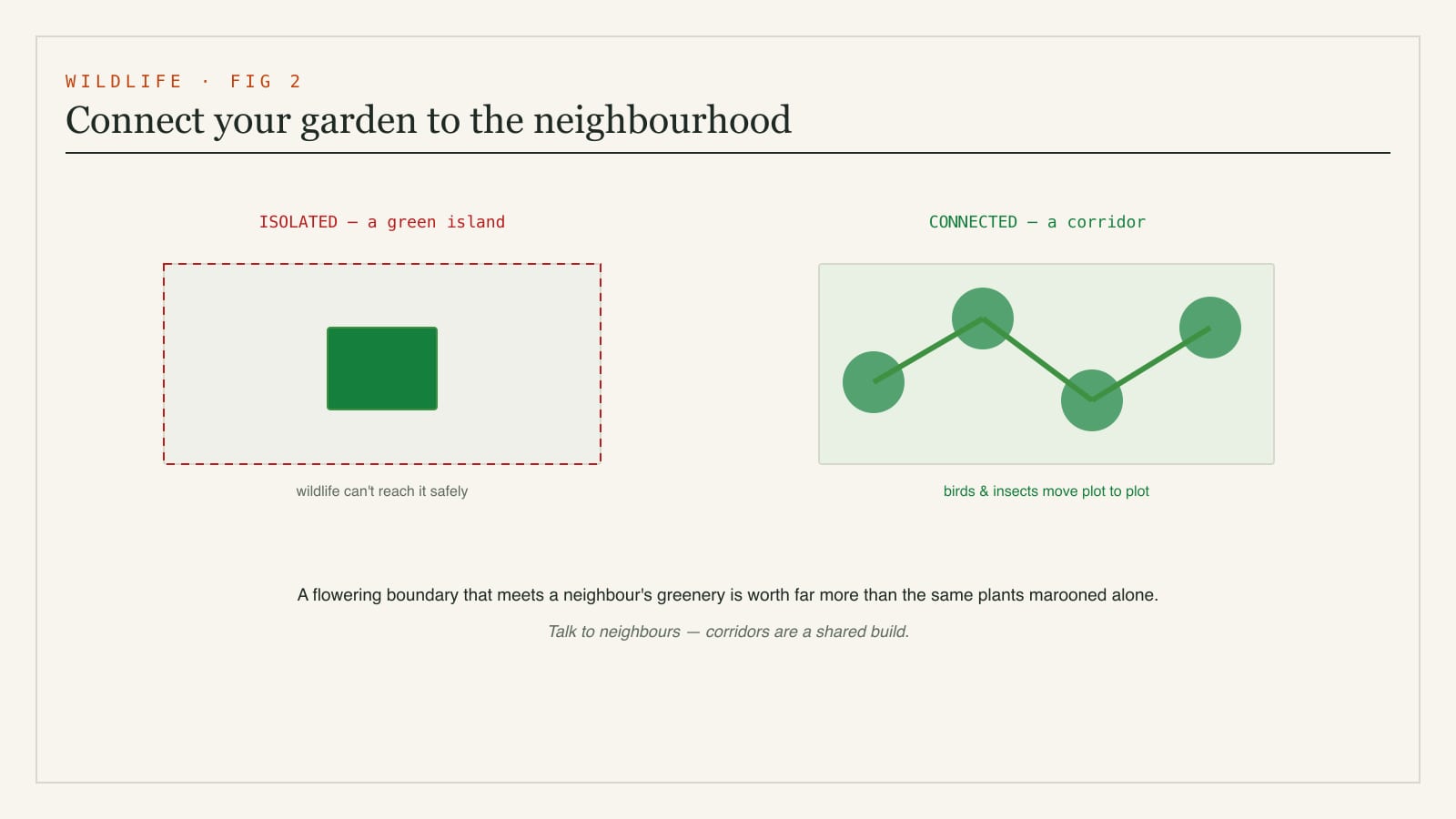
Practically, this means thinking past your boundary wall:
- Plant your edges, not just your centre. A green boundary that touches a neighbour's tree, a park, or a roadside avenue lets wildlife hop safely across the neighbourhood.
- Favour hedges over solid walls where rules allow, or grow creepers on walls and compound fencing to soften the barrier.
- Talk to your neighbours and RWA. A street where several homes grow native flowering plants becomes a genuine corridor. Many resident welfare associations will support a "pollinator-friendly avenue" or oppose blanket pesticide fogging once someone explains the benefit. Apartment dwellers can lobby for native species in society common areas and rooftop planters.
- Link to the larger green grid — a nearby lake, scrubland, or temple grove — by aligning your planting with that habitat's species.
This neighbourhood thinking is where a private garden becomes civic ecology.
No pesticides: work with nature, not against it
Broad-spectrum pesticides are fundamentally incompatible with a wildlife garden. They kill indiscriminately — the ladybird with the aphid, the bee with the caterpillar — and they break the very food web you are trying to build. Worse, by wiping out predators they often make pest outbreaks more violent, because the natural checks are gone.
The wildlife-friendly approach is integrated and patient:
- Build the predator base. Ladybirds, lacewings, spiders, mantises and predatory wasps will control most pests if you let them live. A few aphids are food, not a crisis.
- Tolerate cosmetic damage. Chewed leaves are normal and usually invisible from the verandah. The goal is a balanced garden, not a sterile one.
- Intervene gently and locally — a strong jet of water, hand-picking, neem oil spot-treatment, or removing a badly affected plant. Avoid systemic insecticides entirely, and never fog or spray flowers where pollinators feed.
- Feed the soil, not the plant with compost and mulch; healthy plants resist pests better, and the soil life feeds the surface food web.
The honest realities: mosquitoes, snakes and monkeys
A guide that only sells the romance does you a disservice. Inviting wildlife means accepting that you cannot choose only the pretty guests — but every common worry can be managed sensibly.
Mosquitoes. The real risk in India, given dengue and chikungunya, and the most legitimate fear. The answer is not pesticide but water discipline: eliminate all stagnant water in pots, saucers, old tyres and clogged gutters; refresh bird baths every day or two; keep any pond stocked with native larvivorous fish or moving water. A healthy garden actually helps — dragonflies, geckos, frogs, bats and insectivorous birds are voracious mosquito predators. The sterile, sprayed garden often has more mosquitoes, not fewer, because it has killed their enemies.
Snakes. Mostly harmless and ecologically valuable (they control rats), and a wildlife garden will occasionally host them. Reduce surprise encounters by keeping log and rubble piles away from doorways and high-traffic paths, trimming dense growth right beside entrances, controlling rodents (the real snake-attractant) without poison, and wearing closed shoes when gardening at dusk. Keep a local snake-rescue helpline number handy rather than killing — most species are non-venomous and protected.
Monkeys. A genuine nuisance in many towns and hill stations, and worth honest planning. You cannot fully "design out" troops where they are established, but you can avoid planting an open buffet of their favourite fruit right at the boundary, secure compost and food waste, and never feed them. Where pressure is severe, focus your wildlife planting on flowering and host plants (less raided) rather than soft fruit, and use thorny native shrubs along vulnerable edges.
The mindset that makes all of this work is the same one behind a restful outdoor room — acceptance that a living garden is dynamic, not a static display. That philosophy is explored from the human side in Outdoor Wellness Spaces, and the food-growing dimension in our sibling guide Productive Gardens Explained, where many of the same flowering plants double as pollinator magnets.
Bringing it together
A wildlife-friendly garden is not a special, separate kind of garden — it is simply a garden designed with the food web in mind. Start with native plants as the backbone, stack the layers from canopy to litter, give butterflies their host plants as well as nectar, add clean shallow water, leave a little productive mess, keep something in bloom every month, connect your edges to your neighbours', and put the pesticides away. Do that, and the rest arrives on its own — the sunbird at the Hamelia, the tailorbird stitching its leaf, the first lime butterfly laying eggs on a curry leaf you almost pruned. The garden stops being decoration and starts being alive.
References & further reading
- Indian Society of Landscape Architects (ISOLA) — resources and journals on ecological and native planting in Indian landscapes.
- Indian Institute of Horticultural Research (ICAR–IIHR), Bengaluru — horticulture and pollinator research relevant to Indian gardens.
- Bombay Natural History Society (BNHS) — field guides and resources on Indian birds and butterflies.
- Isaac Kehimkar, "The Book of Indian Butterflies" (BNHS / Oxford University Press) — definitive guide to species and their host plants.
- Salim Ali, "The Book of Indian Birds" (BNHS) — the standard reference for garden and Indian birdlife.
- Royal Horticultural Society (RHS) — "Wildlife gardening" and pollinator-planting guidance, adaptable to Indian species.
Export this guide
Related Guides — Deep-dive reading
The Best Trees for Indian Homes
A research-grade guide to choosing and placing trees around an Indian home — the real cooling and clean-air numbers, the right species for shade, flowers, fragrance and fruit, and the placement science that keeps roots out of your walls and drains.
LandscapeHow Buildings Can Give Back: Biodiversity and Environmental Health
How an Indian home and its plot can actively improve the ecology and environment around it, not just reduce harm
SustainabilityEdible Landscapes for Indian Homes — Beautiful and Productive
Weaving food plants into the ornamental garden — borders, hedges, containers, vertical screens and specimen fruit trees that look gorgeous and feed the family
LandscapeRelated Tools — Try Free
Cross-Ventilation Analyzer
Estimate airflow and air changes per hour (ACH) from room size, window areas, layout, and local wind — with NBC 2016 Part 8 compliance check.
Ventilation CalculatorRainwater Tank Sizer
How big should your rainwater tank be? Computes annual harvest, recommended tank capacity in litres, water-bill savings, and payback — for 10 Indian cities.
RWH CalculatorGarden Planning Toolkit
Get a tailored garden plan — planting layers, Indian species, features and a checklist — from your climate, space, sun and goals.
Planner