

Rain Gardens Explained — Catch, Soak and Recharge at Home
What a rain garden is, how it works in section, siting and sizing, the soil mix and plant palette for India, overflow design, and the mosquito myth answered
A rain garden is the single cheapest, prettiest piece of water infrastructure you can build at home — a shallow planted hollow that swallows the runoff from your roof and driveway, holds it for a few hours, and quietly returns it to the groundwater instead of letting it rush into the storm drain and flood the road. In a country that floods in July and runs dry by April, that small act of catching water where it falls is close to revolutionary, and it costs a fraction of an underground recharge pit.
Most Indian homes treat rainwater as a nuisance to be evicted as fast as possible — sloped paving, kerbs, drains, and a downpipe that fires straight into the municipal storm line. The result is the worst of both worlds: streets that flood within twenty minutes of a cloudburst, and aquifers that keep dropping because almost nothing soaks in. A rain garden flips that logic. It is the landscaping equivalent of a sponge, and unlike a bare recharge pit, it earns its keep all year as a living, flowering part of the garden.
What a rain garden actually is
A rain garden is a deliberately constructed shallow depression — typically 15 to 30 cm deep — planted with species that can shrug off both a day of standing water and a fortnight of drought. Runoff from a hard surface (roof, terrace, driveway, paved courtyard) is channelled into it. The water ponds briefly on the surface, then percolates down through a layer of mulch and a specially blended, free-draining soil mix, where plant roots and soil microbes filter out sediment, oils and nutrients before the water recharges the ground below.
It is a form of what engineers call bioretention, and it is the residential cousin of the bioswales and rain gardens used in Water Sensitive Urban Design worldwide. The key distinction from a soak pit or recharge well: a rain garden is broad and shallow rather than narrow and deep, it is fully planted, and it is designed to be looked at. It is one tool in a wider toolkit — our broader overview of Sustainable Water Management in the Landscape lists it alongside swales, ponds and recharge wells — but this guide is the dedicated, build-it-yourself how-to.
Why bother — five real returns
- It stops runoff and street flooding. A 100 sq m roof sheds roughly 6,000 to 9,000 litres in a single 60–90 mm Mumbai or Bengaluru downpour. A rain garden intercepts that surge instead of dumping it on the road.
- It recharges the aquifer. Every litre that soaks in is a litre added to the falling groundwater table — the same logic the Central Ground Water Board pushes through mandatory recharge in notified blocks.
- It cuts waterlogging around the house. Routing the downpipe into a sited basin keeps water away from foundations and soggy lawns.
- It filters pollutants. Soil and roots strip out silt, hydrocarbons from the driveway, and excess fertiliser before they reach the groundwater.
- It looks beautiful. Done well, it reads as a lush ornamental bed, not a piece of plumbing — which is why it belongs in any Biophilic Landscape Design scheme.
How a rain garden works, layer by layer
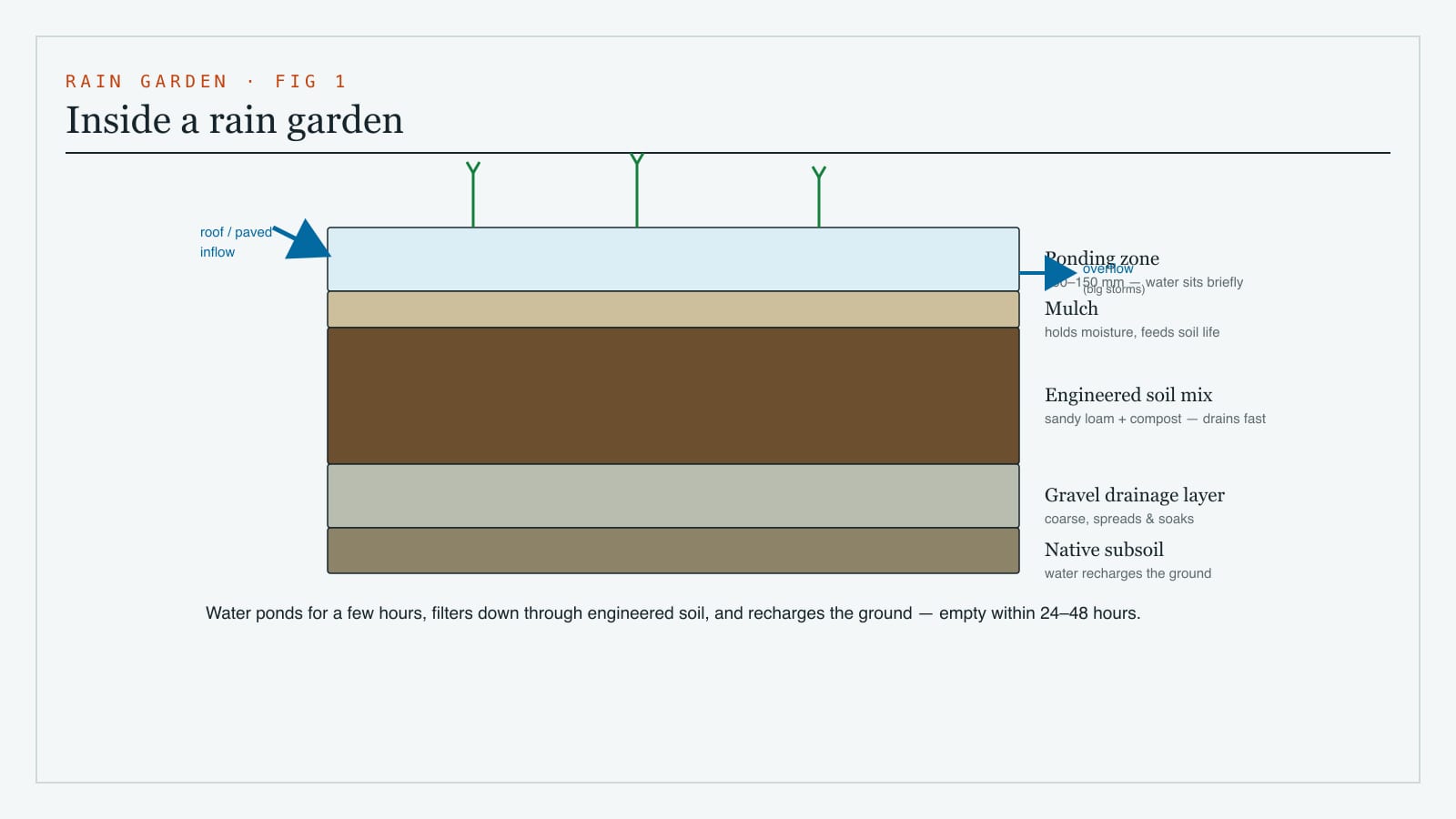
Picture a section cut through the basin. From top to bottom, water passes through a sequence of zones, each doing a job.
| Layer | Depth | Job it does |
|---|---|---|
| Ponding zone (the bowl) | 15–25 cm of empty freeboard | Temporarily stores the incoming surge so it can soak in gradually |
| Mulch layer | 50–75 mm | Slows incoming water, traps sediment, keeps soil moist, suppresses weeds |
| Engineered soil mix (filter media) | 40–60 cm | The working layer — sandy loam that drains fast while roots and microbes filter the water |
| Transition / sand layer | 50–100 mm | Stops the fine soil washing into the gravel below |
| Gravel drainage layer (optional) | 150–300 mm | Stores water and speeds percolation on slow-draining soils; can hold a perforated pipe |
| Native subsoil | — | The final destination — water percolates here and recharges the aquifer |
On sandy or loamy ground that already drains well, you can skip the gravel layer entirely and let the filter media sit straight on the subsoil — an "infiltration" rain garden. On heavy black-cotton or clay soils (much of Maharashtra, Gujarat and the Deccan), add the gravel layer and, if percolation is very poor, a perforated underdrain pipe that ferries the slowly-treated water to a recharge pit or storm line — a "filtration" rain garden.
Two features make or break the design, and both are covered below: a defined inflow (where water enters) and a defined overflow (where excess leaves safely in a once-a-year cloudburst). A rain garden is not a sealed pond; it is a flow-through device.
Siting: where to put it
Siting is where most home rain gardens go wrong. Get these rules right before you dig.
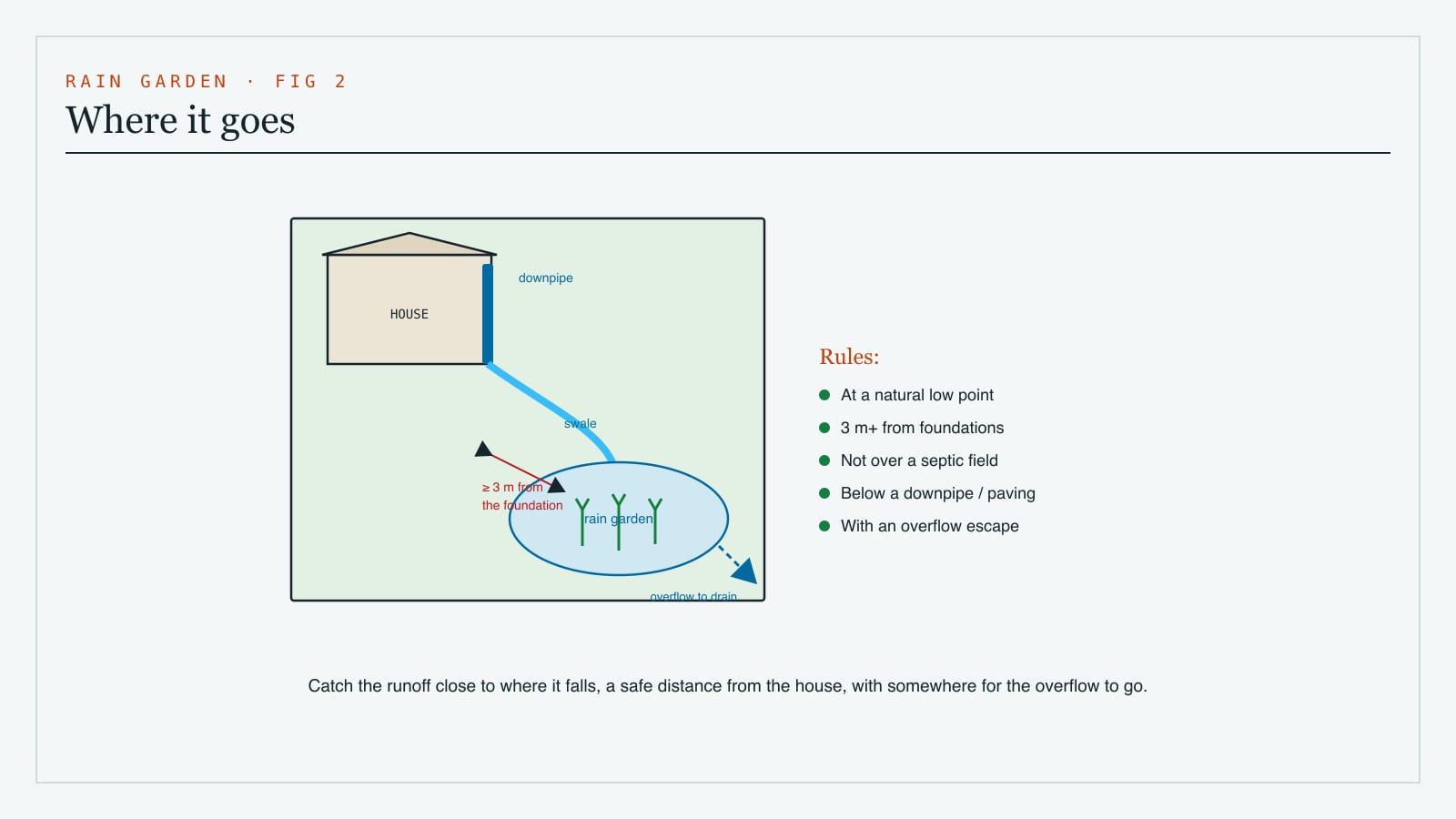
- At least 3 metres from the building foundation, and on the down-slope side. You want water soaking into the aquifer, not wicking into your plinth and causing dampness or settlement. On expansive clay soils, push this to 4–5 m.
- At a natural low point where water already tends to collect — work with the land, not against it. Watch where puddles form after rain and site the garden there.
- Downstream of a downpipe or paved area. The whole point is to capture a defined catchment. Disconnect the relevant downpipe from the municipal drain and route it — by surface channel, a shallow grassed swale, or a buried pipe — to the garden's inflow.
- Not over a septic tank, soak pit, or the leach field of an STP, and not directly above buried utility or water lines.
- In full or part sun if you want the flowering palette below to thrive; most rain-garden plants are sun-lovers.
- Away from large existing trees whose roots will both clog the bed and resent the periodic flooding.
If your plot slopes, a short swale leading into the garden does double duty — it slows and spreads the water. This pairs naturally with the techniques in Rainwater Harvesting Through Landscape Design, where the garden becomes one node in a chain of swales and basins. For larger plots, the same principle scales up beautifully within a full Villa Landscape Design.
Sizing: how big should it be?
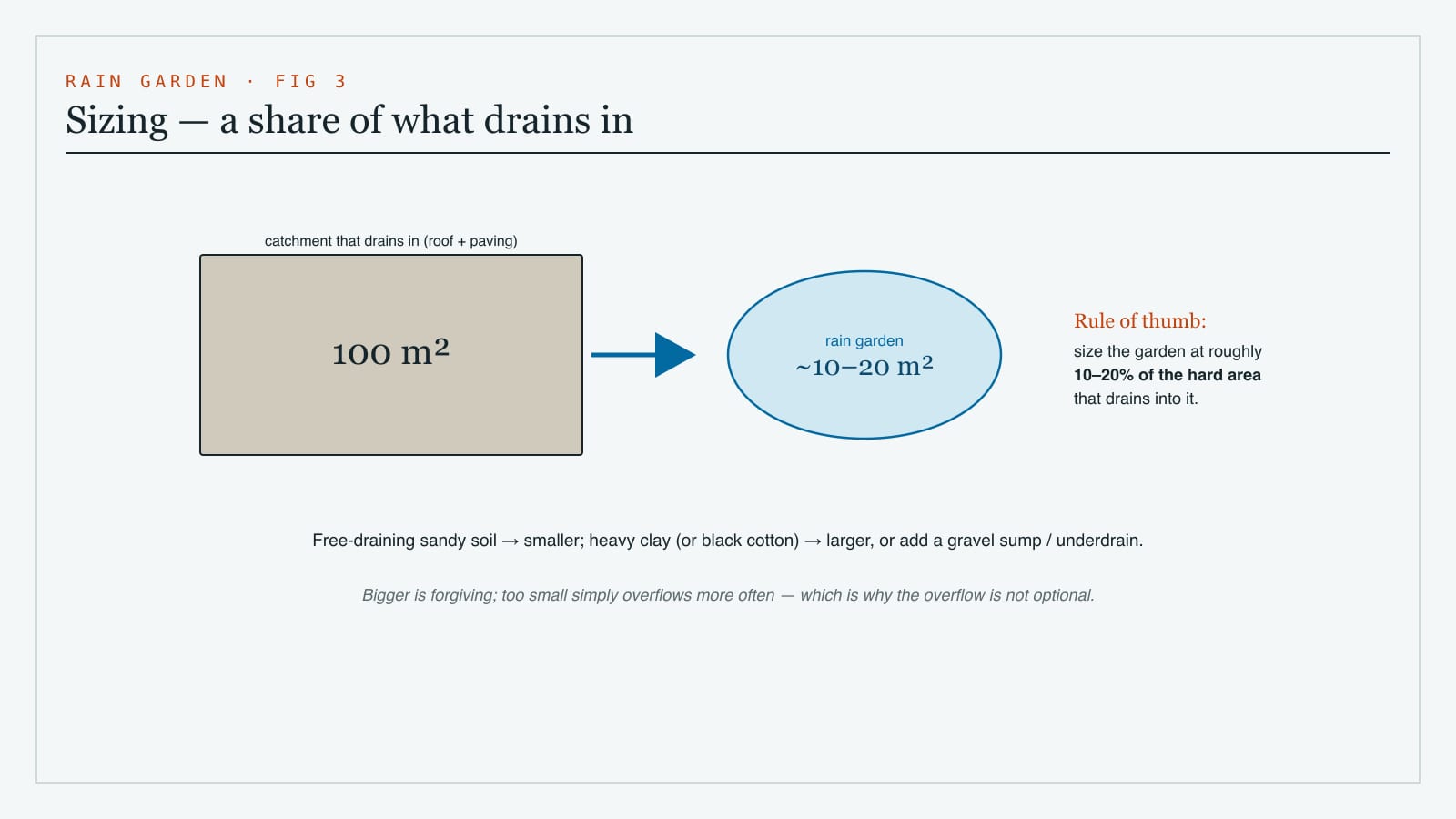
A rain garden does not need to be large. The standard rule of thumb sizes the garden as a percentage of the impervious catchment area that drains into it — the roof or paving, not your whole plot.
| Subsoil type | Garden area as % of catchment | For a 100 sq m roof |
|---|---|---|
| Sandy / fast-draining | 5–10% | 5–10 sq m |
| Loam / medium | 10–20% | 10–20 sq m |
| Clay / black cotton (slow) | 20–30% (or add underdrain) | 20–30 sq m |
So a typical urban Indian home with a 100 sq m terrace and reasonably draining soil needs a rain garden of roughly 10–15 sq m — a bed about 3 m × 4 m. Keep the ponding depth at 15–25 cm; deeper holds more but takes longer to drain and looks more like a pit. If the calculated size feels too big for your plot, build a smaller garden and let an overflow carry the excess to a recharge pit — partial capture is still hugely worthwhile.
A quick sanity check: a garden 12 sq m in area with a 20 cm ponding depth temporarily holds about 2,400 litres on its surface, plus a great deal more in the pore space of the soil and gravel below — comfortably absorbing the first, dirtiest flush of a heavy monsoon shower.
The soil mix and the infiltration test
The filter media is the engine of the rain garden, and ordinary garden soil will not do — it compacts and clogs. Blend a free-draining mix, roughly:
- 50–60% coarse sand (river/concrete sand, not fine plastering sand)
- 20–30% good topsoil or sandy loam
- 10–20% compost or well-rotted organic matter (kept modest — too much releases nutrients you are trying to filter out)
The target is a mix that drains at roughly 50–200 mm per hour. Before you commit, run a simple percolation test: dig a hole 30 cm deep where the garden will go, fill it with water and let it drain once to saturate the soil, then refill and time the drop.
- Drains in under 24 hours: an infiltration rain garden works as-is.
- Drains in 24–48 hours: workable, but improve the media and consider a gravel layer.
- Still holding water after 48 hours: you have heavy clay — add the gravel drainage layer and a perforated underdrain to a recharge pit, or reconsider the location.
This 24–48 hour drain time is not just a performance number; it is the whole answer to the mosquito question below.
The plant palette for India
The plants must survive a paradox: a day or two underwater after a downpour, then weeks of dry heat between rains. Choose tough, deep-rooted marginal and ornamental species, and zone them — moisture-lovers in the centre bottom, drought-tolerant species on the rim.

| Plant | Type | Zone | Notes |
|---|---|---|---|
| Canna (Canna indica) | Flowering rhizome | Centre / base | Workhorse of Indian rain gardens — bold, flowers all season, loves wet feet |
| Umbrella sedge (Cyperus alternifolius) | Sedge | Base | Architectural, thrives in periodic flooding, very forgiving |
| Iris (Iris pseudacorus / domestica types) | Rhizome | Centre | Striking flowers, classic bioretention plant |
| Heliconia | Tropical foliage | Base, warm/humid coasts | Lush in Kerala, Goa, coastal climates; needs warmth |
| Lemongrass (Cymbopogon) | Aromatic grass | Mid / rim | Drought-hardy, mosquito-deterrent aroma, useful in the kitchen |
| Hibiscus (Hibiscus rosa-sinensis) | Shrub | Rim (drier edge) | Tolerates the drier outer band; year-round colour |
| Native sedges & grasses (Vetiver, Khus) | Grass | Rim & slopes | Deep roots bind the soil and resist erosion superbly |
| Indian Vetiver (Chrysopogon zizanioides) | Grass | Inflow & edges | Outstanding for stabilising the inflow point and filtering sediment |
Avoid pure aquatics like lotus or water lily — they need permanent standing water and will die when the garden dries out. Mulch the surface with 50–75 mm of bark, coir or gravel to keep moisture in and weeds out. A well-chosen palette also makes the garden a magnet for bees, butterflies and birds, dovetailing with Wildlife-Friendly Home Landscapes.
Inflow and overflow design
Inflow. Water must enter without scouring a channel through your new soil. Line the entry point with river stones, a small splash pad of rounded cobbles, or a clump of vetiver to dissipate the energy of water arriving from the downpipe. If feeding from a roof, a first-flush diverter (sending the first dirty 1–2 mm of rain elsewhere) keeps the garden cleaner.
Overflow. This is non-negotiable. In a once-in-a-few-years cloudburst, the garden will fill faster than it drains, and it must spill safely rather than overtop towards the house. Set a defined overflow at the height of your maximum ponding depth — a notch in the lower bund, a stone-lined spillway, or a slotted drain — leading the excess to a lawn, a recharge pit, or, as a last resort, the storm drain. Always design the overflow to flow away from the building.
The mosquito myth — settled honestly
The single biggest objection to rain gardens in dengue-and-malaria India is: "won't it breed mosquitoes?" The honest, evidence-based answer is no, not if it is built correctly.
Aedes and Anopheles mosquitoes need standing water that persists for about a week to complete the egg-to-adult cycle. A properly built rain garden drains within 24 to 48 hours — far too fast for any larvae to mature. The water is gone long before mosquitoes can use it. This is precisely why a rain garden is safer than the alternatives it replaces: blocked drains, water-filled potholes, and forgotten buckets, which all hold water for weeks.
The garden only becomes a mosquito risk if it is broken — built on clay with no underdrain so it holds water for days, or undersized and constantly soggy. The safeguards are simple: get the percolation test right, include drainage on slow soils, and never let it become a permanent pond. If you want any permanent water feature, that is a different design with its own management (mosquito fish, aeration) — covered in our Sustainable Water Management in the Landscape guide, not here.
Build steps
1. Test and mark. Run the percolation test, confirm the size, and mark the outline with sand or string. Call before you dig if utilities are nearby.
2. Excavate. Dig 60–90 cm deep (filter media plus any gravel plus ponding depth). Keep the base level so water spreads evenly. Set excavated topsoil aside for the mix.
3. Build the layers. Lay gravel and the sand transition layer if needed, then backfill with the engineered filter media to leave a 15–25 cm ponding bowl. Lightly firm — do not compact.
4. Form the inflow and overflow. Build the stone splash pad at the inlet and cut the overflow notch at ponding height with its spillway.
5. Plant. Set out plants by zone, densely — about 6–10 plants per square metre so they knit together and out-compete weeds.
6. Mulch and water in. Spread 50–75 mm of mulch, water thoroughly, and protect the inflow with extra stones.
A modest 10–15 sq m home rain garden, done with hired labour, typically costs ₹15,000 to ₹40,000 depending on the gravel/underdrain and plant choices — broadly:
- Excavation and labour: ₹4,000–10,000
- Filter media (sand, soil, compost): ₹4,000–10,000
- Gravel and underdrain (if required): ₹3,000–8,000
- Plants and mulch: ₹4,000–12,000
That is a fraction of a packaged underground recharge system, and it doubles as a flower bed. For comparison and to pair it with tank-based storage, see our home-systems guide on Rainwater Harvesting at Home.
Maintenance
Rain gardens are low-maintenance, not no-maintenance — and the work is front-loaded.
- First monsoon (establishment): check after every heavy rain; water in dry spells until plants root in; weed regularly; top up any soil that washes out at the inflow.
- Routine (after year one): clear leaf litter and silt from the inflow twice a year, before and during monsoon; replenish mulch annually; cut back canna and sedges at season's end; weed as needed.
- Watch for trouble: if water sits longer than 48 hours, the media has clogged — scrape and replace the top few centimetres, or check the underdrain. Erosion at the inflow means the splash pad needs more stone.
Done once and tended lightly, a rain garden quietly does its work for decades — turning the day the sky opens from a flooding emergency into a recharge event, and keeping the garden green long after the rains have stopped. It is one of the most satisfying expressions of a Climate-Responsive Landscape Design: the wet season feeds the dry one, on your own plot.
References & further reading
- Central Ground Water Board (CGWB), Ministry of Jal Shakti — Master Plan for Artificial Recharge to Ground Water in India and rooftop rainwater harvesting/recharge guidelines.
- Central Public Health and Environmental Engineering Organisation (CPHEEO), Ministry of Housing & Urban Affairs — Manual on Storm Water Drainage Systems.
- Rainwater Club / Biome Environmental Solutions (S. Vishwanath, Bengaluru) — open resources on rainwater harvesting and groundwater recharge in Indian cities.
- Melbourne Water — Water Sensitive Urban Design (WSUD) Guidelines and rain garden (bioretention) construction and planting notes.
- Indian Society of Landscape Architects (ISOLA) and IGBC / GRIHA green-building rating criteria on stormwater management and site water balance.
- US EPA — Soak Up the Rain: Rain Gardens technical and homeowner guidance on bioretention sizing and infiltration testing.
Export this guide
Related Guides — Deep-dive reading
Stormwater & Surface Drainage in India: Getting Rain Off Your Roof, Paving and Plot
A homeowner's guide to stormwater drainage — sizing roof outlets and downpipes for monsoon rainfall, surface channels and catch basins, grading the plot away from the house, and where the water finally goes, kept firmly separate from your foul drains.
PlumbingFoundation & Subsoil Drainage in India: French Drains, Weep Holes and Keeping Groundwater Off Foundations, Basements and Retaining Walls
A professional guide to subsoil drainage in India — French drains built from perforated pipe, gravel and geotextile; sub-surface drains around basements; weep holes and drainage board on retaining walls; and how you route the water you collect to a sump or soak pit. Plus the high-water-table and black-cotton-soil problems that make it hard, and why drainage and waterproofing are one system, not two.
PlumbingRooftop Rainwater Harvesting
The rain that lands on your roof is a free water supply and, in most Indian cities, a legal duty. What a rooftop rainwater harvesting system is, the two paths (store it for reuse or recharge the groundwater), the parts that make it work, how much a roof can actually collect, and the maintenance that keeps it honest. Plain language, India-grounded.
RoofingRelated Tools — Try Free
Rainwater Tank Sizer
How big should your rainwater tank be? Computes annual harvest, recommended tank capacity in litres, water-bill savings, and payback — for 10 Indian cities.
RWH CalculatorGarden Planning Toolkit
Get a tailored garden plan — planting layers, Indian species, features and a checklist — from your climate, space, sun and goals.
PlannerCross-Ventilation Analyzer
Estimate airflow and air changes per hour (ACH) from room size, window areas, layout, and local wind — with NBC 2016 Part 8 compliance check.
Ventilation Calculator