
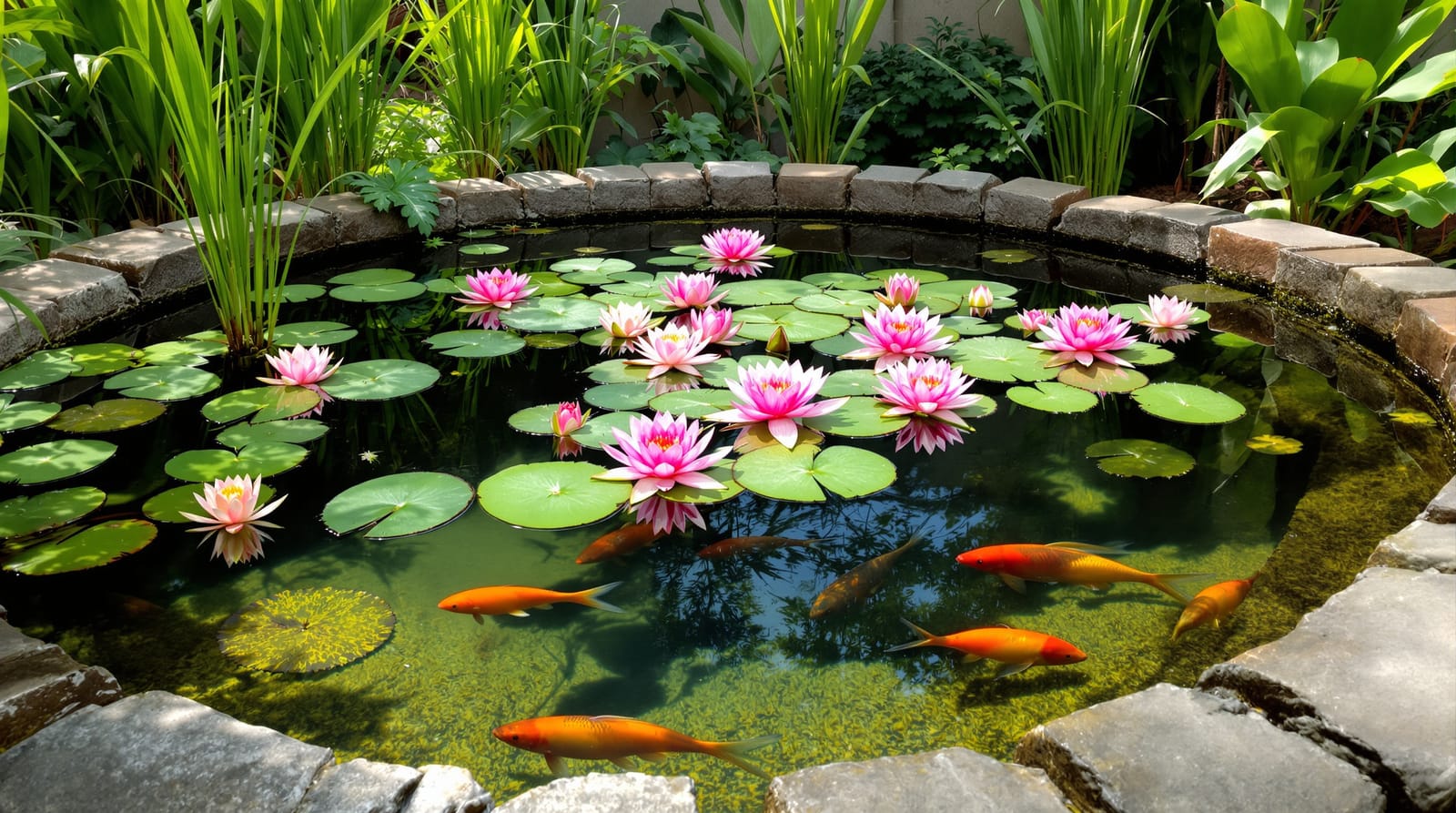
Pond Design Guide — Building a Beautiful Garden Pond in India
Wildlife, lily and koi ponds — siting, depth zones, construction methods, the balanced ecosystem, water plants, filtration, maintenance and safety
A garden pond is not a swimming pool you keep topping up — it is a small living ecosystem, and the moment you stop fighting it with chemicals and start designing for balance, it begins to look after itself. Done well, a pond is the most alive thing in an Indian garden: dragonflies at dawn, frogs after the first rains, water lilies opening by mid-morning, koi rising for shade. Done badly, it is a green soup and a dengue worry. This guide is about getting it right — choosing the type, digging the depth zones, building the shell, and stocking the balance that keeps the water clear without a chemistry kit.
This is the planted, living-water companion to the broader Water Features in Landscape Design pillar. Where that piece surveys the whole family of fountains, rills and reflecting pools, this one digs into the ornamental garden pond specifically.
First decide what kind of pond you actually want
There are three honest archetypes, and they pull in different directions. Choose before you dig, because the type decides depth, filtration, planting and cost.
| Pond type | Best for | Filtration | Depth (India) | Maintenance |
|---|---|---|---|---|
| Wildlife pond | Frogs, dragonflies, birds, biodiversity | None — plants do the work | 30–60 cm with gentle shelves | Low, seasonal |
| Ornamental / lily pond | Looks, lotus and water lilies, reflections | Optional small pump | 45–75 cm | Moderate |
| Koi / fish pond | Keeping prized fish | Mandatory mechanical + bio filter | 90–150 cm deep zone | High, year-round |
A wildlife pond is the easiest and most forgiving: no pump, no electricity, gently sloping edges so birds and frogs can get in and out, and a thick fringe of native marginals. If your goal is a living corner rather than show fish, stop here — it is also the cheapest. Pair it with the principles in Wildlife-Friendly Home Landscapes.
An ornamental pond is the lily-and-lotus picture most people imagine — clear-ish water, blooms, maybe a few small fish, a gentle waterfall for sound and aeration.
A koi pond is a different animal. Koi are large, long-lived and produce a lot of waste; they need deep cool water, serious filtration and a real commitment of time and money. Do not start a koi pond casually.
Siting: get this wrong and you fight it forever
- Sun, but not all day. Water lilies and lotus want 5–6 hours of sun to flower. But in Bengaluru's mild light you can push for full sun, whereas in Delhi, Nagpur or Chennai, an unshaded pond in May becomes hot algae soup. Aim for morning sun and light afternoon shade.
- Away from heavy leaf-fall. Sites directly under gulmohar, peepal, mango or other heavy-shedding trees mean constant skimming and decaying leaves that foul the water. A little leaf litter feeds a wildlife pond; a deluge kills it. Keep the pond off the drip-line of large deciduous trees.
- Level ground, visible from the house. Water finds its own level, so a sloping site means costly retaining on one side. Pick the flattest available spot, ideally viewable from a verandah or living area so you actually enjoy it.
- Power and a top-up tap nearby if you intend a pump or waterfall.
- Vastu note: the north-east (Ishanya) is traditionally favoured for water bodies, and keeping water in the NE/N quadrant is genuinely compatible with good landscape practice. Avoid the south-west. Treat this as a tiebreaker, not a structural constraint.
Sizing and the all-important depth zones
A common beginner mistake is making a pond uniformly shallow. Shallow water heats fast, swings in temperature, and grows algae. The fix is depth zones — a shelf-mid-deep profile that gives each life form what it needs.
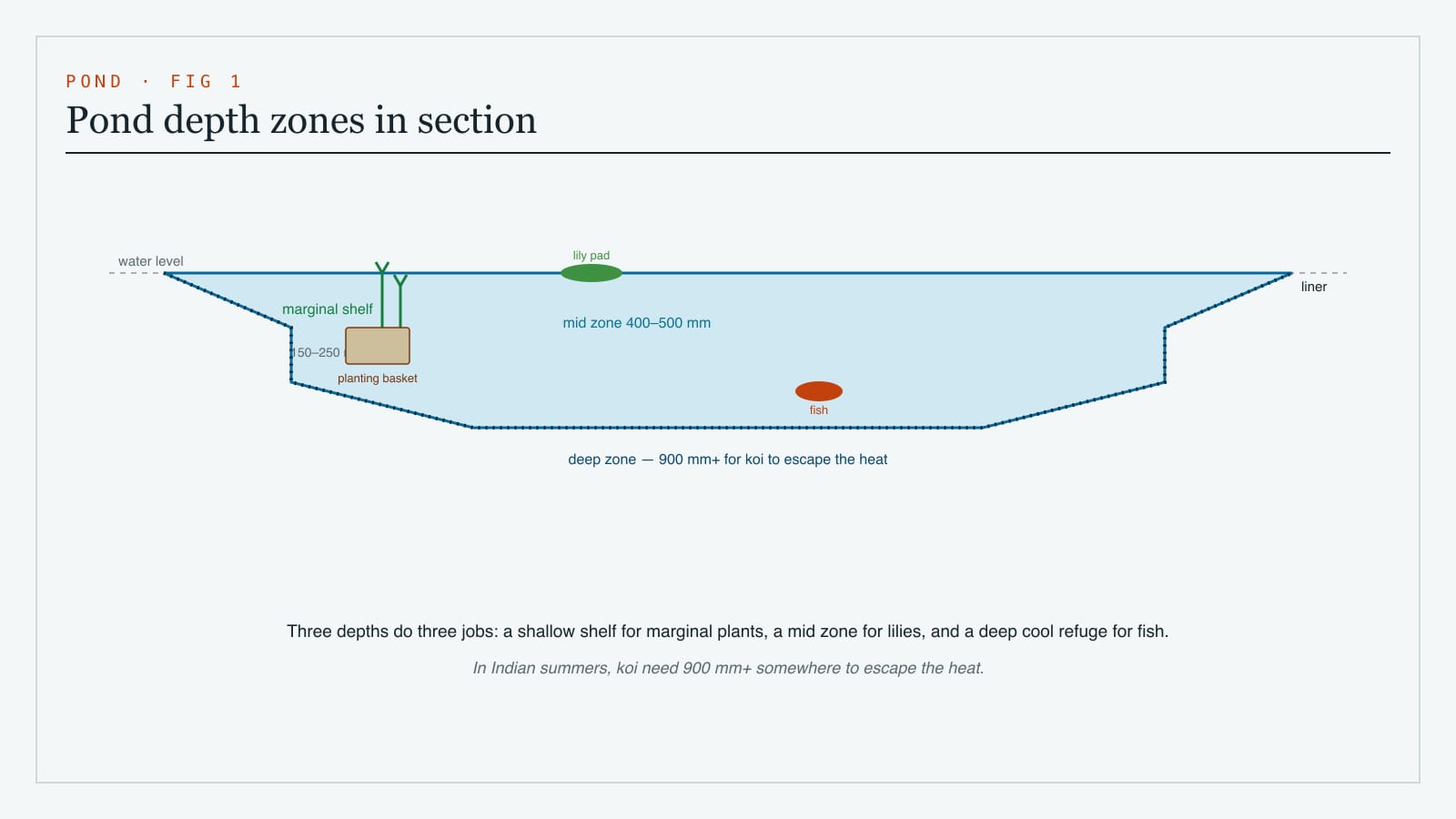
- Marginal shelf (15–25 cm deep): a ledge around the rim for marginal plants in baskets — sedges, pickerel, dwarf papyrus. It also gives birds a safe place to bathe and frogs an exit.
- Mid zone (40–60 cm): for water lilies, whose baskets sit here while leaves float to the surface.
- Deep zone (90–120 cm for fish): in Indian heat this matters. A deep cool refuge keeps water temperature stable and gives fish somewhere to retreat when the surface bakes in summer. For koi, go 120–150 cm. A pond with no deep zone will cook its fish in a North-Indian May.
As a rule of thumb, bigger is more stable. A pond under about 2,000 litres swings wildly and is hard to balance; 3,000–8,000 litres is a comfortable home range. For fish, allow roughly 50 litres of water per small fish and far more for koi (1,000 litres or more per adult koi). Surface area matters too — at least 50–60% of the pond should be open water if you want reflections rather than a planter.
Construction: liner vs concrete vs preformed
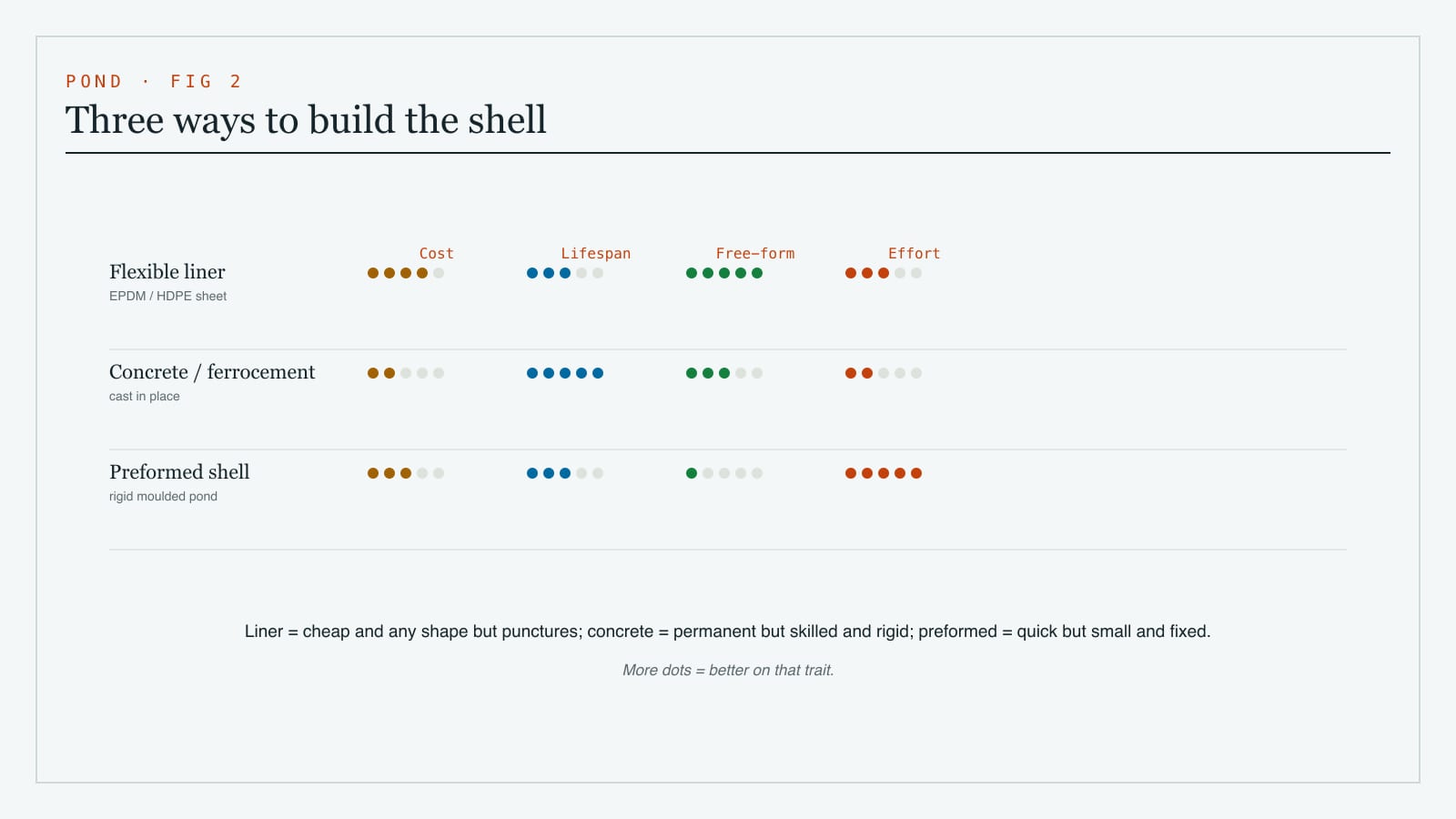
How you build the shell is the biggest single cost and durability decision.
| Method | Indicative cost | Lifespan | Flexibility | Notes |
|---|---|---|---|---|
| Flexible liner (EPDM / HDPE) | ₹150–450 per sq.m of liner | 15–25 yrs (EPDM) | Any shape, any depth | Easiest DIY; needs underlay against puncture |
| Concrete / ferrocement shell | ₹1,200–3,000 per sq.m built | 20–40 yrs | Fixed shape, very robust | Must cure and neutralise lime before stocking |
| Preformed rigid pond | ₹8,000–40,000 per unit | 10–20 yrs | Fixed size, small only | Quick, but limited shapes and capacity |
Flexible liner is the most popular modern choice. Dig the profile with shelves, lay a protective underlay (geotextile, or old carpet/sand in a pinch), then drape a single EPDM or HDPE sheet and fill — the water pushes it into shape. EPDM (rubber) is more flexible and forgiving than HDPE and the better pick for cold-tolerant longevity, though HDPE is cheaper. Always over-order so you can fold generous edges under the coping.
Concrete or ferrocement suits permanent, formal ponds and is the traditional Indian approach (it shares technique with overhead and underground tanks). It is the most durable but unforgiving of ground movement — a hairline crack leaks. Crucially, fresh concrete leaches lime and raises pH lethally; cure it for weeks, scrub, apply a sealer or neutraliser, and fill-and-drain a couple of times before any plant or fish goes in.
Preformed rigid ponds are quick but limited to small sizes and pre-set shapes — fine for a courtyard accent, not a koi pond.
Whichever you choose, finish with a stable, slightly overhanging coping of stone or brick that hides the liner edge and stops rim runoff carrying soil and fertiliser into the water.
The balanced ecosystem — why this beats chemicals
This is the heart of pond-keeping. A pond is run by the nitrogen cycle: fish and decaying matter produce ammonia (toxic), beneficial bacteria convert it to nitrite (still toxic) and then to nitrate (a plant food), and plants take up that nitrate. Algae is simply what grows when there is surplus nitrate and sunlight and not enough competing plants. So the real war against green water is won with plants and balance, not algaecide — chemicals knock algae back briefly, then the nutrient rebound makes it worse.
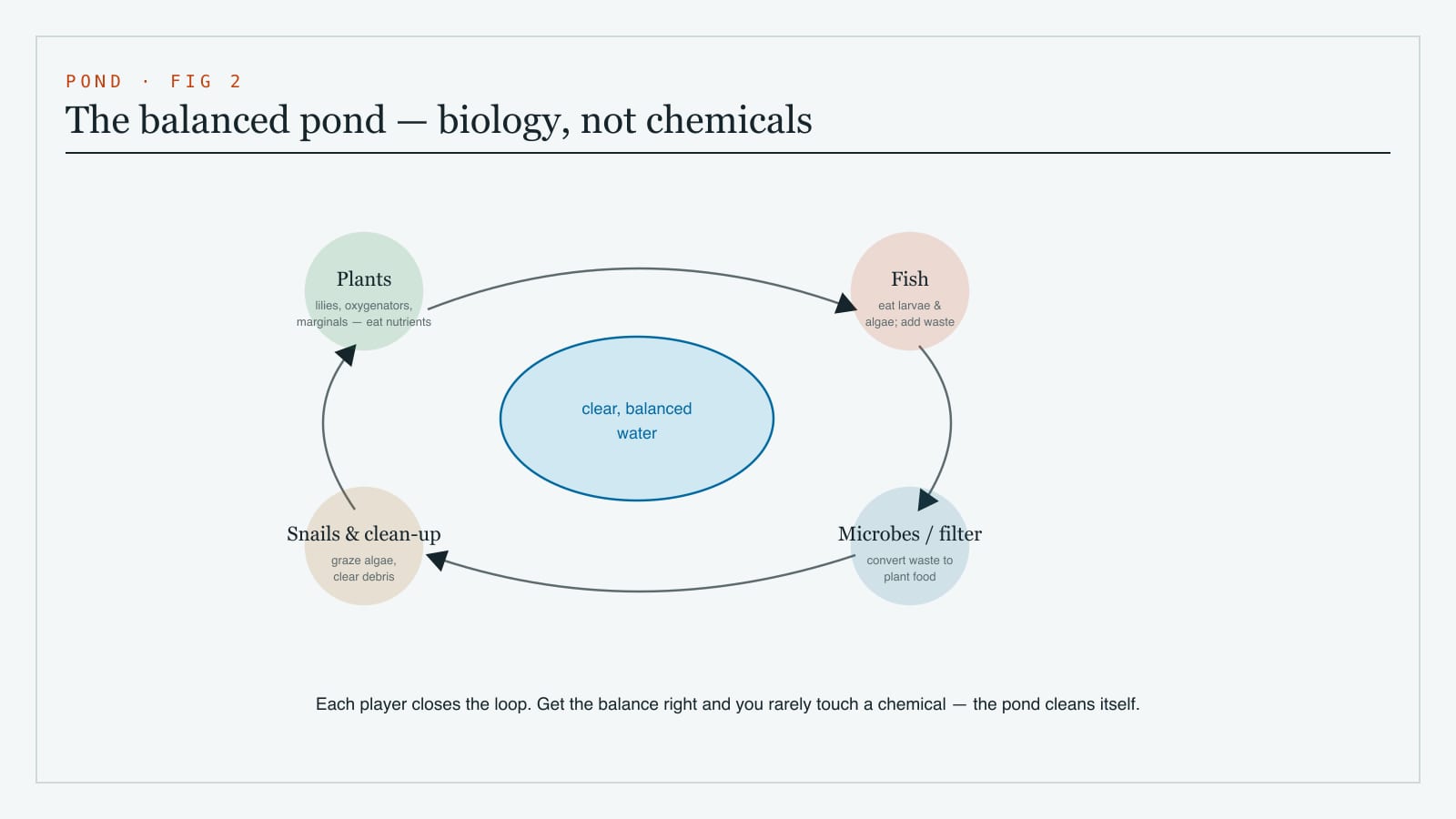
A balanced pond combines four working groups:
- Submerged oxygenating plants (hornwort/Ceratophyllum, Hydrilla used cautiously, Vallisneria) that grow underwater, soak up nutrients directly and release oxygen. These are the unglamorous engine of clarity — aim to plant them generously at the start.
- Floating-leaf plants (water lilies, lotus) that shade the surface. Aim to cover 50–60% of the surface with leaves; shade starves algae of light and cools the water.
- Marginals around the shelf that take up nutrients and soften the edge.
- Animals — a few fish to eat mosquito larvae and pond snails to graze algae off surfaces.
Give a new pond 4–8 weeks to mature before adding fish, so the bacterial colonies establish. A pond that goes green in week two and then clears on its own is behaving exactly as it should — resist the urge to dose it.
Filtration and pumps — when you genuinely need them
The honest answer: it depends entirely on fish load.
- Wildlife pond — no pump, no filter. Plants and the natural cycle handle a lightly-stocked or fishless pond. Adding a pump just disturbs the still water that dragonflies and lilies prefer.
- Ornamental pond with a few small fish — optional. A small pump driving a gentle waterfall or spill adds oxygen and movement (and helps with mosquitoes), but a well-planted pond can manage without.
- Koi pond — mandatory. Koi waste overwhelms any planting. You need a mechanical filter (to trap solids) plus a biological filter (media that hosts the nitrogen-cycle bacteria), sized to turn over the whole pond volume roughly every 1–2 hours. Budget ₹8,000–30,000 for a decent pump-and-filter setup, plus running electricity 24×7.
A submersible pump for a modest waterfall costs ₹2,500–8,000 and draws 30–90 W. Size the pump to lift the water to your spill height with flow to spare. For the waterfall design itself, see Waterfalls for Home Landscapes, which ponds are so often paired with.
Water plants suited to India
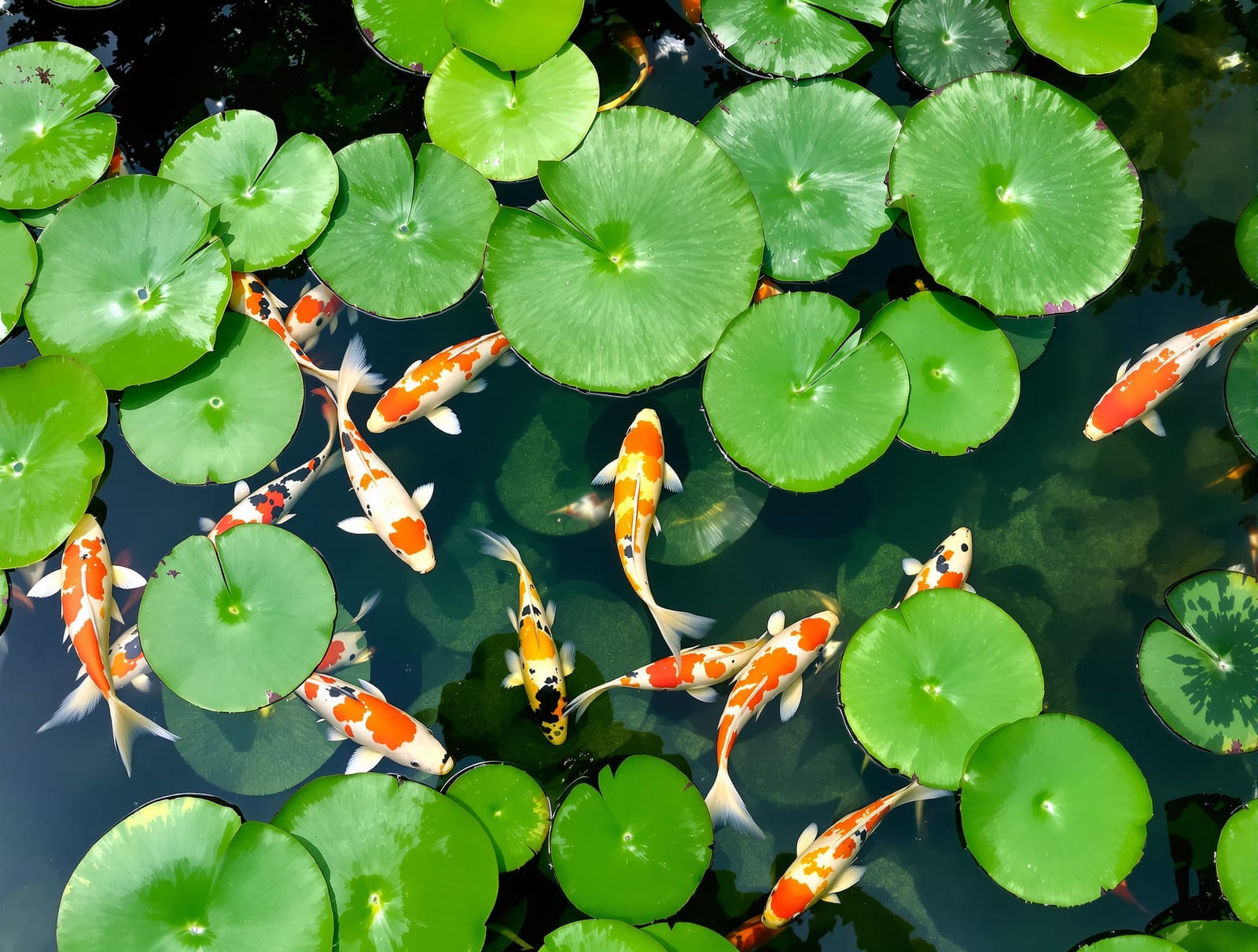
India is rich in beautiful pond plants — and a couple of notorious thugs to avoid.
| Plant | Type | Role | Notes |
|---|---|---|---|
| Lotus (Nelumbo nucifera) | Deep-water | Iconic bloom, big leaves | Loves heat and full sun; needs a large basket and space |
| Water lily (Nymphaea, incl. native N. nouchali) | Deep-water | Shade + flower | The workhorse; hardy across India |
| Papyrus / dwarf papyrus (Cyperus) | Marginal | Vertical accent, nutrient uptake | Striking in baskets on the shelf |
| Pickerel (Pontederia) | Marginal | Blue flower spikes | Good nutrient stripper |
| Native sedges and rushes (Cyperus, Juncus, Typha) | Marginal | Edge habitat, filtration | Typha (cattail) spreads — contain it |
| Hornwort (Ceratophyllum) | Submerged | Oxygenator, algae control | No planting needed; floats and grows |
A serious caution: water hyacinth (Eichhornia crassipes). It is gorgeous, sold cheaply everywhere, and it is one of India's worst invasive weeds — it has choked lakes from Bengaluru to Kolkata. It doubles in days, blankets the surface, and if a fragment escapes to a drain or lake it becomes an ecological disaster. Do not introduce it to a garden pond that can overflow into stormwater during the monsoon. The same wariness applies to Salvinia and Pistia (water lettuce). If you want floaters, prefer well-contained natives and keep them netted back.
Maintenance through the Indian year
- Algae: expect a green flush each spring as light increases; let plants out-compete it. Pull blanketweed by hand (twirl it out on a stick). Persistent green water usually means too few plants, too much sun, or overfeeding fish — fix the cause, not the symptom. Feed fish only what they finish in two minutes.
- Summer evaporation: in peak summer a pond can lose several centimetres a week to evaporation. Top up little and often. If on municipal/borewell water, let chlorinated water stand a day or dechlorinate before large top-ups. This is a real water cost — read it alongside Sustainable Water Management in the Landscape and consider rainwater harvesting to feed the pond.
- Monsoon overflow: the rains will fill and overflow the pond. Build a deliberate overflow point — a slightly lower section of coping leading to a planted soakaway or rain garden — so the pond cannot flood the lawn and so floaters and fish are not washed out. Never let overflow carry invasive plants to public drains.
- Autumn/seasonal: net or scoop fallen leaves before they sink and rot. Thin overgrown plants once a year; divide lilies every 2–3 years.
Safety and mosquitoes — handled honestly
Two fears stop people building ponds. Both are manageable.
Child safety. A pond is a drowning risk for toddlers. If you have small children, either defer the pond, fence it, or build a pebble/bog pond with no open standing water — a basin filled with rounded stones and bubbling water that is beautiful and safe. Never rely on supervision alone around open water.
Mosquitoes and dengue. This is the question every Indian household asks, and the answer is reassuring if you design correctly. Mosquitoes breed only in stagnant water. A healthy pond does not breed them because:
- Fish eat the larvae. Even a few small fish — guppies (Poecilia), the native larvivorous Gambusia/mosquitofish where appropriate, or small ornamental fish — will clear mosquito larvae faster than they hatch. Dragonfly nymphs eat them too.
- Moving water from even a small pump or spill prevents egg-laying on the surface.
- No shallow dead corners. Keep water bodies connected; do not leave isolated puddles in plant trays.
The danger is not the pond itself but a neglected, fishless, stagnant pond — which is exactly what you avoid by keeping it balanced and stocked. A living pond is a mosquito sink, not a source.
A realistic budget
For a modest 3,000–5,000 litre EPDM-liner ornamental pond, expect roughly: liner and underlay ₹8,000–18,000; excavation and coping stone ₹10,000–25,000; pump and small waterfall ₹3,000–8,000; plants and a few fish ₹3,000–8,000 — a typical all-in of ₹25,000–60,000 for a handsome garden pond. A simple fishless wildlife pond can be done for under ₹15,000. A serious koi pond with full filtration runs ₹1.5–4 lakh and upward.
A well-made pond is the cheapest luxury in a garden to enjoy and, once balanced, one of the cheapest to run. Build the depth zones, plant heavily, stock lightly, skip the chemicals — and let the ecosystem do the work.
References & further reading
- Central Ground Water Board (CGWB), Ministry of Jal Shakti — guidance on groundwater, recharge and water conservation, www.cgwb.gov.in
- Central Pollution Control Board (CPCB) — water quality criteria and inland water-body guidance.
- Rainwater Club / S. Vishwanath (Bengaluru) — practical Indian writing on rainwater, urban water and small water bodies.
- Indian Society of Landscape Architects (ISOLA) — landscape practice resources for Indian conditions.
- Royal Horticultural Society (RHS) — wildlife pond and garden pond construction and planting guidance (adapt depths for Indian heat).
- Botanical Survey of India / state forest department lists — for native aquatic species and invasive-species advisories (water hyacinth, Salvinia).
Export this guide
Related Guides — Deep-dive reading
Water Features in Landscape Design — A Complete Guide for Indian Homes
Why water, the full family of features (fountains, ponds, waterfalls, reflecting pools, rills), how to choose, site, cost and maintain one — with safety and mosquito control
LandscapeHow Buildings Can Give Back: Biodiversity and Environmental Health
How an Indian home and its plot can actively improve the ecology and environment around it, not just reduce harm
SustainabilitySmart Air Purifiers for Indian Homes: Beating PM2.5
Across Delhi-NCR winters and year-round urban haze, indoor air is often worse than the street. This guide explains what actually makes a purifier smart, how CADR and room sizing work, what HEPA and activated carbon really remove, honest running costs on filters and power, and which brands earn their price in Indian conditions.
Smart HomeRelated Tools — Try Free
Rainwater Tank Sizer
How big should your rainwater tank be? Computes annual harvest, recommended tank capacity in litres, water-bill savings, and payback — for 10 Indian cities.
RWH CalculatorLandscape Cost Calculator
Estimate a garden's cost — hardscape, softscape, lawn, irrigation, lighting and annual upkeep — by area, tier and city.
Budget CalculatorMonsoon-Readiness Checklist
Pre-rain home audit across 9 categories — terrace, drains, waterproofing, electrical, HVAC, pest, vehicles, documents.
Seasonal Audit