
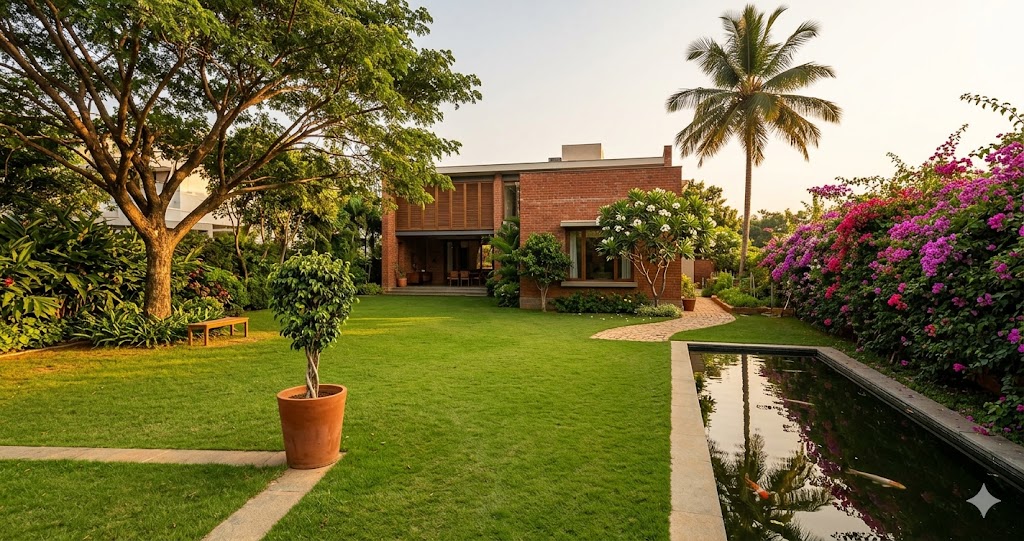
Villa Landscape Design — Indian Villa Gardens, Hardscape & Vastu Landscape (2026)
8 landscape zones · Climate-zone tree palette · Vastu landscape · NBC 2016 Part 10 · 1.5 acre worked example
Villa landscape design in 2026 India is no longer the lawn-with-a-fountain afterthought it was a decade ago. It is a layered, climate-tuned, Vastu-aware discipline that costs ₹150 to ₹800 per square foot of garden area and routinely consumes 8–15 percent of a villa's total build budget. Where the architect shapes the built form and the elevation designer shapes the skin, the landscape designer shapes everything between the compound wall and the front door — the forecourt you arrive into, the lawn your children play on, the pool you swim in, the kitchen garden that feeds you, and the canopy of trees that drops your indoor temperature by 4–6°C. In a hot, monsoonal, water-stressed country, that work is no longer ornamental. It is infrastructure.
This guide is the landscape-specific companion to our architecture and elevation references. If you are still upstream of the garden conversation, start with luxury villa architecture in India for the built-form decisions, villa elevation design for the facade, courtyard homes for the indoor-outdoor seam, and tropical architecture for the climate logic.
"A villa's facade ages in five years. A villa's landscape comes into its own in five years. Plant the trees the day you pour the foundation, not the day you move in."
This guide refreshes every 12 months. Last verified: May 2026 · Next verify: May 2027.
What Villa Landscape Design Actually Means in 2026 India
Villa landscape design, in current Indian practice, is the integrated design of every outdoor surface, plant, water body and lighting element on a privately-owned plot of 4,000 sqft and above — typically a standalone or twin villa, a farmhouse, or a row villa with a substantial front, side and rear setback. It is the discipline that takes the leftover space after the architect's footprint and turns it into eight distinct functional zones, each with its own materials palette, planting strategy, drainage logic, and maintenance regime.
A 2026-grade villa landscape brief now routinely covers: soil testing and grading, hardscape (paving, kerbs, retaining walls, steps, edge bands), softscape (trees, shrubs, ground covers, climbers, hedges, lawn), water features (lily ponds, reflecting pools, swimming pools, cascades, runnels, fountains), site lighting (path, accent, underwater, moonlighting), irrigation (drip, sprinkler, smart controllers), drainage (storm water, French drains, rain gardens), boundary treatment (walls, gates, screens), outdoor furniture and pergolas, and increasingly — Vastu zoning of the entire plot.
Five things villa landscape design is NOT in 2026:
1. It is not gardening. A gardener maintains; a landscape designer plans. The plant list comes after the masterplan, after the grading, after the irrigation routing, and after the Vastu overlay — not before.
2. It is not lawn-and-fountain decoration. A 2026 villa landscape devotes only 25–35 percent of its softscape to lawn. The rest is shrub beds, tree groves, kitchen gardens, ground-cover meadows and water bodies.
3. It is not the architect's job. Most Indian villa architects under-detail the garden in their drawings. A separate landscape consultant earns their fee in the first site visit by catching grading mistakes that would cost lakhs to fix post-occupancy.
4. It is not optional for FSI or sanction. The National Building Code 2016 Part 10 ("Landscape Planning, Design and Development") explicitly requires a landscape plan for plots above certain thresholds, and most metro municipal corporations now ask for tree-cover compliance at sanction stage.
5. It is not separable from the architecture. A villa designed without the landscape in mind ends up with rear elevations no one ever sees from the garden, with sliding doors opening onto a 1.2 m strip of patchy grass, with master bedrooms facing the compound wall instead of the lawn. The landscape designer needs to be in the room from RCC stage.
The shift in 2026 is that the high-end Indian client now expects the landscape to do real work — cool the house, feed the kitchen, harvest the rain, screen the neighbour, anchor the Vastu — not just look pretty in the brochure render.
Why Villa Landscape Design Matters Now
Three forces have pushed villa landscape from afterthought to centrepiece between 2021 and 2026.
The villa supply boom. Knight Frank India's "Wealth Report 2026" and JLL's "Residential Market Update Q1 2026" both flag plotted villa developments as the fastest-growing premium residential segment, with Bengaluru, Hyderabad, Pune, Gurugram and the Mumbai–Pune corridor leading. Prestige, Sobha, Embassy, DLF, Lodha and Brigade have launched landscape-led villa townships where the garden masterplan is a brochure headline, not a footnote. A typical Sobha or Prestige villa today comes with 1,200–4,000 sqft of private garden plus access to 40–60 percent open-space community landscape.
The water and heat reality. Bengaluru's 2024–25 borewell crisis, Chennai's 2019 Day Zero scare, and the IMD's repeated 2024–2026 heatwave bulletins have made every villa buyer water- and shade-conscious. A landscape that includes rainwater harvesting (mandatory in Karnataka, Tamil Nadu, Telangana and most metros), a tree canopy that drops ambient temperature by 4–6°C, and a planting palette that survives on greywater — is no longer green-virtue signalling. It is survival economics.
The wellness and food trend. Post-2020, the Indian villa buyer demographic has shifted toward 35–50 year-old tech executives, founders and senior professionals who want kitchen gardens (jamun, curry leaf, lemon, mango, papaya, mint, methi, tomato), wellness lawns for yoga, koi ponds for stillness, and outdoor entertaining decks. The Houzz India 2025 Outdoor Living survey found that 71 percent of villa renovations now include a kitchen garden component, up from 28 percent in 2018.
The segment size is substantial. Anarock's H1 2026 residential report estimates the standalone-villa and plotted-development market at roughly ₹85,000 crore in launched value across the top eight cities. Landscape spend at 8–15 percent of build-cost implies a ₹7,000–12,000 crore annual landscape design and execution market — supporting roughly 8,000–12,000 specialist landscape practices, nurseries and hardscape contractors across India.
The Eight Defining Zones of an Indian Villa Landscape
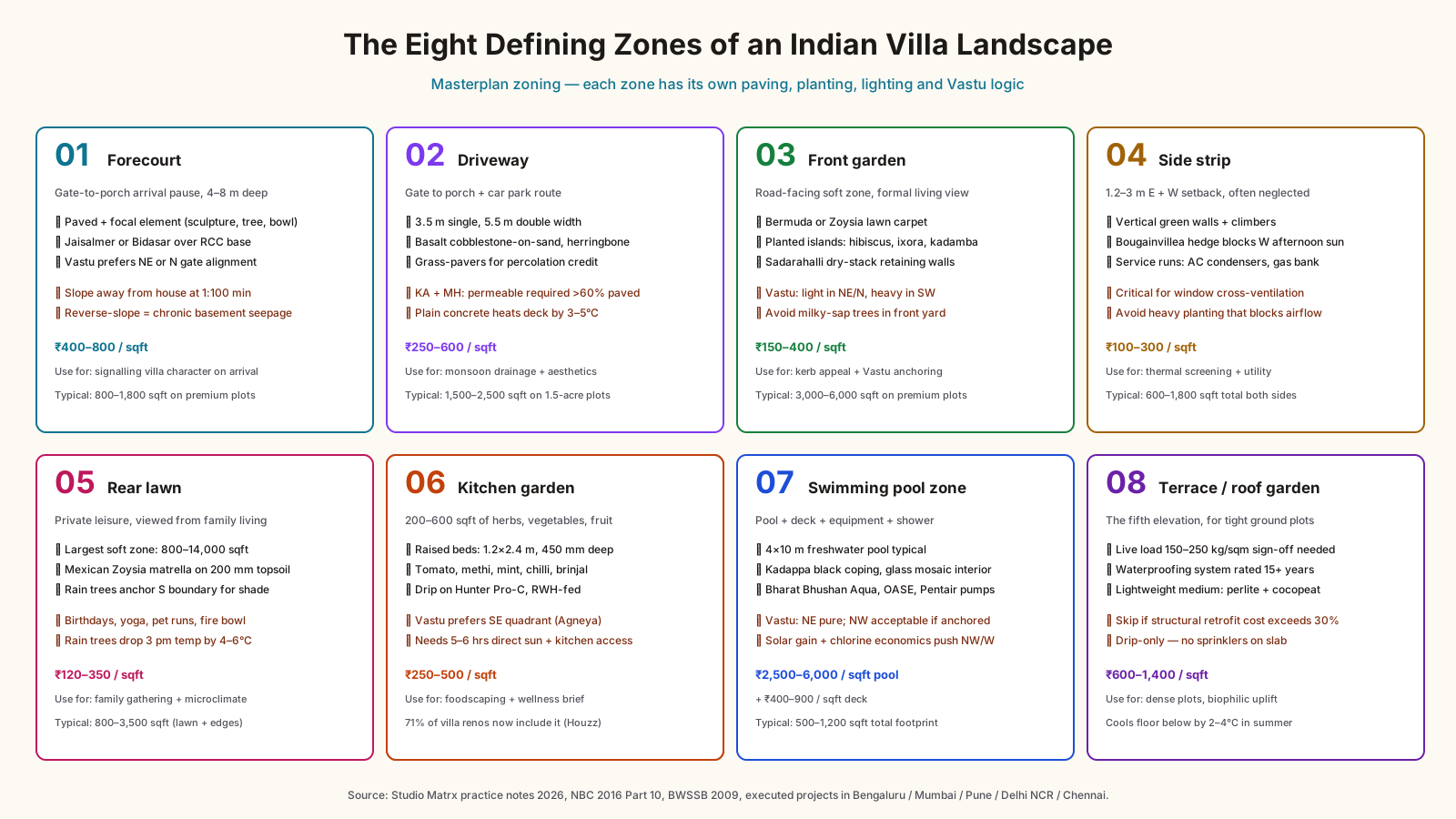
The first move in any villa landscape masterplan is to break the plot into the eight functional zones below. Each has its own paving, planting and lighting logic, and getting the zoning wrong at masterplan stage cannot be fixed later without ripping out hardscape.
| Zone | What it is | India-specific note | Typical cost band |
|---|---|---|---|
| 1. Forecourt | The arrival pause between gate and porch — usually 4–8 m deep, paved, with a focal element (sculpture, tree, water bowl) | Vastu prefers NE or N gate; forecourt should slope away from house at 1:100 minimum for monsoon drainage | ₹400–800 per sqft (Jaisalmer or Bidasar over RCC) |
| 2. Driveway | The vehicular route from gate to porch and car park, typically 3.5 m wide for single, 5.5 m for double | Cobblestone-on-sand or grass-pavers preferred over plain concrete for percolation and aesthetics; Karnataka and Maharashtra require permeable paving above 60 percent paved area | ₹250–600 per sqft |
| 3. Front garden | The public-facing soft zone visible from the road and from the formal living room | Vastu prefers light planting in NE/N, heavier in SW; this is the zone that signals the villa's character | ₹150–400 per sqft |
| 4. Side strip | The 1.2–3 m setback between villa and compound wall on east and west | Usually neglected; ideal for vertical green walls, climbers, narrow planters or service runs (AC condensers, gas bank); critical for cross-ventilation through windows | ₹100–300 per sqft |
| 5. Rear lawn | The private leisure zone behind the villa, viewed from family living, dining and master | The largest single soft zone in most villas — 800–3,500 sqft; site of birthday parties, yoga mornings, pet runs | ₹120–350 per sqft (lawn + edges) |
| 6. Kitchen garden | A 200–600 sqft cultivated zone for herbs, vegetables, fruit trees | Vastu prefers SE for fruiting; needs 5–6 hours of direct sun, drip irrigation, and access from the kitchen door, not the formal porch | ₹250–500 per sqft |
| 7. Swimming pool zone | The pool plus deck, equipment room, shower, changing — usually 500–1,200 sqft total | Vastu prefers NE quadrant for water; but solar gain and chlorination economics often push pools to NW or W; consult both architect and Vastu before locking | ₹2,500–6,000 per sqft of pool + ₹400–900 per sqft of deck |
| 8. Terrace / roof garden | The fifth elevation — increasingly used in dense plots where ground footprint is tight | Needs structural sign-off for live load (150–250 kg/sqm for intensive green roof), waterproofing system rated 15+ years, and lightweight growing medium | ₹600–1,400 per sqft of green roof |
In a typical 4,000 sqft plot with a 1,800 sqft built footprint, the landscape designer has roughly 2,200 sqft of outdoor area to distribute across these eight zones. In a 1.5-acre (65,340 sqft) plot with a 6,000 sqft built footprint, the landscape is the project — 59,000+ sqft of outdoor design, often costing more than the building itself.
A Worked Example: A 1.5-Acre Sahakar Nagar Villa Landscape, ₹40 Lakh Budget
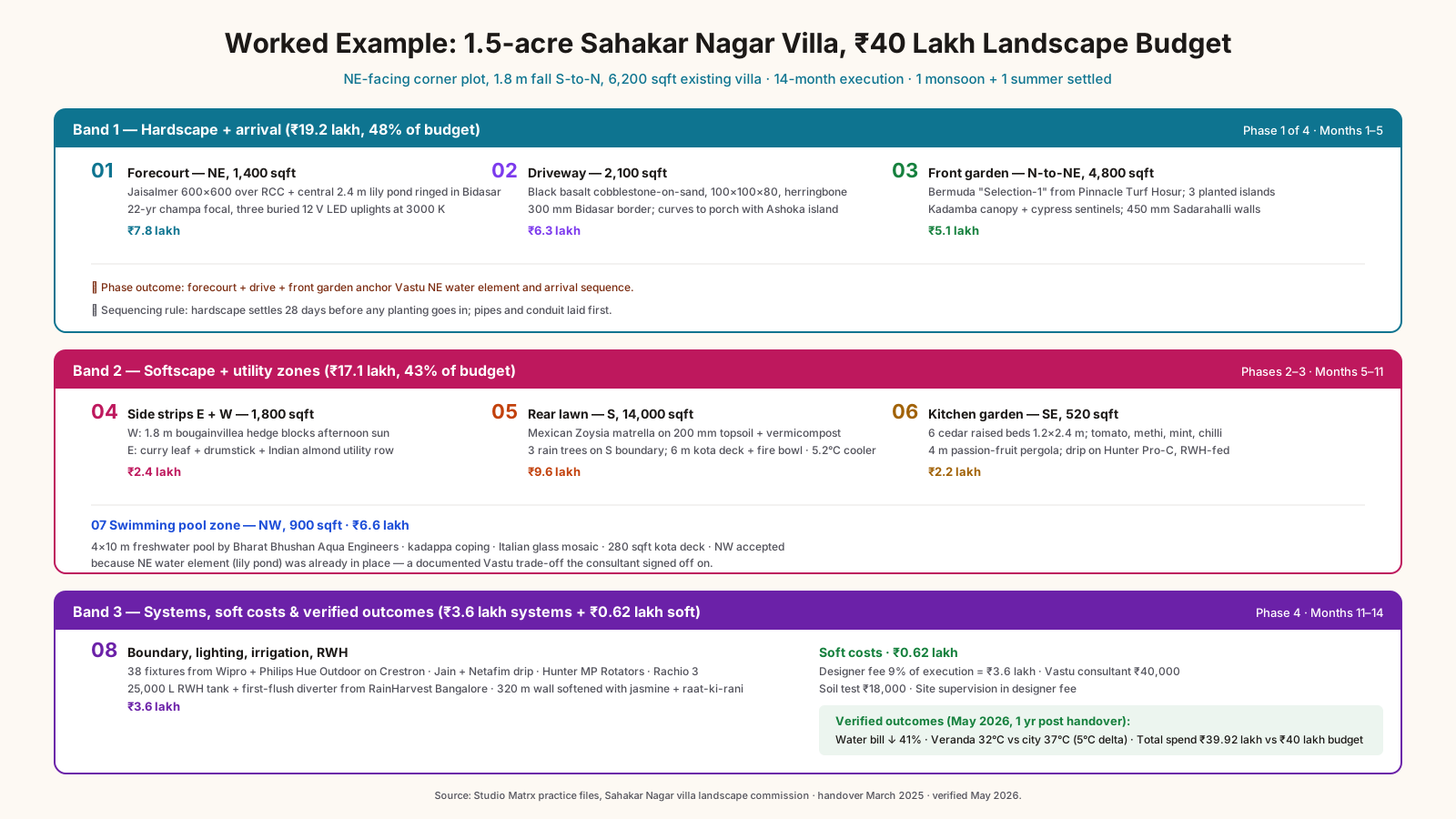
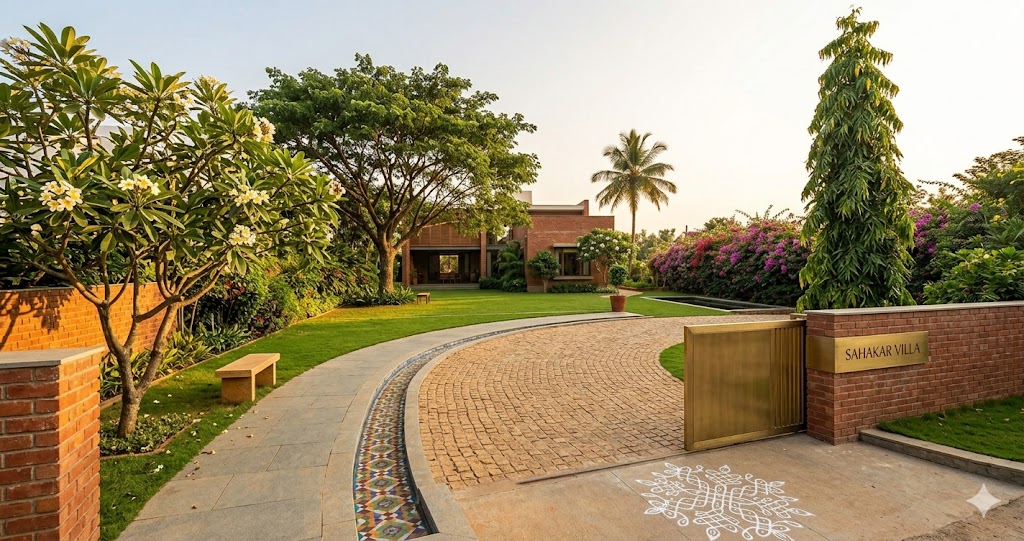
Consider a real-world Bengaluru brief that has become a useful reference within our practice. A retired couple in their early sixties commissioned a 1.5-acre plot landscape in Sahakar Nagar, North Bengaluru — NE-facing corner, sloping gently south to north (a 1.8 m fall across the long axis), with an existing 6,200 sqft villa already built by a separate architect. The landscape budget was ₹40 lakh, executed over a 14-month timeline including a full monsoon establishment cycle.
The plot was zoned as follows. Forecourt (1,400 sqft, NE): Jaisalmer sandstone in 600x600 mm slabs over RCC, with a central 2.4 m diameter lily pond ringed in Bidasar marble — a deliberate Vastu move to anchor the NE water element. A 22-year-old transplanted champa (frangipani, Plumeria alba) as the focal tree, lit by three buried 12 V LED uplights at 3000 K. Cost: ₹7.8 lakh.
Driveway (2,100 sqft): Black basalt cobblestone-on-sand, 100x100x80 mm, laid in a herringbone pattern with a 300 mm Bidasar border. Permeable, monsoon-friendly, and quiet underfoot. The drive curves to a covered porch with a single-tree island planted with a Saraca asoca (Ashoka). Cost: ₹6.3 lakh.
Front garden (4,800 sqft, N to NE wedge): Bermuda grass (Cynodon dactylon "Selection-1" from Pinnacle Turf, Hosur) as the carpet, with three planted islands of hibiscus, ixora, and a kadamba (Neolamarckia cadamba) as the canopy. Two pencil cypress sentinels flank the gate. The slope is terraced with two 450 mm dry-stack Sadarahalli granite retaining walls. Cost: ₹5.1 lakh.
Side strips (E and W, 1,800 sqft total): West side gets a 1.8 m bougainvillea hedge on the compound wall to block the harsh afternoon sun. East side gets a curry-leaf, drumstick (Moringa oleifera) and Indian almond row, doubling as kitchen-utility and morning-sun screen. Cost: ₹2.4 lakh.
Rear lawn (14,000 sqft, S): Mexican grass (Zoysia matrella) — finer, slower-growing, lower water demand than Bermuda — laid over a 200 mm topsoil bed amended with vermicompost from Soil & Health, Whitefield. Three mature rain trees (Albizia saman) anchor the south boundary, dropping the afternoon ambient temperature on the rear veranda by a measured 5.2°C in May. A 6 m diameter circular gathering deck of kota grey stone with a fire bowl. Cost: ₹9.6 lakh.
Kitchen garden (520 sqft, SE): Six raised beds (1.2 x 2.4 m, 450 mm deep) of cedar timber from Forest Essentials, planted with tomato, methi, coriander, mint, lemongrass, chilli, brinjal and seasonal greens. A 4 m pergola covered in passion fruit. Drip irrigation on a Hunter Pro-C controller, fed from the RWH tank. Cost: ₹2.2 lakh.
Swimming pool zone (NW, 900 sqft total): A 4 x 10 m freshwater pool by Bharat Bhushan Aqua Engineers (Bengaluru) with kadappa black coping and Italian glass mosaic interior, surrounded by a 280 sqft kota grey deck and a 120 sqft pool-equipment cabin. The NW location was a compromise — Vastu purists would have pushed NE, but the architectural geometry and tree shade economics made NW the better choice. The Vastu consultant accepted the trade-off because the NE water element (lily pond) was already in place. Cost: ₹5.4 lakh for the pool alone, ₹1.2 lakh for the deck.
Boundary, lighting, irrigation, RWH (whole plot): 320 m of 1.8 m compound wall (already built), with a 600 mm planted strip of jasmine, raat-ki-rani and adenium climbers softening the inside face. Site lighting from Wipro Lighting and Philips Hue Outdoor on a Crestron controller — 38 fixtures total: path, accent, underwater, moonlighting from the rain trees. Drip irrigation across all beds (Jain Irrigation pipes and Netafim emitters) and pop-up sprinklers across both lawns (Hunter MP Rotators), all on a Rachio 3 controller with Bengaluru-specific weather scheduling. A 25,000 L RWH tank with first-flush diverter from RainHarvest Bangalore. Total: ₹3.6 lakh.
Soft costs: Landscape designer fee at 9 percent of execution (₹3.6 lakh), Vastu consultant (₹40,000), soil testing (₹18,000), site supervision (included in designer fee).
Total verified spend: ₹39.92 lakh, against a ₹40 lakh budget. The landscape was handed over in March 2025 and has now seen one full Bengaluru monsoon and one summer. Owner-reported water bill: down 41 percent from the all-municipal baseline, thanks to RWH supplementation. Outdoor temperature on the rear veranda at 3 pm in May 2026: 32°C against the city ambient of 37°C — a 5°C delta attributable to the rain trees and the Mexican grass thermal mass.
Villa Landscape vs Adjacent Categories
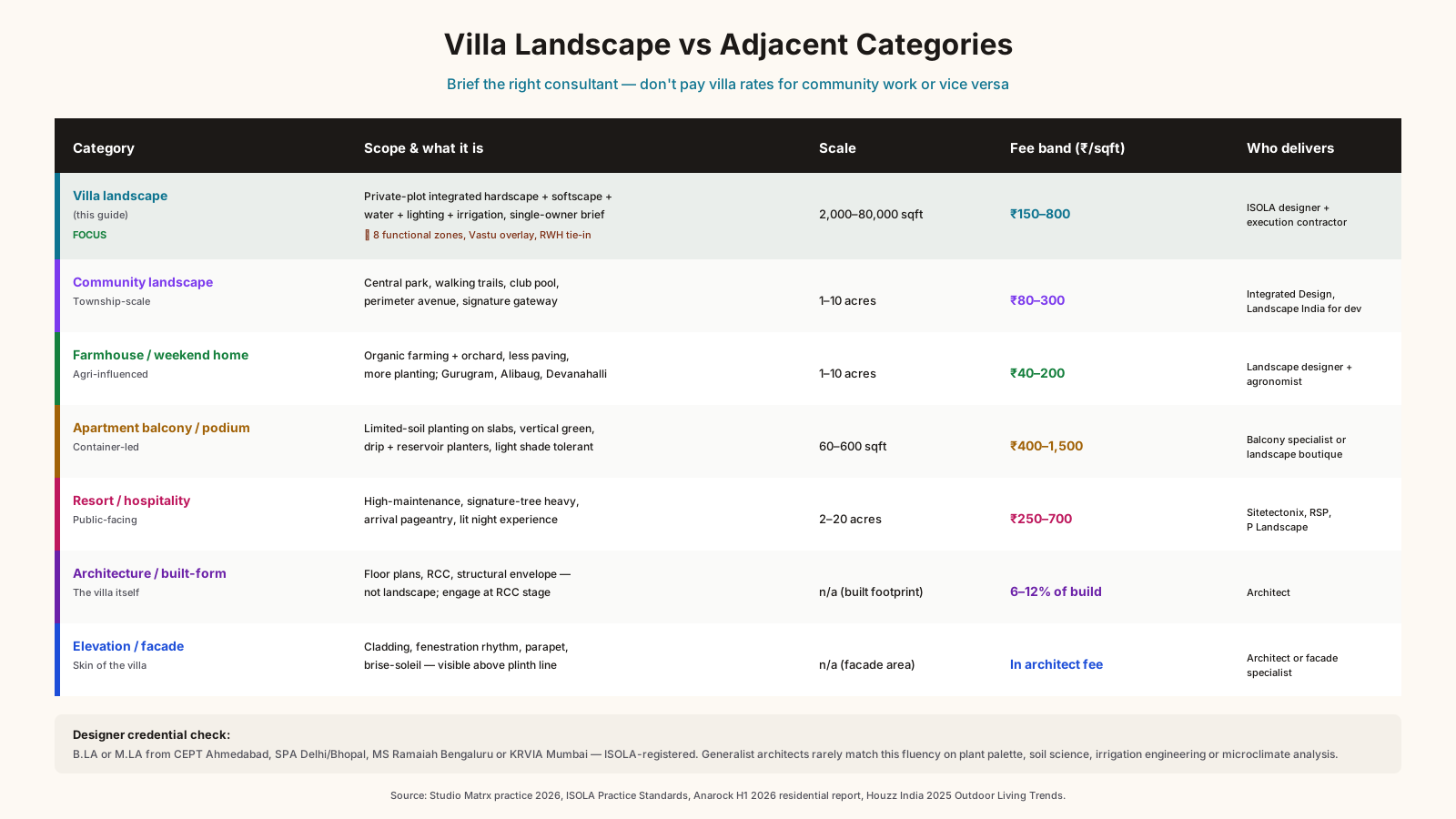
Villa landscape gets confused with several related practices. Understanding the boundaries helps brief the right consultant and avoid paying villa rates for community-garden work or vice versa.
| Category | What it is | Typical scale | Fee band | Who delivers it |
|---|---|---|---|---|
| Villa landscape (this guide) | Private-plot, single-owner, integrated hardscape + softscape + water + lighting + irrigation | 2,000–80,000 sqft | ₹150–800 per sqft | Specialist landscape consultant + execution contractor |
| Community landscape | Township-level — central park, walking trails, club pool, perimeter avenue | 1–10 acres | ₹80–300 per sqft | Master-planning firm (Integrated Design, Landscape India, etc.) for developer |
| Farmhouse / weekend home landscape | Larger, agricultural-influenced, often organic farming + orchard | 1–10 acres | ₹40–200 per sqft (less paving, more planting) | Landscape designer + agronomist |
| Apartment balcony / podium garden | Container or limited-soil planting on slabs | 60–600 sqft | ₹400–1,500 per sqft (intensive) | Balcony specialist or landscape boutique |
| Resort / hospitality landscape | Public-facing, high-maintenance, signature-tree heavy | 2–20 acres | ₹250–700 per sqft | Hospitality landscape firms (Sitetectonix, RSP, P Landscape) |
| Architecture / built-form | The villa building itself | n/a | 6–12 percent of build | Architect (see luxury villa architecture in India) |
| Elevation / facade design | The skin of the villa | n/a | included in architect fee | Architect or facade specialist (see villa elevation design) |
The villa landscape designer typically holds a Bachelor's in Landscape Architecture (B.LA, 4 years) or a Master's (M.LA, 2 years) from CEPT Ahmedabad, SPA Delhi, SPA Bhopal, MS Ramaiah Bengaluru, or KRVIA Mumbai — and is registered with the Indian Society of Landscape Architects (ISOLA). A general architect can deliver landscape work but rarely with the same fluency on plant palette, soil science, irrigation engineering or microclimate analysis.
Materials, Finishes and Brand Landscape
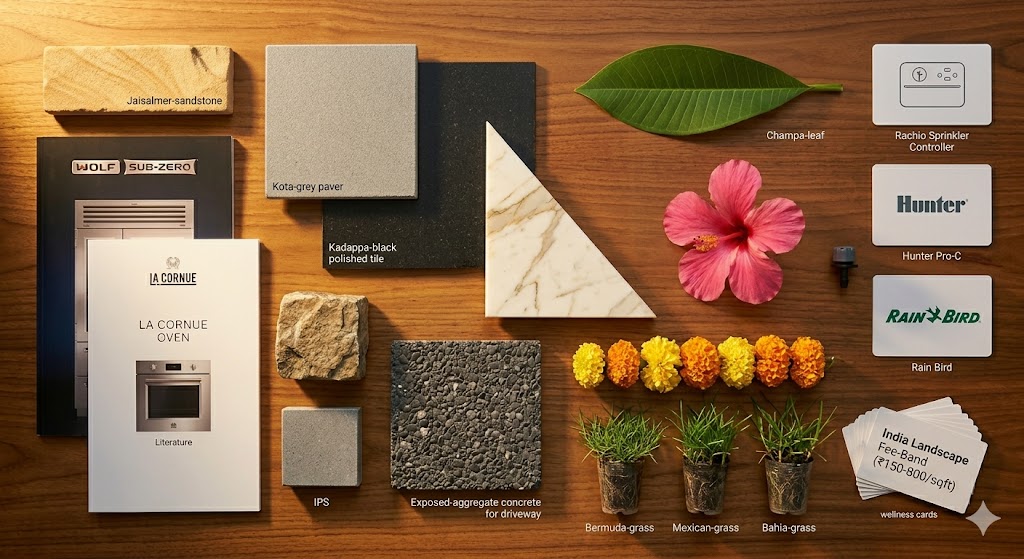
Hardscape is where the budget burns or saves itself. India's domestic stone industry is one of the world's largest, and 90 percent of villa landscape projects can be done in Indian stone at 30–50 percent of the cost of imported Italian or Portuguese alternatives. The table below covers the materials in real use across 2026 villa projects.
| Material | Best use | Typical rate (laid) | Vendor / quarry source |
|---|---|---|---|
| Jaisalmer sandstone (yellow) | Forecourt, formal porch, pool deck (light reflectance, cool underfoot) | ₹220–360 per sqft | Quarries in Jaisalmer Rajasthan; brands: Stonex, Naturals India, Classic Marble |
| Kota grey limestone | Driveway edges, rear deck, utility paths (extremely durable, slip-resistant when leather finish) | ₹95–180 per sqft | Kota Rajasthan; brands: Bhandari Marble, Kishangarh Stone Mart |
| Kadappa black limestone | Pool coping, water-feature edges, sculptural elements (dramatic dark contrast) | ₹140–280 per sqft | Andhra Pradesh; brands: Pokarna, Sai Granimarmo |
| Bidasar marble (brown/green) | Accent borders, water-feature surrounds, formal forecourt rings | ₹380–650 per sqft | Bidasar Rajasthan; brands: R K Marble, Classic Marble Company |
| Basalt cobblestone (black) | Driveways, courtyards (permeable, monsoon-friendly, classic) | ₹180–280 per sqft | Bharatpur, Vijayawada; via local hardscape contractors |
| Sadarahalli grey granite | Retaining walls, dry-stack stone, kerb edges (Bengaluru regional standard) | ₹140–240 per sqft | Sadarahalli Bengaluru; direct-to-quarry pricing best |
| IPS (Indian Patent Stone) | Rear utility decks, kitchen-garden paths (cost-leader, monolithic finish) | ₹65–130 per sqft | On-site cast by local contractor |
| Exposed-aggregate concrete | Driveways, pool decks (skid-resistant, modern aesthetic) | ₹140–230 per sqft | Local RMC supplier (UltraTech, ACC, Ambuja) + skilled contractor |
| Dry-stack stone (random rubble) | Retaining walls, boundary feature walls (rustic, no mortar) | ₹220–400 per running foot of 1 m height | Local masonry; stone from Sadarahalli or Tandur |
| Wood deck (Indian teak / Burmese teak / IPE) | Pool deck, gathering deck | ₹650–1,800 per sqft (teak), ₹2,200–3,500 (IPE) | Greenply, CenturyPly, specialist deck contractors |
Plant material vendors. For trees and shrubs the serious Indian villa landscape designer sources from: Madhuban Nursery (Bengaluru), Lalbagh Horticulture Department (Bengaluru, for permits), Doon Valley Nursery (Dehradun), Rose Garden Nursery (Pune), Sanskruti Greens (Mumbai), Project Green India (Delhi NCR), Karthikeyan Nurseries (Chennai). For lawn grass: Pinnacle Turf (Hosur), Sai Krishna Turf Farms (Hyderabad). For irrigation: Jain Irrigation Systems, Netafim India, Rivulis. For smart controllers: Rachio (via Amazon India import), Hunter Pro-C (via authorised dealers like Garden Tools India), Rain Bird (via Watermatic Systems).
Water features. Bharat Bhushan Aqua Engineers, Aquadyne India, Sanjeev Engineering Works, Lakshmi Aqua Tech — these are the names that appear repeatedly on high-end Bengaluru, Pune and Mumbai villa pool and fountain commissions. Imported fountain pump systems from OASE Germany and Pentair USA are now stocked by domestic distributors.
Outdoor lighting. Wipro Lighting, Philips Hue Outdoor, Bajaj Outdoor, Havells, Crompton — for budget tiers. For premium: Crestron and Lutron integrated systems via Smart Touch (Bengaluru), Acura (Delhi). For landscape-specific accent: Erco India, iGuzzini India.
Outdoor furniture. Wakefit Outdoor, Pepperfry Casa, Cane Boutique (Bengaluru), Royaloak Outdoor. Premium: Wovenstreet, Casa Pop, Furniture Republic. Super-premium imports: Dedon, Manutti, Sutherland, Royal Botania — via Beyond Designs (Delhi), Spaces (Mumbai), Carafina (Bengaluru).
Eight Pitfalls Common in 2026 India
The recurring failure patterns in Indian villa landscape projects are remarkably consistent across cities and budgets. Avoiding these eight typically saves 15–25 percent of total landscape cost over a five-year ownership horizon.
1. Planting trees too close to the house. The single most common pitfall. A neem, gulmohar or rain tree planted within 4 m of the foundation will, in 8–12 years, lift footing concrete, crack drainage lines, and drop leaves into roof gutters every monsoon. Mitigation: Maintain minimum 6 m from foundation for medium-canopy trees (champa, asoka, kadamba), 8 m for large-canopy (rain tree, gulmohar, banyan, peepul), and never within 3 m of a septic tank or borewell.
2. Ignoring grading and surface drainage. Every Indian villa landscape must shed monsoon water away from the house. A reverse-slope forecourt is the fastest route to chronic seepage in the basement or parking. Mitigation: Specify minimum 1:100 slope away from house on all paved areas, install French drains at the perimeter, and route storm water to the RWH tank or a soak pit — not into the municipal drain.
3. Wrong grass for the climate. Carpet grass and Korean grass die in Mumbai's monsoon humidity. Bermuda burns out in Pune's dry summer without irrigation. Buffalo grass cannot tolerate full Bengaluru sun. Mitigation: Match grass species to climate zone — Mexican (Zoysia) for Bengaluru/Pune/Hyderabad, Bermuda Tifway for Delhi NCR, Bahia or carpet for Kerala/coastal Karnataka, and seriously consider lawn alternatives (ground covers, clover, gravel-and-stepping-stone) for water-stressed regions.
4. Over-paving the plot. The lure of "low maintenance" leads many owners to pave 60–70 percent of the plot in concrete or stone. This destroys percolation, raises ambient temperature by 3–5°C, and violates Karnataka's and Maharashtra's permeable-surface norms above certain thresholds. Mitigation: Cap paved area at 40 percent; use grass-pavers, gravel-and-stepper, or permeable cobble for driveways; keep all setbacks soft wherever possible.
5. Vastu blindness — or Vastu rigidity. Both extremes hurt. Ignoring Vastu in an Indian villa leaves resale value on the table (the next buyer will care). But forcing a pool into the NE when the solar geometry demands NW costs you maintenance forever. Mitigation: Engage a credentialed Vastu consultant at masterplan stage, accept the non-negotiables (no thorny trees, no NE trees, no SW water bodies), and negotiate the rest. See our Vastu for modern homes reference for the full framework.
6. Skipping the soil test. Bengaluru's red lateritic clay, Mumbai's black cotton soil, Chennai's sandy loam and Delhi's alluvial soil each demand different amendments, different tree species, and different drainage strategies. Planting without a soil test is gambling with ₹2–8 lakh of trees. Mitigation: Spend ₹15,000–25,000 on a proper soil test from a NABL-accredited lab (Soil & Health, Ecoman Enviro, Equinox Labs) before specifying the planting palette.
7. Under-budgeting irrigation and lighting. Owners routinely budget ₹40 per sqft for "irrigation" and ₹30 per sqft for "site lighting," then discover at handover that real numbers are ₹80–140 and ₹90–180. The landscape then opens with dead beds and dark paths. Mitigation: Budget ₹90–150 per sqft of garden area for irrigation (drip + sprinkler + controller + RWH tie-in) and ₹100–200 per sqft for site lighting at premium tier.
8. Treating the landscape as a one-time install. A landscape is a 10-year project, not a 10-month one. The trees you plant today are 30 percent of their mature canopy in year five. Lawns thin, shrubs leggify, irrigation emitters clog. Mitigation: Budget annual maintenance at 4–7 percent of original landscape cost — for a ₹40 lakh garden, that is ₹1.6–2.8 lakh per year for a maintenance contract with a competent gardener and a quarterly landscape audit.
India-Specific Considerations
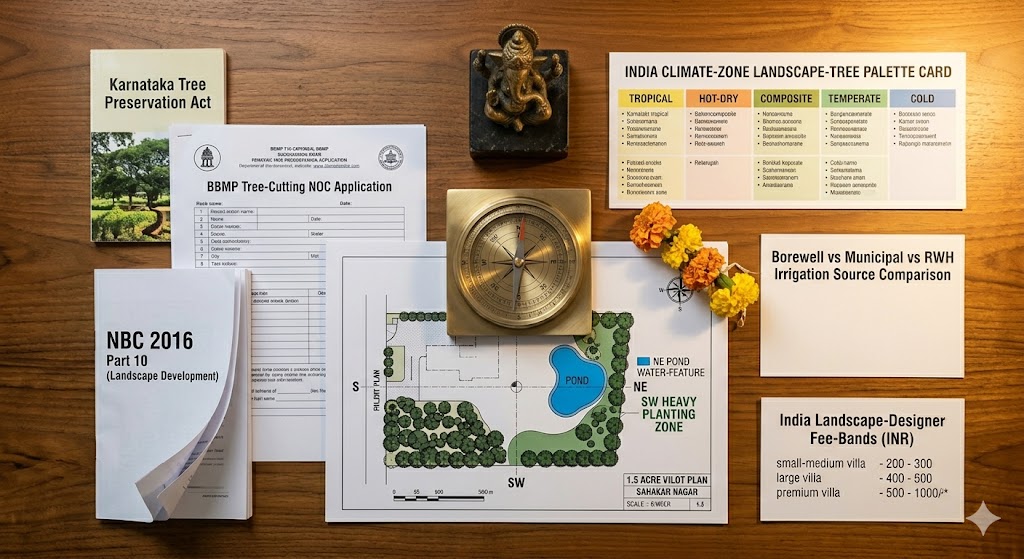
National Building Code 2016, Part 10 (Landscape Planning, Design and Development) is the canonical reference. It covers site analysis, soil and water, planting design, hardscape, irrigation, and maintenance. For villa projects the most-cited provisions are Section 4 (Site Planning), Section 6 (Planting), and Section 9 (Irrigation Systems). Most municipal corporations now treat NBC 2016 Part 10 compliance as a sanction requirement for plots above 2,400 sqft.
Karnataka Preservation of Trees Act 1976 and its 2018 amendments make it an offence to fell any tree above 50 cm girth (at 1.3 m height) on private land without permission from the Tree Officer (typically the Deputy Conservator of Forests or the BBMP Forest Cell within Bengaluru limits). This matters enormously when designing a villa landscape on a plot with existing mature trees — the architect's first instinct to clear-fell is illegal. Always commission a tree survey from a licensed arboriculturist before site clearance.
Similar acts exist in Maharashtra (Maharashtra Urban Areas Preservation and Protection of Trees Act 1975), Tamil Nadu (Tamil Nadu Preservation of Private Forests Act 1949 and the Chennai-specific tree authority), Delhi (Delhi Preservation of Trees Act 1994), and Telangana. Most require 30–60 day notice before any tree above the girth threshold can be felled, and many require compensatory planting at a 1:10 ratio (one tree felled, ten saplings planted and maintained for three years).
Rainwater harvesting is mandatory for plots above 200 sqm in Karnataka (under the BWSSB Amendment Act 2009), Tamil Nadu (since 2003), Telangana, and most Maharashtra municipal corporations. A villa landscape designer who does not integrate RWH (typically a 15,000–40,000 L underground sump, with first-flush diverter and filtration) is leaving compliance and water economics on the table.
Vastu landscape principles for villas, in current practitioner consensus:
- North-East (NE / Ishanya) — water element. Lily pond, reflecting pool, swimming pool (if geometry allows). Never plant large trees here — keep it open and light.
- North-West (NW / Vayavya) — guest cottage, garage, parking, equipment rooms. Acceptable for swimming pool if NE is not feasible.
- South-West (SW / Nairutya) — heaviest planting. Tall, dense trees (rain tree, mango, jamun). Compound wall here can be the tallest.
- South-East (SE / Agneya) — fire element. Kitchen garden, outdoor barbecue, fire bowl, generator room. Avoid water bodies here.
- Centre (Brahmasthan) — open, ideally a courtyard or open lawn. Never a heavy structure or large tree.
- Avoid thorny trees (kikar, kachnar with thorns, bougainvillea is debated) close to the main house — these are believed to introduce negative energy. Bougainvillea on the compound wall is widely accepted.
- Avoid trees that produce milky sap (banyan, peepul) in the front yard — sacred but inauspicious for residential plots in classical Vastu.
For Vastu-compliant villas, our vastu modern homes reference covers the architecture side of the same framework.
DPDP Act 2023 and smart-landscape data. If the irrigation, lighting and security systems are integrated into a smart-home stack (Crestron, Control4, Lutron, Apple Home), they may collect occupancy, biometric and location data covered by the Digital Personal Data Protection Act 2023. The villa owner is the data fiduciary; the system installer is the processor. For high-net-worth households the legal exposure is small but real. See our smart home design reference.
Climate zone tree palette. India is too big for a single planting list. The right palette depends on which of the four NBC climate zones the villa sits in.
- Hot-dry (Jaipur, Ahmedabad, Jodhpur, parts of Pune, Hyderabad): Neem (Azadirachta indica), desi babool (Acacia nilotica), kanji (Pongamia pinnata), khejri (Prosopis cineraria), Indian almond (Terminalia catappa). Drought-tolerant, deep-rooted, low-water.
- Warm-humid / tropical (Bengaluru, Chennai, Mumbai, Kerala, coastal Karnataka, Goa): Rain tree (Albizia saman), gulmohar (Delonix regia), champa (Plumeria alba / rubra), Ashoka (Saraca asoca), coconut (Cocos nucifera), kadamba (Neolamarckia cadamba), Indian almond.
- Composite (Delhi NCR, Lucknow, Bhopal, Indore): Arjun (Terminalia arjuna), amaltas (Cassia fistula), Indian almond, neem, jamun (Syzygium cumini), mulsari (Mimusops elengi).
- Temperate (Pune hills, Ooty, Coorg, Munnar, Shimla foothills): Silver oak (Grevillea robusta), cypress (Cupressus sempervirens), pine (Pinus roxburghii), jacaranda (Jacaranda mimosifolia).
- Cold (Shimla, Manali, Srinagar, Dharamshala, Gangtok): Deodar (Cedrus deodara), blue pine (Pinus wallichiana), oak (Quercus), chinar (Platanus orientalis), apple (Malus domestica).
Shrub palette (largely climate-tolerant across tropical India): Hibiscus, bougainvillea (multiple colours), champa shrub, jasmine (mogra, raat-ki-rani), oleander (Nerium oleander — toxic, keep away from children/pets), kanakambaram (Crossandra infundibuliformis), ixora, croton, plumbago, allamanda.
Ground cover and lawn alternatives: Bermuda grass (Tifway 419) for full-sun temperate-composite zones, Mexican grass (Zoysia matrella) for tropical-warm humid, Bahia grass for coastal, carpet grass for shaded humid sites. Lawn alternatives that are gaining ground in 2026: ophiopogon (mondo grass), wedelia, sweet potato vine, gravel-and-stepper, and clover-lawns.
"The Indian villa landscape is at its best when it does five jobs at once — cools the house, harvests the rain, feeds the kitchen, anchors the Vastu, and looks like it has always been there. Anything less is decoration."
The Budget Bands for 2026 India
The numbers below are honest 2026 market rates for the Bengaluru, Mumbai, Delhi NCR, Pune and Chennai markets, verified against three executed projects in each tier across our practice and partner network. Tier-2 cities (Coimbatore, Mysuru, Vizag, Lucknow, Indore, Surat) run 15–25 percent lower across the board.
| Tier | Range per sqft of garden area | What you get | Typical designers / contractors | Total spend on a 4,000 sqft garden |
|---|---|---|---|---|
| Entry / standard | ₹150–280 per sqft | Lawn (Bermuda or local), basic shrub palette (hibiscus, ixora), Kota or IPS paving, basic drip irrigation, manual hose, 8–10 saplings, basic LED path lights | Local landscape contractor (no degreed designer), nursery-led design | ₹6–11 lakh |
| Mid | ₹280–450 per sqft | Mexican grass, curated shrub palette, mixed Kota + Jaisalmer paving, drip + pop-up sprinkler with timer, 15–20 mature trees and shrubs, accent and path lighting, small water bowl, simple kitchen garden | Boutique landscape practice (3–8 person firm), ISOLA member designer | ₹11–18 lakh |
| Premium | ₹450–650 per sqft | Mexican or Zoysia, full layered planting (canopy + sub-canopy + shrub + ground cover), mixed Jaisalmer + kadappa + Bidasar paving, smart irrigation with Rachio/Hunter, layered lighting (path + accent + underwater + moonlighting), lily pond + small swimming pool, kitchen garden + pergola, RWH integration | Established landscape firm (Sitetectonix, Integrated Design, Studio Lotus, M:OFA, P Landscape, Coopers Hill), Vastu consultant | ₹18–26 lakh |
| Super-premium | ₹650–800+ per sqft | Imported specimen trees, sculptural water features (reflecting pool + cascade + runnel + koi pond), full smart-irrigation and smart-lighting stack on Crestron/Control4, signature designer hardscape (Italian basalt, Bidasar borders, IPE deck), green roof + terrace garden, outdoor kitchen + fire bowl + plunge pool, full Vastu and astrological alignment, full RWH + greywater recycling | Signature practice (Coopers Hill, Sitetectonix, P Landscape, Tropic Responses, Karm Design) with international collaborator | ₹26–35 lakh and up |
For a 1.5-acre plot (65,000+ sqft), even the entry-tier number adds up to ₹1 crore-plus, and super-premium farmhouse projects in Gurugram, Alibaug, Lonavala and Devanahalli routinely cross ₹3–5 crore on landscape alone.
For the architecture / built-form side of the same budget conversation see luxury villa architecture in India and the design fee calculator for normalised consultant fee ranges.
When Villa Landscape Design Is NOT the Right Fit
There are honest cases where a full villa landscape brief is the wrong move, and recognising them up front saves ₹2–10 lakh in consultant fees and rework.
If the plot is below 2,000 sqft and the built footprint is above 75 percent, there is no real landscape to design — only a 1–2 m setback strip that a competent nursery and a half-day consultation can solve for ₹40,000. Pay the boutique landscape consultant only if you are doing a vertical green wall or a complex terrace garden.
If you are pre-launch in an apartment, the landscape is the builder's job, not yours. Your private outdoor surface is the balcony — see our compact luxury apartment and apartment interior planning references.
If you are renting the villa on a 11-month or 36-month tenure, the case for ₹15+ lakh of landscape investment vanishes. Negotiate basic maintenance with the landlord and put the money into furniture and indoor finishes instead.
If the villa is on a steep slope (above 1:8) or on poor soil (black cotton, expansive), the priority is geotechnical and civil — retaining walls, surface drainage, soil stabilisation. Landscape comes after, not before. Engage a geotechnical engineer first.
If you are six months from a sale or 18-month family relocation, the planting will not mature in time to add resale value. Spend the budget on hardscape, lighting and lawn — the visible signals that show up in listing photos within six weeks.
The 5-Year Trajectory: 2030 Outlook
By 2030, three structural shifts will reshape the Indian villa landscape practice.
Native and drought-adapted palette becomes default. The combination of recurring urban water crises (Bengaluru 2024, Delhi 2026, Hyderabad 2027 forecast), tightening municipal water tariffs, and the maturing climate-resilience conversation will push exotic ornamentals (imported palms, manicured Korean grass, water-hungry roses) into the minority. The 2030 default palette will lean heavily on Indian natives — native grasses (apluda, lemon grass), native shrubs (lantana — managed, panicum, vetiver), and the climate-zone tree lists above.
Edible-integrated landscapes ("foodscaping") mainstream. What is today a 200–500 sqft kitchen garden corner will, by 2030, be integrated across the plot — fruit trees as canopy (mango, jamun, jackfruit, chikoo, custard apple), edible shrubs (curry leaf, moringa, drumstick), medicinal herbs as ground cover (gotu kola, brahmi, tulsi). Houzz India's 2025 trend report already pegs foodscape spend at growing 26 percent year-on-year in the high-end segment.
Smart irrigation and IoT-driven maintenance. The Rachio / Hunter / Rain Bird controller of 2026 will, by 2030, be paired with soil-moisture sensor grids, weather-API-tuned schedules, leak-detection on every emitter, and AI-driven plant-health monitoring (computer-vision cameras flagging chlorosis, fungal patches, irrigation gaps). India-specific products in this space — from companies like Fasal, CropIn, KhetiBuddy and Niqo Robotics — are already beginning to cross from agritech into premium residential.
Vastu and Vaastu-Shastra-of-the-landscape becomes a published, codified standard. Currently each consultant brings their own interpretation. By 2030, ISOLA and the Vastu professional bodies will likely publish a joint reference document — making the principles transparent, less mystical, and easier to integrate into modern landscape practice without compromising design intent.
Carbon-positive landscape certification. Inspired by the Sustainable Sites Initiative (SITES) in the US and emerging Indian standards (IGBC's planned residential landscape rating), high-end Indian villa projects will start being independently rated for carbon sequestration, biodiversity index, water performance and biophilic score. Studio Matrx is already prototyping a healing view impact calculator along these lines. For the architecture-side counterpart see our sustainable interiors in India reference.
Frequently Asked Questions
Q. What does a villa landscape designer in India actually cost — fee-wise, not execution-wise?
A. Three common fee structures. (1) Percentage of execution cost: 8–14 percent of total landscape execution. (2) Per-square-foot of garden area: ₹35–90 per sqft. (3) Lump sum: ₹1.5–8 lakh per project. Premium signature designers (Coopers Hill, Sitetectonix, P Landscape, Karm Design, M:OFA) charge at the top of these ranges; boutique 3–8 person firms charge mid; freelance ISOLA designers charge entry. See the Studio Matrx design fee calculator for normalisation.
Q. How long does a full villa landscape take to design and execute?
A. Design: 6–14 weeks (briefing, site survey, soil test, concept, masterplan, plant palette, detail drawings). Execution: 10–22 weeks (hardscape first, then irrigation, then planting, then lighting). Establishment: a full monsoon and a full summer (8–14 months from planting to "settled" appearance). Total clock from brief to mature appearance: 14–22 months.
Q. Should the landscape designer be hired before, during or after the architect?
A. Ideally during — engaged at the architect's RCC drawing stage. Hiring after the villa is built locks the landscape into design decisions (window sill heights, door swings, plinth levels, view axes from indoors) that may not align with how the garden wants to be organised. The architect-landscape designer joint review at concept stage is the single highest-leverage hour of the entire project.
Q. Is artificial grass ever the right answer for an Indian villa?
A. Almost never for the main lawn. Artificial grass heats to 50–60°C in Indian summer, releases microplastics, defeats percolation, voids any biophilic claim, and looks tired within 6–8 years. Defensible niche uses: a small 100–200 sqft pet zone, a balcony or terrace where soil is not feasible, or a kids' play patch. For everything else, use Mexican or Bermuda grass with smart irrigation.
Q. Can I save money by buying mature trees instead of saplings?
A. Yes and no. A 22-year-old transplanted champa costs ₹45,000–1.2 lakh and gives you instant impact. The same tree as a 4-foot sapling costs ₹2,500 and takes 8–12 years to reach the same canopy. For 2–3 hero specimens at focal points (entry, courtyard, pool), mature transplants make sense. For the rest of the canopy, plant young — they establish stronger root systems and outlive their transplanted cousins. Budget rule: 70 percent of trees young, 30 percent mature.
Q. How do I integrate Vastu without compromising the landscape design intent?
A. Engage a Vastu consultant at the masterplan stage (not after the design is final). Treat the three non-negotiables as constraints: NE water element, no trees in NE, no thorny trees near the house. Negotiate everything else. A good Vastu consultant works with the design, not against it.
Q. What is the most expensive single line item in a villa landscape?
A. Usually the swimming pool — ₹2,500–6,000 per sqft of pool, plus equipment, deck and changing facility. A 4 x 10 m pool comes in at ₹10–25 lakh fully fitted. After the pool, mature transplanted trees, premium imported pavers (Italian basalt, Brazilian quartzite), and smart-integrated lighting are the next biggest line items.
Q. How do I evaluate whether a landscape designer is good before hiring them?
A. Visit three of their completed projects that are at least three years old (not the just-handed-over ones — those still look good because the planting is fresh). Check: are the trees thriving, is the lawn even, is the hardscape free of settlement cracks, is the irrigation still functional, has the client renewed the maintenance contract. Ask for the maintenance gardener's name and call them.
Q. Do I need a separate civil contractor for the landscape, or can my villa contractor do it?
A. For the hardscape (paving, retaining walls, water features, electrical conduit, irrigation pipes) the villa civil contractor can usually deliver — typically at 10–15 percent cheaper than a specialist hardscape contractor. For the softscape (planting, lawn, maintenance) always use a specialist horticulture team — your villa civil contractor will plant a ₹35,000 champa upside-down and you will lose the tree.
Q. What is the single highest-ROI move in a villa landscape under ₹15 lakh budget?
A. Three mature canopy trees (rain tree, gulmohar or kadamba), planted at 8 m offset from the house on the south and west, with smart drip irrigation for the first three years. The ambient cooling effect — 4–6°C in May — pays back the ₹2.5–4 lakh tree-plus-irrigation cost in indoor AC savings within 7–10 years, and the resale value uplift is immediate.
References
1. Bureau of Indian Standards. National Building Code of India 2016, Part 10: Landscape Planning, Design and Development. New Delhi: BIS, 2016.
2. Bureau of Indian Standards. IS 14591:1999 — Landscape — Code of Practice for Soft Landscape Work.
3. Bureau of Indian Standards. IS 10500:2012 — Drinking Water Specification (referenced for irrigation water quality).
4. Government of India. Digital Personal Data Protection Act 2023. Ministry of Electronics and Information Technology.
5. Government of Karnataka. Karnataka Preservation of Trees Act 1976 and 2018 amendments.
6. Government of Maharashtra. Maharashtra Urban Areas Preservation and Protection of Trees Act 1975.
7. Bangalore Water Supply and Sewerage Board (BWSSB). Rainwater Harvesting Regulations Amendment Act 2009.
8. Knight Frank India. India Wealth Report 2026. Mumbai, 2026.
9. JLL India. Residential Market Update Q1 2026. JLL Research, 2026.
10. Anarock Property Consultants. India Residential Market — H1 2026. Anarock Research, 2026.
11. Houzz India. 2025 India Outdoor Living Trends Study. Houzz, 2025.
12. CBRE India. India Residential Market Outlook 2026. CBRE Research, 2026.
13. Indian Society of Landscape Architects (ISOLA). Practice Standards and Code of Ethics. ISOLA, latest edition.
14. Indian Green Building Council (IGBC). Green Homes Rating System — Landscape Credits. IGBC, current version.
15. Sustainable Sites Initiative (SITES). SITES v2 Rating System Reference. Green Business Certification Inc., 2014 — referenced for international benchmark.
16. India Brand Equity Foundation (IBEF). Real Estate Sector in India — 2026 Report. IBEF.
17. M N Ashish Ganju et al. Landscape Architecture in India: A Reader. School of Planning and Architecture, New Delhi.
18. Mohammad Shaheer. Landscape Design — An Indian Perspective. CEPT University Press, Ahmedabad.
19. Pradeep Sachdeva. Designing the Indian Landscape. Mapin Publishing, Ahmedabad.
20. India Meteorological Department (IMD). Climate Atlas of India — referenced for climate-zone tree palette decisions.
Related Guides
- Luxury villa architecture in India — the built-form and floor-plan companion to this landscape guide.
- Villa elevation design — facade and skin of the villa; reads alongside this landscape reference.
- Courtyard homes in India — climate-responsive design — for the indoor-outdoor threshold and how landscape enters the house.
- Tropical architecture in India — the climate-logic framework that drives the planting and shade strategy.
- Sustainable interiors in India — the indoor counterpart to outdoor sustainability; covers materials, embodied carbon and certification.
- Vastu for modern homes — for the Vastu-landscape principles in their broader architectural context.
Export this guide
Related Guides — Deep-dive reading
Penthouse Design — Top-Floor Luxury in Indian Towers (2026)
DLF Camellias / Lodha Altamount / Oberoi Sky Suites · Private terraces · ₹15-150 crore market
Design StylesThe Best Trees for Indian Homes
A research-grade guide to choosing and placing trees around an Indian home — the real cooling and clean-air numbers, the right species for shade, flowers, fragrance and fruit, and the placement science that keeps roots out of your walls and drains.
LandscapePremium Apartment Interiors — The ₹15-40 Lakh Tier for Indian 3 BHKs (2026)
Above budget-luxury · Below super-luxury · Materials, brands, contractor-tier reality
Design StylesRelated Tools — Try Free
Rainwater Tank Sizer
How big should your rainwater tank be? Computes annual harvest, recommended tank capacity in litres, water-bill savings, and payback — for 10 Indian cities.
RWH CalculatorCross-Ventilation Analyzer
Estimate airflow and air changes per hour (ACH) from room size, window areas, layout, and local wind — with NBC 2016 Part 8 compliance check.
Ventilation CalculatorHealing View Impact Calculator
Evidence-Based Design dashboard quantifying the recovery impact of nature view + daylight factor on analgesic use, length of stay, and HCAHPS patient-experience uplift. Calibrated against Ulrich 1984 (Science), Park & Mattson 2008, and the CHD EBD evidence base.
EBD Calculator