
Natural Swimming Pools — A Chemical-Free Pool for Indian Homes
How a plant-filtered swimming pond works, its zones, plants, construction, the honest India climate realities, and how it compares with a chlorinated pool
A natural swimming pool is one you swim in that is kept clean by plants and living biology instead of chlorine — and while the idea is beautiful, India's warm climate makes it harder to pull off than in Europe, so good design is everything.
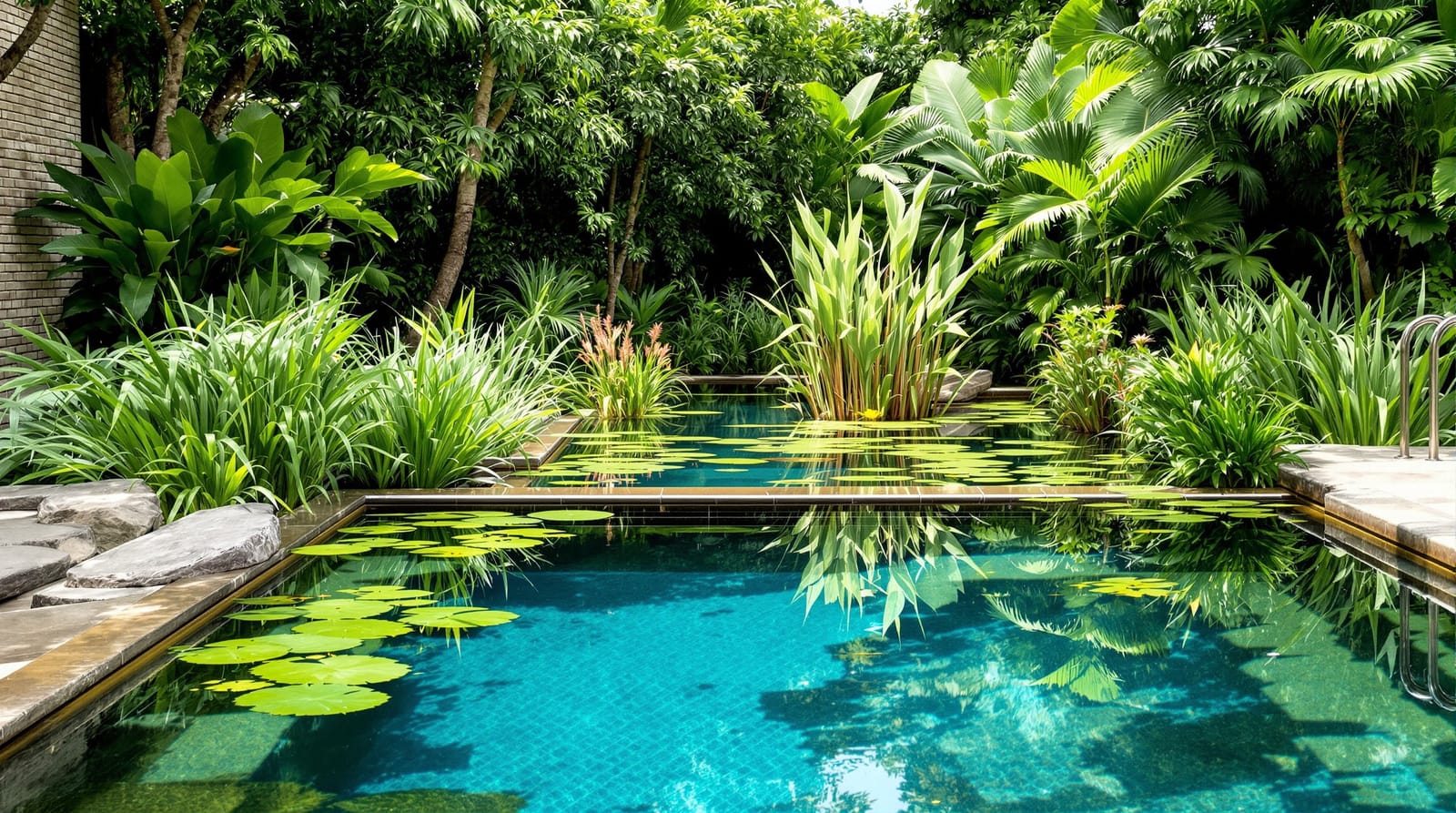
A natural swimming pool (NSP) — sometimes called a natural pool or swimming pond — gives you a clear, swimmable body of water with no chlorine, no salt cell, no acrid eye-stinging smell. The cleaning is done by aquatic plants, gravel, and the microbes that live on them. It looks like a pond, it swims like a pool, and it asks more of its designer than either. Done well in India, it is one of the most alive things you can build in a garden. Done badly, it becomes a warm green algae soup that breeds mosquitoes. This guide explains how an NSP actually works, the zones and plants that make it tick, what it costs against a conventional pool, and the honest realities of running one in an Indian climate.
What a natural swimming pool actually is
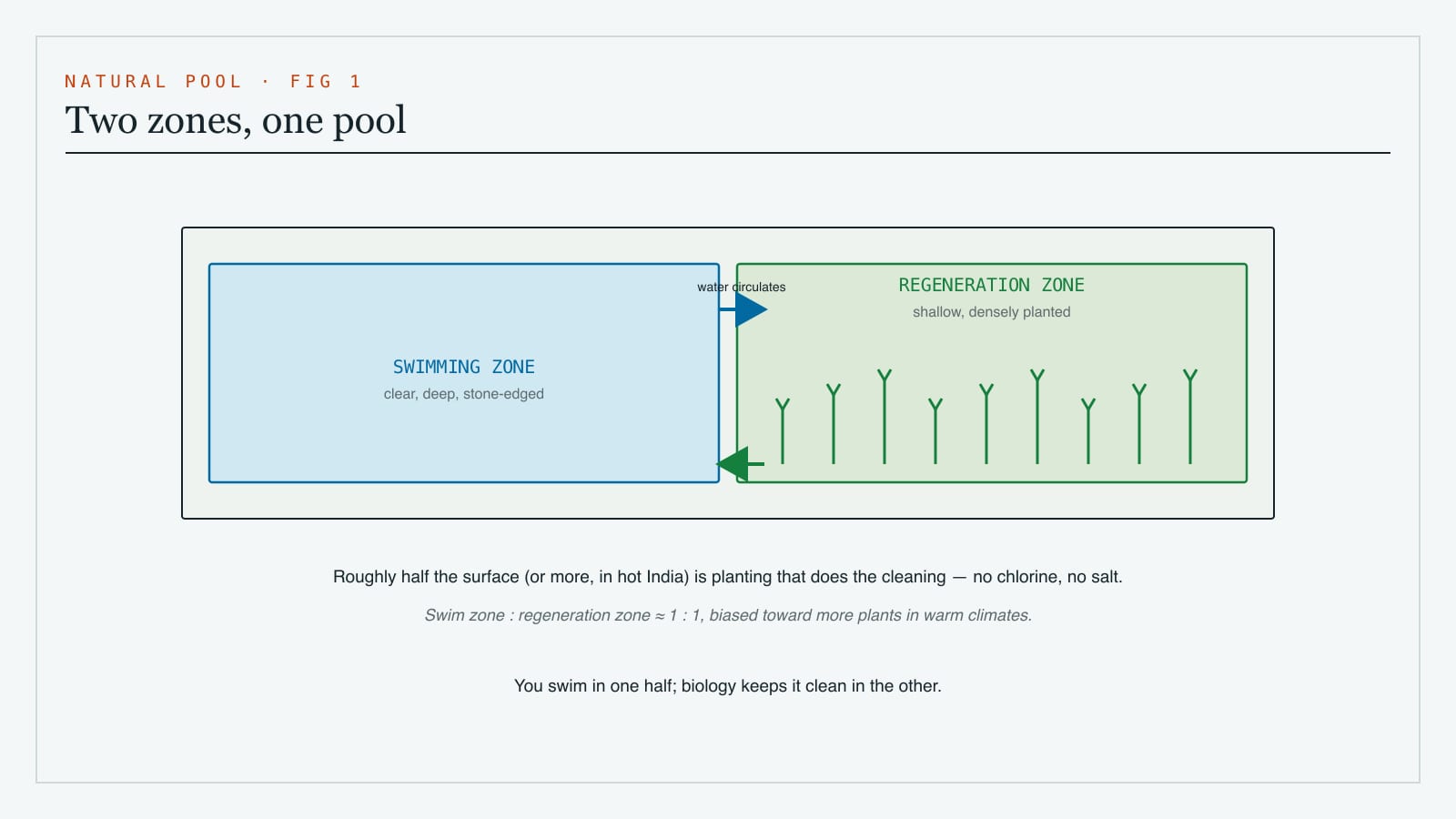
An NSP is a two-part system. One part is the swimming zone — open, deep, clear water you get into. The other is the regeneration zone — a shallow, densely planted area where the cleaning happens. Water is circulated continuously between the two. The plants and the biofilm on the gravel consume the nutrients (nitrogen, phosphorus) that would otherwise feed algae, so the water stays clear without chemicals. The swimmer never enters the planted zone; the two are separated by a low wall or barrier, usually hidden just below the waterline.
It helps to be clear about what an NSP is not:
- It is not a conventional chlorinated pool. A chlorine pool kills everything in the water with a chemical residual. An NSP keeps the water "alive" — there is biology in it by design — and clarity comes from starving algae of food, not from poisoning the pool.
- It is not an ornamental pond. An ornamental pond is for looking at and for fish; you do not swim in it, and it is usually fed and stocked, which adds nutrients. An NSP is engineered for body-contact bathing, so it must hold low nutrient levels and good circulation. If you want a planted pond to admire rather than swim in, see our Pond Design Guide — that is a different brief.
This guide sits under our pillar on Water Features in Landscape Design, which compares the whole family of water features and helps you decide whether an NSP is even the right ambition for your site.
How it works — the living filter
The heart of the system is biological filtration. As water moves slowly through the gravel and root mass of the regeneration zone, a film of bacteria coating every gravel surface converts ammonia to nitrate, and the plants take up the nitrate and phosphate as fertiliser. Strip out those nutrients and algae has nothing to grow on. Add mechanical skimming for leaves and a slow, steady pump to keep water turning over, and the pool clears itself.
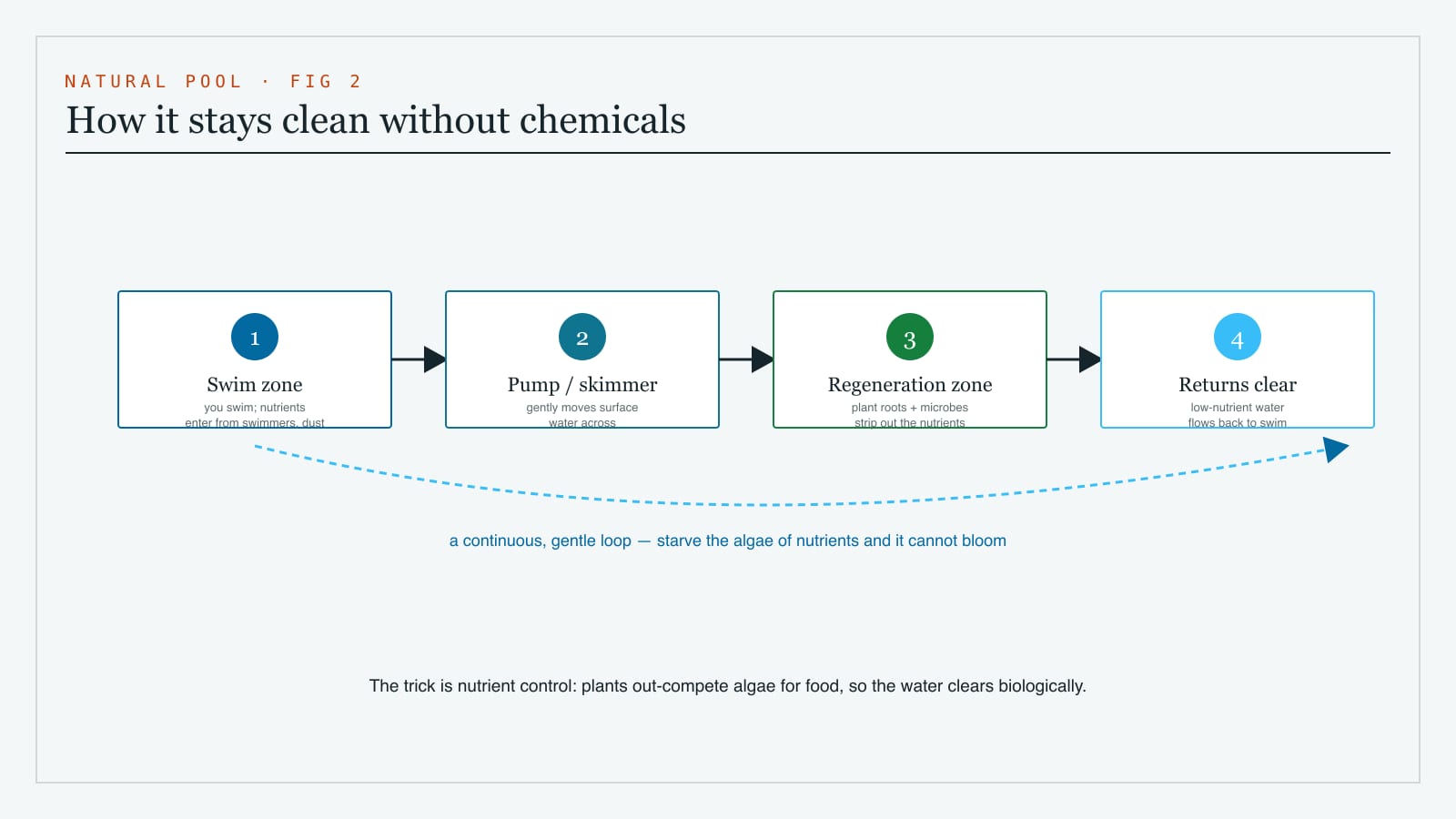
The working cycle, simplified:
1. A low-energy pump draws water from the swimming zone, usually via a surface skimmer that captures floating leaves and pollen before they sink and rot.
2. Water is pushed (or gravity-fed) into the regeneration zone, where it percolates slowly through gravel beds planted with reeds and rushes.
3. Bacteria on the gravel break down ammonia; plant roots absorb the freed nutrients.
4. Clarified, oxygen-rich water returns to the swimming zone.
Turnover is gentle and continuous — the whole volume is typically cycled once every few hours, not blasted around like a chlorine pool's high-pressure sand filter. Many designs add a small UV clarifier or a bog/biofilter chamber as insurance; purists keep it fully passive. In India's heat, a small UV unit on the return line is sensible insurance against green-water blooms and is not "cheating" — it sterilises drifting algae cells without putting any chemical in the water.
Zones, layout and the area ratio
The single most important design number in an NSP is the ratio of regeneration area to swimming area. The plants are your filter, and a warmer climate makes more nutrients available and runs algae faster, so you need more plant area, not less.
| Zone | What it does | Typical depth | Notes for India |
|---|---|---|---|
| Swimming zone | Open clear water for bathing | 1.2–2.0 m | Deeper water stays cooler and resists algae; steep walls discourage plants creeping in |
| Regeneration zone | Planted biological filter | 0.1–0.6 m | Shallow and sunny so plants thrive; this is your "filter capacity" |
| Separation barrier | Keeps swimmers out of the planting | Just below water level | Low wall or submerged ridge; water flows over/through it |
| Skimmer + pump zone | Removes surface debris, drives circulation | — | Site the skimmer downwind of the prevailing breeze |
European NSPs often run a regeneration-to-swimming ratio of around 1:1 (equal planted and swimming area). In India's hotter, sunnier conditions the safe guidance is to bias towards more plants — plan for 1:1, and do not go leaner than about 1:0.5 (i.e. planted area at least half the swimming area) unless you are leaning on a UV/biofilter assist. Skimping on the planting zone is the commonest reason Indian NSPs go green. Budget the total footprint accordingly: a modest 6 × 3 m swimming zone realistically wants another 9–18 sq m of planted regeneration area beside it.
Layout options range from a single basin split internally by a hidden wall, to two adjacent basins linked by a stream or weir (which doubles as a charming water feature and adds oxygenating turbulence). Orient the regeneration zone to catch sun for the plants, and try to shade part of the swimming zone — a pergola or a tree to the west — so the water does not bake all afternoon.
The plants that do the cleaning
Three plant roles matter, and India has good native and naturalised options for each.
- Emergent reeds and rushes (the workhorses, rooted in shallow gravel with leaves above water): Indian sweet flag (Acorus calamus, "vacha"), common reed (Phragmites karka), cattail/typha (Typha angustifolia — vigorous, hungry, but spreads, so contain it), and umbrella sedge (Cyperus alternifolius). These are the nutrient-hungry stars of the regeneration zone.
- Submerged oxygenators (live underwater, release oxygen, outcompete algae): hornwort (Ceratophyllum demersum) and Vallisneria (eel grass) both grow readily in Indian conditions and are the cleanest way to keep dissolved oxygen up.
- Floating-leaf and surface shade plants (cool the water, shade out algae): water lily (Nymphaea species, including native blue lotus Nymphaea nouchali) and, used very sparingly and contained, water lettuce or duckweed. Aim to shade roughly a third of the surface in peak summer.
A note of honesty: avoid letting aggressive floaters like water hyacinth (Eichhornia crassipes) anywhere near the system — it is an invasive menace in Indian waterways and will choke the pool. Choose vigorous but containable species, and plant the regeneration zone densely from the start; bare gravel is an invitation to algae. Our guides on Wildlife-Friendly Home Landscapes and Biophilic Landscape Design go deeper on choosing Indian aquatic and marginal species.
Construction and the liner
Most NSPs are lined basins rather than concrete tanks, which keeps cost down and allows organic shapes. The build sequence, broadly:
1. Excavate both zones to profile, shaping shallow shelves in the regeneration zone and steep-ish walls in the swimming zone.
2. Protect and line. Lay a geotextile underlay (protects against root and stone puncture), then the waterproof membrane. The usual choice in India is a reinforced EPDM pond liner (durable, flexible, 20+ year life) or, on a tighter budget, a thick HDPE/PVC liner. A fully concreted/shotcrete swimming zone with a tiled or plastered finish is also possible if you want crisp edges — it costs more but gives a "pool-like" look.
3. Build the separation barrier between zones, finished just below the design water level.
4. Place gravel and substrate in the regeneration zone — washed, low-nutrient aggregate, not garden soil (soil dumps nutrients and feeds algae).
5. Install plumbing: skimmer, low-energy circulation pump, return lines, and any UV/biofilter assist.
6. Plant and fill, ideally before the monsoon so plants establish with rainwater top-up, then allow several weeks for the biology to mature before heavy swimming.
Use municipal or harvested rainwater to fill rather than hard borewell water where you can — high mineral or nutrient loads make the first season's balancing harder. If you are already harvesting roof runoff, an NSP pairs neatly with it; see Rainwater Harvesting at Home.
The honest India realities
This is where an NSP earns its keep — or doesn't. India is not central Europe, and the differences are real.
- Heat and algae. Warm water holds less oxygen and grows algae faster. This is the central challenge. The answers are design answers: a generous regeneration zone, dense oxygenating plants, partial shade over the swimming zone, deeper (cooler) swimming water, and good continuous circulation. Expect to manage algae actively in peak summer, especially the first year before plants mature.
- Evaporation. A summer NSP can lose serious water to evaporation — easily a couple of centimetres a day in hot, dry regions. Plan an automatic top-up from harvested rainwater or a storage tank, and accept this as a running reality. (Read alongside Sustainable Water Management in the Landscape and Water-Secure Homes before committing to any standing-water feature in a water-stressed city.)
- Monsoon. Heavy rain dilutes and overflows the pool, and runoff from surrounding ground can wash nutrients and silt in. Build a designed overflow, and grade the surrounding paving and beds to drain away from the pool so garden fertiliser and soil do not enter it.
- Mosquitoes and dengue. This is the honest fear, and the honest answer is moving water does not breed mosquitoes — Aedes and Anopheles lay in still, stagnant water. A correctly circulated NSP with a working skimmer and surface movement is far less mosquito-prone than a neglected ornamental pond or a covered, stagnant tank. The risk lives in dead corners; keep the whole surface gently moving and skimmed. Frogs and dragonflies that colonise the pool are allies — their larvae eat mosquito larvae.
- Snakes and frogs. Be honest with yourself: a lush planted water body in an Indian garden will attract frogs (welcome) and may occasionally attract snakes drawn to the frogs (less welcome). Keeping the regeneration planting tidy at the edges, lighting the surrounds, and not letting dense cover meet the house reduces this. It is a genuine consideration in semi-rural and peri-urban plots and worth weighing honestly before you build.
Cost vs a conventional chlorinated pool
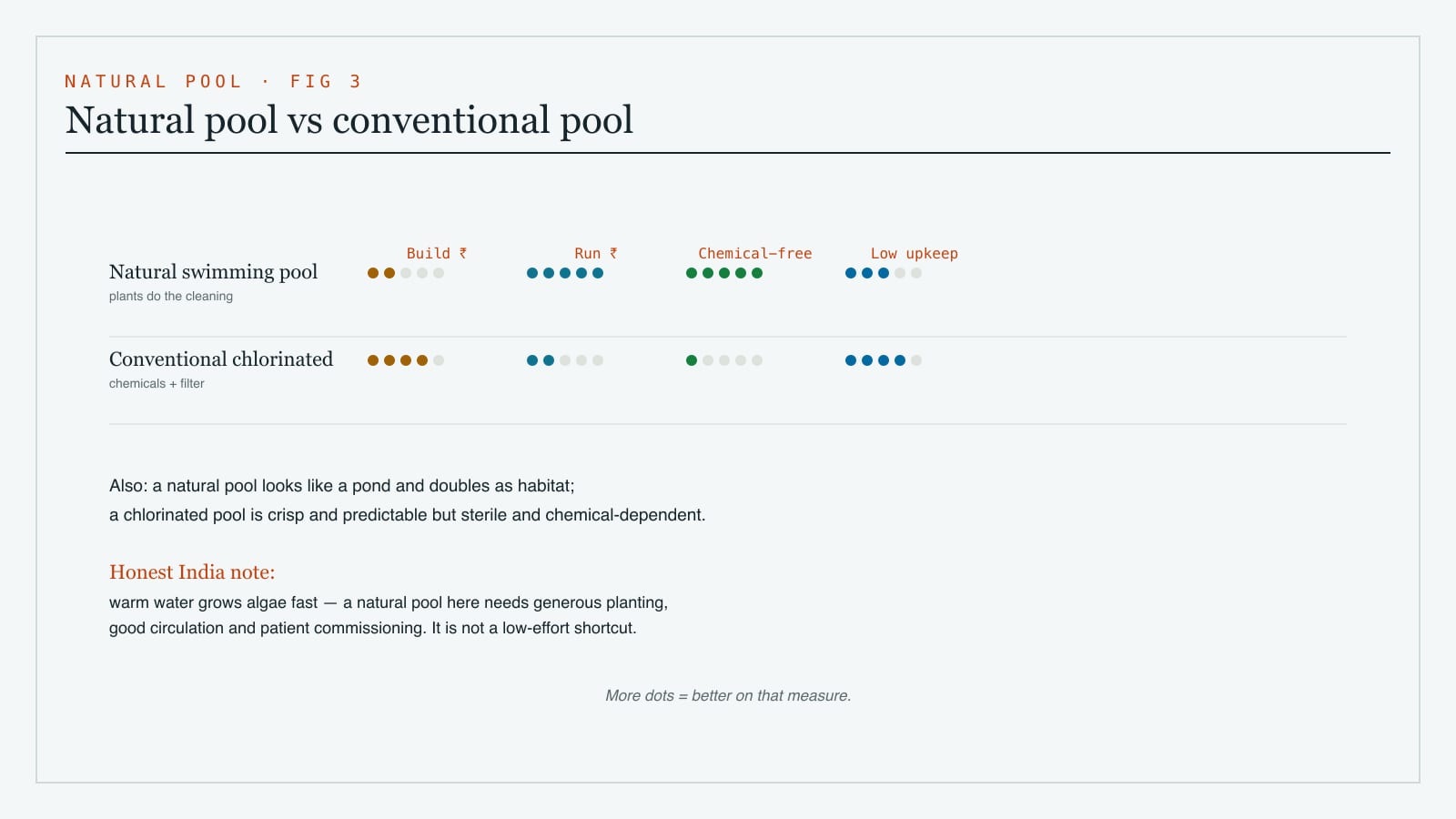
The economics of an NSP are the mirror image of a chlorine pool: higher to build, cheaper to run, no chemicals.
| Factor | Natural swimming pool | Conventional chlorinated pool |
|---|---|---|
| Build cost | Higher — you also build the regeneration zone (extra excavation, liner, gravel, plants) | Lower per swimmable sq m |
| Running cost | Lower — small low-energy pump; no chlorine, no acid, no salt | Higher — chemicals, filtration energy, frequent backwashing |
| Chemicals | None | Chlorine/salt, pH adjusters, algaecides |
| Maintenance | Seasonal, garden-style (pruning, skimming, biology) | Routine chemical dosing and testing |
| Water loss | Evaporation + monsoon overflow; backwash-free | Evaporation + regular backwash water wasted |
| Look & feel | Soft eyes, no smell, living, landscape-integrated | Crisp, blue, sterile, chemical odour |
| Footprint | Larger (needs the planted zone) | Compact |
As rough Indian planning figures, a quality lined NSP commonly lands around ₹2,500–₹6,000+ per sq ft of total water area built (swimming plus regeneration), depending on liner choice, edging, and whether the swimming zone is concrete or lined. A comparable conventional pool sits lower on build but then carries an ongoing chemical and electricity bill of the order of several thousand rupees a month that the NSP largely avoids. Treat these as order-of-magnitude planning numbers, not quotations — get site-specific costing, because excavation and access dominate. Over a 10–15 year horizon, the NSP's near-zero chemical running cost narrows and can erase the higher build cost, while saving water through backwash-free operation.
Maintenance rhythm
An NSP is maintained like a garden, not like a chemistry set.
- Weekly: empty the skimmer basket, clear surface debris, check the pump is running and water is moving.
- Monthly: check water clarity, thin out over-vigorous oxygenators, watch for algae build-up in still corners.
- Seasonally: before summer, make sure shade and circulation are ready for the heat; before monsoon, check the overflow; in autumn, cut back and remove dying plant matter (this is the key step — decaying leaves dump nutrients back in).
- Annually: remove accumulated sediment from the bottom of the regeneration zone, divide and replant where needed, inspect the liner edges.
The hardest period is always the first season, while the plants establish and the biology balances. Expect some green water early; resist the urge to "fix" it with chemicals — that kills the very biology doing the work. Mature NSPs (year two onward) are remarkably stable.
Who it suits
An NSP suits you if you have the space for the regeneration zone, want a chemical-free swim and a living landscape feature, accept a higher build cost and active first-year management, and are not in an acutely water-scarce situation where any open water is hard to justify. It pairs beautifully with a generous garden — think villa and farmhouse plots; see Villa Landscape Design for how a natural pool anchors a larger landscape.
It is the wrong choice if your plot is tiny, if you want a crisp turquoise lap pool with no plants in sight, or if you are unwilling to do (or pay for) garden-style seasonal care. In those cases a conventional pool, or a non-swimmable ornamental pond, will serve you better. For a fuller comparison of swimmable versus ornamental water and how to integrate either into the garden's water budget, return to the pillar guide on Water Features in Landscape Design and the Pond Design Guide.
References & further reading
- Central Ground Water Board (CGWB), Ministry of Jal Shakti — groundwater status and guidance relevant to standing-water features and top-up sources.
- Central Public Health and Environmental Engineering Organisation (CPHEEO) — manuals on water supply and water quality benchmarks.
- Rainwater Club / S. Vishwanath — practical Indian writing on rainwater, ponds and household water self-reliance.
- Melbourne Water — Water Sensitive Urban Design (WSUD) guidelines, for biological water-treatment and constructed-wetland principles transferable to NSPs.
- IGBC / GRIHA — green-building rating frameworks covering sustainable site water and landscape practices.
- Michael Littlewood, "Natural Swimming Pools: Inspiration for Harmony with Nature" — recognised design text on regeneration zones and area ratios (adapt ratios upward for India's warmer climate).
Export this guide
Related Guides — Deep-dive reading
How Buildings Can Give Back: Biodiversity and Environmental Health
How an Indian home and its plot can actively improve the ecology and environment around it, not just reduce harm
SustainabilityBiological Culture Management in an STP: The Heart of Good O&M
The microbes in your aeration tank do the actual work of cleaning sewage. Keep them healthy — the right MLSS, food, oxygen and nutrients — and everything else falls into place. Here is how operators manage the living culture, diagnose bulking and foaming, and recover after a crash.
Sewage Treatment PlantsSwimming Pool Maintenance: The Complete Home Guide
Filtration, sanitising, water chemistry and a simple weekly routine — how to keep a home pool clean, safe and clear, what it costs, and when to call a professional.
Swimming PoolsRelated Tools — Try Free
Rainwater Tank Sizer
How big should your rainwater tank be? Computes annual harvest, recommended tank capacity in litres, water-bill savings, and payback — for 10 Indian cities.
RWH CalculatorCross-Ventilation Analyzer
Estimate airflow and air changes per hour (ACH) from room size, window areas, layout, and local wind — with NBC 2016 Part 8 compliance check.
Ventilation CalculatorPool Water Calculator
Chlorine, shock and salt doses plus top-up water for your pool — an indicative balancing guide.
Pool Calculator