
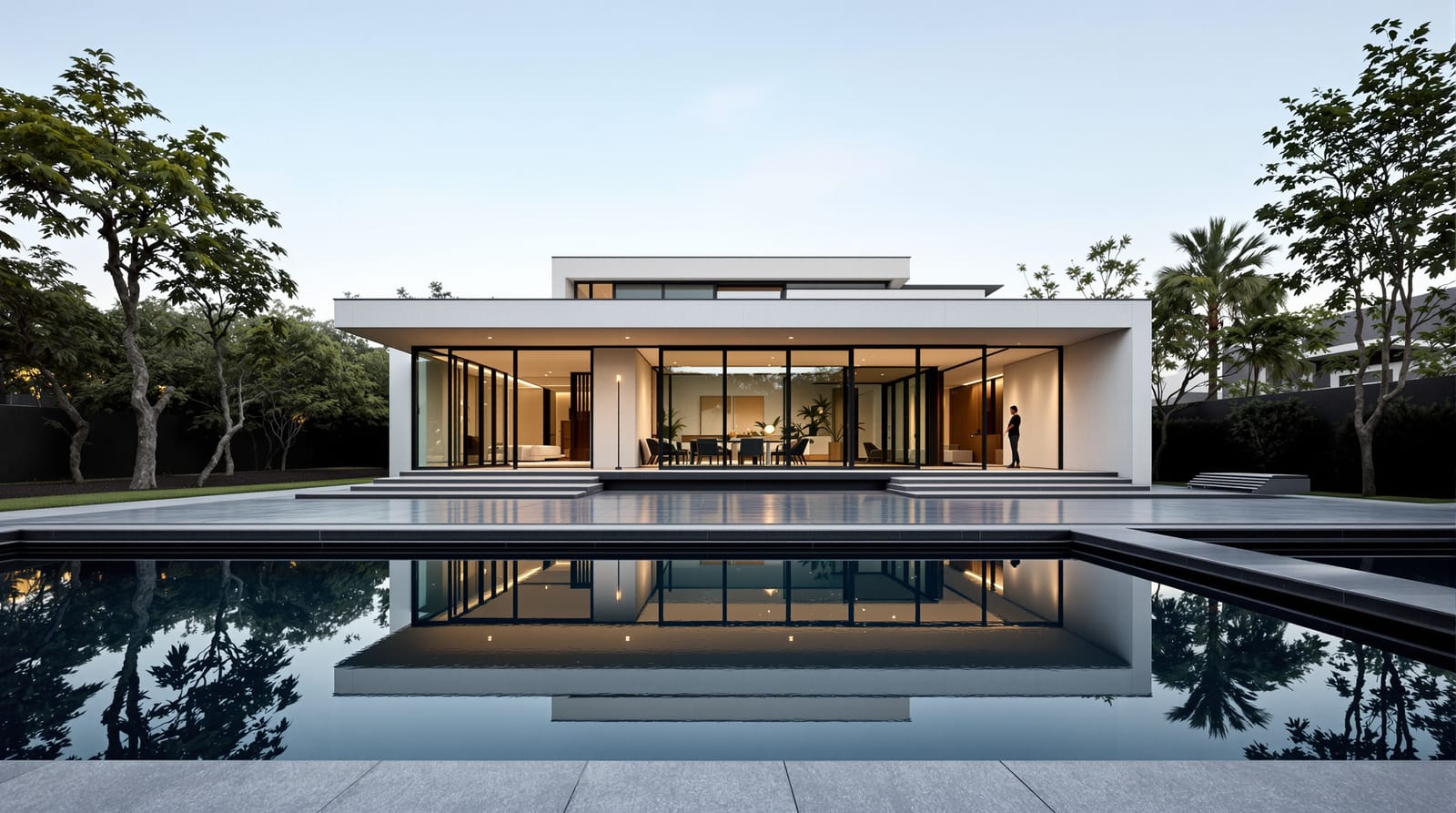
Reflecting Pools in Architecture — Designing the Still-Water Mirror
From the Mughal charbagh to Modernism — how reflection works, proportions, edge details, keeping water still and clean, and how it differs from a pond
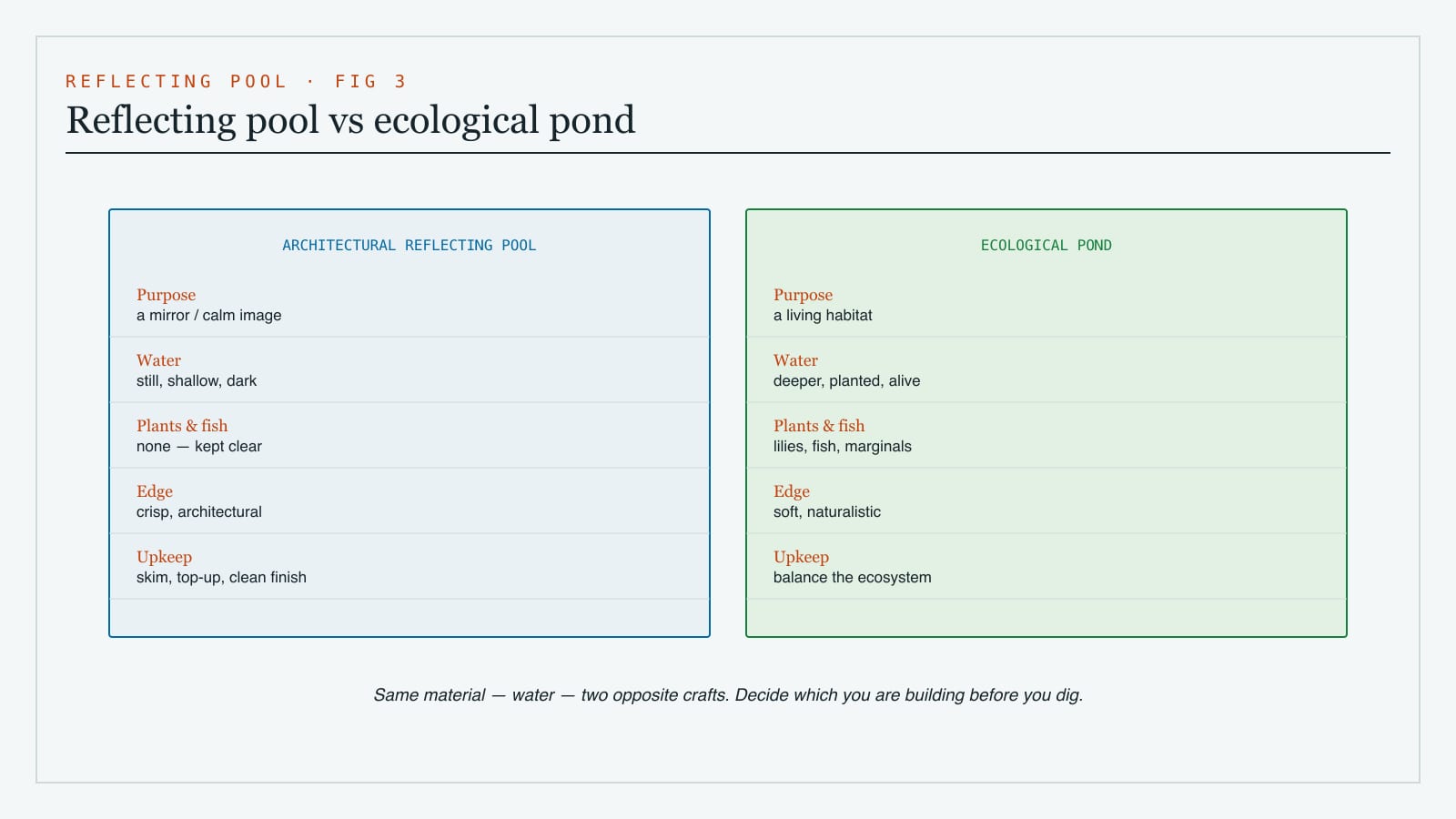
A reflecting pool is not a swimming pool, a fountain or a pond — it is a still, shallow sheet of dark water whose only job is to hold a mirror up to your house, your sky and your trees, doubling the architecture and quietening everything around it. Done well it is the calmest, most architectural water you can build; done badly it is a green, dusty puddle. This guide is about the still mirror — the deliberate, minimal pool that belongs to a building's geometry. If you want fish, lilies, frogs and a living edge, you want a different thing entirely, and our Pond Design Guide covers that ecology in full. Here we stay strictly in the mirror lane.
A very old idea
The reflecting pool is one of the oldest moves in architecture, and India wrote much of the rulebook. The Mughal charbagh — the four-part paradise garden — used narrow channels and still tanks on a strict central axis so that a tomb or pavilion would appear twice: once in stone, once in water. The Taj Mahal's long axial pool is the most photographed reflecting pool on earth precisely because the designers understood the rules below — a long still sheet, dark in its depths, aligned dead-centre on the building. Temple tanks (the "kalyani" or "pushkarni" of South Indian temples, the stepped tanks of Gujarat) did the same with sacred geometry. Modernist architects rediscovered the device in the still court pools that double a clean white facade. The instinct is universal: still water makes a building look composed, weightless and twice as large.
Your home version is the same idea at domestic scale — a court, a forecourt, a strip along a verandah — and it sits naturally alongside a Courtyard Landscape Design, where a central still pane organises the whole space.
How a reflecting pool actually works
A clear reflection is not magic; it is four physical conditions stacked together. Get all four and any phone camera will show a flawless mirror. Miss one and the effect collapses.
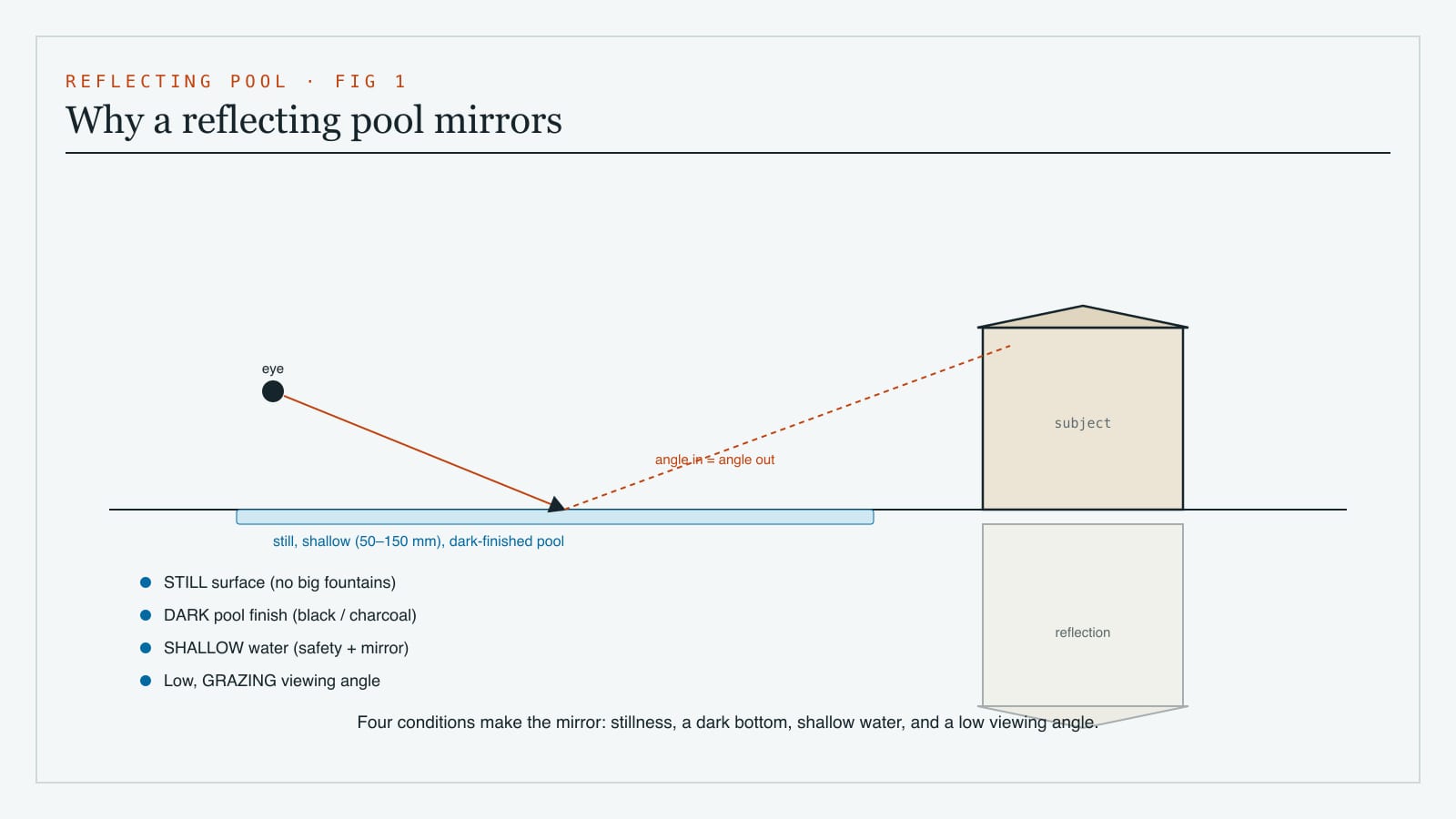
1. A perfectly still surface. Reflection is specular — light bounces off a flat surface at a clean angle. The smallest ripple scatters that light and smears the image. This is why a reflecting pool must have almost no visible water movement: no bubbling fountain, no splashing return, no wind-whipped fetch. Calm is the entire point.
2. A dark interior. Water itself is nearly transparent, so what you "see" on the surface is a competition between the reflection above and whatever lies below. A pale blue mosaic floor lets the bottom win and you get a swimming-pool look. A black or near-black finish kills the view of the bottom, so the only thing left to see is the reflection. Dark wins the mirror.
3. Shallow depth. You do not need depth to reflect — you need stillness and darkness. A shallow pool is cheaper, safer, uses a fraction of the water, and (counter-intuitively) reads as a deeper, more perfect mirror because there is no visual cue to its true floor.
4. A low viewing angle. Reflection strength rises sharply at grazing angles (the physics is called the Fresnel effect). Looking across a pool from a seat or a low verandah gives a far stronger mirror than looking straight down from a balcony. Place the pool where people view it obliquely — from the level of a sitting room, a plinth or a path — not from above.
Hold these four in your head and every design decision below follows logically.
Keep it shallow — the single best decision
The most common mistake is digging a reflecting pool like a swimming pool. You do not need to. A water depth of just 50–150 mm reads as a perfect, bottomless mirror. Going shallow is the decision that makes everything else easier.
| Depth choice | Reflection quality | Safety | Water volume (per 10 m²) | Verdict |
|---|---|---|---|---|
| 50–80 mm | Excellent mirror | Very safe — a stumble, not a drowning | ~0.5–0.8 m³ | Ideal for most homes |
| 100–150 mm | Excellent mirror | Safe, still shallow | ~1.0–1.5 m³ | Good if you want more thermal/visual mass |
| 300–450 mm | No better as a mirror | Drowning risk for toddlers | ~3.0–4.5 m³ | Avoid unless a structural reason exists |
| 600 mm+ | No mirror benefit | Serious hazard; needs barriers | ~6 m³+ | This is a pond/pool, not a reflecting pool |
Shallow water means a smaller liner or tank, far less water to lose to evaporation, much lower mosquito-management burden, and a genuinely low drowning risk — important in Indian homes with toddlers, grandparents and house help moving around. A common, safe detail is a 75 mm water depth over a black-finished slab, with the structural shell only as deep as construction needs. If you want a sense of greater depth, darkness and edge shadow do that job — not litres of water.
Proportion, axis and placement
A reflecting pool is a geometry instrument, so it must be placed with intent, not dropped wherever there is space.
- Align it with the building's axis. The pool should sit on the centre-line of the facade or court it reflects, or run parallel to a strong wall. A pool skewed to the architecture looks like an accident.
- Frame one clear subject. Decide what the pool reflects — the front elevation, a single tree, a temple-style jali, the open sky — and compose for that. A reflecting pool with no subject is just a puddle.
- Favour long over wide for buildings. A pool longer in the viewing direction captures the full height of a tall facade in reflection. The Mughals knew this: long axial channels reflect the full tomb.
- Mind the foreground. Keep the near edge clean and low so the reflection starts right at your feet. Clutter at the near edge — pots, lights, a fussy border — breaks the illusion.
A useful rule of thumb: for the reflection of a building element to read fully, the pool should extend in the viewing direction by at least the apparent height of that element as seen from the viewing point. In practice that means a generous strip, not a token square. If space is tight, a narrow rill (a slim channel, 300–600 mm wide) running toward the building still gives a strong axial line and a slice of sky.
Edge details — where the design lives
The edge is where a reflecting pool succeeds or fails as architecture. The aim is almost always to make the water meet the building or paving cleanly, with no clumsy lip.
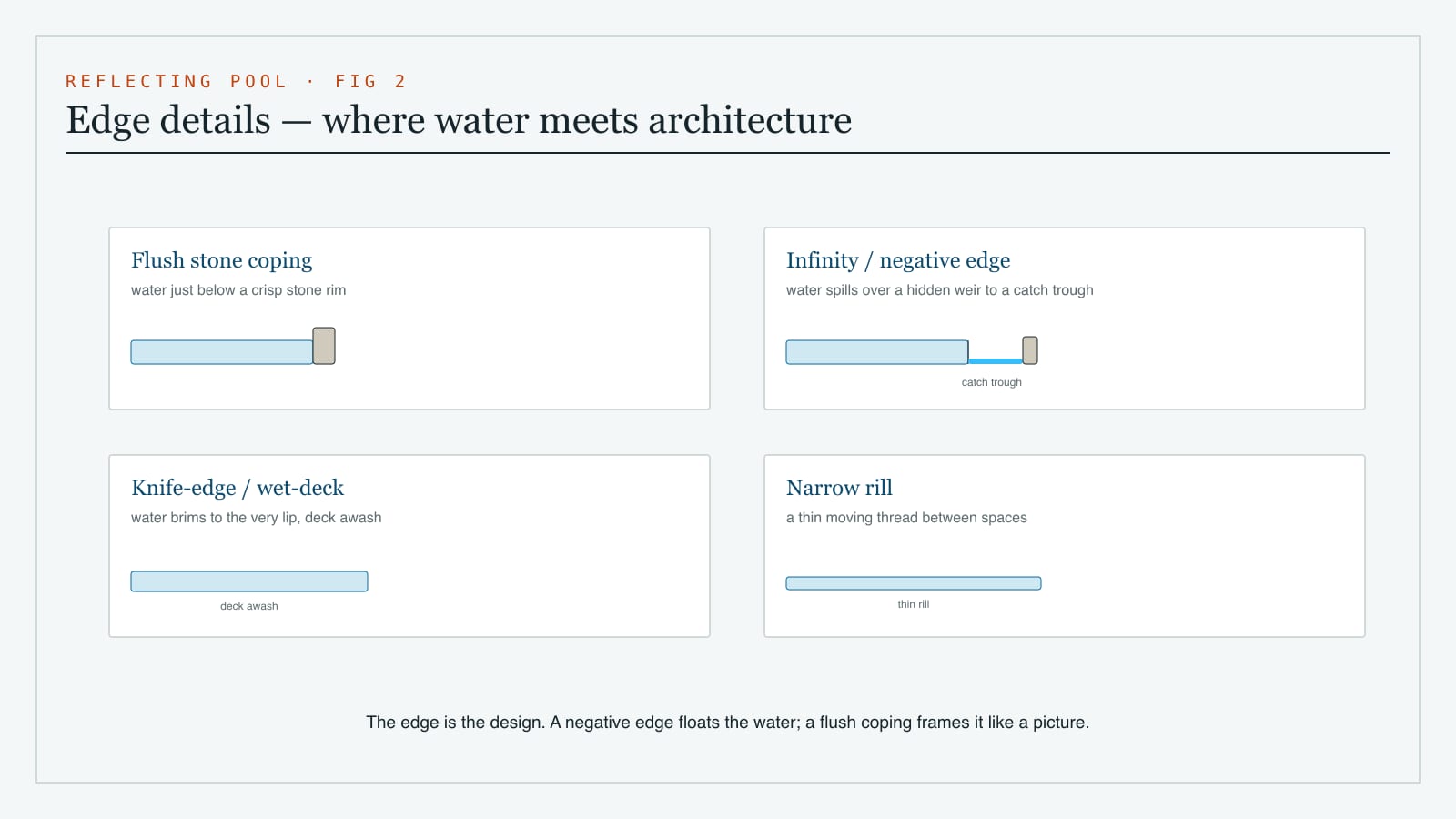
| Edge type | What it does | Detailing note | Relative cost |
|---|---|---|---|
| Flush coping | Stone laid level with water, water right to the brim | Needs precise levels and a slot drain to catch overflow | ₹ |
| Knife-edge / wet-edge | Water films over a razor-thin stone lip into a slot | The "water to the very edge" look; demands flat, true stonework | ₹₹ |
| Infinity / negative edge | Water spills over a far edge into a hidden catch trough | Reads as water meeting sky or a view beyond; needs a balance tank + pump | ₹₹₹ |
| Rill | A slim channel, water held just below paving | Cheap, graphic, great for tight courts and axes | ₹ |
| Planted/soft edge | Marginal plants soften the line | This is pond language — generally avoid in a true reflecting pool | — |
For the still-mirror look, flush coping or a knife-edge is usually right: the water sits level with the surrounding stone, so the architecture appears to grow straight out of its own reflection. The infinity edge is dramatic where there is a drop or distant view to "disappear" into, but it requires constantly moving water over the lip — which fights the stillness rule — so use it where the spill edge is short and the main body stays calm. Whatever the edge, the coping material should echo the building: Kota, granite, basalt or the same stone as the plinth ties water and wall together. Note the deliberate contrast with the soft, planted edge of an ecological pond — there, the edge is meant to blur; here it is meant to be crisp.
Keeping the water clean and still
Still water is the whole point, but stagnant water is the enemy — algae, dust film and mosquitoes. The trick is to circulate gently and invisibly.
- Hide all movement. The supply and return should enter and leave below the surface, through slots or submerged nozzles sized to turn the water over slowly. No visible jets, no audible splash. A small, quiet pump turning the volume over every two to four hours is plenty for a shallow pool.
- Fight algae with darkness and UV. A black finish that suppresses the visible bottom also reduces the light reaching algae. Add a small UV clarifier in the circulation loop to keep the water clear without chemicals you can smell. A modest dose of pool-grade chlorine or a black non-toxic pond dye are both common; for an architectural pool with no fish or plants, light chlorination is simple and effective (unlike a [Pond Design Guide] system, where livestock rules out chlorine).
- Skim the surface. Dust, leaves and pollen settle as a film that dulls the mirror. A surface skimmer or a slot-drain perimeter that constantly draws the top film away keeps the reflection sharp. In India's dusty pre-monsoon months this is the single biggest maintenance item.
- Plan for evaporation top-up. In peak Indian summer a shallow pool can lose several millimetres of depth a day. An automatic float-valve top-up (the same device as a toilet cistern, scaled up) keeps the level dead constant — and a constant level is essential, because a dropping level exposes a dirty tide-mark that ruins the look. Tie the top-up to harvested rainwater where you can; see Rainwater Harvesting at Home and Water-Secure Homes for storage that can feed it.
This is the cleanest way to think about it: an ecological pond is a small ecosystem you manage; an architectural reflecting pool is a quiet machine you keep clear. Different philosophies, different kit.
The Indian climate, honestly
A reflecting pool in India faces real conditions a glossy photograph never shows. Address them at design stage, not after.
- Dust. North and central India coat everything in fine dust for months. The reflection survives only with active surface skimming and a top-up that holds the level so the film does not concentrate.
- Evaporation and scarcity. A still sheet loses water steadily in summer. Going shallow already cuts the volume; pair it with rainwater top-up and a level controller. Building a large, deep reflecting pool in a water-stressed city is hard to defend — keep it modest. Our Sustainable Water Management in the Landscape guide frames the bigger water budget.
- Monsoon. Heavy rain overtops a flush pool and can flood the surround. Build in an overflow slot drain sized for a downpour, and a clear path for that water to go (ideally to a recharge pit or storage, not the street).
- Mosquitoes and dengue. This is the serious one. Still water is exactly what Aedes mosquitoes want. You manage it three ways: the gentle circulation above (eggs and larvae dislike moving water and a skimmed surface), a tight surface with no leaf litter, and — if the pool will sit unattended for spells — the option to drain it or run the pump on a timer to keep the top film moving. Never let a reflecting pool become a forgotten, stagnant tank.
- The off-season. Many homeowners run the pool full for guests and the cool months, then drain it in deep summer or during long absences. A reflecting pool that drains cleanly to a dark, flat stone floor still looks intentional empty — design it so the dry state is handsome too.
Lighting for night reflection
A reflecting pool is, surprisingly, often better at night, when a lit facade or a single tree glows in black water. The rules invert what you might expect:
- Light the subject, not the water. Wash the facade, the tree or the wall the pool reflects. The water then mirrors that light. Submerged lights inside the pool destroy the mirror by revealing the bottom — the opposite of what you want.
- Keep the pool surface itself unlit and dark. Darkness is the mirror; light in it is a leak.
- Use warm, low, glare-free fixtures at the far edge so the source is hidden from the viewing seat. A grazing light up a textured wall, mirrored in still water, is one of the most serene effects in landscape lighting and pairs beautifully with the calm of an Outdoor Wellness Spaces scheme.
Vastu, honestly
Vastu does speak to water, and it is worth being straight about it. The traditional guidance places water bodies in the north or north-east (the "Ishanya" corner) and treats clean, still or gently flowing water there as auspicious and calming. A reflecting pool in a north or north-east court therefore aligns comfortably with Vastu for those who follow it. The cautions worth respecting on their own merits, Vastu aside: avoid large standing water in the south-west (it conflicts with the heavier, grounded zone many like to keep solid), keep the water clean (stagnant, dirty water is discouraged in every tradition for good reason), and do not place a water body directly under or against a structural element it could damage. Treat Vastu as one input among siting, drainage and architecture — not the sole driver.
What it costs
Costs vary widely with finish and edge, but for a domestic architectural reflecting pool in India, working figures (2026) are roughly:
| Item | Typical range | Notes |
|---|---|---|
| RCC shell + waterproofing | ₹1,800–3,500 / m² | The watertight box; shallow keeps this small |
| Black/dark finish (epoxy, dark tile, dyed render) | ₹600–1,800 / m² | Drives the mirror; quality matters |
| Stone coping / knife-edge detail | ₹1,200–4,000 / running metre | Precision stonework is the cost driver |
| Circulation pump + UV clarifier + skimmer | ₹15,000–60,000 | Small, quiet kit for a shallow pool |
| Auto float top-up + slot drain | ₹8,000–25,000 | Holds the level; non-negotiable |
| Subject + edge lighting | ₹12,000–50,000 | Light the wall, not the water |
A modest 6–10 m² flush-coped reflecting pool, shallow and well detailed, commonly lands in the ₹1.2–3.5 lakh range installed; an infinity-edge or large axial pool with premium stone runs well beyond. Running cost is low — a small pump, occasional clarifier, and top-up water. Compared with a swimming pool or an ecological pond, the reflecting pool is one of the cheapest pieces of "wow" water you can build, because shallow water and no ecosystem keep both the build and the upkeep light.
In short
Stay in the lane. Keep it shallow, keep it dark, keep it still, and align it with your architecture. Skim the surface, hold the level, hide the movement, light the subject and not the water, and be honest about dust, evaporation and mosquitoes. Do that, and a few centimetres of black water will double your house and hand you the calmest corner of the property. For the living, planted, fish-filled alternative, go to the Pond Design Guide; for the full vocabulary of moving and still water together, start at the pillar, Water Features in Landscape Design.
References & further reading
- Central Ground Water Board (CGWB), Ministry of Jal Shakti — guidance on groundwater, recharge and water budgeting in Indian cities.
- Rainwater Club / S. Vishwanath (Bengaluru) — practical writing on domestic water, rainwater harvesting and reuse in the Indian context.
- Indian Society of Landscape Architects (ISOLA) — professional resources on landscape water features and detailing.
- IGBC and GRIHA rating manuals — water-efficiency criteria relevant to landscape water bodies in green homes.
- CPHEEO Manual on Water Supply and Treatment, Ministry of Housing and Urban Affairs — water quality and circulation fundamentals.
- "Sunset Garden Pools, Fountains & Waterfalls" and standard landscape-construction references — for reflecting-pool edge and finish detailing principles.
Export this guide
Related Guides — Deep-dive reading
Infrared vs Colour Night Vision CCTV in India (2026): Which Sees Better in the Dark?
A homeowner's head-to-head between traditional infrared (IR) night vision, which lights the scene invisibly and shows a black-and-white image, and colour night vision, which keeps the picture in colour at night using a very sensitive sensor and a little white light — with an honest verdict on when each wins and why a hybrid camera is usually the smartest buy.
SecurityAngles, Curves and Breaking the Pattern Intentionally
Why an Indian home should mostly stay a grid of right angles — and how a single deliberate curve, angle or arch, placed where it eases circulation, resolves an awkward plot or breaks a rhythm, becomes the most powerful move in the room.
Design PrinciplesCool Roof vs Green Roof: Which Beats Roof Heat Better?
Two very different ways to stop your slab from cooking — the cheap, light, reflective cool roof that bounces the sun away, versus the planted green roof that insulates, shades and gives you a garden. A balanced, India-grounded comparison across heat, cost, structural load, waterproofing, upkeep and co-benefits.
RoofingRelated Tools — Try Free
Cross-Ventilation Analyzer
Estimate airflow and air changes per hour (ACH) from room size, window areas, layout, and local wind — with NBC 2016 Part 8 compliance check.
Ventilation CalculatorRainwater Tank Sizer
How big should your rainwater tank be? Computes annual harvest, recommended tank capacity in litres, water-bill savings, and payback — for 10 Indian cities.
RWH CalculatorMonsoon-Readiness Checklist
Pre-rain home audit across 9 categories — terrace, drains, waterproofing, electrical, HVAC, pest, vehicles, documents.
Seasonal Audit