
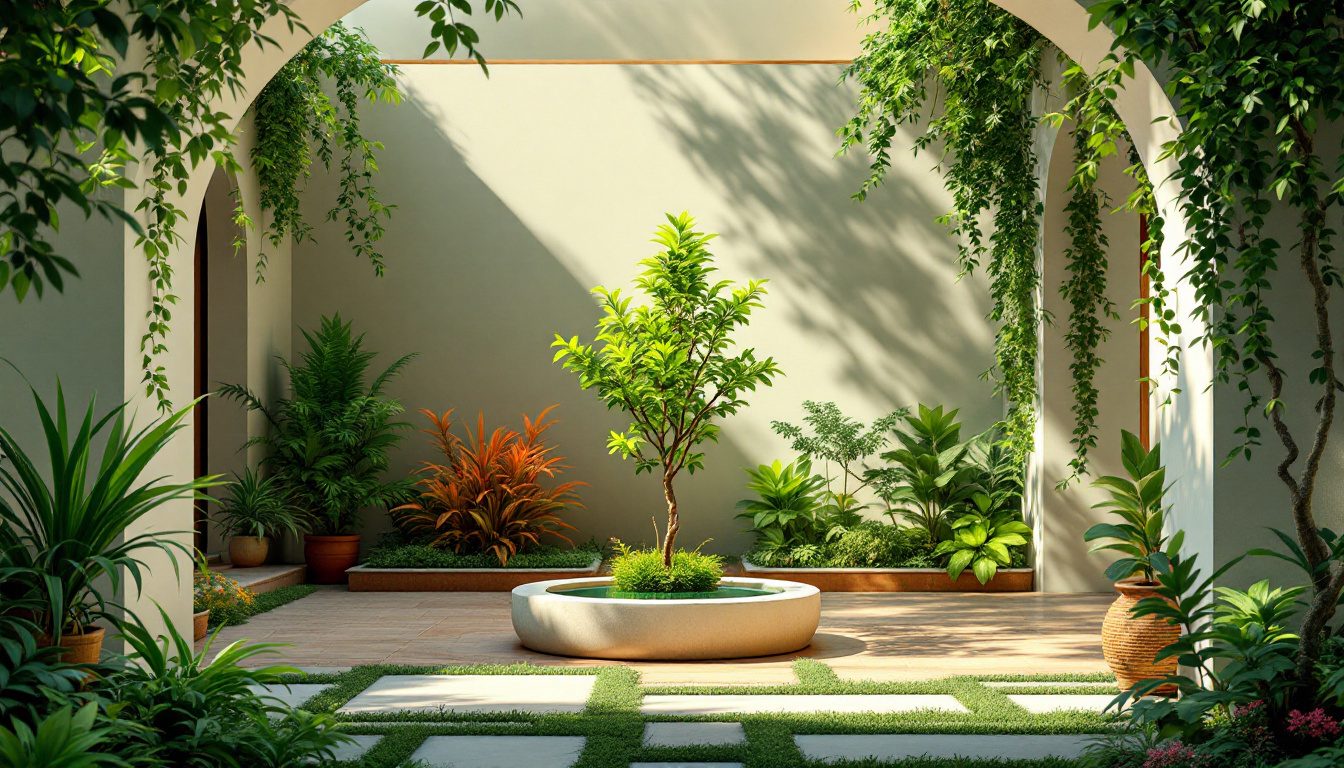
Courtyard Landscape Design for Indian Homes
How to plant and design the aangan, nadumuttam and brahmasthan — India's oldest restorative garden and a passive-cooling engine in one square
Step into the heart of a Kerala nalukettu at noon and the day changes around you. Outside the laterite walls the sun is a hammer; inside, in the open square of the nadumuttam, the light falls soft and green through a tulsi plant, the stone underfoot is cool, and a column of slow air rises past your face toward the bright rectangle of sky overhead. The house has no garden in the English sense — no lawn, no border, no view out. It has a garden turned inward, a piece of cultivated nature folded into the centre of the plan, and for two thousand years across this subcontinent that inward garden has been the most reliable way to make a hot place habitable and a busy life calm.
This guide is about that inward garden specifically — the planting and landscape design of the courtyard, the aangan, the brahmasthan, the nadumuttam, the wada chowk. Not the architecture of the courtyard house, which we treat separately, but the green heart inside it: what to plant in an enclosed, half-shaded void, what to put at its centre, how water cools it, how the paving drains a monsoon downpour, and how the same square works at the scale of a heritage haveli or a six-foot light-well. The courtyard is India's oldest restorative garden, and it rewards being designed as one.
A courtyard is not leftover space in the middle of a house — it is a designed microclimate and a restorative garden in one square. Plant it for shade and stillness rather than display, give it a single calm centre, let water do the cooling, and a void most builders treat as a skylight becomes the coolest, quietest, most loved room you own.
The oldest restorative garden we have
The courtyard predates almost every other idea in domestic architecture. Excavations at Mohenjo-daro and Harappa, more than four thousand years old, show houses built around open central courts; the form recurs in the Roman atrium, the riad of the Maghreb, the Chinese siheyuan and, most richly of all, across the Indian subcontinent. It survives not because it is decorative but because it solves several problems at once — climate, privacy, light, social life and, we now know, the mind.
That last claim used to be folklore; it is now measured. Roger Ulrich's landmark 1984 study in Science found that hospital patients whose windows looked onto trees recovered faster and needed less pain medication than identical patients facing a brick wall — the first hard evidence that a view of nature is physiologically restorative. Rachel and Stephen Kaplan, in The Experience of Nature (1989), gave the mechanism a name: Attention Restoration Theory, the idea that natural settings let our depleted attention recover through "soft fascination" — the undemanding interest of leaves moving, water glinting, light shifting. A courtyard is almost a laboratory model of these ideas: a contained, safe, sky-open enclosure full of soft fascination, glimpsed dozens of times a day from every surrounding room. You do not visit it the way you visit a park; it sits at the centre of ordinary life, dispensing small restorative doses every time you cross the house.
The courtyard is the room with no roof and no walls of its own — only sky above and the whole house gathered around it. To garden it is to garden the centre of your own attention.
Edward O. Wilson's biophilia hypothesis — that humans carry an innate affiliation with living things — and Stephen Kellert's biophilic-design framework both point to exactly the qualities a good courtyard concentrates: prospect and refuge together, water, dappled light, a single ordering centre. To score how strongly your own design delivers these, our biophilic-score tool walks through the same criteria room by room.
The climate logic before the planting
Before choosing a single plant, understand why the empty courtyard works, because the planting either reinforces that physics or fights it. The courtyard is first a passive-cooling engine — the architecture of which we cover in courtyard homes and climate-responsive design. The landscape's job is to amplify it.
Through the day the courtyard floor and walls are shaded for most hours by their own geometry, so they stay cooler than any exposed external wall. At night the open square radiates the day's heat straight up to the cold sky and fills with a pool of cool, dense air — night-flush cooling — which by morning has seeped into the surrounding rooms. As the sun finally reaches the floor, the warmed air rises out of the open top and pulls room air after it through the doors and jaalis that ring the court — the stack effect, the same chimney that drives a tall room. A planted, watered, shaded courtyard makes every stage stronger: leaves intercept the midday sun, transpiration and a water body cool the rising air by evaporation, and a deep canopy keeps the floor in shade longer.
The numbers are real. Studies of vernacular courtyard houses in hot-dry India — Jaisalmer and Bikaner havelis among them, and the wider courtyard-microclimate literature — report courtyard and adjacent-room temperatures running several degrees Celsius below the outdoor maximum through the hottest hours, with the deepest, most planted courts performing best. Evapotranspiration adds a cooling layer on top: a tree does not merely shade, it pumps water vapour and latent heat out of the air, which is why the air under a watered canopy feels cooler than shade alone can explain.
| Courtyard service | What it does | What the landscape adds |
|---|---|---|
| Shade / self-shading | Floor and walls shaded by geometry, staying cool | A canopy tree extends deep shade for more hours |
| Night-flush cooling | Open top radiates heat to sky; pool of cool air forms | Soft ground and planting reduce stored daytime heat |
| Stack-effect ventilation | Warm air rises out; room air drawn through jaalis | Evaporative cooling drops the temperature of rising air |
| Daylight / light-well | Brings soft, top-down daylight deep into the plan | Foliage filters glare into dappled, comfortable light |
| Privacy | Outdoor life held inside, screened from the street | Green walls and a central feature give a focal refuge |
| Restoration | Constant glimpsed contact with nature and sky | Plants, water and movement supply "soft fascination" |
How much cooler: the data
The cooling claim deserves real figures rather than romance. Across the courtyard-microclimate literature and the wider urban-heat evidence, a few robust numbers recur. The chart below assembles representative values for a hot-dry Indian afternoon, comparing a planted, watered courtyard with an exposed external surface and a sealed internal room.
The headline findings behind those bars: shaded surfaces in the urban-heat literature (US EPA, Reducing Urban Heat Islands) run 11 to 25 degrees Celsius cooler than the same material in full sun — exactly what a courtyard canopy and shaded paving deliver. Vernacular-courtyard field studies in hot-dry India report courtyard air running roughly 3 to 6 degrees Celsius below the outdoor peak through the afternoon, with night-time temperatures lower still. A single mature tree transpires hundreds of litres on a hot day, and that evaporative cooling — plus an open water body — measurably lifts the comfortable-hour count without mechanical cooling. It is the same evapotranspiration and shading physics quantified in our tropical landscape design guide, concentrated into one enclosed square.
| Measured effect | Typical magnitude | Source / basis |
|---|---|---|
| Shaded vs sunlit surface temperature | 11 to 25 degrees C cooler | US EPA, Reducing Urban Heat Islands |
| Courtyard / room air vs outdoor peak | 3 to 6 degrees C cooler (afternoon) | Vernacular courtyard field studies, hot-dry India |
| Air-temperature drop under watered canopy | 1 to 5 degrees C cooler | Urban-climate evapotranspiration studies |
| Transpiration from one mature tree | Hundreds of litres/day (latent cooling) | i-Tree / ecosystem-services valuations |
| Recovery / stress benefit of nature view | Faster recovery, less analgesia | Ulrich (1984), Science |
Designing the planting: a garden in the shade
The single mistake people make is planting a courtyard like an open garden. A courtyard is by definition enclosed and for much of the day shaded by its own walls; sun reaches the floor only in a moving slot, and the deeper or narrower the court, the less direct light it gets. The palette must suit those conditions — shade-tolerant, humidity-loving, understorey species that thrive in dappled light, layered the way a forest floor is rather than the way a flowerbed is.
Think in three layers, as a tropical planting does but compressed and shade-shifted. A canopy or feature layer — usually one tree or tall specimen that defines the centre and casts shade. A mid layer of shrubs and large foliage against the walls, where light is weakest. A ground and edge layer of ferns, ground covers and pot groupings that read as a cool green floor. Keep flower colour incidental; in a shaded court, foliage texture and shades of green do the visual work far more reliably than blooms that may never get enough sun.
| Layer | Role in the courtyard | Shade-tolerant Indian species (botanical / common) |
|---|---|---|
| Canopy / central feature | Defines centre, casts shade, the focal living thing | Plumeria / champa (frangipani); Saraca asoca / ashoka; Murraya paniculata / kamini; a trained Ficus |
| Wall / mid layer | Greens the deepest-shaded vertical surfaces | Philodendron, Monstera, Dieffenbachia; Aglaonema; Calathea; Dracaena |
| Climbers / green wall | Softens walls, adds height without floor space | Pothos / money plant (Epipremnum); Syngonium; Rhaphidophora; Piper betle / paan |
| Ground / edge | Cool green floor, pot groupings, soft fascination | Ferns (Nephrolepis, maidenhair); Ophiopogon / mondo grass; Tradescantia; Peperomia |
| Sacred / aromatic | The cultural and fragrant heart | Ocimum / tulsi; Jasminum / mogra; Pandanus; Cymbopogon / lemongrass |
A few discipline points keep the garden from becoming a burden. Favour foliage over flowers, which demand light a shaded court rarely has. Prefer evergreens so the court is never bare. Use generous pots where the floor sits over a slab and a bed is impossible — most modern courts are container gardens, and a cluster of large pots reads as a planted bed. And resist overplanting: a courtyard's calm comes from restraint and the open centre, not from filling every corner.
The centre: a single calm focus
Every great courtyard has one ordering centre, and choosing it is the most consequential decision in the design. The eye, crossing the house, lands there; the room is built around it. Indian tradition offers four classic centres, and the right one depends on climate, plan and belief.
A central tree is the most generous choice where the court is large enough — a champa, an ashoka, a frangipani — giving shade, scent, seasonal change and a living anchor. A water body — a pool, a channel, a still basin or a wall spout — suits where cooling and quiet matter most; it cools by evaporation, masks city noise, reflects the sky, and draws birds. A tulsi vrindavan, the raised masonry planter for the holy basil, is the traditional sacred centre of the Hindu courtyard — daily watered and lit, at once a religious focus and a fragrant, medicinal, pollinator-friendly plant. And a sculptural or paved centre — a stone, a sculpture, a paving figure — suits the smallest light-wells where neither tree nor water will fit.
| Central feature | Best when | Gives you | Watch out for |
|---|---|---|---|
| Specimen tree | Court is large; roots have soil or a deep planter | Shade, scent, seasonal change, a living anchor | Leaf litter, root depth, drain blockage |
| Water body / channel | Cooling and acoustic calm are the priority | Evaporative cooling, sound masking, sky reflection | Mosquito control, waterproofing, upkeep |
| Tulsi vrindavan | A Hindu household wants the sacred centre kept | Daily ritual, fragrance, pollinators, tradition | Should sit within the open brahmasthan, not crowd it |
| Sculpture / paved figure | Court is a small light-well; no room for tree/water | Focus and order with near-zero maintenance | Can feel sterile if not paired with edge planting |
The vastu dimension belongs here, handled even-handedly. Traditional vastu shastra holds the centre of the house to be the brahmasthan, the seat of Brahma, and counsels that it be kept open and uncluttered — precisely where the courtyard sits in a classical Indian plan. Read functionally rather than mystically, this is sound design advice that happens to be very old: keeping the centre open preserves the light-well, the stack-effect chimney and the cross-ventilation, and gives the eye a calm void to rest in. Tulsi at that centre carries the same double reading — devotional for those who hold the belief, and a fragrant, pollinator-friendly, low-care plant for everyone. You can honour the tradition and the physics with the same gesture; they do not conflict.
Water, paving and drainage
Water earns its place for three reasons beyond beauty: it cools by evaporation, it masks noise with the soft sound that Attention Restoration Theory calls fascination, and it reflects the sky, making a small court feel larger and alive. The forms scale down well — a still basin in a tiny light-well, a narrow rill across a mid-size court, a wall spout where floor space is precious. Keep it shallow and moving or filtered to avoid mosquitoes, detail the waterproofing where the court sits over habitable rooms, and remember even a small still sheet delivers most of the cooling and reflective benefit of a large one.
Paving is the floor and the surface you look at most. Choose for thermal behaviour and drainage, not just appearance. Light, matte natural stone — Kota, Jaisalmer yellow, Tandur, sandstone — stays cooler underfoot than dark or polished surfaces and bounces soft light into the rooms; traditional courts were floored in exactly these local stones for that reason. Leave generous planting joints so rain percolates, and avoid large dark, heat-absorbing expanses that turn the court into a hot plate.
Drainage is where courtyards most often fail, because the court collects every drop of rain falling into its open top — in a monsoon, a lot, fast. The floor must fall to a central or perimeter drain sized for a cloudburst, screened against leaf litter and easy to clear, and many traditional courts paired the catchment with a tank or recharge pit to harvest the water. Get drainage right and the open top is a gift; get it wrong and the first heavy monsoon floods the surrounding rooms.
| Element | Recommended approach | Why |
|---|---|---|
| Water feature | Shallow, moving or filtered; still basin if small | Evaporative cooling and sound; avoids mosquitoes |
| Paving material | Light, matte local stone (Kota, Jaisalmer, sandstone) | Stays cool, reflects soft light, drains well |
| Planting joints | Generous joints or soft borders, not full hard seal | Percolation, root health, softer look |
| Drainage | Central/perimeter drain sized for cloudburst, screened | Court catches all rain; monsoon-proofs the rooms |
| Rainwater | Link drain to a tank or recharge pit | Harvests the very catchment the court creates |
Courtyards across India — and at any size
The courtyard is not one form but a family of regional traditions, each tuned to its climate, and each suggesting a different landscape emphasis. Understanding them helps you borrow the right instinct for your own home.
The Kerala nalukettu sets a small, often planted nadumuttam at the centre of four wings, frequently with a tulsi or a single tree, tuned to a warm-humid climate where shade and drying matter most — lush, foliage-heavy planting suits it. The Rajasthani and Gujarati haveli wraps a deep, high-walled court that maximises self-shading in a brutal hot-dry climate; planting is restrained, water and cool stone do the heavy lifting. The Maharashtrian wada opens a large stone-paved chowk for daily life and ceremony — hardy planting in pots around a generous open centre. The Tamil Chettinad mansion lines its court with cool stone and columns, a grand ventilated room. And the modern internal court or light-well — the version most readers actually have — may be only a few feet across, lit from a glazed roof or a small slot, planted entirely in pots and on green walls, proving the principle scales all the way down.
| Tradition / type | Region & climate | Landscape emphasis |
|---|---|---|
| Nalukettu — nadumuttam | Kerala, warm-humid | Lush foliage, tulsi or single tree, deep shade |
| Haveli court | Rajasthan / Gujarat, hot-dry | Restraint; cool stone, water, deep self-shading |
| Wada chowk | Maharashtra, composite | Large open paved centre; hardy potted planting |
| Chettinad court | Tamil Nadu, warm-humid | Stone-and-column ventilated room; potted edges |
| Modern light-well | Pan-India, any | Container garden + green wall; scales to a few feet |
Whatever the scale, the same rules hold: plant for shade, keep one calm centre, let water cool, mind the drainage, and leave the middle open. A six-foot light-well planted with ferns, a money-plant green wall and a single still water bowl delivers a real fraction of a nalukettu's restorative and cooling power. The courtyard idea is generous that way — it gives back at every size.
What this means for your home
1. Treat the void as a room, not a skylight. Design any internal court or light-well's floor, walls and centre deliberately, not as a bare service shaft.
2. Plant for shade, not display. Choose shade-tolerant, evergreen, foliage-led species layered like a forest floor; let flowers be incidental. Group large pots where a bed is impossible.
3. Choose one centre and commit. A tree, a water body, a tulsi vrindavan or a sculptural focus — pick the one your climate and beliefs call for, and let the court be calm around it.
4. Use water if you can. Even a small still basin cools by evaporation, masks noise and reflects the sky. Keep it shallow and moving to stay mosquito-free.
5. Floor it in cool, light, local stone. Matte natural stone stays cool, drains, and bounces soft light into the rooms.
6. Engineer the drainage first. The open top catches every monsoon drop; size and screen the drain for a cloudburst and harvest the water into a tank or recharge pit.
7. Keep the centre open. Read as the brahmasthan or simply as the chimney and light-well, the open middle is what makes the whole system — cooling, light, calm — actually work.
How Studio Matrx helps
Designing a courtyard garden is an exercise in restraint and microclimate that is hard to picture from a plan — which palette suits a half-shaded north light-well, where a single tree should sit, how a water channel reads against Kota paving. DesignAI lets you visualise your courtyard at different planting densities, central features and paving finishes before anything is built, so you can feel the difference between a bare shaft and a planted, watered, restorative court. Pair it with our biophilic-score tool to check how strongly your design delivers the restorative qualities the research rewards, and read it alongside why some gardens feel peaceful, courtyard homes and climate-responsive design, and tropical landscape design for India.
References
1. Ulrich, R. S. (1984). "View Through a Window May Influence Recovery from Surgery." Science, 224(4647), 420–421. (Stress Recovery Theory; nature views and faster recovery.)
2. Kaplan, R. & Kaplan, S. (1989). The Experience of Nature: A Psychological Perspective. Cambridge University Press. (Attention Restoration Theory; soft fascination.)
3. Wilson, E. O. (1984). Biophilia. Harvard University Press. (The innate human affiliation with living things.)
4. Kellert, S. R., Heerwagen, J. & Mador, M. (2008). Biophilic Design: The Theory, Science and Practice of Bringing Buildings to Life. Wiley.
5. Cooper Marcus, C. & Barnes, M. (1999). Healing Gardens: Therapeutic Benefits and Design Recommendations. Wiley. (Restorative design of enclosed garden space.)
6. US Environmental Protection Agency. Reducing Urban Heat Islands: Compendium of Strategies — trees, vegetation and shaded-surface temperature reductions.
7. Krishen, P. (2006). Trees of Delhi: A Field Guide. Penguin. (Native and naturalised species, shade and habit.)
8. Foundation for Revitalisation of Local Health Traditions (FRLHT) — Indian medicinal and sacred plants, including tulsi (Ocimum) and their cultivation.
9. Reddy, B. V. V. and others — studies on the thermal performance and microclimate of Indian vernacular courtyard houses (hot-dry havelis and warm-humid nalukettu).
10. i-Tree (USDA Forest Service) — quantified ecosystem services of trees, including transpiration, shading and cooling valuations.
11. Bureau of Indian Standards / CPWD — rainwater harvesting and drainage guidance relevant to courtyard catchment and recharge.
Part of the Studio Matrx Landscape series. Continue with why some gardens feel peaceful, courtyard homes and climate-responsive design, and tropical landscape design for India.
Export this guide
Related Guides — Deep-dive reading
The Best Trees for Indian Homes
A research-grade guide to choosing and placing trees around an Indian home — the real cooling and clean-air numbers, the right species for shade, flowers, fragrance and fruit, and the placement science that keeps roots out of your walls and drains.
LandscapeBiophilic & Healing Environments for Healthcare in India
An Architect's Working Reference — Roger Ulrich's Restorative Theory, Stephen Kellert's 14 Patterns of Biophilic Design, Therapeutic Gardens, Hospital Courtyards, Patient-Room Nature Views, End-of-Life Space, Indian Planting Palette, and the Biophilic Healthcare Toolkit
Healthcare ArchitectureThe Architectural Psychology of Comfortable Spaces
Why some rooms feel right and others never do — the science of space and the human mind
Design EducationRelated Tools — Try Free
Healing View Impact Calculator
Evidence-Based Design dashboard quantifying the recovery impact of nature view + daylight factor on analgesic use, length of stay, and HCAHPS patient-experience uplift. Calibrated against Ulrich 1984 (Science), Park & Mattson 2008, and the CHD EBD evidence base.
EBD CalculatorCross-Ventilation Analyzer
Estimate airflow and air changes per hour (ACH) from room size, window areas, layout, and local wind — with NBC 2016 Part 8 compliance check.
Ventilation CalculatorAcoustic Privacy (STC) Visualizer
Indian healthcare acoustic visualizer — compare wall assemblies and noise sources, see received SPL after STC attenuation, and check FGI 2018 / IS 1950 / NABH speech-privacy compliance with live dual-canvas waveform.
Acoustic Tool