
Sustainable Water Management in the Landscape
The full water-wise toolkit for India's gardens — rain gardens, greywater, drip, hydrozoning and drought-tolerant native planting
In June 2019 the taps in much of Chennai ran dry. The city's four reservoirs had shrunk to under one percent of capacity, water trains rumbled in from 200 kilometres away, and offices asked staff to stay home because there was nothing to flush with. Two years later Bengaluru's borewell owners were drilling past 1,500 feet and still hitting dust. These were not freak events. They were the visible edge of a slow emergency unfolding under almost every Indian garden: groundwater drawn out faster than the monsoon can replace it, reservoirs that swing from flood to empty in a single year, and a per-capita water supply that has fallen by more than two-thirds since Independence.
A home garden cannot fix a national water crisis. But it is one of the places where ordinary households quietly spend — or save — the most water, and where a few design decisions ripple outward into the aquifer below. This guide is the full water-wise toolkit for the Indian landscape: not just a rain barrel, but the whole interlocking system of rain gardens, permeable ground, greywater, efficient irrigation, drought-tolerant native planting and healthy soil that keeps a garden green while drawing far less from a stressed supply.
A water-wise garden is not a thirsty garden made guilty — it is a garden redesigned so that every drop is caught where it falls, stored in the soil, matched to the plant that needs it, and recharged into the ground rather than run off to a drain. Done well, it cuts outdoor water use by half or more while looking lusher, not barer.
The water India is running out of
To design a water-wise garden you first have to feel the scale of the problem it answers. India holds about 18 percent of the world's people and only around 4 percent of its renewable freshwater. The Central Water Commission's long-cited figure is that average annual per-capita water availability fell from roughly 5,200 cubic metres in 1951 to under 1,500 cubic metres by the 2010s, crossing the international "water-stressed" threshold; on current trajectories large parts of the country are sliding toward the 1,000 cubic-metre "water-scarce" line.
The deeper alarm is underground. The Central Ground Water Board (CGWB), which assesses thousands of groundwater units yearly, has repeatedly classified a large share of India's assessment blocks as "over-exploited," "critical" or "semi-critical" — meaning extraction meets or exceeds annual recharge. India is the largest user of groundwater on earth, pumping more than the United States and China combined, and roughly 85 to 90 percent of rural drinking water depends on it. Agriculture takes the lion's share — about 80 to 90 percent of all freshwater use in India goes to irrigation — but in cities the household garden, the lawn and the borewell are the visible local actors.
Two truths sit underneath every recommendation that follows. First, India is not short of rain; it is short of retained rain — the monsoon delivers most of the year's rainfall in a few intense months, and the design failure is letting it sheet off hard surfaces into storm drains instead of soaking in. Second, the cheapest, safest "reservoir" a homeowner owns is not a tank but the soil itself, which holds and slowly releases water to roots and aquifer alike if we stop sealing it over.
| Indicator | Value | What it signals | Source |
|---|---|---|---|
| Per-capita water availability | ~5,200 m³ (1951) → under 1,500 m³ (2010s) | Crossed into "water-stressed" territory | Central Water Commission |
| Share of world freshwater vs population | ~4% water, ~18% people | Structural scarcity | FAO / CWC |
| Groundwater as share of irrigation + rural drinking | Majority of irrigation; ~85–90% rural drinking | Aquifer is the lifeline | CGWB |
| Over-exploited / critical assessment blocks | A large, persistent share nationally | Extraction outpaces recharge | CGWB Dynamic Groundwater Resources |
| Irrigation share of total freshwater use | ~80–90% | Outdoor water is where savings hide | FAO AQUASTAT |
The water-wise toolkit, seen whole
It helps to picture the strategies not as a menu but as a single plumbing system that begins the moment rain hits your plot. Permeable surfaces let it soak in; a rain garden and a bioswale catch what runs off and hold it long enough to infiltrate; healthy, mulched soil stores it; drought-tolerant plants grouped by need draw it down slowly; drip irrigation tops up only what the soil cannot supply; and greywater from the bathroom returns to the beds instead of the sewer. Each element reduces demand on municipal supply and the borewell, and several actively recharge the aquifer.
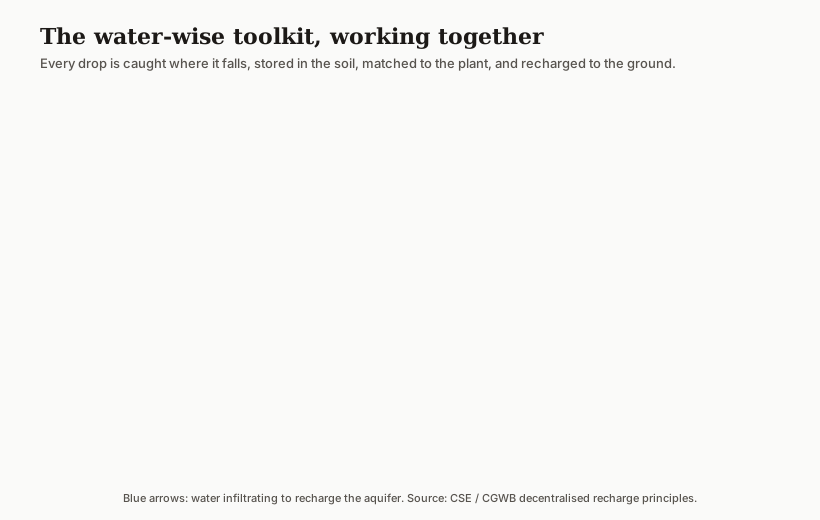
This whole-system view is the heart of climate-responsive landscape design and of why some gardens simply feel calmer and more alive than others — a garden that manages its own water is greener, cooler and lower-maintenance at once. The sections below take the toolkit element by element, with the numbers behind each.
What each measure actually saves
The single most useful thing a homeowner can know is how much water each intervention saves, so scarce effort and money go where they count. Drip irrigation, hydrozoning and mulch are the highest-return, lowest-cost moves; greywater and xeriscaping add large structural savings; rainwater harvesting (covered in our dedicated rainwater harvesting guide) replaces supply rather than reducing demand.
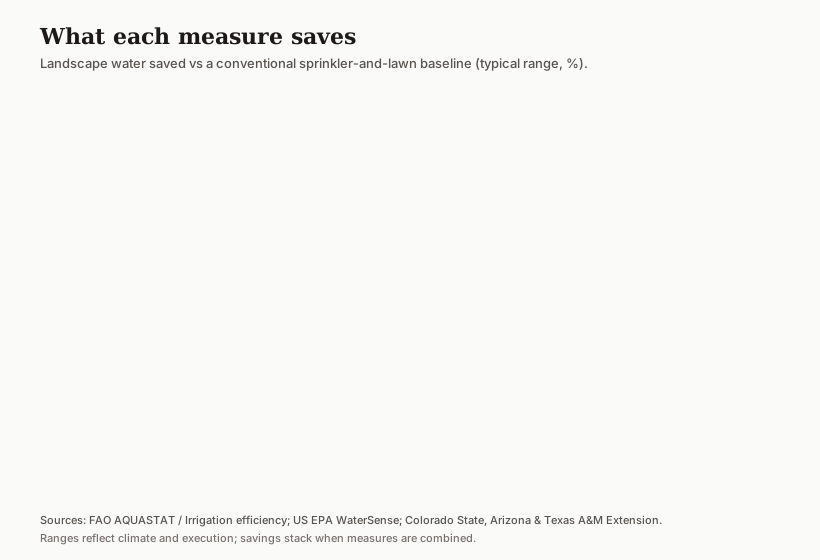
The figures below are drawn from FAO irrigation efficiency data, US EPA WaterSense and university extension studies (Colorado State, Arizona, Texas A&M), and Indian field experience; ranges reflect climate and execution.
| Measure | Typical water saved vs baseline | Why it works | Cost / effort |
|---|---|---|---|
| Drip / micro-irrigation vs sprinkler or hose | 30–60% | Delivers water to roots; cuts evaporation and runoff; 90%+ application efficiency vs 50–70% for sprinklers | Low–moderate |
| Mulching (75–100 mm organic layer) | 20–50% of bed evaporation | Shades soil, slashes evaporation, suppresses weeds, builds soil | Very low |
| Hydrozoning (grouping by water need) | 20–40% | Stops over-watering low-need plants to satisfy high-need ones | Free (design choice) |
| Xeriscaping / drought-tolerant native beds | 50–75% vs conventional lawn-heavy garden | Plants matched to rainfall; lawn area minimised | Moderate (one-time) |
| Greywater reuse for irrigation | Offsets 30–50% of household water as a reclaimed source | Re-uses bath/wash water that would go to sewer | Moderate |
| Smart / weather-based irrigation controller | 15–30% over a fixed timer | Skips watering after rain; adjusts to evapotranspiration | Low–moderate |
| Replacing lawn with groundcover / native bed | Up to 50–70% of the lawn's water | Lawn is the thirstiest surface in most gardens | Moderate (one-time) |
We treat rain as a nuisance to be drained away as fast as possible, and then we buy water to pour back onto the same ground. The water-wise garden simply stops doing both.
Soil, mulch and the cheapest reservoir you own
Before any device, fix the soil. Water-wise design lives or dies on the soil's ability to absorb rain quickly and hold it long enough for roots to use. Compacted, bare, low-organic soil — the default around new Indian construction — sheds water in a downpour and bakes dry in a heatwave. The remedy is humble and powerful: organic matter and mulch.
Adding compost or well-rotted manure raises the soil's water-holding capacity markedly; as a rule of thumb, each one percent of organic matter added to topsoil holds a meaningful extra quantity of water per square metre, because organic matter acts like a sponge and improves the structure that lets water infiltrate rather than run off. On top of that, a 75 to 100 millimetre layer of organic mulch — dried leaves, bark, coir, sugarcane trash, straw — shades the surface and can cut bed evaporation by a large fraction, keeping roots cooler and reducing watering frequency. Mulch also suppresses water-competing weeds and breaks down to feed the soil it protects.
The discipline is simple: never leave bare soil. In India's intense sun, exposed earth is a water leak. Mulch every bed, keep a living groundcover under trees, and let fallen leaves become mulch rather than waste.
Hydrozoning: stop watering everything the same
The most common watering mistake is uniformity — running one sprinkler schedule across roses, lawn, succulents and shade trees as if they all drank alike. They do not. Hydrozoning is the practice of grouping plants by their water demand and microclimate so each zone gets only what it needs, and it is essentially free because it is a design decision rather than a purchase.
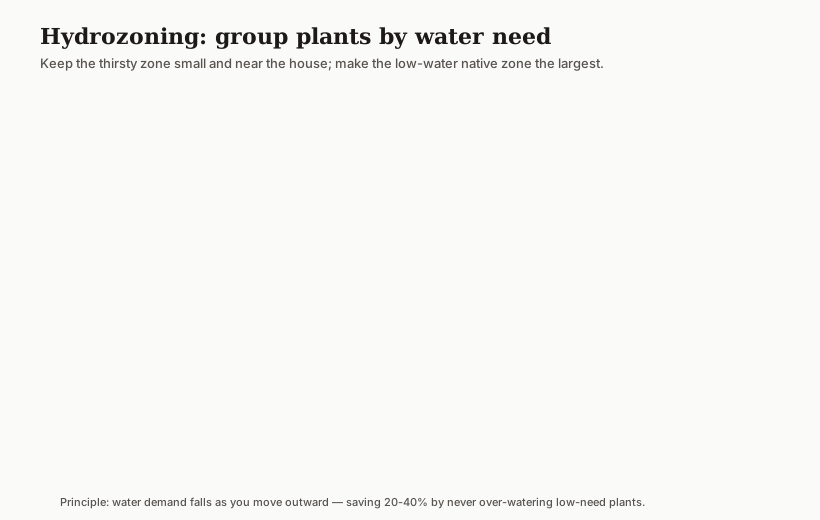
A practical Indian hydrozone scheme has three or four bands. The high-water zone — kept small, near the house, and ideally fed by greywater or rainwater — holds the plants you most want lush: a few vegetables, a small herb patch, prized flowering shrubs. The moderate zone holds established ornamentals and fruit trees that need topping up only in the dry months. The low-water zone, which should be the largest, is planted with drought-tolerant natives that survive on rainfall once established. A fourth "oasis" micro-zone may sit in a naturally damp spot — the base of a downpipe or a rain garden — where moisture-loving plants thrive on collected runoff.
| Hydrozone | Water need | Place in plot | Example Indian plants |
|---|---|---|---|
| High / oasis | Frequent, ideally recycled water | Small, near house, low points | Vegetables, tulsi, hibiscus, banana, ferns |
| Moderate | Periodic, dry-season top-up | Mid-plot | Curry leaf, guava, jasmine, ixora, citrus |
| Low | Rainfall + occasional deep soak | Largest area, plot edges | Neem, bougainvillea, oleander, lantana-alt natives |
| Very low / xeric | Rainfall only once established | Hot, exposed margins | Aloe, agave, Euphorbia, frangipani, cacti, native grasses |
Xeriscaping and the lawn problem
The English lawn is the thirstiest feature in the typical Indian garden, and an ecological mismatch in most of the country's climate. A managed lawn can demand 1,000 to 1,500 millimetres of water a year to stay green through a hot-dry summer — often more than the local rainfall — which is why lawns are usually the first casualty of a municipal water cut and the biggest line in a garden's water budget.
Xeriscaping — coined in drought-prone Denver, from the Greek xeros, dry — is the deliberate alternative: a landscape designed to thrive on local rainfall with minimal added water, through drought-tolerant planting, efficient irrigation, mulch and good soil. Crucially, it does not mean a gravel-and-cactus moonscape. Well-designed xeriscapes in climates like India's can be richly green and flowering; they simply lean on plants adapted to the rainfall they will actually receive. University extension studies of xeriscape conversions commonly report outdoor water savings of 50 to 75 percent against conventional lawn-dominated landscapes.
Lawn alternatives that work in India include hardy native or low-water groundcovers in place of turf, larger beds of drought-tolerant shrubs, dwarf or buffalo-type grasses for the small play areas that genuinely need turf, and permeable paving or decked seating where a lawn was only ever decorative. Choosing plants by water demand — favouring natives that evolved with the local monsoon — is the through-line; it overlaps strongly with climate-responsive landscape design, where palettes are matched to hot-dry, warm-humid, composite and temperate zones.
Catching the rain: rain gardens, swales and permeable ground
Demand reduction is half the story. The other half is capturing the monsoon where it falls instead of letting it run to a drain — which both reduces erosion and flooding and actively recharges the groundwater that India is depleting.
A rain garden is a shallow, planted depression — typically 100 to 250 millimetres deep — positioned to receive runoff from a roof downpipe, driveway or paved area. The water ponds briefly, then soaks into amended, free-draining soil within a day or so (well short of mosquito-breeding time), watering the deep-rooted plants in the basin and recharging the aquifer below. A bioswale is its linear cousin: a gently sloped, vegetated channel that conveys and infiltrates runoff along its length rather than in a single basin, ideal along a driveway or boundary.
Permeable paving attacks the problem at source. Conventional concrete and tile shed nearly all the rain that falls on them; permeable alternatives — open-jointed pavers, gravel, porous concrete, grass pavers, stabilised stone dust — let water pass into the ground beneath. On a small urban plot where space for a rain garden is tight, switching a driveway or part of the paving to a permeable surface is often the highest-impact recharge move available, and the Centre for Science and Environment (CSE) has long advocated such decentralised, plot-level rainwater management as the realistic way to recharge India's urban aquifers. To size a tank for the roof runoff you do collect, our rainwater tank sizer turns roof area and local rainfall into a volume; the deeper mechanics of storage and recharge pits are in the rainwater harvesting guide.
| Capture measure | Best for | Approx. depth / spec | Primary benefit |
|---|---|---|---|
| Rain garden (basin) | Roof / paved runoff, low point | 100–250 mm ponding; drains in 12–24 h | Infiltration + recharge + planting |
| Bioswale (channel) | Driveways, boundaries, slopes | Gentle slope, vegetated, mulched | Conveyance + infiltration |
| Permeable paving | Driveways, paths, sit-outs | Open-jointed / porous + gravel base | Cuts runoff at source |
| Recharge pit / well | Concentrated roof runoff | 1–3 m deep, filtered inlet | Direct aquifer recharge |
Greywater: the bathwater that waters the garden
Greywater — the gently used water from baths, showers, washbasins and (with care) laundry, but not toilet blackwater or grease-heavy kitchen-sink water — is one of the largest reusable streams in a home. A typical household generates enough greywater daily to irrigate a meaningful share of its garden, offsetting a large fraction of outdoor demand from a source that would otherwise vanish into the sewer.
The rules of safe practice matter, because greywater is not drinking water. Use it on ornamental and fruit-tree root zones, not on leafy salad crops eaten raw. Apply it to soil and mulch, never spray it. Use it within about 24 hours so it does not turn septic. Choose low-sodium, low-boron soaps so you are not slowly salting your beds. Keep a simple diverter to switch to the sewer when you use harsh cleaners or when beds are saturated. A basic gravity system — bathroom outlet to a mulch-filled basin or a branched drip-to-mulch network — needs no pump and little maintenance.
Regulatory context is improving: many Indian cities now mandate or incentivise dual plumbing and greywater reuse in new and larger buildings, and national water-mission guidance encourages it, though enforcement still varies by municipality. For a homeowner, the safe-practice principles above matter more than any single code, and they pair naturally with hydrozoning — greywater is the ideal supply for the high-water zone near the house.
Irrigate like every drop is borrowed
However water-wise the planting, most gardens still need supplementary irrigation in the dry season, and how that water is delivered determines how much is wasted. The contrast is stark. A hose or sprinkler loses a great deal of water to evaporation, wind drift and runoff — application efficiencies of roughly 50 to 70 percent are typical — and waters leaves and paths as much as roots. Drip and micro-irrigation deliver water slowly at the base of the plant, reaching 90 percent or more application efficiency and cutting irrigation water use by 30 to 60 percent for the same plant health, which is exactly why India's national micro-irrigation programmes have pushed drip so hard in agriculture.
Layer on a few habits and the savings compound. Water deeply and infrequently rather than little and often, to drive roots down and build drought resilience. Water at dawn or dusk, when evaporation is lowest and the FAO reference evapotranspiration (the rate at which a well-watered surface loses water to the atmosphere) is at its daily minimum. Add a smart or weather-based controller — or even a soil-moisture sensor or rain shut-off — and you stop the absurdity of sprinklers running during a monsoon shower; such controllers typically save another 15 to 30 percent over a fixed timer.
What this means for your garden
1. Start with the soil and the mulch. Add compost, then mulch every bed 75 to 100 millimetres deep. It is the cheapest measure and it multiplies the effect of everything else.
2. Hydrozone your plot. Group plants by water need; keep the thirsty zone small and near the house, make the low-water native zone the largest. This is a free redesign that ends over-watering.
3. Shrink or rethink the lawn. Replace decorative turf with native beds, groundcover or permeable surfaces; keep grass only where people actually use it. This alone can halve a garden's water budget.
4. Switch to drip and a smart timer. Move from hose and sprinkler to micro-irrigation, water at dawn or dusk, and add a rain shut-off so you never water in the rain.
5. Catch the rain where it falls. Add a rain garden at a downpipe, a bioswale along the drive, and permeable paving in place of sealed concrete — recharge the aquifer instead of feeding the storm drain.
6. Reuse greywater safely. Divert bath and basin water to ornamental and fruit-tree beds, sub-surface to mulch, within a day, using low-sodium soaps — and pair it with a roof-water tank sized for your rainfall.
7. Choose plants by water demand. Favour drought-tolerant natives adapted to your climate zone; let the garden live mostly on the rain it receives.
A garden that does these things is no sacrifice. It is greener in a heatwave, calmer in a downpour, cheaper to run, and quietly part of the answer to the slow emergency under our feet.
How Studio Matrx helps
Designing a water-wise landscape means holding plant palettes, hydrozones, rain-garden placement and paving choices in your head at once — and seeing how they fit your actual plot and climate. DesignAI lets you visualise your garden with drought-tolerant native planting, permeable surfaces and rain-garden zones before you dig, and pair it with the rainwater tank sizer to plan the storage and recharge that close the loop. Start with the soil, design for the monsoon, and let your garden hold its own water.
References
1. Central Ground Water Board (CGWB), Ministry of Jal Shakti. Dynamic Ground Water Resources of India (annual assessments) — over-exploited / critical block classifications and recharge-vs-extraction data.
2. Central Water Commission. Water and Related Statistics — per-capita water availability trends and basin data.
3. FAO AQUASTAT and Crop Evapotranspiration (Irrigation and Drainage Paper No. 56), Allen et al. — reference evapotranspiration, irrigation efficiency and water-use shares.
4. Centre for Science and Environment (CSE). Making Water Everybody's Business / Rainwater Harvesting resources — decentralised, plot-level rainwater management and urban recharge.
5. US EPA WaterSense — outdoor water use, efficient irrigation and the case for drip and weather-based controllers.
6. Colorado State University Extension and "Xeriscape" (Denver Water) — origin of xeriscaping and documented 50–75% outdoor water savings.
7. Arizona Cooperative Extension and Texas A&M AgriLife — drought-tolerant planting, hydrozoning and mulch evaporation-reduction studies.
8. National Water Mission, Ministry of Jal Shakti — greywater reuse, recharge and demand-management guidance.
9. Bureau of Indian Standards / CPHEEO Manual on Water Supply and Treatment — greywater quality and reuse considerations for Indian conditions.
Part of the Studio Matrx Landscape series. Continue with why some gardens feel peaceful and climate-responsive landscape design.
Export this guide
Related Guides — Deep-dive reading
Stormwater & Surface Drainage in India: Getting Rain Off Your Roof, Paving and Plot
A homeowner's guide to stormwater drainage — sizing roof outlets and downpipes for monsoon rainfall, surface channels and catch basins, grading the plot away from the house, and where the water finally goes, kept firmly separate from your foul drains.
PlumbingClimate-Responsive Landscape Design for India
Designing your garden to work with India's five climate zones — shade, water, air and planting palettes that fit hot-dry, humid, composite and cold
LandscapeThe Best Trees for Indian Homes
A research-grade guide to choosing and placing trees around an Indian home — the real cooling and clean-air numbers, the right species for shade, flowers, fragrance and fruit, and the placement science that keeps roots out of your walls and drains.
LandscapeRelated Tools — Try Free
Rainwater Tank Sizer
How big should your rainwater tank be? Computes annual harvest, recommended tank capacity in litres, water-bill savings, and payback — for 10 Indian cities.
RWH CalculatorGarden Planning Toolkit
Get a tailored garden plan — planting layers, Indian species, features and a checklist — from your climate, space, sun and goals.
PlannerLandscape Cost Calculator
Estimate a garden's cost — hardscape, softscape, lawn, irrigation, lighting and annual upkeep — by area, tier and city.
Budget Calculator