
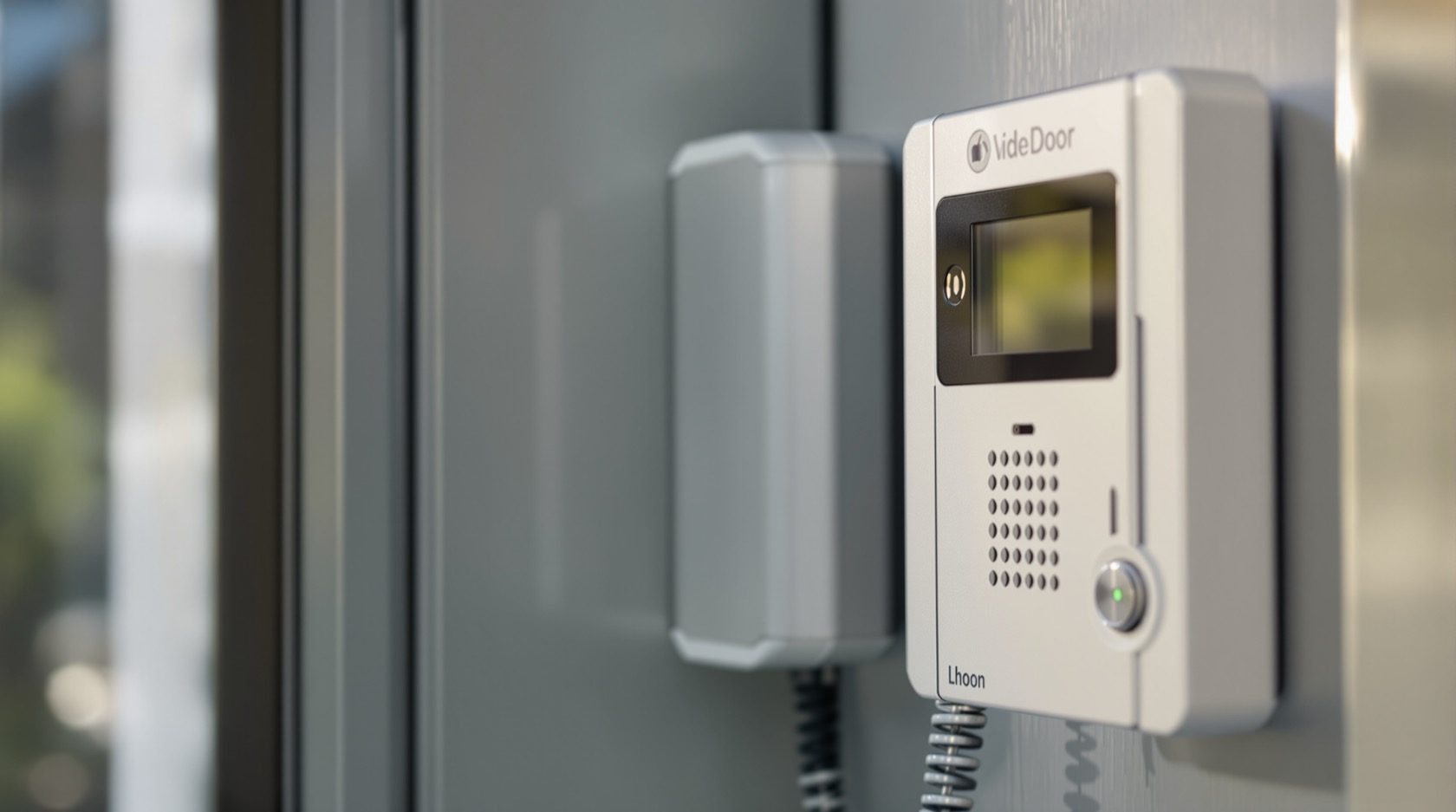
Video Door Phone Two-Way Audio in India (2026): Talking Back at the Door
The talk-back function that turns a door camera into a doorway intercom: how the mic and speaker at the gate and monitor work, why full-duplex feels natural, and what good two-way audio needs in Indian conditions.
A door camera that only shows you who is outside is half a device. The other half is being able to answer them — "leave it by the gate," "please wait, I'm coming," "who are you here for?" — without unbolting a single latch. That talk-back function is what turns a screen on your wall into a proper doorway intercom, and it is the single feature people use most after they stop noticing the video at all.
This guide is the focused explainer on video door phone two-way audio in Studio Matrx's video door phone hub. It stays in one lane: the conversation through the door — the microphone and speaker at the gate, the one on your monitor or phone app, and what makes that exchange feel natural instead of clumsy. For the wider CCTV-side law on recording audio, we point you to the CCTV two-way audio guide rather than repeat it.
Scope, safety and audio law. This guide helps you plan and choose two-way audio well. Mounting the door station, running cable and any mains-electrical or doorbell-transformer work belong to a licensed installer or electrician — decide the position and features here, install with a qualified hand, and never let a device or its wiring obstruct a door, gate or fire-escape route (see the electrical hub). Audio is legally sensitive in India: playing back and, on most units, recording a visitor's speech engages privacy and consent. Treat what follows as general education, not legal advice — consult a qualified professional for your situation.
What two-way audio actually is
A plain doorbell camera lets sound travel one way — you hear the visitor, or you see them, and that is all. Video door phone two-way audio adds a return path: a speaker and microphone at the door station outside, matched by a speaker and microphone at your indoor monitor and, if the unit has an app, on your phone. Press to answer and you can hold a short conversation, both of you hearing and replying, exactly like a phone call that also shows you the caller.
That is the line that separates a video door phone (VDP) from a mere camera. A video door phone is a two-way intercom answered from an indoor monitor or app — the audio is not a bonus, it is the point. A smart video doorbell does the same thing with the monitor replaced by your phone; a CCTV doorbell camera may look identical but is built and governed as a camera. The difference that matters day to day is whether you can comfortably talk back.
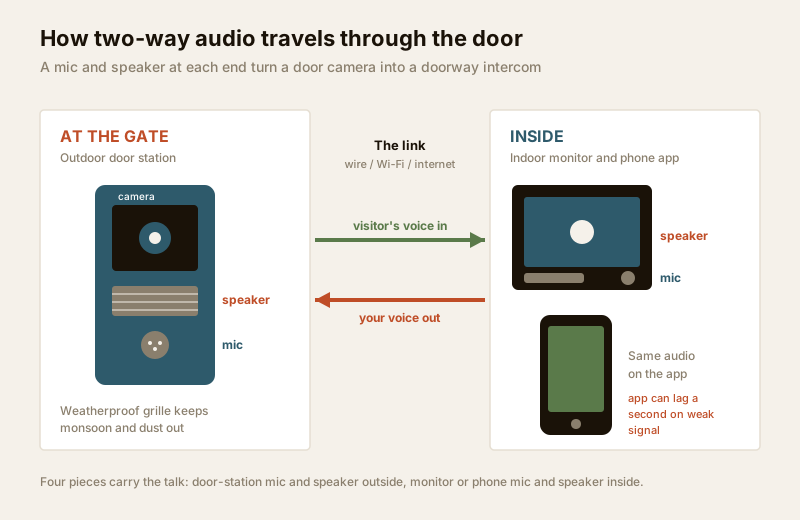
The four pieces that carry your voice
Every talk-back exchange rides on four small components, two at each end:
- The door-station microphone picks up the visitor at the gate. Outdoors, it fights traffic, wind and rain — the hardest job of the four.
- The door-station speaker plays your voice out to the visitor. It must be loud enough to be heard over a scooter idling at the gate.
- The indoor mic and speaker (or your phone's) do the mirror job inside, where conditions are gentle.
- The link between them — wire, Wi-Fi or the internet — carries the audio. On a wired VDP it is near-instant; on a wireless or IP unit reached over the app, there can be a small delay that shapes how the conversation feels.
Half-duplex versus full-duplex: the difference you will feel
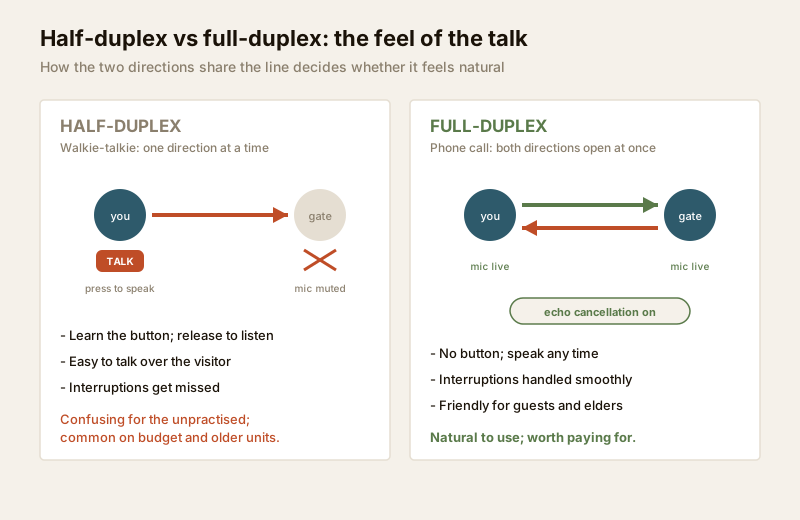
The single most important thing to understand about door audio is how the two directions share the line. There are two ways, and they feel completely different in the hand.
Half-duplex is walkie-talkie style: only one person can be heard at a time. You press a "talk" button to speak, release it to listen, and while you are talking the door mic is muted. It is simple, cheap, and works — but it is easy to talk over the visitor, awkward for anyone not used to push-to-talk, and it stumbles the moment two people both try to speak.
Full-duplex is telephone style: both microphones stay open, so either party can speak or interrupt at any moment, hands-free. Nobody hunts for a button; the conversation just flows the way a phone call does. This is what makes two-way audio feel natural rather than fiddly, and it is a big part of why a good VDP is pleasant to use and a cheap one is not. Full-duplex is harder to build well — it needs echo cancellation so your own voice does not loop back — which is exactly why it is a mark of the better units.
| Half-duplex (push-to-talk) | Full-duplex (hands-free) | |
|---|---|---|
| How it works | One direction at a time; press to talk, release to listen | Both directions open at once |
| Feels like | A walkie-talkie | A phone call |
| Ease of use | Learn the button; easy to talk over the visitor | Natural, no button hunting |
| Interruptions | Awkward — you miss what they say while talking | Handled smoothly |
| Needs echo cancellation | Less critical | Essential (both mics live) |
| Typical on | Budget and older analog units | Better VDPs and smart doorbells |
| Elderly / guest-friendly | Confusing for the unpractised | Much friendlier |
If the choice is open to you, full-duplex is worth paying for — it is the difference between an intercom people actually use and one they avoid. The feature selector tool can help you weigh it against the rest of your shortlist, and the type selector narrows the class of unit first.
What good two-way audio needs — especially in India
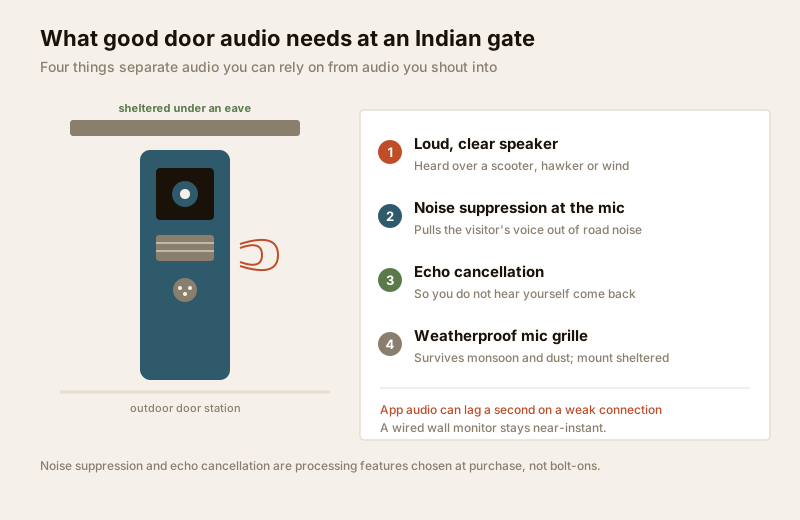
Talk-back that works in a showroom can fall apart at a real Indian gate. Four things separate audio you can rely on from audio you end up shouting into.
1. A speaker loud and clear enough for the gate
The visitor stands outdoors, often beside a road. Your voice has to reach them over a running two-wheeler, a hawker, wind, or a generator two houses down. A weak door-station speaker gets swallowed by all of it, and you find yourself repeating "LEAVE IT AT THE GATE" three times. Look for a unit that names a decent speaker output and, ideally, lets you turn the outdoor volume up. This matters most on a villa or independent house where the gate is far from where you answer.
2. Noise suppression at the door mic
The reverse problem: the door microphone has to pick out the visitor's voice from all that background. Good units apply noise suppression so traffic and wind are filtered down and speech comes through. Without it, you hear a wash of road noise with a voice buried somewhere inside it. This is a processing feature, not something you can bolt on later, so it belongs on the buying checklist.
3. Echo cancellation
With both mics live (full-duplex), your voice coming out of the door speaker can be picked straight back up by the door mic and sent to you as an echo — you hear yourself, delayed, and the conversation becomes unbearable. Acoustic echo cancellation (AEC) removes that loop. Any hands-free unit worth buying has it; if a demo echoes, walk away.
4. A weatherproof mic that survives the monsoon and dust
The door station lives outdoors through forty-degree summers, driving monsoon rain and dust storms. Its microphone sits behind a small grille that must keep water and grit out while still letting sound in. A poorly sealed mic muffles badly once monsoon moisture gets into it, and dust clogging the grille does the same over a year or two. Two things help: a door station with a genuine weather rating (an IP-rated housing) and a sheltered mounting position — under an eave, a porch or a gate canopy — rather than fully exposed to the sky. Plan the position for shelter and hand the mounting and sealing to your installer; a well-placed unit keeps its voice for years, an exposed one goes muffled after the first heavy monsoon.
The app-audio catch: latency
When you answer on your phone app rather than the wall monitor, the audio travels out to the internet and back, so a small delay — latency — creeps in. On good broadband it is barely noticeable; on a weak mobile signal or congested Wi-Fi it can stretch to a second or more, and suddenly you and the visitor are both starting sentences into each other's pauses. It is the same physics that shapes a laggy video call. The wall monitor on a wired link has almost none of this, which is one reason a fixed monitor beside the door still earns its place even when everyone has the app. The mobile-app VDP guide covers getting the connection solid.
The everyday uses — why people love it
Two-way audio earns its keep in small, daily moments far more than in dramatic ones:
- Guide a delivery. "Leave it inside the gate," "hand it to the guard," "it's the second floor" — spoken from the sofa, no trip downstairs, no door opened to a stranger. This is the single most common use.
- Tell a visitor to wait. "One minute, I'm coming" keeps a guest from ringing again while you finish what you are doing.
- Answer without opening. Screen an unexpected caller — a salesperson, an unknown face — with your voice and a locked door between you. You stay in control and never expose the doorway.
- Speak to the guard or gate. In an apartment or gated community, the same audio lets you talk to the guard at the gate or clear a visitor through, part of the wider multi-apartment door system.
When two-way audio matters most
For some homes it is a convenience; for others it is close to essential.
- A villa gate far from the house. When the gate is thirty metres from your front door, walking out to every caller is the whole problem two-way audio solves. Answer from inside, decide, and only make the walk when it is worth it — the core case in the villa VDP guide.
- Answering safely at night. After dark, speaking to an unknown late caller through the door — seeing them on night vision and answering with your voice — is far safer than opening up to find out who it is.
- Elderly residents. For an older person for whom the walk to the gate is slow or unsafe, a full-duplex intercom they can answer from a chair is genuinely enabling. Here the hands-free, no-button design is not a luxury — it is what makes the device usable at all, which is another reason to favour full-duplex.
- A household that receives many deliveries. If couriers come daily, the ability to direct each one by voice, without interrupting your day or opening the door, quickly pays for itself in convenience.
The consent note — record with care
Playing your voice out to a visitor is uncontroversial. The sensitive part is that most door stations also record what the microphone hears — and recording people's speech, at your gate or in a shared corridor, engages India's privacy and data-protection concerns.
Keep the lens narrow and defensive:
- Talk-back is for brief exchanges you are part of — greeting a courier, answering a guest. It is not a tool for continuously capturing the private conversations of neighbours, staff, guards or passers-by.
- Many owners keep recording of audio off by default and simply speak when they choose to. A live conversation you initiate is very different from a mic silently logging everyone who passes — the second is what to avoid.
- India's Digital Personal Data Protection Act, 2023 frames identifiable audio as personal data to be handled with a legitimate purpose and appropriate care. Treat it as a reason to be minimal and transparent, not a box to self-tick.
- In a society or apartment, where the door station may face a shared corridor or the gate covers common area, agree audio use with your RWA committee first — see the gated communities guide.
For the full treatment of the audio-recording law — notice, consent, where it applies — read the companion CCTV two-way audio guide, which covers the recording side in depth. This guide's lens is the doorway conversation, not the recording law, and the two are best read together.
When to bring in a professional. Decide the position and the audio features yourself, then hand the mounting, cabling, weatherproof sealing of the door station, doorbell wiring and commissioning to a licensed installer, and any mains or transformer work to a licensed electrician (see the electrical hub). Never mount a device or run wiring where it obstructs a door, gate or fire-escape route. For the legal and consent side of recording audio, the professional is a lawyer, not an installer — treat this guide as education, not legal advice.
Key takeaways
- Two-way audio is what makes a video door phone an intercom — the mic and speaker at the door station, matched inside or on the app, let you answer a visitor without opening the door.
- Full-duplex beats half-duplex for real use: hands-free, phone-call-natural, no push-to-talk button to fumble — the difference between an intercom people use and one they avoid, and it matters most for elderly residents.
- Good door audio needs four things in India: a speaker loud enough to be heard over traffic, noise suppression at the mic, echo cancellation, and a weatherproof mic grille mounted under shelter to survive the monsoon and dust.
- App audio can lag — latency on a weak connection makes talking over each other likely; a wired wall monitor stays near-instant, which is why it still earns its place.
- Record with care: playing your voice is fine, but recording a visitor's speech engages the DPDP Act, 2023 — keep audio recording minimal and purposeful, agree it with your RWA in shared spaces, and read the CCTV two-way audio guide for the law. This is educational guidance, not legal advice.
References
- Digital Personal Data Protection Act, 2023 — identifiable audio can be personal data; keep any recording of visitors minimal and purposeful, be transparent, and agree audio use with an RWA where a door station covers shared space.
- Manufacturer specifications — verify full-duplex support, acoustic echo cancellation and noise suppression, speaker output, and the door station's IP weather rating on the maker's own datasheet before ordering.
- National Building Code of India (SP 7), Bureau of Indian Standards, and local bye-laws for any electrical, doorbell-transformer or egress aspect of an install; verify the current edition via the BIS catalogue: https://www.services.bis.gov.in/
This is an educational overview, not legal advice. Mounting, cabling, weatherproof sealing and any electrical work are qualified professional tasks — engage licensed installers, consult a lawyer on audio consent and recording, and verify any standard's current status via the BIS catalogue before relying on it.
Export this guide
Related Guides — Deep-dive reading
Security for People Living Alone in India (2026): Calm, Practical Habits When There Is No Second Person to Notice
Living alone is an ordinary and growing part of Indian life - the student in a new city, the working single, the elder whose children are abroad, the person after a separation. It does not call for fear. It calls for a few deliberate habits, because there is no second person in the home to notice trouble, raise the alarm, or catch an accident. This is calm self-reliance, layer by layer.
SecurityCCTV vs Video Door Phone: Which Does Your Home Need?
They look similar and get confused constantly, but a CCTV camera and a video door phone do different jobs — one watches the whole property and records, the other answers your door and controls who comes in. This guide settles CCTV vs video door phone for Indian homes: what each is for, where they overlap, real rupee costs, apartment versus villa relevance, and why most homes end up wanting both.
Smart HomeVisitor Vehicle Management in India: A Professional Guide
The everyday weak point of every society and office gate is not the resident's car — it is the visitor, the cab, the delivery rider and the contractor who must be let in without opening the whole park to anyone. This is the process, not just the hardware: verify at the gate before the boom lifts, park visitors away from resident bays, and never jam the gate a fire tender needs.
SecurityRelated Tools — Try Free
Video Door Phone Type Selector
Answer a few questions about your building, cabling, budget and internet and get the right video door phone — analog / wired / wireless / IP, single-home or multi-apartment, monitor or app.
Door Phone SelectorCCTV System Type Selector
Answer five questions and get the right CCTV setup — analog / IP / hybrid, wired / wireless, local / cloud — with reasons.
CCTV SelectorApartment Video Door System Planner
Enter flats, entrances, floors and guard desk for a first-pass building intercom plan — door stations, indoor monitors, guard station, the right architecture and an indicative cost band.
Building Planner