
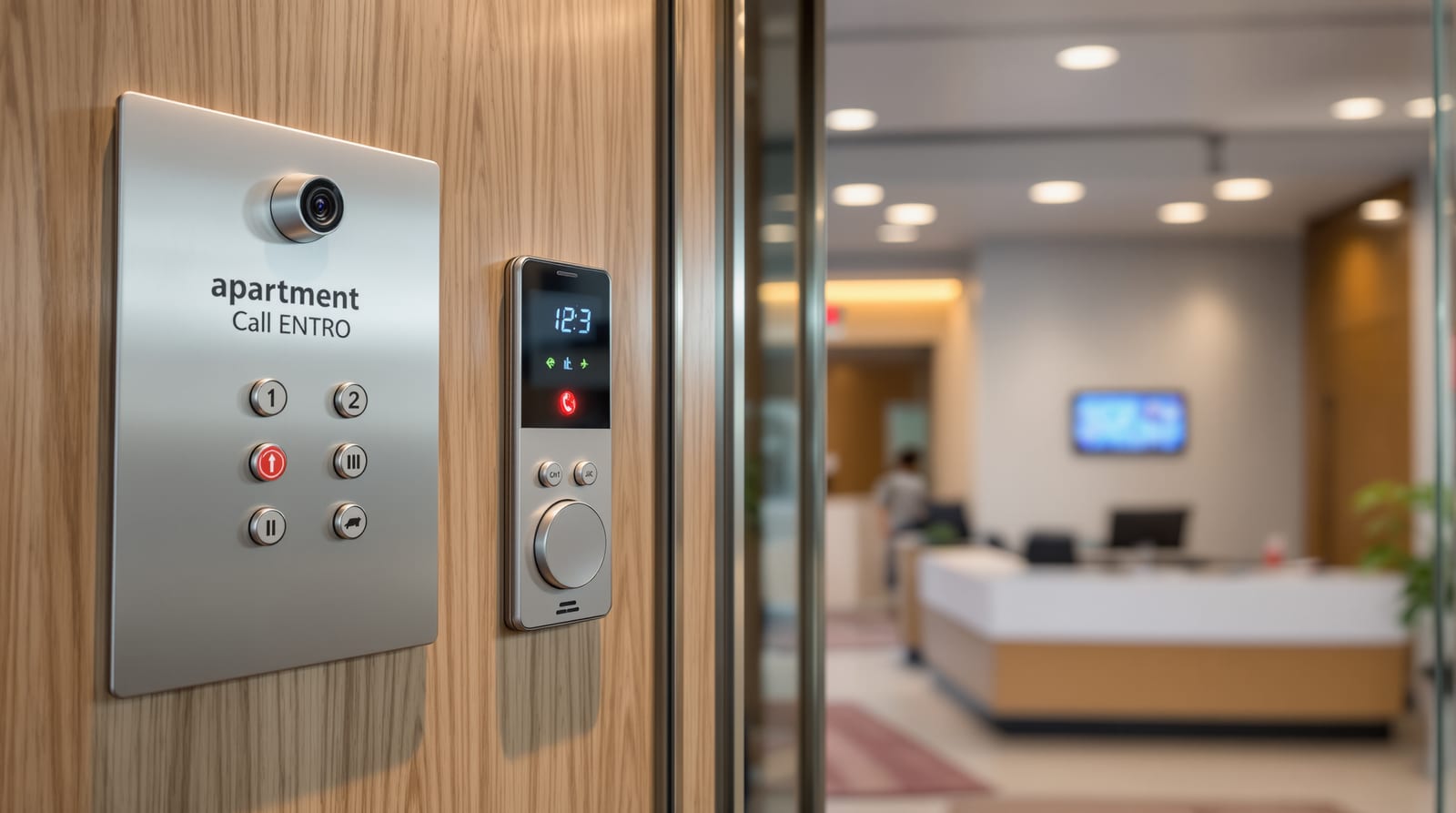
Apartment Intercom Systems for Societies India 2026
How lobby panels, guard stations and flat units connect across a building, plus riser-wired vs IP architecture, app integration and AMC.
For a housing society, the intercom is the spine of everyday access: it is how the gate or lobby reaches a flat before a visitor is let in, how the guard speaks to a resident, and increasingly how a delivery or cab is approved from a phone. Apartment intercom systems are very different from a single villa video door phone — they must address hundreds of flats from one entry panel, survive Indian power-cuts and monsoon humidity, and stay serviceable for a decade under an RWA's AMC budget. This guide is written for builders, RWAs, society committees and integrators specifying or upgrading a system. For the wider product and standards picture, pair it with our video intercom systems guide and the complete door guide.
What an apartment intercom system has to do
Unlike a one-to-one home unit, a society system is a small telephone exchange for the building. The core jobs are:
- Entry panel to flat: a visitor at the lobby or main gate dials a flat number (or scrolls a building directory) and the resident's indoor monitor rings with video and audio.
- Guard to flat and flat to guard: the security cabin has a dedicated console (a guard/master station) to call any flat and to receive resident calls.
- Flat to flat: residents can call other flats internally — useful and free, but some societies disable it to limit nuisance calls.
- Door / gate release: the resident presses unlock on the monitor to release the lobby electric strike or trigger the main-gate boom or wicket door.
- Common-area and emergency calling: clubhouse, lift lobby, panic buttons.
The two big distinctions from a villa unit are addressing (one panel must reach every flat) and scale (the wiring and power must serve the whole block, not one door).
The two architectures: riser-wired vs IP
Every society system is one of two families, and choosing correctly at the planning stage decides cost, cabling and future flexibility.
Bus / riser-wired systems
A traditional analogue or proprietary-digital system runs a small number of wires up a vertical riser through each floor's distributor box, dropping a pair into every flat. The entry panel, distributors and indoor monitors share one bus. It is robust, has no dependence on a building LAN, and is cost-effective for mid-rise blocks. The trade-off: addressing capacity is limited per riser, video quality is modest, and adding app features usually means a separate gateway.
IP (network) systems
Every entry panel, guard station and indoor monitor is a network device on the building LAN, powered by PoE (Power over Ethernet) or local adaptors and managed by server or cloud software. IP scales cleanly to many blocks, gives crisp HD video, supports mobile-app answering natively, and unifies CCTV, access control and the intercom on one infrastructure. It costs more up front and depends on a well-built, backed-up network — a society that cannot maintain a switch room should think twice.
| Attribute | Riser-wired (bus) | IP / network |
|---|---|---|
| Cabling | Few-core riser + drops | Cat6 structured + PoE switches |
| Addressing / scale | Limited per riser; good mid-rise | Excellent; multi-block from one server |
| Video quality | Modest (analogue/CVBS or low-res) | HD, multi-stream |
| App / cloud answering | Add-on gateway needed | Native |
| CCTV / access integration | Limited | Unified on same network |
| Network dependency | None | High (needs managed LAN + UPS) |
| Best for | Single-block, budget RWAs | Townships, premium, future-proofing |
The building directory and addressing
A usable entry panel needs a building directory — residents searchable by flat number or name on a touchscreen or keypad, not a wall of buttons. For large townships, panels typically address by block + flat (e.g. A-1204). Keep the directory data in one place (ideally the management software) so a resident move-out updates everywhere at once. Privacy matters: under the DPDP Act 2023, displaying resident names and capturing visitor video makes the society a data fiduciary — publish a notice, restrict who can export footage, and set retention.
Gate, door and visitor flow
The panel must drive real hardware. At the lobby, the indoor monitor's unlock button releases an electric strike or magnetic lock on the glass entrance door. At the main gate, the call can trigger a boom barrier and/or a pedestrian wicket. The life-safety rule is non-negotiable: any access-controlled door on an escape route must allow free egress — NBC 2016 requires people to get out without a key, card or app, and maglocks on such doors must drop on fire-alarm activation. Specify fail-safe behaviour and a fire-panel interface for lobby maglocks; see fail-safe vs fail-secure locks.
Integration with society apps and gate visitor entry
The biggest shift in Indian societies is the management app (MyGate, ADDA, NoBrokerHood and similar) becoming the visitor gateway. Rather than only ringing the wall monitor, a guard or gate panel raises an approval request to the resident's phone — useful when nobody is home. A well-specified system bridges both worlds: keep the in-flat monitor for reliable local answering during internet outages, and add the app layer for remote approval, pre-approved visitor codes, delivery and cab logging, and an audit trail. Treat the app and the wired intercom as complementary, not either-or; the wired monitor is your fallback when the app or broadband is down. For the data and audit side, see visitor management systems and door access audit logs.
Power, wiring and the Indian reality
Power-cuts are the silent killer of society intercoms. Plan from the start:
- UPS / battery backup at the entry panel, distributors and guard station so the gate still works during an outage.
- PoE budgeting on IP systems — confirm the switch's total wattage covers all panels and monitors plus headroom.
- Surge and earthing for riser cabling that runs the full height of the building; lightning and ground faults are real on tall blocks.
- Segregated cable trays keeping intercom risers away from power cables to avoid hum and interference.
This is integrator and licensed-electrician territory — isolate supply before working on panels, and document the riser so future faults are traceable. Estimate the project envelope with our access control cost estimator and design the layout with the access control system designer.
What apartment intercom systems cost (India 2026)
Apartment intercom is project-engineered and quote-driven; treat these as planning bands, all plus 18% GST.
| Component | Indicative band (₹) | Notes |
|---|---|---|
| Lobby / gate entry panel (video) | 15,000-60,000 | Touchscreen + directory dearer |
| Indoor flat monitor (per flat) | 3,000-12,000 | Wired vs IP/Wi-Fi |
| Guard / master station | 12,000-40,000 | One per cabin |
| Riser distributor / floor box | 2,000-8,000 each | Bus systems |
| PoE switch + server (IP) | 25,000-1,50,000+ | Scales with blocks |
| UPS / backup per panel | 5,000-20,000 | Essential in India |
| Door / gate release hardware | 1,500-6,000 per door | Strike or maglock |
| Cabling + installation | quote | Riser height drives this |
| AMC (annual) | 5-12% of system value | Pro-rated per flat |
For a per-flat answer, run figures through the video door phone selector before you sign.
Scaling to many flats and blocks
A single riser bus tops out at a finite number of addresses, so large blocks are split across multiple risers or distributors with the entry panel addressing block+flat. IP systems scale by adding switches and licences rather than re-cabling, which is why townships of several hundred flats almost always go IP. Whatever the choice, insist on a directory that updates centrally, spare capacity (10-15%) for new fit-outs, and a documented as-built so the next integrator is not reverse-engineering a decade-old riser.
AMC and lifecycle
An intercom is a ten-year asset, and the cheapest install with no service plan is the most expensive over its life. A sound AMC covers: preventive visits, panel and monitor replacements, software/firmware updates, directory edits on resident churn, UPS battery health, and a defined response time for a dead gate panel (a security risk, not a convenience). Budget 5-12% of system value annually, hold spares for discontinued monitors, and keep the management-app subscription separate and named in the contract. For broader maintenance practice see door automation AMC and tie gate access to the wider gated society access control plan.
Frequently asked questions
Should our society choose a wired or IP intercom?
For a single mid-rise block on a tight budget, a riser-wired system is robust and cheaper and needs no LAN. For townships, multiple blocks, HD video or native app answering, IP is worth the higher up-front cost — provided the society can maintain a backed-up network and switch room. Match the choice to your maintenance capability, not just the brochure.
Can residents answer the gate from their phone?
Yes, when the system is bridged to a society-management app or an IP intercom with a mobile client. Keep the wired in-flat monitor too, because it answers reliably during broadband or app outages. Treat the app as a remote-approval and audit layer over a dependable wired core.
What happens to the intercom during a power-cut?
Without backup, panels and gate release go dead — a real risk in India. Specify UPS or battery backup at the entry panel, distributors and guard station so the gate still functions. Remember that any access-controlled escape door must still allow free manual egress regardless of power, per NBC 2016.
Is flat-to-flat calling safe to enable?
It is convenient and costs nothing extra, but some societies disable it to curb nuisance or harassment calls. A middle path is to allow it with a setting to mute or block specific extensions. Decide as a committee and document it.
Are we responsible for the data the system captures?
Yes. Capturing visitor video and storing resident names and movement logs makes the society a data fiduciary under the DPDP Act 2023. Publish a privacy notice, restrict who can export footage, set a retention period, and secure the server or cloud account.
How big an AMC budget should an RWA plan?
Budget roughly 5-12% of the installed system value per year, covering preventive visits, panel/monitor replacement, firmware updates, directory edits and UPS battery health, with a guaranteed response time for a dead gate panel. Keep the management-app subscription as a separate, named line item.
Export this guide
Related Guides — Deep-dive reading
Video Door Phones with Access Control in India (2026): The Door Phone as Entry System
How a video door phone becomes the front end of a real access-control system — releasing a gate or lobby door, adding cards, PINs and app credentials, and keeping an audit trail — with life-safety egress and networked-lock risks kept honest.
SecurityAccess Control System Cost in India (2026): Priced Per Door, Per System, Per User
What a building-scale access control system actually costs in India — broken down per controlled door (reader, electric lock, controller, cabling and power) and per system (software, licences, integration and AMC) — with the standalone-versus-networked split, how the bill scales with the number of doors and the credential you choose, and the non-negotiable rule that escape-route doors must fail safe.
SecurityRelated Tools — Try Free
Security Cabling & PoE Planner
Estimate cable length, drops, PoE power budget, the right switch, conduit and cost for a CCTV/security cabling plan.
Cabling PlannerApartment Video Door System Planner
Enter flats, entrances, floors and guard desk for a first-pass building intercom plan — door stations, indoor monitors, guard station, the right architecture and an indicative cost band.
Building PlannerVideo Door Phone Type Selector
Answer a few questions about your building, cabling, budget and internet and get the right video door phone — analog / wired / wireless / IP, single-home or multi-apartment, monitor or app.
Door Phone Selector