
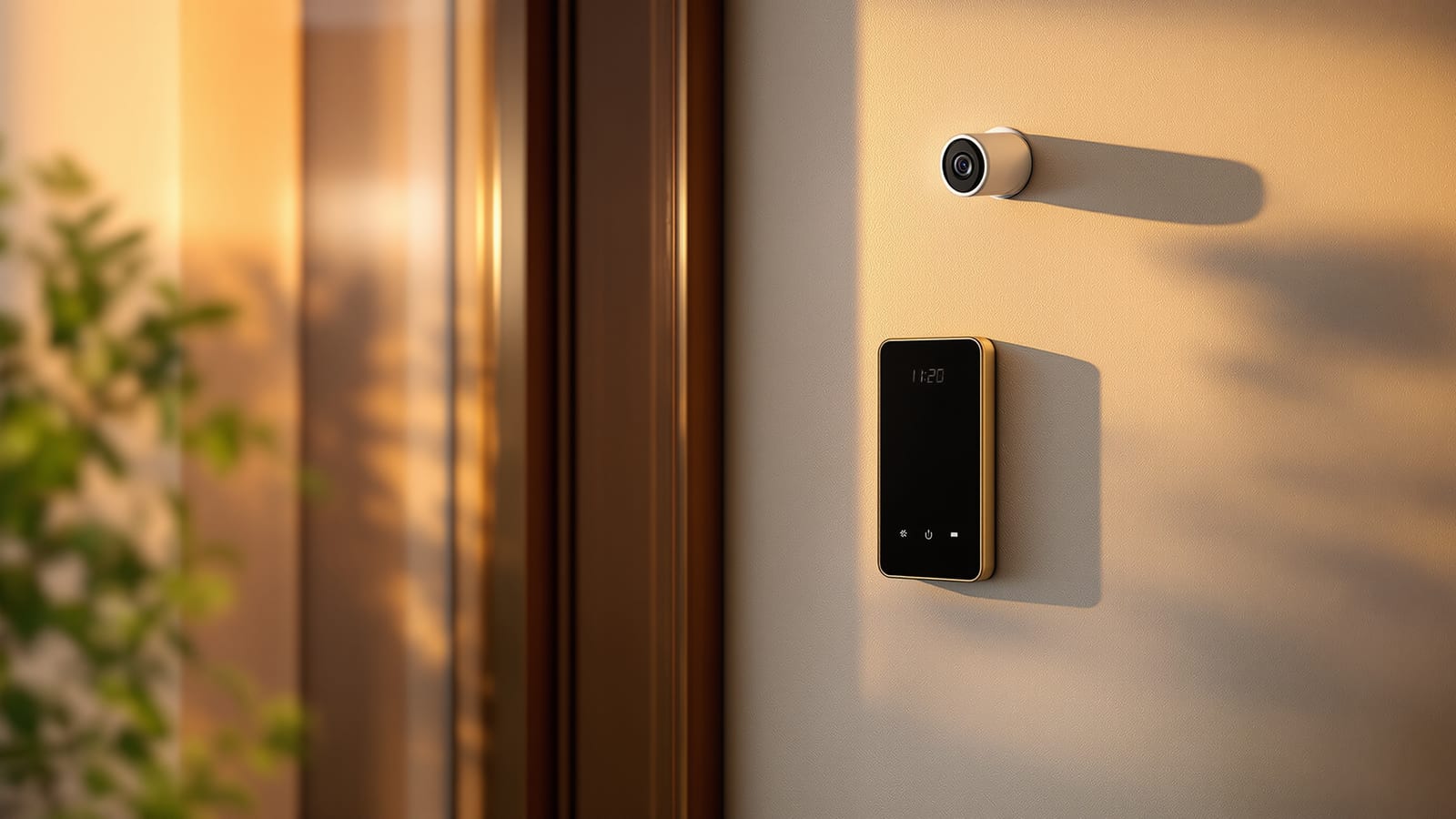
CCTV vs Video Door Phone: Which Does Your Home Need?
They look similar and get confused constantly, but a CCTV camera and a video door phone do different jobs — one watches the whole property and records, the other answers your door and controls who comes in. This guide settles CCTV vs video door phone for Indian homes: what each is for, where they overlap, real rupee costs, apartment versus villa relevance, and why most homes end up wanting both.
Walk into any electronics shop asking to secure your entrance and you will be pitched two things that sound like the same thing: a CCTV camera and a video door phone. Both have a camera, both show video on a screen or phone, both cost a few thousand rupees. So people buy one, assume they are covered, and then discover the gap — the CCTV filmed the courier but could not talk to him, or the door phone showed the visitor but never recorded the person who climbed the compound wall at 2 a.m. They are not competitors. They are two halves of a whole. This guide explains exactly what each does, where they overlap, and how to spend a limited budget wisely.
A video door phone answers your door. CCTV watches your property. One is about who you let in; the other is about what happens whether you are watching or not. Confusing them is how people end up half-protected and surprised.
For the wider picture, read this alongside smart home security systems in India and the ultimate guide to smart homes. If access control is your main concern, pair it with smart door locks; if you have decided on cameras and want to choose models, the choosing CCTV guide goes deeper on lenses, resolution and storage.
The quick verdict
If you can only take one sentence away: a video door phone (VDP) is for answering and controlling your door; CCTV is for surveillance and evidence across your whole property. A door phone makes you safer at the single most important point — the door you actually open. CCTV makes you aware everywhere else and gives you a recording when something goes wrong. Most Indian homes genuinely benefit from both, and the two increasingly talk to each other. If forced to pick one first, an apartment usually starts with a video door phone, and an independent house usually starts with CCTV — we will unpack why below.
What each device is actually for
The clearest way to tell them apart is by the question each answers.
Video door phone. Mounted at your main door or gate, it rings inside, shows you who is there, and lets you talk to them through two-way audio — and, crucially, unlock the door or gate remotely. Its job is the transaction at the threshold: identify the visitor, speak, decide, admit or refuse. Recording is a bonus, usually triggered by the bell or motion, not continuous. It is fundamentally an access and answering device.
CCTV. A set of cameras covering the gate, compound, parking, corridors and blind spots, recording continuously or on motion to a local NVR/DVR or the cloud. Its job is coverage and evidence — it sees the person loitering, the vehicle at the wall, the delivery left unattended, and keeps footage you can review later. It does not answer the door, and most CCTV cameras do not let a visitor talk back.
The head-to-head comparison
| Feature | Video Door Phone | CCTV |
|---|---|---|
| Primary purpose | Answer the door, control access | Surveillance, deterrence, evidence |
| Coverage | The doorstep or gate only | Whole property, multiple angles |
| Recording | Event-based (bell, motion) | Continuous or motion, 24x7 |
| Storage | SD card or short cloud clips | NVR/DVR (days to weeks) or cloud |
| Two-way audio | Yes, core feature | Rare (some smart cameras only) |
| Remote unlock | Yes, many models | No |
| Lock integration | Common with smart locks | Uncommon |
| Number of units | Usually one at the door | Typically 2 to 8 cameras |
| Answers "who is at my door?" | Yes | Partly, if aimed there |
| Answers "what happened last night?" | No | Yes |
| Typical cost | ₹6,000 to ₹25,000 | ₹8,000 to ₹40,000+ (set) |
Two-way audio and remote unlock: the door phone's edge
The feature that truly separates a VDP is interaction. You can tell a courier to leave the parcel at the gate, ask an unexpected visitor who they are before opening, and buzz in a family member — all from inside or from your phone. A CCTV camera, no matter how sharp, is a one-way window: it shows you a stranger at the door but cannot help you deal with them in the moment. For an Indian home with frequent deliveries, domestic help, and visitors at the gate, that live interaction is the everyday value.
Recording and storage: CCTV's edge
CCTV wins decisively on the forensic question. When a car is scratched, a plant is stolen, or a boundary is breached, you want reviewable footage from multiple angles going back days — that is exactly what an NVR or cloud-recording CCTV setup provides. Video door phones typically keep only short clips around a bell press or motion event, on a small SD card, and cover only the door. If evidence and continuous coverage matter to you, sizing recording storage properly is its own decision — work out days of retention and drive size with the CCTV camera storage calculator, and go deeper on camera choice in the choosing CCTV guide.
Where they overlap — and why it confuses people
The confusion is real because the categories have blurred. Smart video doorbells (Qubo, Ring-style, Godrej) record motion clips and stream to your phone like a camera. Some smart CCTV cameras (from CP Plus, Hikvision, TP-Link Tapo, Qubo) now include two-way audio and can sit near a door. So a smart doorbell does a little CCTV, and a smart camera does a little door-answering. But "a little" is the operative phrase: a doorbell still only sees the door and keeps short clips, and a two-way camera still cannot unlock your door or integrate with your lock the way a VDP does. The overlap is convenience at the edges, not a replacement.
Integration with smart locks and the wider home
This is where a video door phone pulls ahead as part of a modern setup. Many VDPs and smart doorbells integrate with smart door locks: see the visitor, verify, and unlock — all in one flow, even remotely. Some tie into the broader home automation system so a bell press can turn on the porch light or trigger a scene. CCTV usually stays a more standalone surveillance layer, though smart cameras can feed the same security app. If you are building an integrated home, the door phone is the piece that participates in access flows; CCTV is the always-watching backdrop. Both should sit on a solid network — see the smart home networking guide for keeping cameras and doorbells reliably online.
Apartment versus independent house
Where you live changes the answer more than any spec.
| Apartment / flat | Independent house / villa | |
|---|---|---|
| Main entry points | One door, shared corridor | Gate, main door, back door, terrace |
| Compound to watch | None (society handles common areas) | Full perimeter is your responsibility |
| Best first buy | Video door phone | CCTV set |
| Why | You mainly need to answer your one door; the society covers building CCTV | You must both watch a large perimeter and answer a gate far from the house |
| Often adds later | A smart camera indoors or on the balcony | A video door phone at the gate for remote answering |
Apartments usually already have building-level CCTV in lobbies and lifts run by the society, and there is no compound of your own to patrol. Your real gap is answering your own flat door — so a video door phone (or a smart doorbell where drilling is limited) is the natural first device.
Independent houses and villas carry the whole perimeter themselves: gate, driveway, boundary wall, back entrances, terrace. That is a surveillance problem CCTV is built for, so it usually comes first. But because the gate can be far from the front door, a gate-mounted video door phone that answers to your phone is a strong, common addition.
Which to buy first on a budget
The honest answer for most homes is both, phased — buy the one that closes your biggest gap now, then add the other.
A practical phasing for a limited budget:
- Apartment, tight budget: start with a video door phone or smart doorbell (₹6,000 to ₹15,000). Add one indoor or balcony smart camera later.
- Independent house, tight budget: start with a 2 to 4 camera CCTV set with an NVR covering gate, driveway and back door (₹12,000 to ₹30,000). Add a gate video door phone when you can.
- Comfortable budget, either home: install both together and, ideally, tie the door phone to a smart lock for see-verify-unlock in one flow.
| Scenario | Buy first | Add next | Rough first-phase cost |
|---|---|---|---|
| Flat, deliveries and visitors your main worry | Video door phone | Indoor camera | ₹6,000 to ₹15,000 |
| Villa, perimeter is the worry | 4-camera CCTV + NVR | Gate VDP | ₹15,000 to ₹35,000 |
| Frequent traveller, want remote control | Smart VDP + smart lock | CCTV set | ₹18,000 to ₹40,000 |
| Full protection from day one | Both together | Automation tie-ins | ₹25,000+ |
To pressure-test any of these against the rest of your smart-home spend, run the figures through the smart home cost calculator.
Why most homes end up with both
Return to the two questions. "Who is at my door right now, and should I let them in?" is answered by a video door phone. "What happened at my gate, driveway and back door while I was asleep or away?" is answered by CCTV. A serious home has both questions, so it needs both answers. They are complementary layers — the door phone is your active checkpoint, the CCTV is your passive witness. Framing it as CCTV versus video door phone is the wrong frame; the real question is which you install first and when the second follows. For how these fit into a layered security design overall, continue with smart home security systems in India, and for the maintenance that keeps cameras and door phones working through India's power cuts, see the smart home maintenance guide.
References
- Bureau of Indian Standards (BIS) — safety and quality standards for electronic security equipment sold in India.
- CERT-In — Indian Computer Emergency Response Team — advisories on securing IP cameras, doorbells and home networks.
- Ministry of Electronics & IT — Digital Personal Data Protection Act — privacy obligations relevant to recording visitors and neighbours.
- TRAI — Telecom Regulatory Authority of India — broadband and connectivity context for cloud-connected cameras and door phones.
- Bureau of Energy Efficiency — energy guidance for always-on security devices.
Export this guide
Related Guides — Deep-dive reading
Smart Home Security Systems in India: CCTV, Sensors, Alarms & AI
How to think in layers — perimeter, entry, interior — and build a system that actually protects an Indian home: AI cameras, video door phones, door and glass-break sensors, alarms, panic buttons, gate automation, monitoring and DPDP-aware privacy, with real brands and rupee costs.
Smart HomeComplete Guide to Security System Cybersecurity in India (2026): Protecting the Systems That Protect You
The cameras, locks, alarms and door phones you install to feel safer are internet-connected computers that can themselves be attacked, and an insecure one is worse than none. This pillar maps the whole attack surface — devices, network, accounts and data, operations — and points to every guide that hardens it.
SecurityLocal versus Cloud Security for Security Systems in India (2026): Where Should Your Footage Live?
The most important cyber choice you make about a camera or alarm is where its footage and control actually live: on-site in your hands, in a vendor's cloud, or both. This even-handed guide weighs privacy, resilience in India's outages, convenience and cost, and shows why a hybrid design is often the safest home answer.
SecurityRelated Tools — Try Free
CCTV Camera Coverage & Count Calculator
Estimate how many CCTV cameras you need, the NVR channels, storage in TB for your retention period, and an indicative all-in cost with GST.
CCTV CalculatorCCTV Cloud vs Local Cost Calculator
Compare cloud CCTV subscription against a local NVR + HDD — upfront, 5-year total, monthly fee and break-even.
Cloud vs LocalApartment Video Door System Planner
Enter flats, entrances, floors and guard desk for a first-pass building intercom plan — door stations, indoor monitors, guard station, the right architecture and an indicative cost band.
Building Planner