
Night-Vision Video Door Phones in India (2026): Seeing Who's at the Door After Dark
How a door station sees at night in India: infrared black-and-white versus colour night vision, why a close, back-lit face makes the doorstep a special case, and what actually matters when you buy.
The doorbell rings at nine at night. The whole point of a video door phone is to know who is there before you open, and after dark is exactly when that matters most, when the corridor light is out, the street is quiet, and you cannot simply peer through a window. If the monitor shows only a black rectangle or a glaring white blob where a face should be, the camera has failed at the one moment you needed it.
Night-vision video door phones solve that by giving the door station a way to see in low or no light. But the doorstep is a peculiar place to point a night camera: the visitor is close, often only a metre away, and frequently back-lit by a streetlight or a lit hallway behind them. That changes what "good night vision" even means here. This guide is the doorstep lens on the subject, part of Studio Matrx's video door phone hub and the wider Security Knowledge Hub. For the deep, general treatment of night vision across all outdoor cameras, see the CCTV companion, night-vision CCTV cameras in India — this guide does not repeat it; it stays at the door.
Scope & safety. This guide helps you plan, compare and choose night-vision features and coordinate a sensible install. A video door phone is a two-way intercom answered from an indoor monitor or app, not a CCTV camera; if you want a smart camera-doorbell instead, see smart video doorbells and doorbell cameras. Any mains wiring for a porch light or the door station itself is a licensed electrician's job — see the electrical hub. Footage of visitors is personal data under the Digital Personal Data Protection Act, 2023; point the camera at your own doorstep, not into a neighbour's home or a shared corridor beyond your entrance. This is educational guidance, not legal advice.
The two ways a door station sees at night
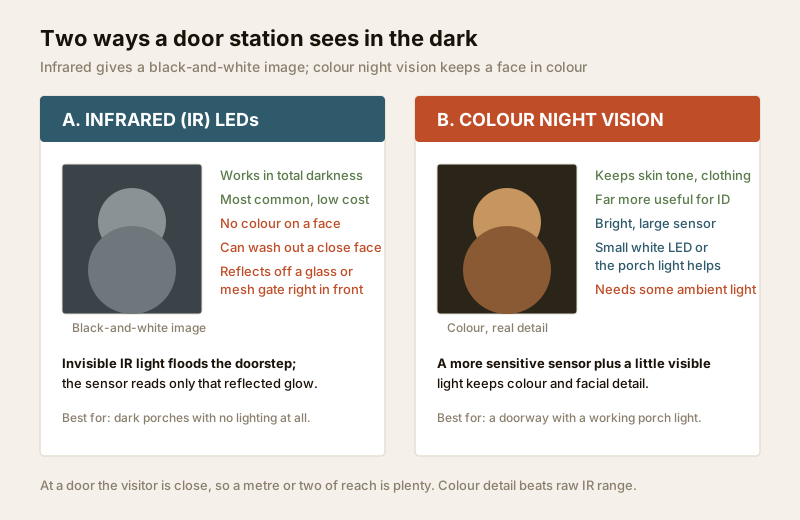
Strip away the marketing and every video door phone uses one of two approaches after dark, and many good ones can switch between them. Understanding the difference is the whole game.
A. Infrared (IR) LEDs — the black-and-white image
The most common method. Around the camera lens sits a ring of infrared LEDs that flood the doorstep with light your eyes cannot see. The image sensor reads that reflected IR glow and builds a black-and-white picture. Its great strength is that it works in total darkness — no porch light, no moon, nothing — and it is cheap and mature, so nearly every budget door phone has it.
The catch, at a door specifically, is twofold. First, IR gives you shape and motion but no colour — you lose the visitor's skin tone, the colour of their clothes, everything that helps you actually recognise or later describe them. Second, and this surprises people, too much IR at close range washes a face out: the LEDs are inches from a visitor who is only a metre away, so the light bounces back hard and can over-expose the face to a featureless white blur while the background stays dark. IR also reflects off glass and mesh — if your door phone sits behind a glass grille gate or a mosquito mesh, the IR can bounce straight back into the lens and fog the whole image.
B. Colour night vision — a face you can actually recognise
The newer, more useful approach for a door. It pairs a more sensitive, larger image sensor (marketed as "starlight," "full-colour night vision," or similar) with a little bit of visible light — usually a small built-in white LED on the station, the porch light, or ambient street lighting. Because it works with visible light, it keeps the image in colour with real facial detail: you see it is your neighbour in a blue kurta, not just a grey silhouette.
The trade-off is that colour night vision needs some ambient light. In a pitch-black porch with nothing at all, a pure colour-only camera struggles, which is why the best door phones do both: they run colour when there is a little light and fall back to IR black-and-white when it goes fully dark, or trigger a white LED on motion. For most Indian homes, where there is usually a porch bulb, a streetlight, or a corridor tube nearby, colour night vision is the more valuable feature.
| Infrared (IR) | Colour night vision | |
|---|---|---|
| Image | Black-and-white | Full colour |
| Works in total darkness | Yes | Only with some ambient light or its own white LED |
| Face detail / recognition | Shape only, no colour | Skin tone, clothing, real detail |
| Close-face washout risk | Higher (bright IR at 1 m) | Lower |
| Glass / mesh gate in front | Reflects, can fog the image | Handles it far better |
| Cost / availability | Cheap, on almost everything | Slightly higher, increasingly common |
| Best for | Fully dark porch, no lighting | A doorway with any working light |
Why the door is a special case (not just "a camera at night")
If you have read the night-vision CCTV guide, you know outdoor cameras obsess over IR range — twenty metres, thirty metres, floodlighting a whole compound. At a door, almost none of that applies, and chasing it leads you to the wrong product.
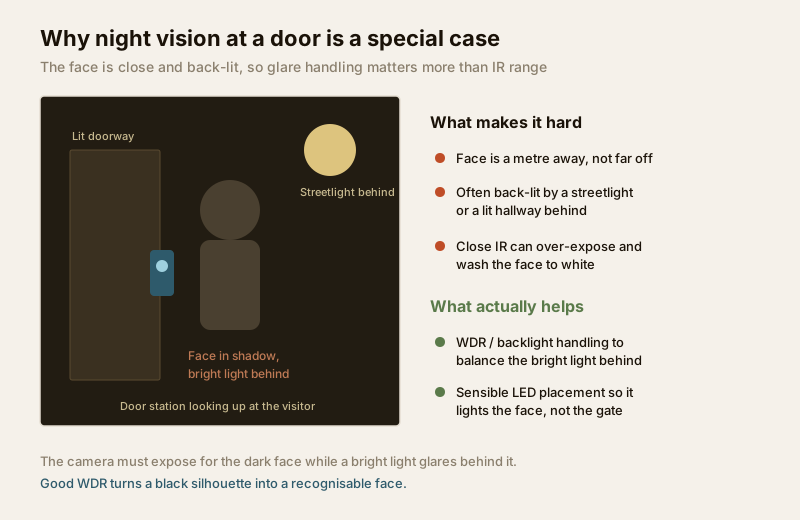
Three things make the doorstep different:
- The face is close. A visitor stands roughly a metre from the station. You do not need thirty metres of IR reach; a metre or two is plenty. A camera boasting a huge IR range is solving a problem you do not have — and its powerful LEDs may actually over-light and wash out the near face.
- The visitor is usually back-lit. This is the real villain. Behind the person is often a streetlight, a gate lamp, or a bright lit doorway/lobby. A cheap camera exposes for that bright background and turns the face into a black silhouette — you can see that someone is there but not who. The fix is Wide Dynamic Range (WDR) or good "backlight handling," which balances the bright background against the dark face so both are visible.
- LED placement matters more than LED count. Where the light sits and which way it throws matters more than how many LEDs there are. A well-placed light that falls on the face beats a bright ring that bounces off a glass gate or blinds a close visitor.
So the door priorities invert the CCTV ones: WDR / backlight handling and colour detail beat raw IR range every time. A door phone that renders a recognisable, colour face of a back-lit visitor a metre away is doing its job; one that reaches thirty metres into an empty street is not.
The India realities: porch lights, monsoon and moths
Three practical things shape night performance in Indian homes far more than any spec sheet.
A porch or gate light is the cheapest upgrade there is
This is the single highest-value move and it costs almost nothing: a working light at the door lifts every night-vision camera dramatically. Even a modest warm LED bulb over the entrance gives a colour-night-vision sensor enough to render a full-colour, recognisable face and spares you the whole IR-washout problem. Before you spend extra on a fancier door phone, spend it on a decent porch light — ideally one that comes on at dusk automatically or on motion. (Any new light fitting or wiring is an electrician's job; see the electrical hub.) A ₹300 bulb often does more for your night image than a ₹3,000 jump in camera model.
Monsoon glare and a filmed lens
India's monsoon is brutal on any door camera. A film of rain, dust or grime on the cover glass is nearly invisible by day but scatters IR light into a milky glare at night, ruining the image exactly when you need it. Two habits help: mount the station under an eave or a small canopy so rain does not sit on the glass, and wipe the cover glass with a soft damp cloth every few weeks. A recessed or shaded mounting also cuts the chance of the porch light or a streetlight flaring directly into the lens.
Moths, insects and false alerts
Warm IR LEDs attract moths and insects at night, which then crawl across the lens or trigger endless motion alerts, and spiders spin webs right over the warm glow. This is a real nuisance in India. A door phone with adjustable motion zones and sensitivity, or one that leans on colour night vision (less insect-attracting IR), suffers less. Keeping the housing clean and, again, a steady porch light rather than a bright IR flood both help.
What to check when buying for night use
Put together, the doorstep rewrites the shopping list. Ignore the headline range numbers and look at what actually produces a usable night face.
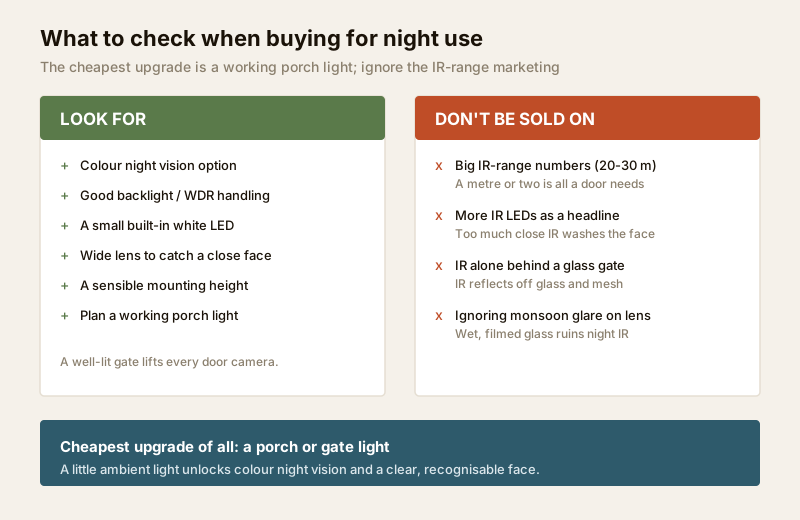
| What to check | Why it matters at a door | The trap to avoid |
|---|---|---|
| Colour night vision | Colour makes a face recognisable, not just present | Assuming IR black-and-white is "good enough" |
| WDR / backlight handling | Balances a back-lit visitor against a bright streetlight | Ignoring it — the No. 1 cause of black-silhouette faces |
| A small white LED | Fills a face with visible light for colour rendering | Buying IR-only for a lit doorway |
| IR as a fallback | Covers a fully dark night when the porch light is off | Buying colour-only for a pitch-black porch |
| Wide lens angle | Catches a close face and anyone standing to the side | Narrow lens that misses a stepped-back visitor |
| A porch light plan | The cheapest, biggest improvement of all | Spending on the camera, forgetting the light |
| IR range in metres | Largely irrelevant — a door is a metre away | Paying for 30 m reach you will never use |
For a structured way to weigh these against your other must-haves, the video door phone feature selector walks you through it, and the type selector helps you settle the underlying wired-versus-wireless-versus-IP question first. Night performance also depends on the class of device you choose, so it is worth reading alongside the IP video door phones, wired and wireless guides, which cover how each type handles power and image quality.
How night vision ties into the rest of the system
Seeing the visitor is only half of answering the door; you also need to talk and, sometimes, to let them in. Good night vision pairs naturally with a few other features:
- Two-way audio lets you speak to a late visitor without opening, which is often the whole point after dark — see video door phone two-way audio.
- Mobile app viewing means you can see and answer the night-time door from your phone whether you are in the bedroom or away from home — see mobile-app video door phones.
- A clear night image feeds recognition sensibly. If you are considering facial-recognition door phones, remember that recognition is only as good as the picture it gets — a washed-out or silhouetted night face defeats it, and a colour night image with good WDR is a precondition, not an afterthought. Recognition is also sensitive personal data under the DPDP Act, 2023 and is often overkill for a home; treat it as a considered, consent-and-notice choice, not a default.
If the door phone is wired into a lock or access control, seeing who is there before you release the door is exactly what night vision buys you — but the lock, egress and fire-interlock side of that is a licensed job. See video door phones with access control and with smart locks; an electric lock on a door people exit through must fail safe and must never block a fire-escape route.
For homes in a society or apartment, the corridor door station and the guard's camera face the same night conditions; the apartment intercom and multi-apartment door systems guides cover shared-entrance night lighting, while villa door phones covers the gate-plus-door setup common to independent houses.
When to bring in a professional. Choosing the night-vision features, planning where the station and a porch light sit, and reading the image quality are all yours to decide and coordinate. Hand the mains wiring for a porch light or a hard-wired door station, any electric-lock and fire-interlock work, and any working at height to a licensed electrician or door-hardware professional — see the electrical hub. Position the station and its light so they illuminate your own doorstep, keep the camera off a neighbour's window or a shared corridor beyond your entrance under the DPDP Act, and never let a lock arrangement block a fire-escape route.
Key takeaways
- A door station sees at night two ways — infrared, which gives a black-and-white image in total darkness, and colour night vision, which keeps a face in colour but needs a little ambient light; the best door phones do both.
- The doorstep is a special case: the face is close and usually back-lit, so WDR / backlight handling and colour detail matter far more than raw IR range — a metre or two of reach is plenty.
- A porch or gate light is the cheapest, biggest upgrade — a modest bulb unlocks colour night vision and a recognisable face, often doing more than a costlier camera.
- Watch for India-specific spoilers: monsoon film scattering IR into glare, a close IR ring washing out the face, IR reflecting off a glass or mesh gate, and moths crowding the lens — clean the glass and shade the mount.
- Ignore the IR-range marketing and choose for colour night vision, good backlight handling and a wide lens; use the feature selector to weigh it against your other needs.
References
- Digital Personal Data Protection Act, 2023 — recorded footage of visitors is personal data; aim a door station at your own entrance, avoid capturing a neighbour's home or a shared corridor beyond your doorstep, and treat any facial-recognition feature as a consent-and-notice, data-minimising choice.
- Manufacturer specifications — verify colour-night-vision sensor claims ("starlight"/full-colour), WDR support, IR wavelength and range, and any built-in white-LED behaviour on the maker's own datasheet before buying; treat headline IR-range figures with scepticism for a door.
- National Building Code of India (SP 7), Bureau of Indian Standards, and local municipal bye-laws for any mains wiring of a porch light or door station and for any electric-lock/egress or fire-interlock aspect of an install; verify the current edition via the BIS catalogue: https://www.services.bis.gov.in/
This is an educational overview, not legal advice. Mains wiring, porch-light and door-station power, electric-lock and fire-interlock work and any work at height are qualified professional tasks — engage a licensed electrician or door-hardware professional, and verify any standard's current status via the BIS catalogue before relying on it.
Export this guide
Related Guides — Deep-dive reading
How to Choose a CCTV Camera (2026): The Homeowner's Decision Guide for India
Cut through the spec-sheet noise and choose the right CCTV camera for each spot around an Indian home. What actually matters — sensor and low-light performance, lens and field of view, form factor, IP and IK ratings, honest smart features — and the marketing claims to ignore.
SecurityCCTV vs Video Door Phone: Which Does Your Home Need?
They look similar and get confused constantly, but a CCTV camera and a video door phone do different jobs — one watches the whole property and records, the other answers your door and controls who comes in. This guide settles CCTV vs video door phone for Indian homes: what each is for, where they overlap, real rupee costs, apartment versus villa relevance, and why most homes end up wanting both.
Smart HomeHow to Choose a Security System (2026): The Master Buying Guide for Indian Homes and Buildings
The mental model that ties the whole buying decision together: start from your own risk, not a product; build the layers your situation actually needs; make the big architecture choices (wired vs wireless, local vs cloud, DIY vs professional); tell real product quality from marketing; and choose a vendor you can trust.
SecurityRelated Tools — Try Free
Video Door Phone Feature Selector
Tick what you want the door phone to do — app, night vision, two-way audio, smart lock, access control or facial recognition — and get the features and integrations to spec, with the privacy and safety caveats.
Feature SelectorVideo Door Phone Type Selector
Answer a few questions about your building, cabling, budget and internet and get the right video door phone — analog / wired / wireless / IP, single-home or multi-apartment, monitor or app.
Door Phone SelectorApartment Video Door System Planner
Enter flats, entrances, floors and guard desk for a first-pass building intercom plan — door stations, indoor monitors, guard station, the right architecture and an indicative cost band.
Building Planner