
Sustainable HVAC: Low-Carbon Comfort That Costs Less to Run
HVAC is a building's biggest energy load, so greening it matters most — the efficiency-first hierarchy for sustainable cooling: reduce the load by design, run efficient equipment, recover and generate clean energy, and electrify, so comfort comes with a small carbon footprint and a smaller bill.
HVAC is usually the single largest energy consumer in a building — and as India's cooling demand soars, HVAC is one of the country's fastest-growing sources of electricity use and emissions. That makes greening it one of the highest-impact things a building can do. Sustainable HVAC isn't about buying one green gadget; it's a hierarchy — reduce the load first, then run efficient equipment, recover and generate clean energy, and electrify. Get the order right and comfort comes with a small carbon footprint and a smaller bill. This guide is the strategy for sustainable, low-carbon cooling.
It is the sustainable-HVAC anchor of the HVAC Knowledge Hub, applying the Ultimate HVAC Guide.
The safety line & scope. This guide is design strategy for sustainable HVAC. System design, sizing and installation are qualified MEP/HVAC work. Efficiency never overrides safety, indoor air quality or code compliance.
The efficiency-first hierarchy
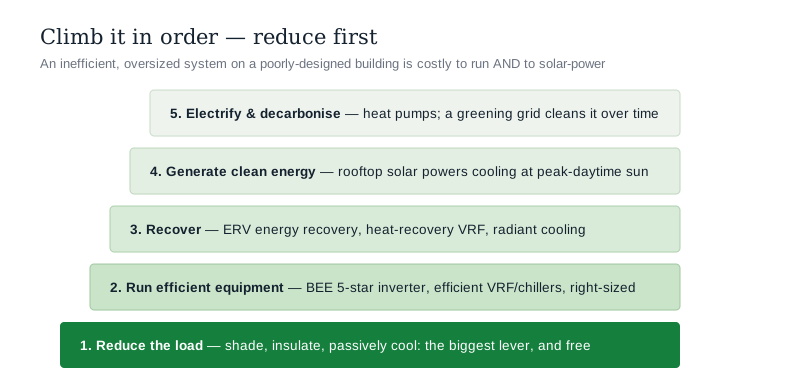
The greenest cooling follows an order, each rung cheaper and greener than the one above:
1. Reduce the load — the biggest lever, and free: a well-designed, shaded, insulated building and passive cooling need less HVAC. Every watt of cooling you design out is a watt you never buy, run or emit.
2. Run efficient equipment — for the load that remains, high-efficiency HVAC: BEE 5-star inverter units, efficient VRF/chillers, and correct right-sizing.
3. Recover and reclaim — heat/energy recovery (ERV) on ventilation, and heat-recovery VRF that moves heat between zones — using energy twice.
4. Generate clean energy — power the (now-small, efficient) cooling with rooftop solar or solar cooling, so it runs on the sun during peak-cooling daytime.
5. Electrify and decarbonise — electric heat pumps for any heating, and a greening grid that cleans it all over time.
The order is everything: an inefficient, oversized system on a poorly-designed building is expensive to run and to solar-power. Reduce first, then the rest is smaller.
Reduce the load — the passive foundation
Because HVAC exists to counter heat gain, cutting that gain is the highest-impact move:
- Orientation, shading and cool roofs — keep the sun's heat out (the efficient-design levers), so there's less to cool.
- Passive cooling — natural ventilation, thermal mass, evaporative and night cooling handle much of India's climate without machines.
- Insulation and good glazing — reduce the load the HVAC must meet.
- Eco Niwas Samhita / ECBC — the codes that set envelope efficiency.
A building that needs little cooling is the foundation of sustainable HVAC — and it's decided at the architecture stage.
Run efficient equipment
For the cooling that remains, efficiency compounds the savings:
- Right-size — an oversized system short-cycles and wastes energy; a proper load calculation is a green measure.
- High ISEER / BEE 5-star inverter units, efficient chillers and VRF with variable-speed drives.
- Good controls — smart thermostats, zoning (cool only occupied spaces), and BAS optimisation.
- Low-GWP refrigerants (R32/R290) under the Kigali Amendment — greener working fluids.
- Maintenance — a clean, well-serviced system stays efficient; a neglected one degrades.
Recover, generate and electrify
The higher rungs, for a genuinely low-carbon system:
- Energy recovery — ERV reclaims most of the cooling in exhaust air; heat-recovery VRF and run-around coils reuse energy.
- Radiant and advanced systems — radiant cooling can cool comfortably at higher, more efficient temperatures.
- Solar — rooftop solar powers cooling with peak-daytime sun; solar air conditioning goes further.
- Ground coupling — earth air tunnels/geothermal use the stable earth to pre-cool.
- Green certification — sustainable HVAC is central to IGBC/GRIHA ratings and net-zero buildings.
The one-line answer
HVAC is a building's biggest energy load, so greening it is one of the highest-impact sustainability moves — and it follows a hierarchy, in order: reduce the load first (a shaded, insulated, passively-cooled building needs far less HVAC — free and decided at design), then run efficient, right-sized equipment (BEE 5-star inverter, efficient VRF/chillers, good controls, low-GWP refrigerants), then recover and generate (ERV energy recovery, radiant cooling, rooftop solar, ground cooling), and electrify with heat pumps on a greening grid. The order is everything — an inefficient, oversized system on a poorly-designed building is costly to run and to solar-power, so reduce first, and comfort comes with a small carbon footprint and a smaller bill. All engineered by a qualified MEP/HVAC professional, never at the cost of air quality or code compliance.
Where to go next
- Design out the load: Passive Cooling Guide · Energy-Efficient Home Design Guide.
- Efficient equipment: HVAC Energy Efficiency Guide.
- Advanced low-energy cooling: Radiant Cooling Guide · Solar Air Conditioning Guide.
- Certify it: Green Building Ratings (IGBC/GRIHA) Guide.
References
- Bureau of Energy Efficiency (BEE) — Energy Conservation Building Code (ECBC), Eco Niwas Samhita, and Star Labelling/ISEER: https://beeindia.gov.in/
- ISHRAE — sustainable HVAC & energy-efficient design guidance; ASHRAE Standard 90.1 (energy).
- IGBC / GRIHA — green-building HVAC criteria; refrigerant phase-down under the Kigali Amendment to the Montreal Protocol.
Sustainable HVAC design and sizing are professional MEP/HVAC work; efficiency measures must not compromise indoor air quality or code compliance. Verify any standard's current status via the BIS catalogue before relying on it.
Export this guide
Related Guides — Deep-dive reading
Designing a Naturally Energy-Efficient Indian Home
Comfort first, gadgets last — passive design, orientation, insulation, ventilation and the climate wisdom that cuts Indian energy bills
SustainabilityEnergy-Efficient Facades in India: How the Building Skin Cuts Your Cooling, Heating & Lighting Bills
How a building facade drives cooling, heating and lighting energy in India, the three levers of solar-heat-gain control, insulation and daylighting, U-value, SHGC, VLT and WWR in plain terms, ECBC and Eco-Niwas expectations, and real Indian green buildings.
Building FacadesPassive Cooling: Keeping a Home Cool Without (Much) Air Conditioning
India cooled itself for millennia before the AC — the passive strategies that keep a building comfortable using design, not machines: shading and orientation, natural and night ventilation, thermal mass, evaporative cooling and cool roofs, and how they slash the cooling load.
HVAC & CoolingRelated Tools — Try Free
Cross-Ventilation Analyzer
Estimate airflow and air changes per hour (ACH) from room size, window areas, layout, and local wind — with NBC 2016 Part 8 compliance check.
Ventilation CalculatorBrise-Soleil Visualizer
Interactive horizontal-louvre cut-off angle calculator — sun altitude, louvre depth, and spacing inputs with a live shadow preview. Computes θ = arctan(spacing/depth) for façade shading, ECBC envelope compliance, hospital daylight design, and tropical sun-control detailing.
Sun Shading ToolRainwater Tank Sizer
How big should your rainwater tank be? Computes annual harvest, recommended tank capacity in litres, water-bill savings, and payback — for 10 Indian cities.
RWH Calculator