

VRF & VRV Systems: One Outdoor Unit, Many Rooms — Explained
The system behind modern villas, offices and hotels — how VRF (and Daikin's VRV) run many indoor units from one outdoor unit with superb zoning and efficiency, why they're not the same as multi-splits, when they're worth it, and what design they need.
When a modern villa, office floor or hotel is air-conditioned cleanly — many rooms, individual control, no forest of outdoor units — it's almost always a VRF system. Variable Refrigerant Flow runs many indoor units from one (or a few) outdoor units, varying the refrigerant it sends to each to match each room's exact need. It's more sophisticated, efficient and controllable than splits, and it's the workhorse of mid-scale buildings. This guide explains VRF (and VRV), how it differs from a multi-split, when it's worth it, and what it takes to design.
It builds on the Building HVAC Design Guide and Air Conditioning Basics, part of the HVAC Knowledge Hub.
The safety line & scope. VRF is an engineered system — design, refrigerant piping, commissioning and servicing are qualified HVAC/MEP work. This guide helps you understand and specify it; it is not a DIY system.
VRF vs VRV — the same thing
First, the naming confusion, settled simply:
- VRF (Variable Refrigerant Flow) is the generic technology name.
- VRV (Variable Refrigerant Volume) is Daikin's trademark for the same thing — they invented it, and the brand name stuck.
- So VRV is VRF — one is the trademark, the other the generic term. Every manufacturer's version is VRF; Daikin's is called VRV. Don't overthink it.
How VRF works
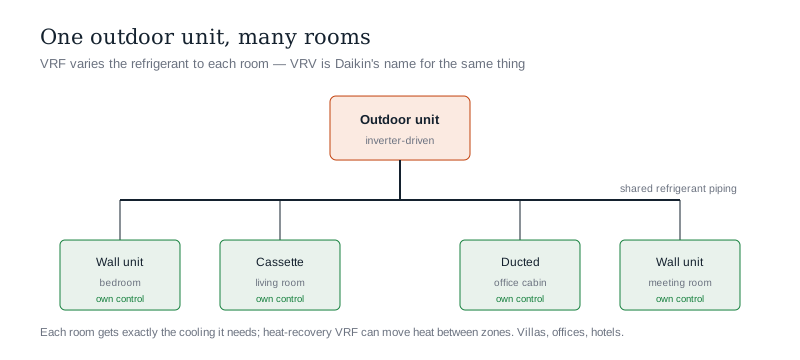
VRF's cleverness is in the word variable:
- One (or a few) outdoor units serve many indoor units through a shared refrigerant piping network.
- The system varies the refrigerant flow to each indoor unit continuously, delivering exactly the cooling each room needs at that moment — so a busy meeting room and an empty office on the same system get different amounts.
- Inverter-driven throughout, it modulates rather than cycles, running very efficiently at part-load (which is most of the time).
- Heat-recovery VRF can even move heat from rooms that need cooling to rooms that need heating simultaneously — highly efficient in mixed-use buildings.
- Indoor unit variety — wall, cassette, ducted and floor units can mix on one system to suit each space.
VRF vs multi-split (they're not the same)
A common confusion — VRF is not just a big multi-split:
- A multi-split connects a few indoor units to one outdoor unit, each essentially on/off, with limited coordination.
- VRF connects many indoor units, continuously varies flow to each, coordinates the whole system intelligently, scales far larger, and offers heat recovery and advanced controls.
- VRF is the engineered, building-scale evolution; a multi-split is a small-scale convenience. The difference is sophistication, scale and control.
When VRF is worth it
VRF earns its (higher) cost where its strengths matter:
- Villas and large homes — many rooms, individual control, few outdoor units to hide, and a clean look.
- Offices — floor-by-floor or tenant zoning, efficient part-load running, and flexible fit-outs.
- Hotels — per-room control, quiet, and reliability.
- Mixed-use buildings — where heat-recovery VRF shines.
- Where outdoor space is limited — one outdoor unit instead of many.
For a single room or a small flat, VRF is overkill — splits are simpler and cheaper. VRF pays off at the multi-room, whole-building scale.
What VRF design needs
Because it's engineered, VRF must be properly designed — not bought off a shelf:
- A load calculation for each zone and the whole building.
- Refrigerant piping design — pipe sizing, lengths, and the branch (refnet) network within manufacturer limits.
- Indoor unit selection per space (type, capacity, location).
- Controls & zoning — thermostats per zone, and often integration with a Building Automation System.
- Refrigerant volume & safety — larger refrigerant charges need attention to ventilation and leak safety per the applicable codes.
- Commissioning — professional charging, testing and balancing.
This is MEP/HVAC consultant and specialist-installer territory, coordinated with the building design.
The one-line answer
VRF — Variable Refrigerant Flow — runs many indoor units from one (or a few) outdoor units, continuously varying the refrigerant sent to each so every room gets exactly the cooling it needs, inverter-driven for excellent part-load efficiency, with heat-recovery versions that move heat between zones. VRV is simply Daikin's trademark for VRF — same technology. It's far more sophisticated than a multi-split (variable flow, intelligent coordination, building scale, heat recovery), which makes it the workhorse of villas, offices and hotels where individual control, efficiency and few outdoor units matter — while being overkill for a single room, where a split is simpler. VRF is an engineered system needing proper load, piping and controls design, and specialist installation and commissioning — MEP/HVAC work, not DIY.
Where to go next
- The building context: Building HVAC Design Guide.
- The simpler home option: Split AC Guide.
- Concealed indoor units: Ducted & Cassette AC Guide.
- The largest scale: Central Air Conditioning Guide.
References
- National Building Code of India, SP 7 (Part 8 — Building Services, air conditioning; verify current edition), Bureau of Indian Standards.
- ISHRAE — HVAC design guidance; refrigerant safety per applicable codes (charge limits, ventilation).
- Refrigerant transition (R32 and others) under the Kigali Amendment to the Montreal Protocol.
VRF is an engineered system; design, refrigerant piping, commissioning and servicing are qualified MEP/HVAC work. Verify any standard's current status via the BIS catalogue before relying on it.
Export this guide
Related Guides — Deep-dive reading
Building HVAC Design Guide: From Apartments to Hospitals
How HVAC scales and changes across building types — the systems, loads and priorities for apartments, villas, offices, hotels, hospitals, schools and industrial buildings, and why a hospital's air is designed on utterly different principles from an office's.
HVAC & CoolingDucted & Cassette AC: Concealed Cooling for a Clean Ceiling
When you want the cooling but not the wall units — how ducted and cassette air conditioners hide in the ceiling to deliver even, discreet comfort, how each works, where each fits, and why they must be planned into the ceiling before it closes.
HVAC & CoolingLow-Rise Plumbing Systems in India: Houses, Villas & Buildings up to 4 Storeys
How plumbing is organised for independent houses, villas and low-rise buildings up to about four storeys — the simple overhead-tank gravity model, when a small booster is still worth adding, single- versus multi-floor distribution, and the simpler stack and venting a low building can get away with.
PlumbingRelated Tools — Try Free
CCTV Cable-Length Calculator
Total cable to buy for a CCTV job and a warning when a run exceeds the cable's maximum length.
Cable LengthApartment Video Door System Planner
Enter flats, entrances, floors and guard desk for a first-pass building intercom plan — door stations, indoor monitors, guard station, the right architecture and an indicative cost band.
Building PlannerCross-Ventilation Analyzer
Estimate airflow and air changes per hour (ACH) from room size, window areas, layout, and local wind — with NBC 2016 Part 8 compliance check.
Ventilation Calculator