
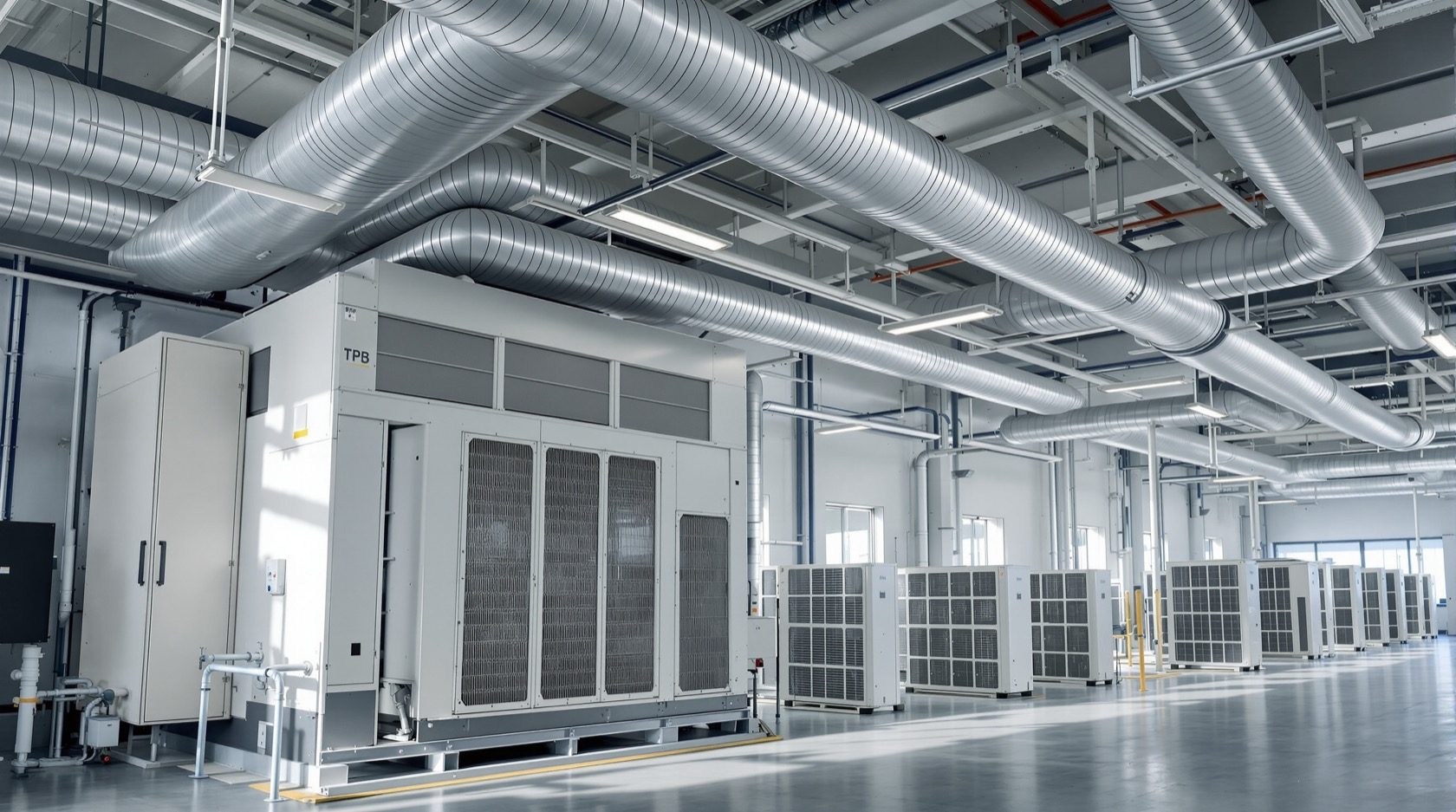
The Ultimate Guide to HVAC Systems: Heating, Ventilation & Air Conditioning
The complete, plain-language grounding in HVAC — what it is, how heating, ventilation and air conditioning actually work together to deliver comfort and clean air, the components and controls behind them, and how to think about efficiency in India's cooling-dominant climate.
HVAC — Heating, Ventilation and Air Conditioning — is the building system that keeps indoor spaces comfortable, healthy and breathable. It is invisible when it works and impossible to ignore when it doesn't: it governs how warm or cool a room is, how fresh the air feels, how humid it gets, and how much of your energy bill disappears into comfort. In India, where cooling dominates, HVAC is often thought of as "the AC" — but it is much more, and understanding the whole system is what lets you plan, specify and judge it well. This is the master guide to the entire cluster.
It is the pillar of the HVAC Knowledge Hub, the starting point the other guides build on.
The safety line & scope. This guide helps you understand and specify HVAC. Installation, refrigerant handling, gas and ductwork are qualified-professional work — a licensed HVAC technician / MEP engineer. Safe homeowner tasks (cleaning filters, using the thermostat, scheduling servicing, choosing equipment) are covered throughout, but the mechanical work belongs to a professional.
What HVAC actually is
HVAC bundles three jobs that together create indoor comfort:
- Heating (H) — adding warmth when it's cold (heat pumps, radiant/underfloor, electric or gas heating). Less dominant in most of India, but essential in hill stations, the north in winter, and many building types.
- Ventilation (V) — supplying fresh outdoor air and removing stale air, moisture, odours and pollutants. The most under-appreciated part, and central to indoor air quality and health.
- Air Conditioning (AC) — cooling and dehumidifying air. In India this is the headline function, from a bedroom split AC to a chilled-water plant serving a tower.
The insight most people miss: comfort is not just temperature. It's temperature and humidity and air movement and air freshness — and HVAC manages all four together. That's the "psychrometric" reality that professional HVAC design works with.
How a system works — the refrigeration cycle
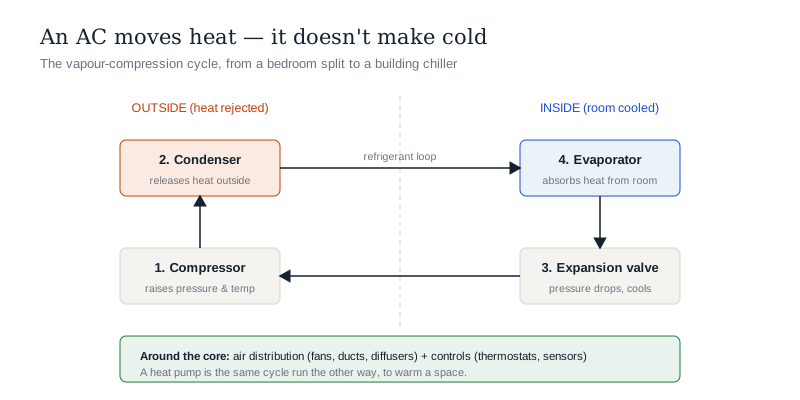
At the heart of cooling is the refrigeration (vapour-compression) cycle — the same principle in a bedroom AC and a building chiller. A refrigerant is pumped around a loop:
1. Compressor — compresses the refrigerant gas, raising its pressure and temperature.
2. Condenser — the hot refrigerant releases heat to the outside (the outdoor unit) and condenses to liquid.
3. Expansion valve — the liquid's pressure drops sharply, cooling it.
4. Evaporator — the cold refrigerant absorbs heat from indoor air (the indoor unit), cooling the room, and returns as gas to the compressor.
So an air conditioner doesn't "make cold" — it moves heat from inside to outside. A heat pump is the same cycle run either way, moving heat in to warm a space. Around this core sit air distribution (fans, ducts, diffusers) and controls (thermostats, sensors) that decide when and how much.
The components of an HVAC system
A complete system, small or large, has these building blocks:
- The refrigeration/plant — compressor, condenser, evaporator, expansion device; scaled up in buildings to chillers, air-handling units (AHUs) and cooling towers.
- Air-side equipment — fans and blowers, ductwork, diffusers and grilles that move and distribute air.
- Ventilation & fresh air — fans and, increasingly, heat/energy recovery ventilators (HRV/ERV) that bring in fresh air efficiently.
- Filtration & air cleaning — filters (from basic to HEPA) that clean the air.
- Controls — thermostats, sensors and, in larger buildings, a Building Automation System (BAS) that runs it all.
- Refrigerant — the working fluid (R32, R410A, R290 and newer low-GWP options).
The complete equipment guide covers how these scale from a home to a hospital.
Types of system, from home to tower
HVAC scales enormously:
- Room/unitary — window and split ACs, the Indian home default; simple, per-room.
- Multi-split / VRF/VRV — one outdoor unit serving many indoor units, common in villas and offices.
- Ducted / packaged — ducted air distribution for whole-home or floor cooling.
- Central / chilled-water — chillers, AHUs and cooling towers for large buildings.
- Specialised — precision cooling for server rooms and data centres, clean-room and hospital systems.
Which is right depends on the building, the load and the use — the heart of system selection.
Controls and comfort
Modern HVAC is only as good as its controls:
- Thermostats — from simple dials to smart, sensor-driven controls that learn and schedule.
- Zoning — cooling only occupied spaces, a major efficiency and comfort gain.
- Sensors — temperature, humidity, CO₂ and occupancy sensors that let the system respond to real conditions.
- Building Automation — in commercial buildings, a BAS optimises the whole plant.
- Smart/AI HVAC — increasingly, predictive control and monitoring.
Good controls are how a system delivers comfort and saves energy rather than just running flat out.
Energy efficiency — the India priority
HVAC is often the single largest energy load in a building, so efficiency matters more here than almost anywhere:
- The BEE star rating — India's Bureau of Energy Efficiency star label rates room ACs; a 5-star inverter AC uses far less than a 1-star fixed-speed unit for the same cooling.
- Inverter technology — variable-speed compressors modulate rather than cycle on/off, saving substantially.
- Right-sizing — an oversized system short-cycles and dehumidifies poorly; a professional load calculation sizes it correctly.
- Efficient design first — a well-designed, insulated, shaded building needs far less HVAC (the efficiency-first principle of sustainable design).
- Standards — ECBC and Eco Niwas Samhita set efficiency benchmarks for buildings.
The greenest, cheapest cooling is the load you design out before the equipment is even chosen.
Maintenance — what keeps it working
HVAC rewards maintenance and punishes neglect:
- Homeowner tasks (safe): clean or replace filters regularly (the single biggest DIY lever on efficiency and air quality), keep outdoor units clear, use the thermostat sensibly.
- Professional tasks: coil cleaning, refrigerant checks, duct cleaning, and the servicing of compressors, chillers, cooling towers and AHUs.
- Preventive maintenance keeps efficiency up, air clean and equipment alive — covered across the hub's maintenance guides.
Where HVAC is going
The field is evolving fast: low-GWP refrigerants (R32, R290) replacing high-warming ones under the Kigali Amendment; heat pumps electrifying heating; smart and AI controls optimising energy; heat/energy recovery making ventilation efficient; and passive and radiant approaches cutting loads. India's rising cooling demand makes efficient, sustainable HVAC one of the most important building challenges of the coming decades.
The one-line answer
HVAC — Heating, Ventilation and Air Conditioning — is the building system that manages temperature, humidity, air movement and air freshness together to deliver comfort and healthy air. At its core is the refrigeration cycle (compressor, condenser, expansion valve, evaporator) that moves heat rather than making cold, surrounded by air distribution (fans, ducts, diffusers), fresh-air ventilation (increasingly with heat recovery), filtration and controls. It scales from a bedroom split AC to a building's chiller plant, and in India — where cooling dominates and HVAC is often the biggest energy load — the priorities are right-sizing, efficiency (BEE-rated inverter equipment), and designing the load out first. You plan, choose and judge it; a qualified HVAC technician / MEP engineer installs and services the mechanical side, while you handle the safe basics like cleaning filters.
Where to go next
- For a home: Complete Guide to Residential HVAC.
- Building it new: HVAC Planning Guide for New Homes.
- Upgrading: HVAC Renovation Guide.
- By building type: Building HVAC Design Guide.
References
- National Building Code of India, SP 7 (Part 8 — Building Services, including HVAC; verify current edition, SP 7 : 2026), Bureau of Indian Standards.
- IS 1391 (Part 1 : 2023 Unitary & Part 2 : 2023 Split) Room Air Conditioners; IS 8148 : 2018 Ducted & Package Air-Conditioners, BIS.
- Bureau of Energy Efficiency (BEE) — Energy Conservation Building Code (ECBC), Eco Niwas Samhita, and Star Labelling for room ACs: https://beeindia.gov.in/
- ISHRAE (Indian Society of Heating, Refrigerating & Air Conditioning Engineers); ASHRAE Standards 55 (thermal comfort), 62.1 (ventilation & IAQ), 90.1 (energy).
HVAC design, sizing and installation are professional work; standards and refrigerant regulations evolve. Verify any standard's current status via the BIS catalogue and use a qualified HVAC technician / MEP engineer.
Export this guide
Related Guides — Deep-dive reading
Designing a Naturally Energy-Efficient Indian Home
Comfort first, gadgets last — passive design, orientation, insulation, ventilation and the climate wisdom that cuts Indian energy bills
SustainabilityHVAC Equipment: The Components That Make Up a Cooling System
A tour of the machinery behind comfort — the refrigeration components (compressor, condenser, evaporator), the air-side equipment (AHUs, fan-coil units, fans, ducts, dampers, filters) and the plant-side (chillers, cooling towers, pumps), what each does, and how they fit together across systems.
HVAC & CoolingResidential Electrical Systems: The Complete Guide for Indian Homes
How the electricity in an Indian home actually works — from the utility supply and meter through the distribution board, circuits, wiring, earthing and protection, to lighting, safety, energy efficiency, smart controls, solar and backup — written so a homeowner can understand, plan and judge it, and know exactly where a licensed electrician must take over.
Electrical & WiringRelated Tools — Try Free
Cross-Ventilation Analyzer
Estimate airflow and air changes per hour (ACH) from room size, window areas, layout, and local wind — with NBC 2016 Part 8 compliance check.
Ventilation CalculatorRainwater Tank Sizer
How big should your rainwater tank be? Computes annual harvest, recommended tank capacity in litres, water-bill savings, and payback — for 10 Indian cities.
RWH CalculatorFuture Home Comfort Score
Score your home 0 to 100 on daylight, ventilation, thermal and acoustic comfort and find the weak link.
Window Tool