

Air Conditioning Basics: How an AC Works & What the Numbers Mean
The grounding every AC buyer needs — how an air conditioner actually cools, what a 'ton' really measures, how to read ISEER and the BEE star rating, why inverter beats fixed-speed, and what the refrigerant inside means, so you can choose and judge any AC with confidence.
Before you can choose an AC well, it helps to understand what you're actually buying — and the specs on the box (tons, ISEER, stars, R32) confuse most people. The good news: a handful of ideas explain almost everything. This guide is the plain-language grounding in air conditioning: how an AC really works, what its numbers mean, and how to read them so you can pick and judge any unit with confidence. It's the anchor of the air conditioning section.
It builds on the Ultimate HVAC Guide and the Residential HVAC Guide, and is part of the HVAC Knowledge Hub.
The safety line & scope. This guide helps you understand and choose. Installation, refrigerant charging and servicing are a qualified HVAC technician's work. Safe homeowner tasks — cleaning filters, setting the temperature, booking servicing — are yours.
How an AC actually cools
An air conditioner doesn't make cold — it moves heat from inside your room to outside, using the refrigeration cycle: a refrigerant is compressed, releases heat outside (the outdoor unit), expands and cools, then absorbs heat from your room's air (the indoor unit) before repeating. So an AC is really a heat pump moving heat outdoors, and its outdoor unit blows out the heat it removed from your room — which is why it must sit in open air.
Two useful consequences: an AC also dehumidifies (moisture condenses on the cold coil and drains away — the condensate water), and its efficiency depends on how hard it has to work against the outdoor heat.
What a "ton" really measures
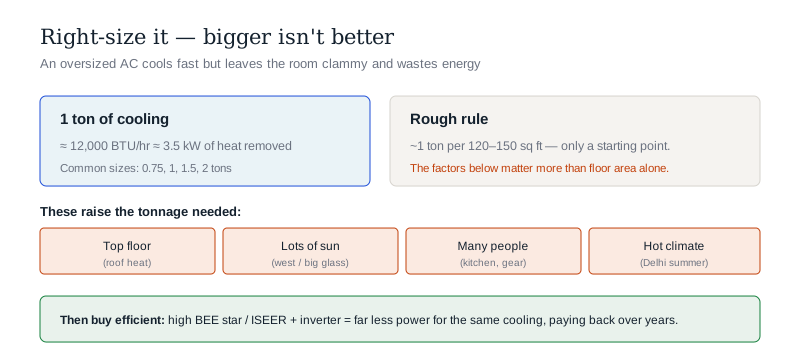
AC capacity is measured in tons — a term that confuses everyone because it has nothing to do with weight:
- One ton of cooling ≈ 12,000 BTU/hour ≈ 3.5 kW of heat removal. It originally meant the cooling of one ton of ice melting in a day.
- Common home sizes: 0.75, 1, 1.5 and 2 tons.
- Bigger isn't better — an oversized AC cools the air fast but switches off before it dehumidifies, leaving a room cold and clammy, and short-cycling wastes energy. A right-sized unit runs longer, steadier and drier.
- How much you need depends on room size, sun, insulation, floor and occupancy — estimate it with the AC Capacity Calculator, and for anything beyond a room, a proper load calculation.
The rough rule — ~1 ton per 120–150 sq ft — is only a starting point; the factors matter more than the floor area alone.
ISEER and the BEE star rating: efficiency
Because an AC is a home's biggest energy load, its efficiency rating decides its running cost:
- ISEER (Indian Seasonal Energy Efficiency Ratio) — how much cooling the AC delivers per unit of electricity, across a season of varying temperatures. Higher ISEER = more efficient.
- The BEE star rating — India's Bureau of Energy Efficiency label translates ISEER into 1 to 5 stars. More stars = less power for the same cooling.
- A 5-star inverter AC can use roughly a third less energy than a 1-star fixed-speed unit — over years of summers, the higher price pays back handsomely.
- Ratings are periodically revised (the bar rises over time), so a "5-star" from years ago may not match today's — check the current label.
Buy by the star rating and ISEER, not just the price tag — the cheap AC is often the expensive one to run.
Inverter vs fixed-speed
The single most important technology choice:
- Fixed-speed AC — the compressor runs full-blast or switches off, cycling on and off to hold temperature. Cheaper upfront; less efficient; more temperature swing and noise.
- Inverter AC — a variable-speed compressor modulates its output to match the cooling need, running steadily at low power once the room is cool. More efficient, quieter, steadier temperature, and better at low voltage.
- For anything used regularly, inverter wins — the energy saving pays back the premium, and comfort is better. (Covered in depth in the inverter-vs-fixed comparison.)
Refrigerants: what's inside
The refrigerant is the working fluid, and it matters for the environment:
- R32 — the current mainstream refrigerant in new Indian ACs; lower global-warming potential (GWP) than the older R410A, and efficient.
- R410A — common in older/existing units; higher GWP, being phased down.
- R290 (propane) — a very low-GWP natural refrigerant used in some efficient ACs; excellent environmentally.
- The world is moving to low-GWP refrigerants under the Kigali Amendment; newer units (R32/R290) are the greener choice.
- Refrigerant is handled only by trained technicians — it must be charged and recovered properly, never vented.
The specs to read on any AC
Putting it together, when you look at an AC:
- Tonnage — matched to the room (not oversized).
- Star rating / ISEER — the efficiency and running cost.
- Inverter — yes, for regular use.
- Type — split, window, or a bigger system.
- Refrigerant — R32 or R290 (newer, greener).
- Noise level, warranty and reputable brand — and ISI/BIS conformity to IS 1391.
The one-line answer
An air conditioner doesn't make cold — it moves heat out of your room via the refrigeration cycle (and dehumidifies as a bonus), so its outdoor unit must sit in open air. Its capacity is in tons (1 ton ≈ 12,000 BTU/hr ≈ 3.5 kW), and bigger isn't better — an oversized AC cools fast but leaves the room clammy and wastes energy, so right-size it (~1 ton per 120–150 sq ft as a start, adjusted for sun, floor, insulation and occupancy). Buy for efficiency — a high ISEER / 5-star BEE inverter unit uses far less power and pays back its premium — choose inverter over fixed-speed for steady, quiet, efficient cooling, and prefer newer low-GWP refrigerants (R32/R290). Read the tonnage, stars, inverter and refrigerant on any AC, and leave the installation and refrigerant work to a qualified technician.
Where to go next
- The home default: Split AC Guide.
- The budget option: Window AC Guide.
- Size it: AC Capacity Calculator.
- Cut the running cost: Home Energy Management Guide.
References
- IS 1391 (Part 1 : 2023 Unitary & Part 2 : 2023 Split) Room Air Conditioners, Bureau of Indian Standards.
- Bureau of Energy Efficiency (BEE) — Star Labelling for room air conditioners and ISEER: https://beeindia.gov.in/
- Refrigerant phase-down under the Kigali Amendment to the Montreal Protocol (R32/R290 low-GWP transition).
- IS 8148 : 2018 Ducted & Package Air-Conditioners, BIS.
Efficiency ratings and refrigerant regulations evolve; verify the current BEE label and any standard's status via the BIS catalogue. Installation and refrigerant handling are a qualified HVAC technician's work.
Export this guide
Related Guides — Deep-dive reading
Split AC Guide: The Indian Home's Default Air Conditioner
Everything on the split AC — how the indoor and outdoor units work together, why it's quieter and more efficient than a window unit, how to choose tonnage, stars and features, where to place both units, and what installation and upkeep it needs.
HVAC & CoolingBEE Star Rating for ACs: How to Read the Label and Buy Smart
The 1–5 star label on every air conditioner, decoded — what BEE stars and ISEER actually mean, why the ratings get tougher over time, how much a higher star really saves, and how to weigh the price premium against the running-cost saving.
HVAC & CoolingInverter vs Non-Inverter AC: Why the Compressor Type Matters Most
The single most important AC choice, explained — how an inverter's variable-speed compressor differs from a fixed-speed one, why it saves energy, runs quieter and copes with low voltage, whether the higher price pays back, and the rare case for a fixed-speed unit.
HVAC & CoolingRelated Tools — Try Free
Window Cleaning Cost Calculator
Estimate professional window cleaning cost per visit and per year by access and frequency.
Window CalculatorBefore vs After — Cost Reality Check
Compare what you expected to pay vs what you actually paid, category by category.
Reality CheckRenovation vs New Build Calculator
Compare renovating vs building new interiors city-wise across 13 work scopes with GST and per-sqft rates.
Cost Comparison