
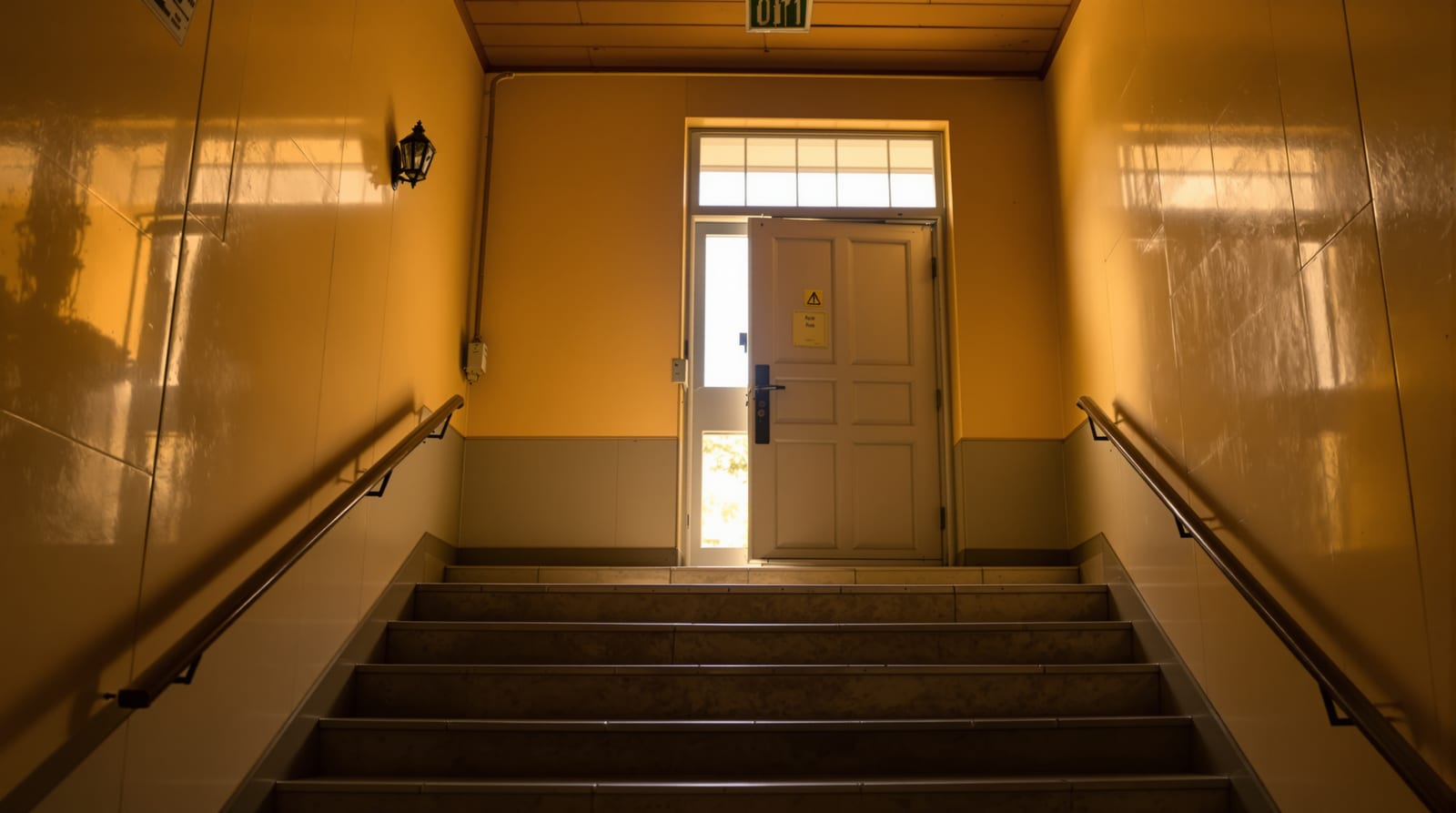
Staircase Door in India: Terrace-Stair, Under-Stair, Child Safety Gates and Stairwell Fire Doors (2026)
Every door around the staircase in Indian homes and buildings - the weatherproof terrace-stair door, the under-stair utility door, a child or elderly safety gate, and the life-safety fire door on building stairwells - with recommended types, standards and indicative costs.
The staircase is the one part of a building that almost every door category touches at once. At the top sits a terrace-stair door that has to survive monsoon and lock against intruders. Underneath the flight is a triangle of dead space hiding a utility cupboard that needs its own door. Across the landing, families with toddlers or elderly parents bolt on a safety gate. And in any apartment block, hostel or office, the stairwell itself is the legally protected escape route - so the door onto it is not a convenience item, it is a fire door that the National Building Code treats as life-safety equipment.
Designers who lump all of these together get every one of them wrong. A flush interior door on a terrace landing swells and warps in two monsoons. A solid timber leaf bricked into a stairwell breaks the fire compartment that is meant to keep smoke out of your only way down. This guide separates the four staircase doors, gives the single driver that should decide each, and pins down the standards and rupee costs for Indian conditions. For the wider room-by-room logic, start with the Doors by Space master guide.
The four staircase doors - and what drives each
Before picking a leaf, name the job. The four positions around a stair have almost nothing in common.
| Staircase door | Primary driver | Recommended door | Indicative ₹ (3x7 ft, + GST) |
|---|---|---|---|
| Terrace / mumty stair door (roof access) | Weather + security | WPC, uPVC, FRP or powder-coated aluminium, multipoint lock | 6,000 - 25,000 |
| Under-stair utility / storage door | Ventilation + fit to odd opening | Flush or louvered, often custom height | 3,000 - 9,000 |
| Stair safety gate (child / elderly) | Fall prevention, easy adult operation | Steel/aluminium pressure or hardware-mounted gate | 2,500 - 9,000 |
| Building stairwell door (escape route) | Fire + smoke compartmentation, egress | Fire-rated steel/treated-timber, self-closing | 12,000 - 45,000+ |
The first three are residential comfort-and-safety items. The fourth is a code-mandated component of the means of escape, and it is the one most often botched on Indian sites. Treat them in that order of consequence.
Terrace-stair door: weatherproof and lockable above all
The door at the head of the stair to the roof - the mumty door - lives a brutal life. One face bakes in 45 degree summer sun and is lashed by monsoon; the other opens into a cool stairwell. That moisture and thermal swing destroys ordinary interior leaves. Solid teak can cope but is expensive and still needs annual sealing; a laminated flush door or panel door meant for bedrooms will delaminate or warp within a couple of seasons.
For the terrace landing, rank by weather resistance and security:
- WPC or uPVC leaf with a steel or aluminium frame - rot-proof, termite-proof, dimensionally stable. The default smart choice for Indian roofs. See WPC doors and uPVC doors.
- FRP door - fully waterproof, light, low-maintenance, good where budget is tight. See FRP doors.
- Powder-coated aluminium or steel door - most secure, fully weatherproof, ideal where the terrace is also a security boundary.
Whatever the leaf, the hardware matters more here than the material: fit a multipoint locking system or at minimum a good mortise lock with a deadbolt, because an unlatched mumty door is a favourite burglar entry from adjoining roofs. Add a drip cap or small overhang above the door, slope the threshold outward to shed rain, and keep the bottom clearance generous so a swollen monsoon leaf still closes. The deeper detailing lives in the dedicated terrace door guide and the connected balcony door guide.
Under-stair utility door: ventilation and a fit to an odd opening
The space below a staircase is prime storage - shoe racks, cleaning kit, a small store, sometimes the inverter and batteries or a water pump. The door for it has two demands ordinary rooms do not: the opening is rarely a standard rectangle (it follows the rake of the flight, so one jamb is often a stub height), and whatever is stored inside frequently needs to breathe.
If the cupboard holds anything that can get musty - linen, shoes, brooms, or especially an inverter and lead-acid batteries that vent gas - specify a louvered door so air keeps moving and heat from electronics escapes. If it is dry hardware storage and you want a clean flush wall, a plain laminated flush leaf is cheapest and tidiest. Because the opening is non-standard, this is almost always a made-to-measure leaf; budget for a carpenter-fabricated frame rather than a stock door. For matching it to what you store, the utility door guide and the broader store-room door guide cover the trade-offs.
A note many homeowners miss: do not seal an inverter or gas appliance into an airtight under-stair cupboard. Lead-acid batteries release hydrogen while charging, and a louvered or grilled door is a cheap safety margin.
Stair safety gate: for toddlers and elderly parents
In Indian multi-level homes, the open well at the top or bottom of a flight is a real fall risk for crawling toddlers and for elderly parents with poor balance or vision. A removable safety gate is the answer, and it is a different object from a door: it must be operable one-handed by an adult carrying a child, yet impossible for a small child to open.
Two mounting types are common: pressure-fit gates that wedge between walls (no drilling, but never use these at the TOP of a stair - they can be pushed loose) and hardware-mounted gates that screw into the wall or newel post, which are the only safe choice at the head of a flight. Choose a gate at least 75 cm tall with vertical bars no more than 6 cm apart (so a head cannot pass through and there are no horizontal bars to climb), and a self-closing, double-action latch. For elderly users, the same gate prevents a disoriented night-time fall down the stairs. This is a hardware fitting rather than a building door, so treat it as a retrofit accessory layered onto an existing stair.
Stairwell fire door: the one the code actually cares about
Here is the part professionals must get right. In any building with a protected stairway - apartments above a certain height, hostels, hotels, offices, institutional buildings - the staircase is the means of escape, and it is meant to be a smoke-free, fire-protected enclosure that gets occupants down even while floors are burning. The door from each floor lobby or corridor onto that stair is therefore a FIRE DOOR, governed by IS 3614 and the egress provisions of NBC 2016. Its job is to hold back fire and smoke for a rated period (commonly 60 or 120 minutes) so the stair stays usable.
Three properties are non-negotiable on a stairwell fire door:
1. It must be FIRE-RATED to the period the code demands for that building - typically 2 hours for the stairwell enclosure of a high-rise. Steel or treated-timber leaf with intumescent seals that swell and choke the gaps when heated.
2. It must be SELF-CLOSING. A fire door propped open is useless, so it carries an overhead door closer and never a latch-back or wedge. Closers must positively pull the leaf into the frame and latch it.
3. It must support EGRESS - the leaf opens in the direction of escape travel (into the stair, in the direction people flow downward and out), it has the clear width the occupant load requires, and on assembly/high-occupancy buildings it carries panic/push-bar hardware so a crowd opens it without a knob.
The diagram below shows the geometry that matters: a self-closing rated leaf, escape flowing through it and down, intumescent seal at the perimeter.
Get the depth on these in the fire-rated doors guide, the fire-exit doors guide, and the NBC door requirements guide. Practical site rules: never let a contractor swap a rated stairwell door for a cheaper non-rated lookalike to save money; never drill large vision cut-outs or letter-slots into the leaf (it voids the rating - use a rated vision panel instead); and never disable the closer or wedge the door open, which is the single most common fire-safety failure in Indian buildings.
Standards to quote on a staircase door schedule
- IS 3614 - fire-check / fire-resisting metal and timber doors; ratings of 30, 60, 90 and 120 minutes. Mandatory on stairwell enclosures and escape routes.
- NBC 2016, Part 4 (Fire & Life Safety) - protected staircases as means of escape, required exit widths by occupant load, doors opening in the direction of escape, self-closing requirement.
- IS 4351 (steel door frames) and IS 1003 (timber door shutters) for the non-rated terrace and under-stair leaves.
- RPwD 2021 / accessibility - where the stair has an accessible alternative, doors on the accessible route need >=900 mm clear width, lever handles and a threshold <=12 mm.
Do and don't
- Do specify weatherproof leaves (WPC/uPVC/FRP/aluminium) for the terrace-stair door, never an interior flush leaf.
- Do ventilate an under-stair cupboard with a louvered door if it holds shoes, linen or an inverter.
- Do hardware-mount any child safety gate at the TOP of a flight - never a pressure-fit gate there.
- Don't compromise the stairwell fire door: keep it rated, self-closing and unobstructed.
- Don't cut unrated openings into a fire door or remove its closer.
- Don't forget the lock - a mumty/terrace door is a real security boundary.
Frequently asked questions
Does a private house staircase need a fire door?
A typical low-rise independent home with an internal open stair does not require a rated stairwell door. The fire-door obligation kicks in for protected staircases in apartments above the NBC height/occupancy thresholds, hostels, hotels, offices and institutional buildings - wherever the stair is the legal means of escape. Confirm against your local fire NOC and the NBC door requirements guide.
What is the best door for a terrace staircase in India?
A WPC, uPVC, FRP or powder-coated aluminium leaf - all rot-proof, termite-proof and weatherproof - with a multipoint or deadbolt lock. Avoid interior flush and ordinary panel doors; they warp and delaminate in monsoon. See the terrace door guide.
Can I put a normal door on the under-stair storage?
Yes, but match it to the contents. A flush leaf is fine for dry storage; choose a louvered door if you store shoes, linen, or an inverter and batteries that need ventilation. Because the opening follows the stair rake, it is usually a custom-sized leaf.
Why must a stairwell fire door be self-closing?
Because a fire door only protects the escape stair when it is shut. A propped-open or wedged door lets smoke flood the one route down. An overhead closer pulls the rated leaf back into its intumescent-sealed frame and latches it automatically. See the door closers guide.
Which way should a stairwell door swing?
In the direction of escape - generally into the protected stair and downward in the line of travel - so a crowd pushes it open without fighting the leaf. High-occupancy buildings add panic/push-bar hardware. The egress rules are in the fire-exit doors guide.
Export this guide
Related Guides — Deep-dive reading
Staircase Fire Safety in India (2026): The Protected Stair That Gets Everyone Down
The staircase is the primary vertical escape route in almost every Indian building, so a protected, smoke-free stair is the spine of egress: enclosed, fire-doored, non-combustible, and above all kept clear.
SecurityUniversal Design Doors for Indian Homes: Inclusive Doors That Work for Everyone (2026)
How to design and specify doors that serve children, the elderly, pregnant women, the injured and wheelchair users by default - generous width, lever handles, near-flush thresholds, low-force closing, contrast and good lighting - without your home ever looking medical.
Home Doors & EntrancesEmergency Exit Door Standards in India: NBC 2016 Egress Rules
How exit door width, swing direction, panic hardware, fire rating and signage are governed by NBC 2016 Part 4 — and where homes differ from assembly and commercial buildings.
Home Doors & EntrancesRelated Tools — Try Free
Accessible Door Checker
Check a door against wheelchair-accessibility guidance — clear width, threshold, handle and closer force per RPwD 2021.
Compliance ToolChild & Elder Home-Safety Audit
Room-by-room safety audit for households with children or seniors — 10 categories, 70+ checkpoints tagged by audience.
Safety AuditDoor Material Comparison Tool
Compare 2–4 door materials on cost, durability, maintenance, security and moisture resistance.
Comparison Tool