
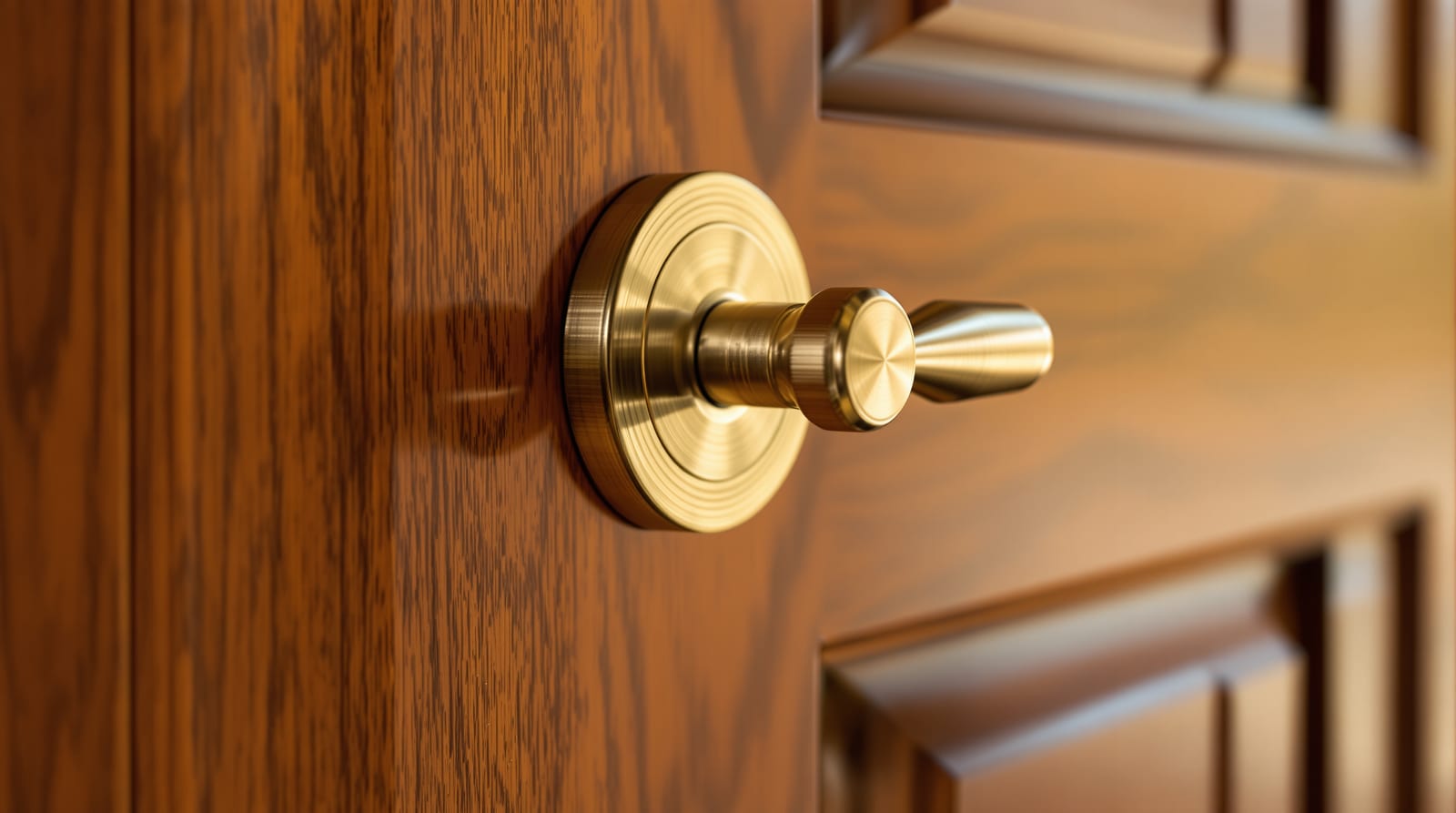
Mortise Lock Guide for Indian Homes: How They Work, Cylinders & Security (2026)
Why the mortise lock — body sunk inside the door leaf — is the standard for Indian main and bedroom doors, and how to choose the cylinder, handle set and brand.
Walk up to almost any well-built front door in India — a teak main door in a Bengaluru villa, a flush bedroom door in a Pune flat — and the lock you are looking at is almost certainly a mortise lock. The handle and keyhole are what you see, but the real machine is hidden: a rectangular steel lock body buried inside a pocket cut into the edge of the door leaf. That single design choice — sinking the mechanism into the timber rather than bolting a box onto the surface — is what makes the mortise lock stronger, quieter and longer-lived than the rim latches it replaced. This guide explains how a mortise lock actually works, how it differs from rim, cylindrical and deadbolt locks, what each component does, how cylinders and keys decide your real security, and how to pick a brand and fit it without ruining the door.
For the bigger picture of how locks fit alongside hinges, handles, closers and bolts, read the door hardware guide; for a tour of every lock family see types of door locks in India. This page goes deep on the mortise lock specifically.
What a mortise lock is — and how it works
"Mortise" is a carpentry word: a mortise is a recess cut into timber to receive a matching part (the way a mortise-and-tenon joint works). A mortise lock is named after that pocket. The carpenter routs a deep, narrow cavity into the closing edge of the door leaf, and the steel lock body slides in flush so only its faceplate shows on the door edge.
Inside that body sit two working parts:
- A latch bolt — the spring-loaded, angled bolt that snaps shut on its own when you pull the door closed and is retracted by turning the handle. This is what holds the door "latched" for everyday use.
- A dead bolt (or one or more dead bolts) — a square-ended bolt with no spring that only moves when you turn the key or thumb-turn. Once thrown, it cannot be pushed back; this is the bolt that actually resists a break-in.
Turning the handle/lever rotates a spindle that passes through the lock body and pulls the latch back. Turning the key rotates the cylinder, which drives a cam that throws or withdraws the dead bolt. When the door is shut, both bolts pass through the strike plate on the frame and into the frame timber, so the load is shared between the steel body in the leaf and the steel strike in the frame. Because the body is encased in wood on all sides, a mortise lock resists prying and jemmying far better than a surface-mounted box — there is simply nothing for a crowbar to grab.
Mortise vs rim vs cylindrical vs deadbolt
Four lock families dominate Indian doors. They are not interchangeable; each suits a different door and budget.
| Lock type | How it mounts | Typical security | Install effort | Indicative ₹ (lock only) | Best for |
|---|---|---|---|---|---|
| Mortise lock | Body recessed inside the leaf edge | High — concealed body, separate dead bolt, resists prying | High — needs a routed pocket; skilled carpenter | ₹600–6,000 (set with handles) | Main doors, bedroom doors, solid/flush leaves 30 mm+ |
| Rim / night latch | Box screwed onto the inside face of the door | Low–medium — surface box can be levered | Low — surface screws, drill for cylinder | ₹300–1,500 | Secondary doors, old doors, quick add-on bolt |
| Cylindrical (tubular/knobset) | Bore-through handle with lock in the knob/lever | Medium — convenient, but knob can be attacked | Medium — two round bores, no deep pocket | ₹400–2,500 | Internal doors, low-cost or hollow-core leaves |
| Deadbolt (standalone) | Separate bolt unit, surface or mortised | High for the bolt itself; no latch | Medium | ₹500–3,000 | Adding a key-throw bolt above an existing latch |
Indicative prices, +18% GST, vary by city, brand and finish; fitting labour is extra.
The short version: rim locks are the easiest to retrofit but the weakest, because everything that matters sits on the surface. Cylindrical/knobset locks are the fastest to fit on a thin internal door and are common on hollow-core flush doors, but the locking is built into the handle, so a hard yank or knob attack can defeat them. Standalone deadbolts add a strong key-throw bolt but no everyday latch, so they are usually paired with a latch. The mortise lock combines latch and dead bolt in one concealed, frame-anchored body — which is why it is the default for any door you care about securing.
The components of a mortise lockset
A mortise installation is really a kit of parts. Knowing them helps you buy the right replacement and talk to your carpenter.
- Lock body (case): the steel box buried in the leaf, containing latch, dead bolt(s), springs and the cam. Sizes are quoted by backset (distance from door edge to the centre of the keyhole/spindle, commonly 45, 60 or 65 mm in India) and case depth. Get the backset right or the handle and key won't line up with the leaf.
- Cylinder: the key-operated barrel. On Indian mortise locks this is usually a profile (euro/pin-cylinder) or an oval cylinder that screws into the body. The cylinder — not the body — is what you upgrade for better key security, and it is the part you replace if you lose keys.
- Handle set (escutcheon/rose + levers): the lever or knob on each face, mounted on a long backplate (escutcheon) or round rose. The handle retracts the latch; the keyhole or thumb-turn sits in the same plate.
- Strike plate (and box keep): the steel plate let into the frame that the bolts shoot into. A box keep (a deep steel pocket behind the strike) hugely improves resistance — without it, the bolt only bites into soft frame timber.
- Spindle, screws and faceplate: the square bar through the body, the through-bolts that clamp the two handles together, and the visible edge plate.
When you buy "a mortise lock set" you usually get body + cylinder + two handles on plates + strike + fixings. Cheaper kits skimp on the box keep and on cylinder quality — both are exactly where money matters.
Single-cylinder, double-cylinder and thumb-turn
How the dead bolt is operated from each side defines three configurations:
- Single cylinder: key from outside, thumb-turn (knob) from inside. Fast egress in an emergency because you don't need a key to get out — the recommended choice for main doors of homes with children or elderly residents, and aligned with life-safety thinking in NBC 2016 Part 4 (occupants must be able to exit without a key or special knowledge).
- Double cylinder: key required on both sides. More resistant if there is glass beside the door (a burglar can't break the glass, reach the thumb-turn and let themselves in). But it is a fire/emergency risk — if you can't find the key, you are trapped. If you must use it, leave a key on a hook well away from the door but reachable.
- Multipoint mortise lock: a single key/handle throw drives three or more bolts (centre dead bolt plus hooks or rollers top and bottom) into the frame along the leaf height. This spreads force across the whole door edge and is the strongest residential option — standard on premium uPVC, steel and tall teak main doors. See multipoint locking doors for the full picture.
Cylinders and key security — where it really matters
Two mortise locks can look identical from outside and differ wildly in how easily they pick or snap. The cylinder is the battleground.
- Pin-tumbler cylinder: the standard. A row of spring-loaded pins must all rise to the shear line before the cylinder turns. Cheap pin cylinders have few pins and loose tolerances; better ones add security pins (spool/serrated) that resist picking.
- Dimple-key cylinder: keys with cone-shaped dimples instead of edge cuts; pins approach from multiple angles, so they are harder to pick and copy. Common on mid-to-premium European-style locks.
- Anti-bump: "bumping" uses a specially cut key tapped to jump the pins. Anti-bump cylinders use trap pins and stronger springs to defeat it.
- Anti-drill: hardened steel pins or plates inside the cylinder blunt a burglar's drill bit so the cylinder can't simply be drilled out.
- Anti-snap (3-star / sacrificial): the cylinder is designed to break at a sacrificial line if attacked, leaving the working lock intact and locked. Worth specifying where the cylinder protrudes past the handle plate.
A simple rule for Indian homes: spend on the cylinder and the box keep before you spend on a fancy lever finish. A ₹6,000 designer handle on a ₹150 cylinder is a weak door wearing jewellery.
Mortise lock cross-section (inside the leaf)
The diagram below shows the body recessed into the door edge, the latch and dead bolt projecting toward the frame, the cylinder driving the dead bolt, and the strike plate with its box keep on the frame.
Brands and ₹ ranges in India
The Indian market is mature; a few names cover most quality tiers. Prices below are indicative for a lock body + cylinder + handle set, +18% GST, fitting extra, and vary by city and finish.
| Brand | Position | Indicative ₹ (mortise set) | Notes |
|---|---|---|---|
| Godrej | Mass to premium, very wide service network | ₹900–6,000 | Pin-cylinder and anti-drill ranges; easy spares; trusted for main doors |
| Yale | Mid to premium, global brand | ₹1,500–6,000+ | Dimple and anti-bump cylinders, multipoint options, smart upgrades |
| Dorset | Architectural hardware, design-led | ₹1,200–6,000 | Strong lever ranges and finishes; good for matched suites |
| Europa | Value to mid, high-security marketing | ₹800–4,500 | Computerised key, anti-theft cylinders at accessible prices |
Other names you'll meet: Ozone, Hettich, Hafele, Spider, Harrison and Plaza. For internal bedroom doors a ₹600–1,500 set is fine; for the main door, budget ₹2,500–6,000 and put the extra into the cylinder grade and a box keep. A broader brand comparison lives in the door hardware brands guide if you want to match locks, hinges and handles as a suite, and door handles guide covers the lever/escutcheon side.
Installation: getting the pocket right
A mortise lock is only as good as the carpentry around it. The pocket (gain) must be cut accurately so the body sits square and the bolts align with the strike.
1. Mark the backset and height. Lock centre is typically 900–1,050 mm from the floor, comfortable for adults and reachable for most users. Match the body's backset (45/60/65 mm).
2. Rout the mortise. Drill a row of holes and pare out a clean rectangular pocket sized to the body — too tight cracks the leaf, too loose lets the body rock. On a flush door, stay within the solid lock-block; on a hollow-core leaf, only the lock-block area can take a mortise.
3. Bore for cylinder and spindle through the face, then offer up the body and chisel the faceplate flush with the edge.
4. Fit the strike and box keep. Close the door, mark exactly where the bolts touch, and let the strike and box keep into the frame so the dead bolt throws fully. A dead bolt that only half-engages is no security at all.
5. Through-bolt the handles (don't rely on short screws into the rose alone) and check the key throws smoothly with the door both open and shut.
This is skilled work; on a teak or designer leaf, use a carpenter experienced with mortise gains rather than risk a split. To get door and frame dimensions right in the first place, the door installation guide and the door size calculator help. For the wider security build-up — frames, hinges, viewers and bolts — see door security in India.
Climate and maintenance
Indian conditions are hard on locks. Coastal salt air (Mumbai, Chennai, Kochi, Goa) corrodes cheap zinc and mild-steel internals — specify stainless steel or brass bodies and SS 304 handles near the sea. Monsoon humidity swells timber leaves, so a lock that throws smoothly in March may bind in July; leave the door to settle and ease the strike rather than forcing the bolt. Dust is the silent killer of cylinders.
A simple care routine keeps a mortise lock working for decades:
- Twice a year, puff graphite powder or a dry PTFE lubricant into the keyway — never thick oil or grease, which traps dust and gums the pins.
- Lubricate the latch and dead bolt edges with a light dry lube.
- Check the strike alignment after the first monsoon and tighten the handle through-bolts.
- If a key starts turning stiffly, service the cylinder before it fails — a seized cylinder usually means a locksmith and a drilled-out barrel.
Frequently asked questions
Is a mortise lock better than a cylindrical (knobset) lock?
For doors that matter — main doors and bedrooms — yes. The mortise body is concealed and frame-anchored with a separate dead bolt, so it resists prying and forced entry far better than a cylindrical lock built into the handle. Cylindrical locks win only on cost and speed of fitting on thin internal doors.
Should my main door have a single- or double-cylinder mortise lock?
Single cylinder (key outside, thumb-turn inside) is usually the right call for a home, so anyone can exit instantly in a fire without hunting for a key. Choose double cylinder only where there is breakable glass next to the door, and keep a key reachable nearby.
Can I replace just the cylinder if I lose my keys?
Usually yes. The cylinder is a separate, screw-in part on most Indian mortise locks, so a locksmith can swap it (and re-key) without replacing the whole body or re-cutting the door — far cheaper than a new lockset.
What cylinder upgrades are worth paying for?
For an Indian main door, prioritise anti-drill and anti-bump features and, where the cylinder protrudes, an anti-snap (sacrificial) design. A dimple key adds copy resistance. Spend here before spending on a designer handle finish.
How often should I service a mortise lock?
Twice a year: a puff of graphite or dry PTFE in the keyway, light dry lube on the bolts, and a check of strike alignment and handle through-bolts — especially after the monsoon, when timber movement can throw the bolt out of line.
Export this guide
Related Guides — Deep-dive reading
Reinforced Wooden Doors in India (2026): Making the Timber Main Door Actually Secure
A homeowner's decision guide to choosing or upgrading the wooden main or flat door most Indian homes actually have, so it genuinely resists a break-in, without pretending a hollow flush door is secure.
SecurityBurglar-Proof Doors in India: What Actually Stops a Break-In (2026)
A burglar-resistant main door is a system — solid leaf, anchored frame, multipoint lock, anti-saw bolts and visibility — not just an expensive lock. Here is how each layer works and what it costs to upgrade.
Home Doors & EntrancesDoor and Window Security Assessment for Indian Homes
Go opening by opening and rate the hardware itself — leaf and frame, hinges and locks, strike plates, grilles, glazing and latches — so you can grade each door and window's real resistance while never trapping anyone behind it.
SecurityRelated Tools — Try Free
Door Security Rating Calculator
Score your main door out of 100 across leaf, frame, lock and hardware — and see the top upgrades.
Security ToolWindow Hardware Cost Calculator
Estimate window hardware cost — hinges, handles, locks, rollers and multipoint gears.
Window CalculatorDoor Lock Selector
Answer a few questions and get the right lock type — mortise, multipoint, deadbolt, privacy or smart — for any door.
Door Tool