
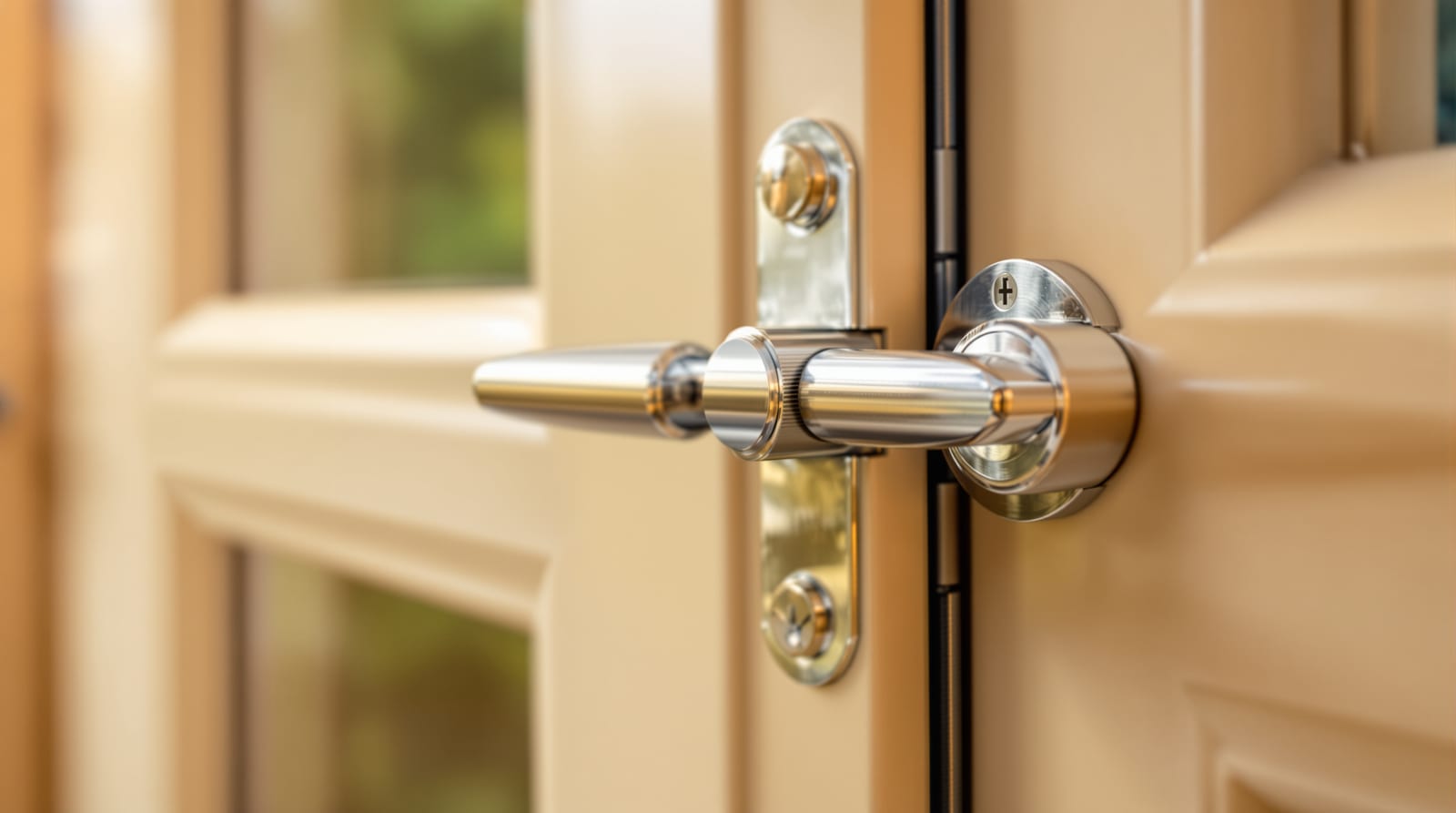
Multipoint Locking Doors in India: 3-Point & 5-Point Lock Guide (2026)
How a multipoint locking door throws bolts into the frame at top, middle and bottom for stronger security, better sealing and warp resistance — with operation, retrofit feasibility, costs and brands.
Most Indian doors are held shut at exactly one spot — a single mortise lock about waist height, with the rest of the leaf simply leaning against the frame. A multipoint locking door changes that. Lift the handle and a vertical drive bar fires bolts into the frame at the top, the middle and the bottom of the leaf in one movement, then a turn of the key holds them all locked. The result is a door that is harder to lever or kick in, that seals tightly against monsoon rain and dust, and that is pulled flat against its frame so it resists the warping and sagging that plague tall single-point leaves. This guide explains how the mechanism works, the difference between 1-point, 3-point and 5-point systems, the bolt types you will be offered, how you operate one, whether it can be retrofitted, and what it costs in India.
This page goes deep on the multipoint mechanism specifically. For the broader picture of how locks sit alongside hinges, handles and closers, read the door hardware guide; for the everyday single-point lock it replaces, see mortise locks in India; and for how multipoint locking fits into a complete defence, read door security in India and burglar-proof doors.
What a multipoint lock actually is
A single mortise lock holds the door at one point — the strike plate roughly in the middle of the closing edge. The top and bottom corners of the leaf are unsecured; that is exactly where a crowbar, a hard shoulder or a kick concentrates force, and where a tall leaf can spring away from the frame.
A multipoint lock (MPL), sometimes called an espagnolette or "multilock", replaces that single point with a continuous steel mechanism running the full height of the closing edge. A central lock case — operated by the handle and key, just like a mortise lock — drives a long vertical bar hidden inside the door edge. When you operate the handle, that bar pushes additional bolts out at intervals along the edge so the leaf is clamped to the frame at several points at once.
The number after "point" simply counts how many places the door bolts to the frame:
- 3-point: typically the central deadbolt/latch plus one bolt near the top and one near the bottom.
- 5-point: the central point plus two more above and two below (or hooks plus rollers plus the centre), spreading the grip even more evenly up and down the leaf.
Because all the bolts are driven from one mechanism, you still operate just one handle and one key — the door does not become any harder to use day to day.
How the bolts fire: gear-driven vs hook and roller
Inside the door edge the drive bar carries different kinds of locking elements, and the type matters for both security and sealing.
- Gear-driven (rack-and-pinion) MPLs use a toothed gear in the central case that engages a toothed drive bar. Lifting the handle rotates the gear, which slides the bar up and down and shoots the bolts. Gear drives give a strong, positive throw and are the norm on quality uPVC and composite doors.
- Hook bolts are curved steel bolts that swing out and hook over a keep in the frame. Because a hook physically catches behind the frame keep, the door cannot be jemmied away from the frame even if it is sprung — hooks are the most lever-resistant element and are common on sliding-and-folding and on high-security swing doors.
- Deadbolts (square bolts) throw straight out into a keep, like a normal mortise deadbolt, and resist a straight push.
- Roller cams (mushroom rollers) are adjustable studs that pull the leaf tight against the weather seal as they engage. They add little anti-jemmy strength on their own but do the sealing and anti-warp work — they clamp the leaf flat.
A typical premium configuration mixes them: hooks for anti-lever security, deadbolts for push resistance, and rollers for compression sealing. That mix is why a good MPL door feels like it is being pulled into the frame as you lock it.
1-point vs 3-point vs 5-point: what you gain
| Feature | 1-point (standard mortise) | 3-point multipoint | 5-point multipoint |
|---|---|---|---|
| Locking points | 1 (centre) | 3 (top, centre, bottom) | 5 (centre + 2 top + 2 bottom) |
| Anti-pry / anti-jemmy | Low — corners free | Good — corners pinned | Very good — load spread evenly |
| Kick / shoulder resistance | Modest | Strong | Strongest |
| Weather sealing | Centre clamps only; edges can gap | Good — leaf pulled flat at 3 points | Excellent — even compression |
| Warp / sag resistance on tall leaves | Poor | Good | Very good |
| Operation | Turn key | Lift handle, then turn key | Lift handle, then turn key |
| Common on | Wooden/flush main & internal doors | uPVC, composite, steel, premium wood mains | Large/tall premium entrance & patio leaves |
| Indicative ₹ (mechanism, fitting extra) | ₹600–6,000 (mortise set) | ₹2,500–8,000 | ₹6,000–18,000+ |
Indicative prices, +18% GST, vary by city, brand and finish; fitting labour is extra. The jump from 1 to 3 points buys you most of the security and sealing benefit; going to 5 points matters most on tall (over ~2.1 m), heavy or exposed leaves where even clamping prevents warp and bowing.
Where multipoint locking is common in India
You will mainly meet MPLs on factory-engineered doors where the lock and leaf are designed together:
- uPVC doors almost always ship with a 3-point or 5-point gear-and-hook MPL. The leaf is hollow multi-chamber plastic over a steel reinforcement, and the MPL is essential to clamp the leaf flat against its gasket so it stays airtight, watertight and warp-free in Indian heat. See uPVC doors in India.
- Composite doors — a GRP/laminate skin over an insulated core — are sold as premium secure entrance doors and use hook-and-roller MPLs as standard. See composite doors in India.
- Steel and security doors use heavy multipoint deadbolt systems, often with bolts firing into all four edges (top, bottom and the hinge side too) for anti-removal strength.
- Premium wooden main doors are increasingly fitted with a multipoint mortise lock — a single-case mortise lock with extension rods that throw extra bolts top and bottom — to bring the same benefit to a traditional teak or engineered-wood leaf.
For an ordinary flush internal door, an MPL is overkill; a standard mortise lock is the right choice. The case for multipoint is strongest on the main door and on tall exposed leaves.
Multipoint bolt positions: a diagram
How you operate a multipoint door
The operating sequence is the one detail that surprises first-time owners, so it is worth learning: lift, then turn.
1. Close the door so the latch holds it shut, as normal.
2. Lift the handle fully upward. This rotates the gear in the central case and drives all the bolts and hooks out into the frame keeps. You will feel the door pull tight.
3. Turn the key (or thumb-turn from inside) to deadlock the whole mechanism so the bolts cannot be pushed back. Remove the key.
To open: turn the key to unlock, then press the handle down to retract every bolt at once, and pull. A common mistake is locking the key without first lifting the handle — on most MPLs the key will not turn unless the handle is lifted, which is a useful built-in reminder. If a door feels stiff to lift, the leaf has usually dropped slightly or the keeps need adjusting (see maintenance below) — never force the handle, as bending the drive bar is an expensive repair.
Can you retrofit a multipoint lock?
Honestly, it depends on the door:
- On uPVC, composite and aluminium doors, the MPL is a standard cartridge you can usually replace or upgrade with a matching unit, because the door was routed for it at the factory. A like-for-like swap is straightforward for a hardware fitter; check the backset, PZ (cylinder centre) and bolt spacing match.
- On a solid wooden or flush leaf, true retrofit is harder. The leaf and frame must be routed to take the long faceplate and the keeps cut into the frame at top and bottom — skilled, irreversible carpentry. The practical route is a multipoint mortise lock with extension rods: a normal-looking mortise case with two rods that run up and down to throw extra bolts. This needs channels routed in the edge but is far easier than a full espagnolette retrofit.
- On a hollow-core internal door, it is not worth it — there is no solid timber to anchor the long mechanism.
If you are commissioning a new premium main door, specify the MPL up front so the leaf and frame are engineered for it rather than compromised later. The door installation guide covers getting frame and leaf square so the bolts line up.
Costs in India
| Item | Indicative ₹ | Notes |
|---|---|---|
| 3-point MPL mechanism (uPVC/composite) | ₹2,500–8,000 | Gear + hook/roller strip, +18% GST |
| 5-point MPL mechanism (premium/large leaf) | ₹6,000–18,000+ | More bolts, branded euro cylinder extra |
| Multipoint mortise lock with extension rods (wood) | ₹3,000–12,000 | For retrofitting a wooden main door |
| Euro/profile cylinder upgrade | ₹600–6,000 | Anti-snap/anti-bump cylinders cost more |
| Fitting labour | ₹600–2,500 | Higher for wood routing vs uPVC swap |
Indicative, varies by city and vendor; the cylinder — not the body — is what you upgrade for key security and the part you replace if you lose keys. Brands you will see in India include Yale, Dorset, Hettich, Hafele, Ozone, Godrej and the European movements (Roto, Maco, GU, Fapim) fitted inside uPVC/composite doors. The lock is only as strong as its keeps and the frame around them, so spend on a deep box keep and a sound frame, not just the mechanism.
Maintenance and the Indian climate
Multipoint mechanisms are reliable but they have more moving parts than a mortise lock, so two habits keep them sweet. First, adjust before you force: if the handle gets hard to lift, the leaf has dropped (common after a humid monsoon swelling cycle) — the roller cams and keeps are adjustable to re-align the throw, a five-minute job for a fitter. Second, lubricate the drive bar lightly once or twice a year with a dry PTFE spray, not thick oil that traps coastal dust. In salt-air coastal homes choose stainless or marine-grade strips and keep the weather gasket intact, since a clamped-flat leaf is exactly what stops driven rain and termite-friendly damp from getting into the edge. For broader upkeep see the door maintenance habits in the door security guide.
Frequently asked questions
Is a multipoint lock really more secure than a good mortise lock?
Yes, mostly because of geometry. A single mortise lock leaves the top and bottom corners free, which is where a lever or kick attacks. A 3-point or 5-point lock pins those corners to the frame, so there is nothing to spring open. The cylinder still matters — pair an MPL with an anti-snap euro cylinder and a deep box keep for the full benefit.
Why does my uPVC door feel like it pulls tight when I lift the handle?
That is the roller cams (mushroom rollers) compressing the leaf against its weather gasket as the bolts engage. That compression is what makes uPVC and composite doors airtight, watertight and resistant to warping in heat — it is working as designed.
Can I add multipoint locking to my existing teak main door?
Often yes, using a multipoint mortise lock with extension rods rather than a full espagnolette. A carpenter routs channels in the leaf edge and cuts keeps in the frame top and bottom. It is more involved than a uPVC cartridge swap but far cheaper than a new door, and brings most of the security and anti-warp benefit to a solid wooden leaf.
What does 3-point versus 5-point change in practice?
The number of places the door bolts to the frame. Three points (top, centre, bottom) gives you most of the security and sealing gain. Five points spreads the clamping more evenly and matters most on tall (over ~2.1 m), heavy or weather-exposed leaves where even compression prevents bowing and warp.
My handle won't turn the key — is the lock broken?
Usually not. Most multipoint locks will only let the key turn after you have fully lifted the handle to throw the bolts. Lift the handle all the way up first, then turn the key. If the handle itself is hard to lift, the leaf has likely dropped and the keeps need re-aligning — have a fitter adjust it rather than forcing it.
Export this guide
Related Guides — Deep-dive reading
Reinforced Wooden Doors in India (2026): Making the Timber Main Door Actually Secure
A homeowner's decision guide to choosing or upgrading the wooden main or flat door most Indian homes actually have, so it genuinely resists a break-in, without pretending a hollow flush door is secure.
SecurityBurglar-Proof Doors in India: What Actually Stops a Break-In (2026)
A burglar-resistant main door is a system — solid leaf, anchored frame, multipoint lock, anti-saw bolts and visibility — not just an expensive lock. Here is how each layer works and what it costs to upgrade.
Home Doors & EntrancesMortise Lock Guide for Indian Homes: How They Work, Cylinders & Security (2026)
Why the mortise lock — body sunk inside the door leaf — is the standard for Indian main and bedroom doors, and how to choose the cylinder, handle set and brand.
Home Doors & EntrancesRelated Tools — Try Free
Door Security Rating Calculator
Score your main door out of 100 across leaf, frame, lock and hardware — and see the top upgrades.
Security ToolWindow Maintenance Cost Calculator
Estimate annual window upkeep by frame material — yearly, per-window and 5-year cost.
Window CalculatorWindow Hardware Cost Calculator
Estimate window hardware cost — hinges, handles, locks, rollers and multipoint gears.
Window Calculator