
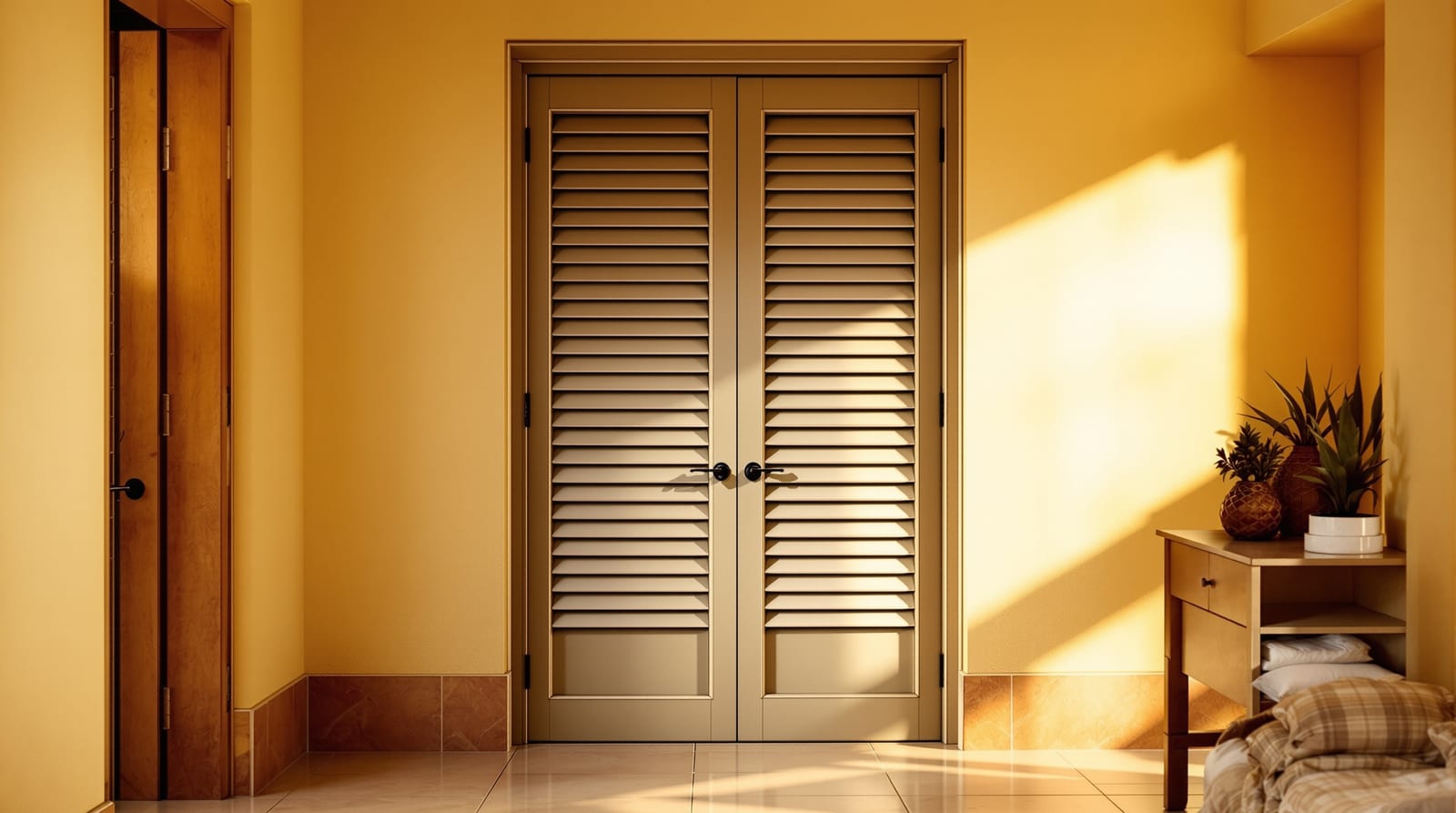
Store Room Door India: Ventilated, Lockable & Compact Options (2026)
How to choose a door for a store room, loft store, under-stair cupboard or dry-grocery store in an Indian home — balancing airflow, pest control, security and tight space.
Almost every Indian home hides a store room somewhere — the dedicated dry-grocery store behind the kitchen, the loft store above a wardrobe, the cupboard tucked under the staircase, or the multipurpose "junk plus provisions" room that holds everything from rice tins to the spare gas cylinder. The door to that space rarely gets the attention the bedroom door does, yet it quietly decides whether your stored grains stay fresh or go musty, whether rats and silverfish get in, and whether your provisions are secure. This guide covers how to choose a store room door in India that breathes when it should, seals when it must, fits a tight passage, and locks when you need it to.
The store room door sits in a slightly different world from other interior doors, so treat this as a focused companion to the room-by-room overview in our interior doors by room guide and the cluster's complete guide to home doors in India.
What a store room door actually has to do
A store room door has a short, specific job list, and the right choice depends entirely on which of these matter most for your particular store:
- Ventilation — to stop the room going musty and to keep stored grains, pulses, papads and pickles from sweating in our humid and monsoon months. Stale, sealed air is the enemy of dry storage.
- Keep dust and pests out — dust spoils provisions, and rodents, cockroaches and silverfish are drawn to grain. Ventilation and pest-exclusion pull in opposite directions, which is the central tension of this door.
- Security — many homes keep provisions in bulk (a sack of rice, ghee tins, the festival dry-fruit stock) plus the occasional valuable (suitcases, gold-locker spillover, important documents) in the store. A lockable door matters.
- Low cost — a store room is back-of-house. Most owners, sensibly, do not want to spend designer-door money here.
- Compact / space-saving — stores are often squeezed into leftover space: a narrow passage, an under-stair void, a loft. The door frequently has to work where a normal swing leaf cannot.
No single door wins on all five. Decide which two or three are non-negotiable for your store, then pick from the options below.
The ventilation-versus-pests trade-off (read this first)
This is the decision that trips people up. A fully louvered or vented door keeps the room dry and prevents that closed-cupboard mustiness — ideal for a dry-grocery store that holds sealed packets, tins and steel containers. But open louvers are also an open invitation: a louvered door does not keep out rats, lizards, cockroaches or fine dust on its own.
The practical resolution Indian kitchens have used for generations: store the actual grains and pulses in airtight steel/PET containers or large drums, and let the door ventilate the room, not the food. With provisions sealed in containers, you get the best of both — a dry, breathing room and pest-proof food. Conversely, if you store loose grain or open sacks, you want a sealed flush door plus a separate exhaust/ventilator and rodent-proofing at the floor gap, because a louvered door will let pests reach the grain.
A quick rule:
- Provisions sealed in containers → choose ventilation (louvered or vented door). Mustiness is your bigger risk.
- Loose/open storage, or a damp room → choose a sealed flush door + dedicated ventilation, and pest-proof the gaps.
Either way, mind the floor gap: keep it under ~10 mm and consider a metal kick-plate or threshold strip at the bottom — rats squeeze through surprisingly small gaps, and a generous under-door gap quietly defeats whatever the door does above it.
The store room door options compared
Here are the realistic choices for an Indian store, with indicative 2026 costs (material plus make; frame, hardware and fitting extra; +18% GST typical; varies by city and vendor). Full benchmarks live in the door cost guide.
| Store room door option | Ventilation | Security | Space-saving | Indicative cost (shutter) | Best for |
|---|---|---|---|---|---|
| Louvered door (full or part louver) | Excellent | Low-medium | Standard swing | ₹4,000-12,000 (wood/WPC) | Dry-grocery store with sealed containers; rooms prone to mustiness |
| Flush door + vent / louver insert | Good | Medium-high | Standard swing | ₹1,500-5,000 (flush) + vent | Best all-round: cheap, lockable, some airflow |
| Plain flush door (sealed) | Low (needs separate vent) | High | Standard swing | ₹1,200-4,000 | Securable store with separate ventilator/exhaust |
| WPC flush door | Low (add vent) | Medium-high | Standard swing | ~₹75-150/sq ft (≈₹2,000-4,500) | Damp/utility-adjacent stores; moisture & termite resistant |
| Sliding door | Depends on leaf | Medium | Excellent (no swing) | ₹450-1,200/sq ft of opening | Tight passages where a swing leaf would block |
| Pocket door | Depends on leaf | Medium | Excellent (vanishes into wall) | Leaf + ₹6,000-15,000 kit | Narrow stores; clean, hidden look |
| Barn door (surface-slide) | Depends on leaf | Low (gaps at edges) | Good (no swing arc) | Leaf + ₹4,000-12,000 track | Statement/utility store with wall beside the opening |
| Half-height / stable door | Good (open top) | Low-medium | Good (under-stair) | ₹2,000-8,000 | Under-stair store; loft store; low headroom |
A few notes on each:
Louvered doors are the classic answer when airflow is the priority — the angled slats let air move while blocking direct line-of-sight. They suit a dry store beautifully, especially in coastal and high-humidity homes. See our dedicated louvered doors guide for slat profiles, maintenance and the dust trade-off (louvers do collect dust and need wiping).
Flush door with a vent insert is, for most homes, the sweet spot: a cheap, solid, lockable flush shutter with a small louvered grille or a few drilled-and-meshed vent holes near the top. You get security and a lock, plus enough airflow to avoid mustiness, at flush-door prices. Browse the flush doors guide for IS 2202 grades.
Sliding, pocket and barn doors earn their place purely on space. If the store sits at the end of a narrow corridor, beside a wardrobe, or in any spot where a swinging leaf would foul shelves or block circulation, a non-swing door is the fix. A pocket door disappears entirely into the wall cavity (cleanest, but needs a stud/cavity wall); a barn door slides on a surface track (easy to retrofit, but leaves edge gaps that pests and dust exploit — pair with sealed containers); and a sliding door on a bottom or top track is the budget non-swing option.
Half-height (stable) doors are the under-the-staircase and loft specialists. A low under-stair void rarely needs a full 7-foot leaf; a half-height door cut to the available headroom is cheaper, lets the cavity breathe over the top, and is easy to reach into. For a loft store, a small hinged or sliding shutter cut to the opening is all you need.
Sizing: the one place a store room door earns flexibility
Unlike a bedroom or main door, a store room door is not bound to standard sizes — and that is an advantage. Cut it to the opening you actually have.
| Store type | Typical leaf size | Notes |
|---|---|---|
| Dry-grocery store (kitchen-adjacent) | 700-800 mm × 2100 mm | Treat like a utility door; 750 mm is comfortable |
| General store room | 750-900 mm × 2100 mm | 900 mm if you carry in bulky items / cylinders |
| Under-stair store | Cut to headroom; often 600-1500 mm wide, ≤1500 mm high | Half-height or angled-top leaf; raked to follow the stair soffit |
| Loft store | Cut to opening | Small hinged or sliding shutter; no standard applies |
For reference, the NBC 2016 and common Indian practice put a utility/kitchen door at 800-900 mm × 2100 mm and a bathroom at 700-750 mm — a store can sit anywhere in or below that range. See the door size standards guide for the full chart. The freedom to make the door smaller is genuine cost saving, since you pay by the square foot. If the leaf will fold or run into stored items, also check swing clearance — the small-space room-measuring lesson covers swing arcs, or use the door swing planner.
Locks and hardware: keep it simple but secure
A store room rarely needs a smart lock, but it should lock. The provisions you keep in bulk — a full sack of rice, festival stock, ghee tins, spare LPG — represent real money, and a locked store also keeps young children away from cleaning chemicals, pest poison and the heavier stuff.
- A cylindrical lock or a simple mortise lock with a key is plenty for most stores. Match the lock to whether the door swings or slides — sliding/barn doors use hook bolts or sliding-door latches, not standard mortise locks.
- For a store that doubles as a mini-strongroom (documents, valuables), step up to a quality mortise lockset; the door hardware guide and door security guide cover grades.
- Use rust-resistant hardware (SS 304 or good powder-coated) if the store is near the kitchen, utility or an exterior wall — humidity and grocery moisture will pit cheap fittings.
- Add a simple tower bolt or aldrop as a secondary on a swing door; it is cheap and lets you padlock the store when you travel.
Material choice: cheap, but right for the spot
Store room doors are the natural home for budget materials — but match the material to the micro-climate of the store:
- Plywood/laminate flush door — the default: cheap (₹1,200-4,000), lightly finished, easy to add a vent grille to. Fine for a dry interior store.
- WPC door — choose this where the store is near water (utility-adjacent, ground-floor damp, coastal homes). WPC shrugs off moisture and termites, runs ~₹75-150/sq ft, and never warps in the monsoon. See WPC doors.
- Solid wood / louvered wood — only if you specifically want the louver airflow and the look; costs more.
- Membrane or laminate finish — a PVC membrane or matching laminate keeps the store door consistent with adjacent doors at low cost; no need for veneer or designer finishes back-of-house.
Avoid hollow-core flush doors in a damp store — they delaminate. In any moisture-prone store, WPC or a properly sealed solid-core leaf is the safer spend. The best door material guide maps materials to climate.
A quick decision path
1. Is space tight (narrow passage, under-stair, loft)? → sliding, pocket, barn or half-height. Skip the swing leaf.
2. Is mustiness / dry-grocery freshness the worry? → louvered or vented door, and store grains in sealed containers.
3. Is security of provisions/valuables the worry? → flush door (sealed or vented) with a proper mortise/cylindrical lock; pest-proof the floor gap.
4. Is the store damp or near water? → WPC, and ventilate the room separately.
5. Default for an ordinary dry store: a plain flush door with a small louvered vent and a key lock — cheapest, does almost everything.
Frequently asked questions
Should a store room door be louvered or solid?
It depends on what is inside. Louvered if the store needs airflow to stay fresh (dry-grocery, humid homes) and your provisions are sealed in containers. Solid/flush if security or pest-exclusion matters more, in which case add a separate ventilator or a small vent grille so the room still breathes.
How do I keep rats and insects out of a ventilated store?
Keep the actual grains and pulses in airtight steel or PET containers so the food is sealed even if the room is ventilated. Then close the floor gap under the door (under ~10 mm, with a kick-plate or threshold strip), mesh any large vent openings, and seal wall and pipe penetrations. Ventilate the room, not the food.
What size should a store room door be?
A store room door is not bound to standard sizes — cut it to your opening. A dry-grocery store works at 700-800 mm wide; a general store at 750-900 mm; under-stair and loft stores are sized to the available headroom, often as a half-height leaf. Standard height elsewhere is 2100 mm, but a store can go shorter.
What is the cheapest good store room door?
A plain plywood/laminate flush door (₹1,200-4,000 per shutter) with a small louvered vent grille and a simple key lock. It is lockable, breathes a little, and costs a fraction of a designer door. Step up to WPC (~₹75-150/sq ft) only if the store is damp or near water.
Can I use a sliding or pocket door for a store room?
Yes, and it is often the best choice for a narrow passage or under-stair store where a swinging leaf would block circulation or foul shelves. A pocket door vanishes into a cavity wall for the cleanest look; a sliding or barn door retrofits easily but leaves edge gaps, so pair it with sealed containers and pest-proofing.
Export this guide
Related Guides — Deep-dive reading
The Complete Home Door Guide for Indian Homes (2026): Types, Materials, Cost, Security & Vastu
Everything an Indian homeowner needs to specify the right door for every opening — from main entrance to bathroom — with real 2026 prices, IS/NBC standards and Vastu sense.
Home Doors & EntrancesGuest Room Door in India: Privacy, Quiet and Smart Picks Without Overspending (2026)
How to choose a guest bedroom door for an Indian home - privacy and acoustics so visitors feel comfortable, but budget-sensible for a room used only now and then: solid-core flush for quiet, panel or laminate for looks, the right privacy lock, simple soundproofing, and a finish that matches the rest of your doors - with picks ranked and indicative rupee costs.
Home Doors & EntrancesBathroom Door for Indian Homes (2026): Waterproof Materials, Sizes, Ventilation & Locks
How to pick a toilet door that survives years of splash, steam and monsoon humidity — material ranking, the wet-area threshold detail, ventilation, narrow sizing, privacy locks and anti-rust fittings.
Home Doors & EntrancesRelated Tools — Try Free
Cross-Ventilation Analyzer
Estimate airflow and air changes per hour (ACH) from room size, window areas, layout, and local wind — with NBC 2016 Part 8 compliance check.
Ventilation CalculatorDoor Cost Calculator
Estimate the all-in cost of a door — leaf, frame, hardware, fitting and GST — by type, material and size.
Door CalculatorDoor Material Comparison Tool
Compare 2–4 door materials on cost, durability, maintenance, security and moisture resistance.
Comparison Tool