
CCTV Placement Staircase Guide (India 2026): Watch the Flight Without Blocking the Escape
Where to mount a camera on the staircase so it reads faces going up and down the flight, why it must never obstruct the escape route or handrail, and how to beat the dim, backlit stairwell in an Indian home or society.
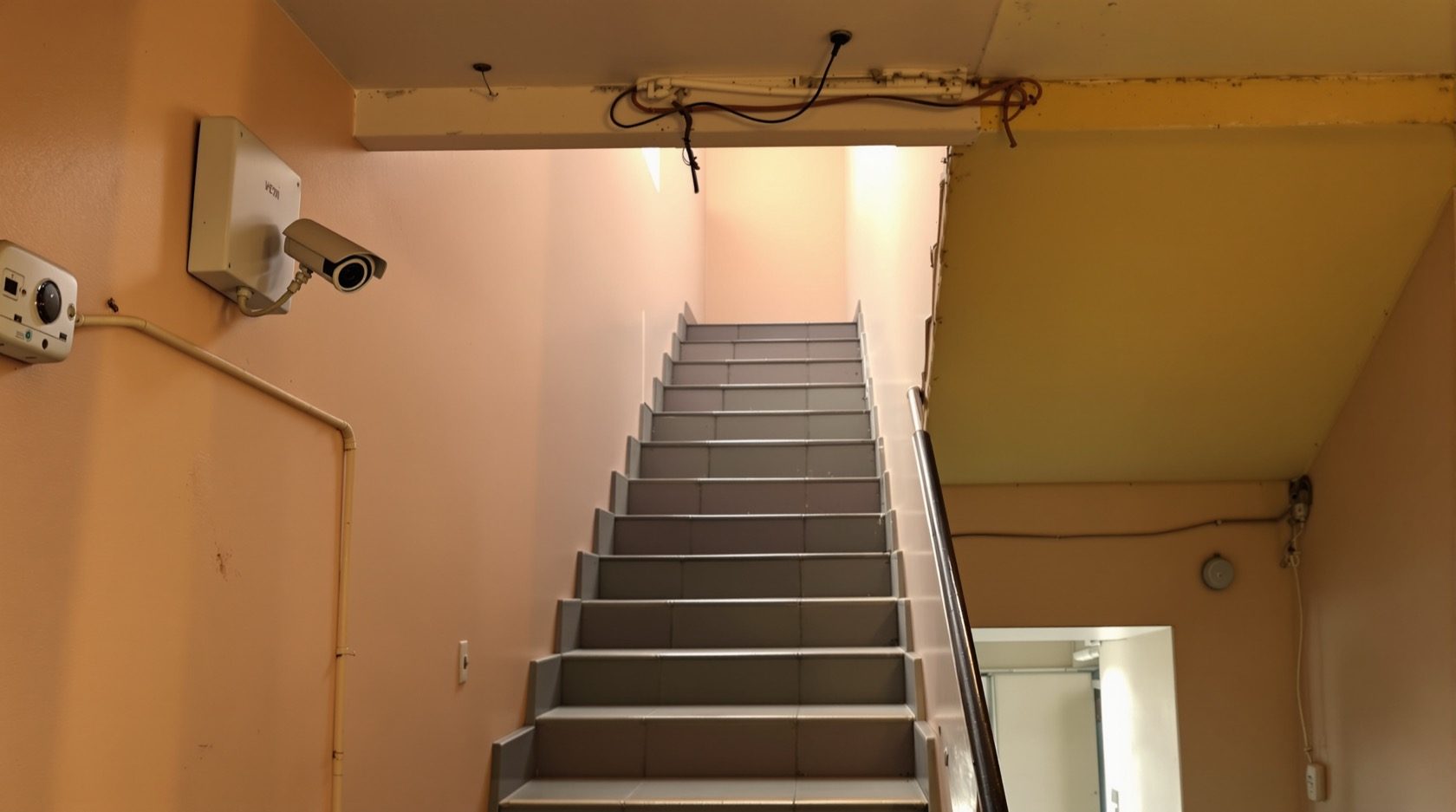
The staircase is the spine of a house. Everyone who moves between floors passes through it, which makes it one of the most valuable single positions on your whole plan — but also one of the easiest to get dangerously wrong. Good cctv placement staircase work turns one camera into a face-reader for every trip between floors. Bad placement turns a life-saving escape route into an obstacle course.
This guide covers just the staircase, applying the wider placement principles to this one zone. For the areas a stair connects to, see the sibling zone guides on the lift lobby and the corridor or passage. Here we stay on the flight, the landing and the well.
Scope & safety — read this first. A staircase is a fire-escape route. The camera, its mounting box, its power supply and every metre of its cabling must NEVER reduce the clear escape width, block the handrail, or sit where it can be tripped over or catch fire. This is not a design preference; it is life safety and it overrides every other consideration below. Plan the position yourself, then have a licensed installer mount at height and run cabling. Cameras belong on the stair itself — never inside bathrooms, bedrooms or changing areas, and in shared societies never aimed into a neighbour's flat door or window.
What you are actually trying to capture
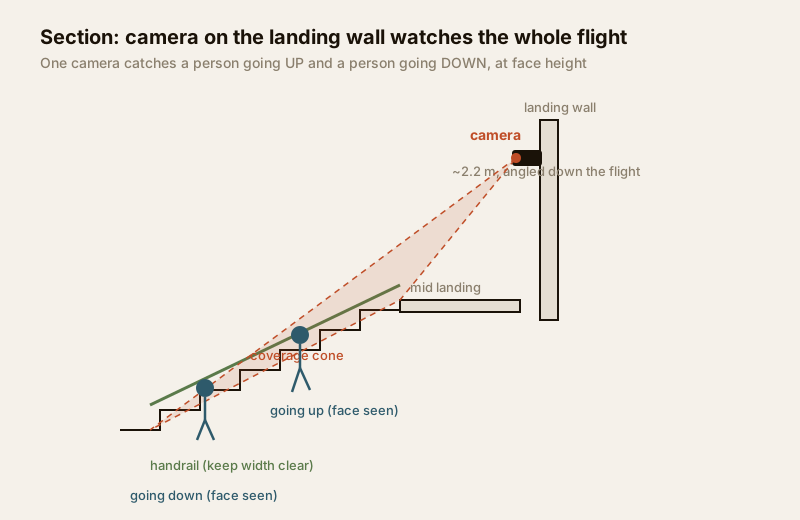
A staircase camera has one job that a gate or driveway camera does not: it must read a face on a moving subject on two directions of travel. Someone climbing has their face tilted up and forward; someone descending has it tilted down. A single well-placed camera on the landing wall, looking back down the flight, catches both — the climber head-on and the descender as they turn onto the landing.
So aim for these captures, in order of priority:
- A clear face of anyone on the flight, at roughly head height, lit well enough to identify.
- The direction of travel — up or down — so the footage tells a story, not just a snapshot.
- The landing itself, where people pause, turn, and can be seen full-length.
You are not trying to watch the treads themselves, or point the lens straight down the stairwell from the top like a drop — that view mostly captures the tops of heads and hats, which identifies no one.
Where to mount it: the landing wall, looking down the flight
The reliable position for almost every Indian staircase — independent house or apartment — is high on the landing wall at the top of a flight, angled down the run of steps. From there the lens looks along the incline of the stairs, so faces present themselves naturally as people climb toward the camera, and the landing sits in the lower frame for the descenders.
Key placement rules for this zone:
- Height: around 2.2–2.5 m above the landing, out of easy reach so no one can casually turn or hood it, but low enough that faces are not foreshortened into a top-down view.
- Angle: tilt down along the slope of the flight, roughly matching the pitch of the stairs, so the cone runs down the steps rather than across them or into the ceiling.
- Corner mount where you can. Tucking the camera into the junction of the landing wall and ceiling gives the widest useful view of both the flight and the landing from a single point, and keeps it clear of the escape path.
- One camera per flight for a typical home. A straight two-storey stair usually needs one camera per landing looking down each flight; a tall apartment core may add one per floor at the lobby-to-stair junction.
For the geometry of height versus tilt in general, the camera height and angle guide has the full method, and the CCTV placement planner lets you drop the camera onto a plan and check the cone before you drill.
Camera choice for a staircase
| Zone need | Sensible choice | Why it suits the stair |
|---|---|---|
| Discreet, tamper-resistant indoor camera | Dome (flush half-ball) | Low-profile on a landing wall; aim hidden; no protruding body to grab |
| All-rounder on an open landing | Turret | No dome glare in a tight well; easy to aim down the flight |
| Wide, short flight in one shot | Fixed wide-angle (2.8 mm) lens | Covers a short run and the landing together |
| Long, tall stairwell | Varifocal lens | Dial the exact reach so distant faces stay large enough |
| Dark internal well | Strong IR / colour night | Stairs are often the dimmest run; night vision is not optional |
A dome is the usual pick for an indoor staircase — it is unobtrusive, hard to grab, and its aim is not obvious. A turret is the strong alternative in a cramped well, because a dome's cover can bounce the camera's own IR back into the lens and fog the night image, while a turret's open face does not. Compare the shapes for your specific well before ordering.
The non-negotiable: keep the escape route clear
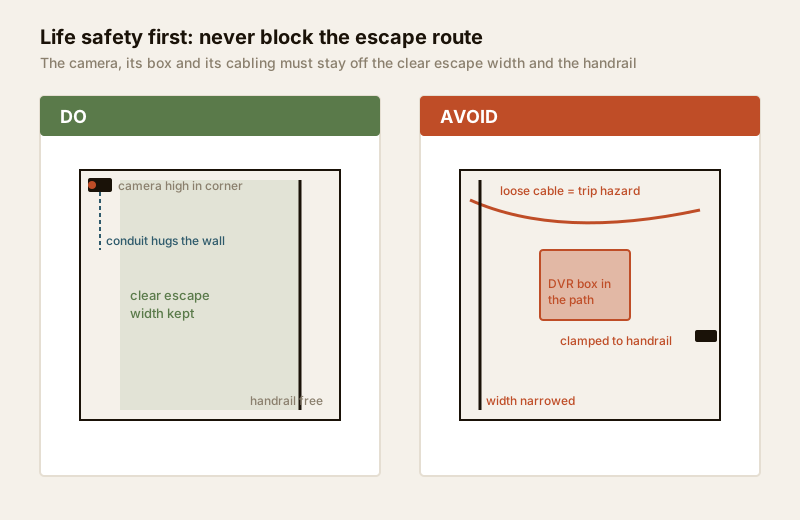
This is the point that sets the staircase apart from every other zone, so it gets its own section. In a fire or a power cut, the staircase is how people get out. Anything you add to it must leave the escape route exactly as clear as you found it.
Do:
- Mount the camera high in the corner, above the reach of people using the stairs, so nothing projects into the walking space or the handrail zone.
- Run the cable in conduit tight to the wall or ceiling corner — never loose across a tread, a landing, or a doorway, where it becomes a trip hazard.
- Keep the recorder (DVR/NVR), UPS and any junction box off the stair entirely — put them in a store, utility cupboard or a room off the landing, not on the flight.
- Leave the handrail completely free along its full length and its grip width.
Never:
- Clamp a camera or bracket onto the handrail — it narrows the grip and the escape width.
- Sit a box, UPS or coil of cable on a landing or in the walking line.
- Let any fixing narrow the clear escape width the stair was built with.
- Route mains power along the stair yourself — mains work is a licensed electrician's job; see the electrical hub.
Beating the dim, backlit stairwell
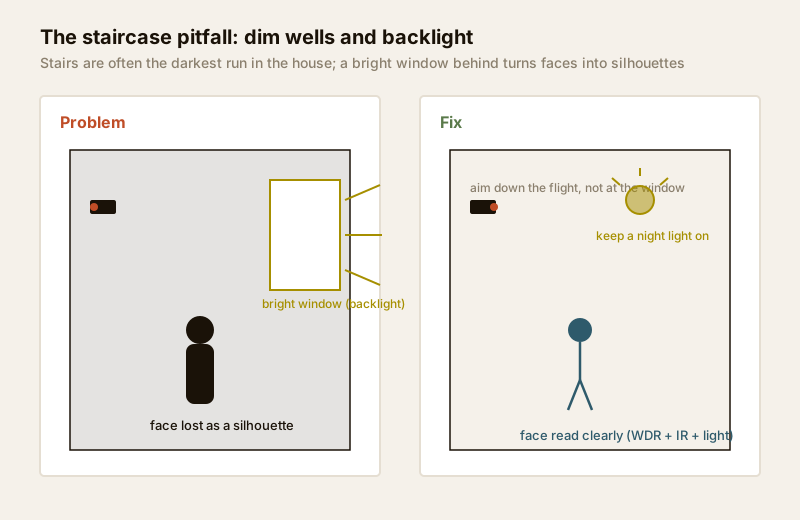
Staircases are frequently the darkest run in a house — an internal well with no window, or lit only by a single dim bulb. And where there is a window on the half-landing, it creates the opposite problem: backlight that turns anyone in front of it into a black silhouette with no readable face. Both are the staircase's signature pitfall.
Handle it like this:
- Do not aim the camera at a bright window or an open doorway to daylight. Face it down the flight so the light source is behind the camera or to the side, not behind the subject.
- Choose a camera with WDR (Wide Dynamic Range) so it can balance a bright window against a dark stair in the same frame. This matters more on a stair than almost anywhere else in the house.
- Prioritise low-light performance and IR. A stairwell that is dim by day is black by night. For the trade-offs, see the low-light CCTV guide.
- Keep a small night light burning on the stair. A single low-wattage lamp both improves the footage and, more importantly, keeps the escape route safely visible during a power cut — plan the recorder on a UPS so the camera survives the cut too.
Mounting spec at a glance
| Parameter | Recommendation | Note |
|---|---|---|
| Mounting height | 2.2–2.5 m above the landing | Out of reach, faces not top-down |
| Position | Landing wall / wall-ceiling corner, top of flight | Widest useful view of flight + landing |
| Aim | Down the slope of the flight | Reads climbers head-on, descenders on the landing |
| Camera type | Dome or turret, indoor-rated | Discreet, tamper-resistant, no protruding body |
| Lens | 2.8 mm wide (short flight) / varifocal (tall well) | Match reach to the run length |
| Light handling | WDR + strong IR / colour night | Beats dim wells and window backlight |
| Cabling | Conduit tight to wall/ceiling | Never across treads or a landing |
| Recorder & UPS | In a store off the stair | Never on the escape route |
Common staircase in a society: consent and privacy
In an apartment or gated society, the staircase is usually a common area, not your private property — and that changes the rules. You cannot simply drill a camera into a shared landing on your own initiative.
- Get RWA / society approval. A camera in a common stairwell is a collective decision. Take it to the managing committee, agree the purpose, who can view footage, and how long it is kept. The gated-communities security guide covers the common-area governance in depth.
- Respect the neighbours. A common-stair camera watches the shared flight — it must not be angled to stare at a neighbour's front door, into a flat when the door opens, or at anyone's window. Use privacy masking to black out any part of the frame that captures a private threshold.
- Signage. Put up a simple notice that CCTV is in operation in the common area, agreed with the RWA. See the CCTV signage guide.
- DPDP Act, 2023. Recording in a shared space carries responsibilities for a legitimate purpose, proportionality and access control. Treat footage as sensitive. (This is general guidance, not legal advice.)
Inside your own flat, a staircase between your floors is your own space — but the fire-safety and no-backlight rules apply exactly the same.
When to bring in a professional. Decide the position, camera type and count yourself using this guide and the placement planner. Then hand the mounting at height, conduit routing, weatherproof terminations and any mains-power connection to a licensed installer and electrician — a stairwell is a working-at-height job, and every fixing has to respect the escape route. If the stair is a shared society space, secure RWA sign-off before any drilling starts.
Key takeaways
- Mount the staircase camera high on the landing wall (2.2–2.5 m), angled down the flight, so it reads faces of people going both up and down.
- Life safety overrides everything: the camera, box, UPS and cabling must never block the escape route, narrow the handrail or become a trip hazard — recorder off the stair, cable in conduit.
- A stairwell is usually the dimmest, most backlit run in the house — use WDR plus strong IR, aim away from bright windows, and keep a night light on a UPS.
- A dome or turret suits the indoor stair; a turret avoids dome IR glare in a tight well.
- In a society the stair is a common area — get RWA consent, mask neighbours' doors, post signage, and treat footage under the DPDP Act, 2023. Route height and mains work to a licensed professional.
References
- Digital Personal Data Protection Act, 2023 — record shared and private stairways only for a legitimate purpose, mask neighbours' private thresholds, and control who can access footage.
- National Building Code of India (SP 7), Bureau of Indian Standards, and local municipal bye-laws for staircase width, escape-route and fire-egress requirements — never let security hardware compromise them; verify the current edition via the BIS catalogue: https://www.services.bis.gov.in/
- Ingress Protection (IP) and camera specifications — confirm indoor rating, WDR and low-light capability on the manufacturer's specification sheet before ordering.
This is an educational overview, not legal advice. Mounting at height, cabling and any electrical work are qualified professional tasks — engage licensed installers, secure RWA consent for shared stairways, and verify any standard's current status via the BIS catalogue before relying on it.
Export this guide
Related Guides — Deep-dive reading
How to Choose a CCTV Camera (2026): The Homeowner's Decision Guide for India
Cut through the spec-sheet noise and choose the right CCTV camera for each spot around an Indian home. What actually matters — sensor and low-light performance, lens and field of view, form factor, IP and IK ratings, honest smart features — and the marketing claims to ignore.
SecurityPublic Footpath Camera Restrictions in India (2026): Your Camera, the Public's Street
You can put a camera on your own gate, but the footpath and road outside are public space full of people who never agreed to be filmed. Here is how to point your camera fairly, capture the least public space you need, and stay a good neighbour.
SecurityCCTV Placement for Corridors and Passages in India (2026): See the Length, Not the Wall
Mount one camera at the end of the corridor facing down its length, add a second at the far end for two-way coverage, catch doors as they open into frame, and never let hardware block a fire-escape passage.
SecurityRelated Tools — Try Free
CCTV Camera Coverage & Count Calculator
Estimate how many CCTV cameras you need, the NVR channels, storage in TB for your retention period, and an indicative all-in cost with GST.
CCTV CalculatorCCTV Placement Compliance Checker
A quick DPDP-grounded privacy and safety self-check for where a camera is pointed — flags the items to fix.
ComplianceCross-Ventilation Analyzer
Estimate airflow and air changes per hour (ACH) from room size, window areas, layout, and local wind — with NBC 2016 Part 8 compliance check.
Ventilation Calculator