
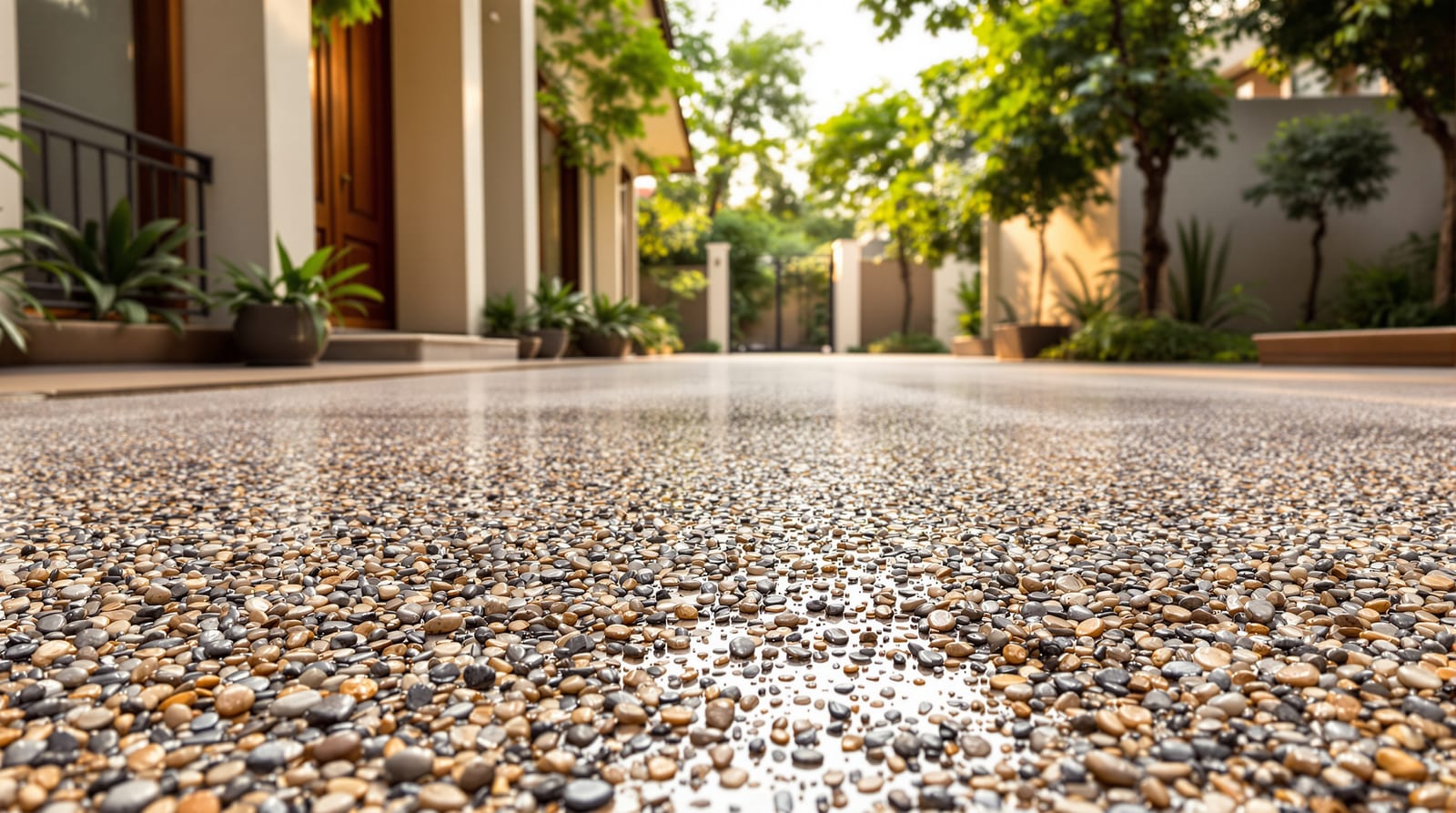
Exposed Aggregate Flooring in India: Method, Aggregate Choices, Cost & Pros and Cons
Concrete cast with decorative pebbles and chips, then surface-washed to reveal the stones, gives a tough, anti-skid, seamless finish for driveways, pool decks, paths, parking and courtyards at ₹60–180 per sq ft — here is how it is made, the aggregate options, costs and trade-offs.
Exposed aggregate is the workhorse decorative concrete of Indian outdoor spaces. You pour ordinary concrete, then wash, brush or abrade the top skin of cement away to reveal the pebbles and chips embedded inside — leaving a seamless, gritty, naturally non-slip surface that costs a fraction of cut stone. At ₹60–180 per sq ft it is the go-to finish for driveways, ramps, pool decks, parking aprons, garden paths and courtyards across India.
This guide covers how the finish is actually made on Indian sites, the two main methods, your aggregate and colour choices, honest pros and cons, and how it stacks up against stamped and plain concrete.
What exposed aggregate flooring is
Exposed aggregate is a concrete finish, not a separate material. A standard concrete slab is a mix of cement, sand and coarse aggregate (the stones). In a normal floated finish, a thin layer of cement paste covers everything, so you never see the stones. In an exposed-aggregate finish, that top paste layer is deliberately removed before the concrete fully hardens — so the decorative stones sit proud and visible, locked permanently into the slab below.
The result is one monolithic, jointed-into-panels surface with no tiles, no grout lines to fail, and a coarse texture that gives genuine grip in the wet. Because the aggregate is the wearing surface, it is extremely durable underfoot and under tyres. It is essentially the same family as polished concrete and other decorative concrete finishes — the difference is purely how the top surface is treated. Studio Matrx classes it among the seamless, in-situ floors alongside IPS and screed.
How exposed aggregate is made: the two methods
There are two ways to get decorative stones to the surface. Both start with a properly compacted sub-base, a damp-proof membrane and reinforcement, and both are poured by your regular concrete mason — no exotic skills, but timing is everything.
Integral (mix-in) aggregate
Here the decorative aggregate is part of the concrete mix itself. The whole slab is cast with selected pebbles or chips, and after the surface is screeded and floated, the top skin is washed off to expose whatever stones happen to be near the top. It is simpler and cheaper, but the exposed face is less uniform because you only reveal a random scatter of the mix — and it wastes expensive decorative aggregate deep in the slab where nobody sees it.
Seeded (broadcast) aggregate
Here the slab is poured with a normal economical concrete, then while it is still plastic the decorative aggregate is hand-scattered ("seeded") evenly over the wet surface and tapped or floated down flush. This puts the good-looking stones exactly where you want them, in a dense even spread, and keeps costs down because the decorative stone is only at the surface. Seeding is the preferred method for show driveways and pool decks in India where appearance matters.
Exposing the surface: retarder and wash
Whichever way the stones get there, the cement skin over them must be removed at the right moment. Three common approaches:
- Wash-and-brush (timing method): the mason waits until the surface has set just enough (often a few hours), then sprays water and brushes or hoses away the surface paste to reveal the stone. Cheap, but the window is short and weather-dependent — a hot Chennai afternoon or a sudden monsoon shower can ruin the timing.
- Surface retarder: a chemical sprayed on the fresh surface (or printed onto the form) keeps the top millimetres from hardening while the slab below sets. The next day you simply pressure-wash the retarded paste off to a controlled, even depth of exposure. This gives far more consistent results and is the professional choice.
- Abrasive exposure: for older or harder slabs, the surface is mechanically ground, shot-blasted or acid-etched to cut down to the aggregate. Used on retrofits and on integral-aggregate floors.
The diagram below shows the cross-section: decorative aggregate sitting in the concrete matrix, with the top cement paste washed away to expose the stones.
After exposure and curing, the floor is acid-washed lightly to clean off any cement haze, then sealed (more on that below).
Aggregate choices and colours
The look of the floor is entirely down to the stones you seed into it. Indian sites have easy access to a wide palette from local stone yards and river beds:
- River pebbles / shingle: smooth rounded tan, grey, brown, black and multicolour pebbles — the classic soft, organic look. Larger pebbles read as a rugged garden path; smaller shingle gives a finer texture.
- Crushed granite / basalt chips: angular grey, black, pink or salt-and-pepper chips give a sharp, modern, hard-wearing surface — very common in South and West India where these stones are quarried locally.
- Crushed marble / quartzite: white, cream, green and pink chips for a brighter, more decorative finish, often used near pool decks and entrances.
- Coloured glass or recycled aggregate: for feature courtyards and bespoke projects.
You can also tint the concrete matrix itself with an integral oxide pigment (the same iron oxides used in red-oxide and concrete finishes) so the binder between the stones complements them — a charcoal matrix with white chips, or a buff matrix with tan pebbles. Bigger, rounder pebbles feel coarser underfoot; smaller angular chips give a smoother but still grippy surface.
Cost in India: ₹ per sq ft
Exposed aggregate sits between plain concrete and stamped concrete on cost, and well below cut natural stone. The table gives indicative all-in ranges (material + labour, varies by city and vendor; add 18% GST; decorative aggregate and seeding push the upper end).
| Finish / option | Indicative ₹/sq ft | Anti-skid in wet | Best use |
|---|---|---|---|
| Plain broom-finished concrete | ₹50–110 | Moderate | Utility paving, service yards |
| Exposed aggregate — integral, local chips | ₹60–110 | Excellent | Driveways, parking, paths |
| Exposed aggregate — seeded, river pebble | ₹100–180 | Excellent | Pool decks, show driveways, courtyards |
| Stamped / textured concrete | ₹120–300 | Good (sealed can be slick) | Patios, mimicking stone or brick |
| Natural stone pavers / cobblestone | ₹150–400+ | Good–excellent | Premium driveways, courtyards |
Compared with laying cut stone or pavers, exposed aggregate avoids slab cost, cutting wastage and the slow piece-by-piece laying labour — which is why it stays cheap. Use the Studio Matrx flooring cost calculator and the anti-slip rating selector to sanity-check a quote and confirm the finish suits a wet zone.
Pros and cons
Pros
- Excellent wet grip — the coarse stone texture gives genuine traction, so it is ideal around pools, on ramps and on monsoon-soaked driveways. It outperforms most smooth or sealed finishes for slip resistance.
- Very durable — the wearing surface is hard stone locked into a concrete slab; it shrugs off tyre traffic, sun and heavy use for decades.
- Seamless, no grout — one monolithic pour with control joints only; nothing to lift, crack or weed up like jointed pavers.
- Cheap versus stone — a stone-textured decorative floor at a concrete price.
- Low maintenance — wash down with water; hides dirt and tyre marks well thanks to its busy texture.
Cons
- Rough on bare feet and furniture — the very texture that grips is uncomfortable to walk on barefoot for long, and makes it hard to slide chairs or wheel trolleys, so it suits outdoors far more than indoor living areas.
- Needs periodic sealing — concrete and the stones are porous; an unsealed floor stains from oil, leaves and hard-water marks and the matrix can dust. A penetrating or acrylic sealer every 2–4 years keeps it sound and can deepen the colour ("wet look").
- Hard to repair invisibly — a patch rarely matches the surrounding texture and colour exactly, so cracks and damage are difficult to hide.
- Timing-sensitive to install — get the wash window wrong and you either bury the stones or over-expose and weaken them; an experienced mason and a retarder matter.
- Can dazzle and heat up — light aggregate in full sun is bright; darker chips absorb heat. For terraces, weigh this against dedicated heat-reflective finishes.
Exposed aggregate vs stamped and plain concrete
All three start as a concrete slab; the finish is the difference. Plain (broom or float) concrete is cheapest and purely functional, with only modest grip. Stamped concrete presses a textured mat into the fresh surface and is coloured to mimic stone, brick or wood — it looks the most decorative but the sealed, smooth-relief surface can become slippery when wet and the colour can wear. Exposed aggregate sits in between: more characterful and far grippier than plain concrete, more genuinely anti-skid and lower-maintenance than stamped, though with a fixed pebbly look rather than a printed pattern. For Indian driveways and pool surrounds where wet grip and durability matter most, exposed aggregate is usually the smarter pick; for a decorative patio mimicking stone, stamped may win on looks.
Where it suits in India
Exposed aggregate is at its best outdoors and in transitional zones: driveways and parking aprons (tyre-tough, grippy), pool decks and surrounds (anti-skid when wet, cool palette options), garden and approach paths, courtyards and verandah floors, ramps and porches. Indoors it is occasionally used as an industrial-chic feature in entry foyers or commercial lobbies, but its roughness makes it a poor choice for bedrooms and living rooms — there, polished concrete or microcement give the seamless look without the grit.
Cross-links and where this fits
This guide is part of the Studio Matrx flooring cluster. For the bigger picture of alternative and outdoor floors, start with the specialty flooring guide and the outdoor flooring guide. To compare seamless concrete options, see concrete floor finishes and polished concrete flooring. For cut-stone alternatives, see natural stone pavers. And because wet grip is the headline benefit here, pair it with anti-slip flooring for wet areas.
Frequently asked questions
Is exposed aggregate flooring slippery when wet?
No — it is one of the more slip-resistant outdoor finishes precisely because the exposed stones create a coarse, grippy texture. That is why it is favoured for pool decks, ramps and monsoon-prone driveways. Take care only when sealing: use a matte or anti-slip sealer rather than a high-gloss one, which can reduce grip.
How long does exposed aggregate flooring last?
A properly poured, sealed exposed-aggregate floor can last several decades outdoors. The wearing surface is hard stone locked into a concrete slab, so it resists tyres, sun and heavy traffic. Longevity depends on a sound sub-base, correct control joints to manage cracking, and resealing roughly every 2–4 years.
Can exposed aggregate be done over an existing concrete floor?
A true seeded or integral finish needs fresh concrete, but you can get an exposed-aggregate look on an existing slab by mechanically grinding or shot-blasting the surface to cut down to its aggregate, or by bonding a thin new topping and exposing that. Both are best left to an experienced contractor.
Why does my exposed aggregate floor need sealing?
Concrete and natural stone are both porous, so an unsealed surface absorbs oil, leaf tannins and hard-water marks, and the cement matrix can dust over time. A penetrating or acrylic sealer protects against staining, binds loose surface grit and, in a "wet look" version, enriches the colour. Reseal every two to four years depending on traffic and weather.
Is exposed aggregate cheaper than natural stone or pavers?
Generally yes. At roughly ₹60–180 per sq ft it avoids the cost of cut stone slabs, cutting wastage and slow piece-by-piece laying, while still giving a stone-textured, durable, anti-skid floor. It costs more than plain broom-finished concrete but usually less than stamped concrete or laid natural-stone pavers.
Export this guide
Related Guides — Deep-dive reading
Patio Flooring in India: Best Decks & Outdoor-Seating Floors for Weather, Grip & Looks
How to floor a patio, deck or outdoor lounge in India so it shrugs off UV and monsoon, grips wet feet, stays barefoot-friendly and still looks like a place you want to entertain.
Flooring & SurfacesConcrete Floor Finishes in India: Stamped, Stained, Broom, Salt, Trowel & Exposed Aggregate Options
The full menu of decorative concrete floor finishes beyond plain grey — stamped, acid-stained and coloured, broom, burnished trowel, salt and stencilled — with what each looks like, where it suits, anti-skid options and costs of ₹80–350 per sq ft.
Flooring & SurfacesBasalt Flooring in India: Black Lava Stone Cost, Finishes & Use Guide
Dense, hard, low-porosity volcanic basalt gives the modern matte-black floor — here is how to choose honed, flamed or leather finishes, where it suits indoors and outdoors, and how it compares with granite.
Flooring & SurfacesRelated Tools — Try Free
Flooring Cost Calculator
Estimate the all-in cost of a floor — material, laying, wastage, skirting and GST — by area and material.
Flooring CalculatorDriveway Flooring Cost Calculator
Estimate driveway surfacing cost — paver blocks, exposed aggregate, stamped concrete, cobblestone or grass paver.
Flooring CalculatorPolished Concrete Cost Calculator
Estimate polished or decorative concrete floor cost by area and finish — polished, stamped, stained or microtopping.
Flooring Calculator