
Police-Response Integration for Alarms in India (2026): The Honest Reality
What police response really means for a home or shop alarm in India: not an automatic police car, but a fast verified alert, a siren, neighbours and the guard first, then a person calling 112.
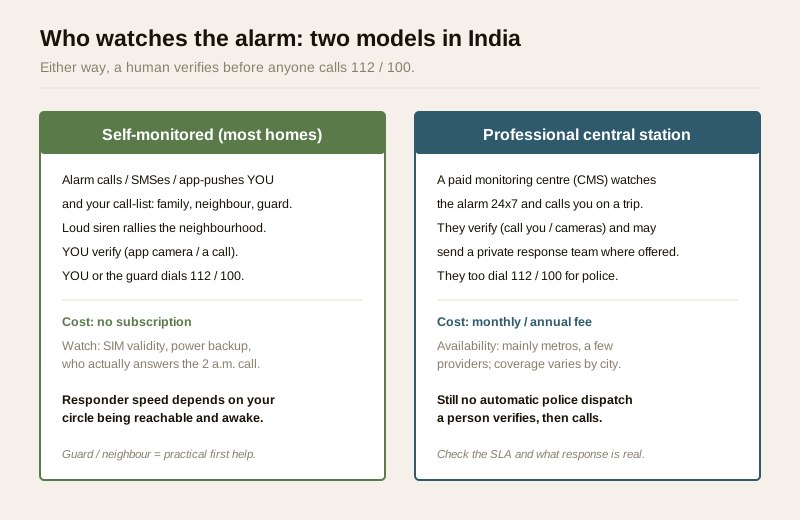
If you have seen a foreign crime drama, you know the trope: a burglar trips an alarm, a monitoring centre lights up, and within minutes a police car is screeching to the door — no one had to call anyone. It is a comforting picture. It is also, in India, largely a fiction. Before you buy an alarm expecting it to conjure a police response on its own, you need the honest version of how this actually works here.
This guide is the most reality-checking piece in Studio Matrx's burglar-alarm library. The plain truth is this: in India there is generally no formal, standardised verified-alarm-to-police auto-dispatch scheme of the kind the UK or parts of the US run. A private alarm does not automatically send a police car. Police-response integration, in the Indian context, is not a wire you connect to a police station — it is a plan you build, in which a human verifies the alert and then calls the police emergency helpline. Get that expectation right and you will design a response chain that actually works. Get it wrong and you will pay for a false sense of security.
Scope & the honest reality. Most Indian alarms are self-monitored: they alert you and a call-list by siren, GSM call/SMS or app push, and a loud siren rallies neighbours and the guard. Professional central-station monitoring exists but is limited — mostly metros, a few providers, a paid subscription. Either way, no alarm automatically summons the police. "Police response" here means a person — you, a monitoring station, or the society guard — verifies the alert is real and then dials 112 (or Dial 100). Never assume guaranteed or automatic police arrival. This is educational guidance, not legal advice.
What "police response" does — and does not — mean in India
It helps to name the gap plainly, because a lot of alarm marketing quietly implies more than it delivers.
- What it is NOT. There is generally no central registry your alarm auto-reports to, no standing agreement that a signal from your panel dispatches a patrol, and no legal duty on the police to treat a private-alarm ping as a call-out. An alarm's siren and app alert have no direct line to a control room that rolls a vehicle.
- What it IS. A well-planned system gives you the three things that genuinely lead to help: a fast, reliable alert so someone knows within seconds; a way to verify it is a real intrusion and not a false trip; and a rehearsed chain of who acts — near help first, then a verified call to the emergency number.
An alarm's real job in India is to deter (the siren and visible presence), detect (the sensors), alert (your circle), and give you a verified basis to call for help. It is not a machine that produces a police car. Once you accept that, every design choice becomes clearer.
The two monitoring models, and why both still need a human
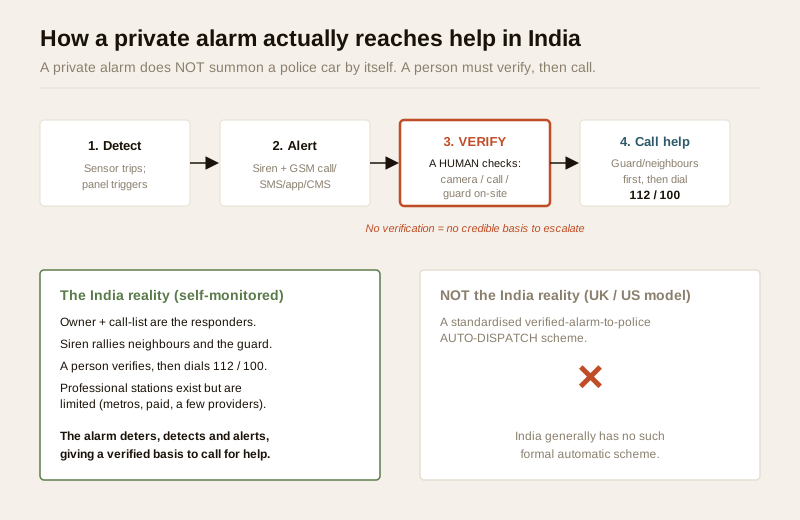
Who is watching the alarm shapes how fast the chain moves — but neither model removes the human verify-and-call step.
| Self-monitored (most homes) | Professional central station | |
|---|---|---|
| Who watches | You and your call-list | A paid monitoring centre (CMS) |
| How you learn of a trip | Siren + GSM call/SMS + app push | The centre calls you on a trip |
| Who verifies | You (app camera / a call) or the guard | The centre (calls you / views cameras) |
| Who calls police | You or the guard, on 112/100 | The centre — still by dialling the helpline |
| Availability | Anywhere with a SIM/network | Mainly metros, a few providers |
| Cost | No subscription | Monthly / annual fee |
| Police arrival | Not automatic | Still not automatic |
The point of the table is the last row. Even a paid professional centre does not trigger an automatic dispatch; it verifies and then calls the same public helpline you would. What you pay a good monitoring service for is speed and reliability of that human step — someone awake at 3 a.m. who will check and act — not a private hotline to the police.
The verified alert path: making sure someone actually knows
None of the response chain matters if the alert never lands. In India three ordinary things quietly break the alert path, and each has a plain fix:
- A silent SIM. A GSM alarm whose prepaid SIM has lapsed on recharge or validity will fail to call or SMS — with no obvious sign. Keep the SIM on a plan with long validity, note the expiry, and test a real alert monthly.
- A power cut that kills the messenger. If the panel and the broadband router lose power, an app-only alert dies with them. Battery-backed panels and a small UPS on the router keep the alert alive through load-shedding; see emergency preparedness.
- The 2G sunset and patchy signal. Older 2G modules are being retired; choose a 4G-capable module and confirm the alarm sits where the SIM has signal.
Layer the channels so one failure does not silence the whole system: a loud audible siren that needs no network at all, plus a GSM call/SMS, plus an app push, and — for the higher-risk or unattended site — a monitoring service. A silent alarm or panic button can alert your circle discreetly when a siren would provoke a confrontation.
Verify before you escalate: the false-alarm problem
Verification is not a nicety; it is the single most important habit in this whole chain, and the one that protects your credibility with the police.
A pet, a swaying curtain, a balloon, a flickering light or a poorly aimed sensor can all trip an alarm. If you dial the helpline on every trip without checking, you will soon be the address that "always calls and it is always nothing" — and repeated unverified false alarms genuinely waste responders' time and erode the trust you will need on the night it is real. The cheap, fast way to verify is a camera you can glance at from the app: a quick look tells you whether to stand down or to call. This is why pairing an alarm with a camera and remote access matters so much for a workable response — and why the glass-break and motion-sensor siting decisions that reduce false trips are part of "police-response integration" too.
The realistic response chain: nearest help first, then the helpline
Because a police car is not summoned automatically and may be some distance away, the chain that actually protects a home or shop leads with the people who are minutes away, not the ones who might be far off.
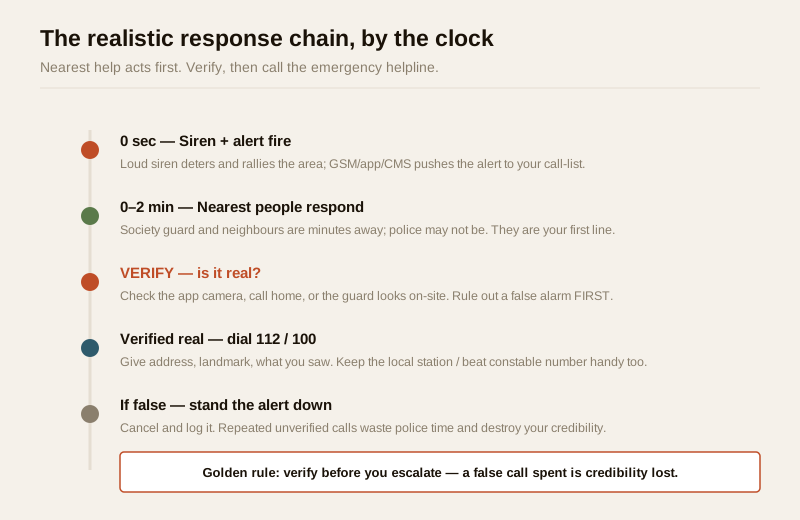
| Step | Timing | Who acts | What they do |
|---|---|---|---|
| Siren + alert | 0 sec | The system | Deters the intruder; pushes the alert to your call-list |
| Nearest people | 0–2 min | Society guard, neighbours | Move toward the site; they are minutes away, police may not be |
| Verify | next | You / guard / monitoring centre | Check camera, call home, or look on-site — real or false? |
| Call helpline | if real | You or the guard | Dial 112 (or Dial 100); give address, landmark, what you saw |
| Stand down + log | if false | You | Cancel, record it, tune out the cause so it does not repeat |
For a flat or gated society, the guard is your practical first responder — reachable in a minute through a guard-to-resident intercom and able to move to the door, confirm the alert and raise the wider alarm long before any outside help arrives. Building that link into your plan is covered in the gated-communities and apartments security guides. A shop or standalone home leans instead on neighbours and, if you subscribe, a monitoring centre's response.
Keep the local numbers you will actually need
Police-response integration in India is, in practice, a contact list and a habit more than a technology:
- 112 is the national single emergency number (police, fire, medical); Dial 100 still reaches the police in most states. Programme both into every phone in the house or shop.
- Your local police station and beat constable. Many stations share a direct number and the beat officer's contact for their area; keep them saved. A verified call to a station that knows your street is worth more than a cold one.
- Any community-policing or police-registered-society initiative. Several cities and states run local schemes — beat-officer WhatsApp groups, senior-citizen registration, RWA-police liaison, or a resident-safety app. These vary widely by city and state, come and go, and are not a guaranteed dispatch channel, so treat them as a useful extra contact, not a promised response — check what your own jurisdiction actually offers rather than assuming it exists.
Setting expectations honestly with your household or RWA
The most valuable thing this guide can leave you with is a calibrated expectation, so that everyone who might act on an alert knows the plan:
- The alarm will wake you and warn the area — that is its job, and it does it well.
- No one is automatically coming. The first move is yours or the guard's: verify, then call.
- Verify every time before dialling the helpline; a false call spent is credibility lost.
- Know who calls, on what number, and what they will say (address, landmark, what was seen) before the night you need it.
Written down and shared — pinned in the kitchen, briefed to the guard, saved in the RWA group — that small plan is what "police-response integration" honestly amounts to in India, and it works far better than a false belief in an automatic patrol. Use the burglar-alarm system selector to match the alert channels to your site, and the pillar guide to place this within the whole system.
When to bring in a professional. Route SIM/network setup, mains-connected panels and any monitored-service contract to a licensed installer or electrician (see the electrical hub) and a verified provider. If you want a watched-and-called service, engage a reputable central-monitoring provider and read the SLA for what "response" really means — confirm it is verification-and-call, not a promised police dispatch. For a society, agree the guard's role and escalation in writing with the RWA. Never rely on any single channel: keep the siren, an alert path, and a written call-list.
Key takeaways
- In India an alarm does not summon the police by itself — there is generally no formal verified-alarm-to-police auto-dispatch scheme; a human must verify and then call.
- Police-response integration here is a plan, not a wire: a fast verified alert, near help first (siren, neighbours, guard), then a call to 112 or Dial 100.
- Verify before you escalate — a quick camera check rules out false alarms; repeated unverified calls waste police time and destroy your credibility on the night it is real.
- Keep the alert path alive: guard against a lapsed SIM, back up the panel and router for power cuts, and choose a 4G module as 2G is retired.
- An alarm's honest job is to deter, detect, alert your circle, and give you a verified basis to call for help — not to conjure an automatic police response.
References
- National Emergency Response System — 112 is India's single all-services emergency number (police, fire, medical); Dial 100 still reaches police in most states. Verify the number and any state variations via the official portal: https://112.gov.in/
- Digital Personal Data Protection Act, 2023 — alert, camera and monitoring data are personal data; keep passwords and app accounts private and agree in writing what a monitoring provider may access.
- Manufacturer specifications — confirm GSM/4G module compatibility, SIM handling and battery-backup runtime on the maker's own datasheet before relying on the alert path.
- National Building Code of India (SP 7), Bureau of Indian Standards, and local municipal bye-laws for any electrical or life-safety aspect of an install; verify the current edition via the BIS catalogue: https://www.services.bis.gov.in/
This is an educational overview, not legal advice, and does not describe or promise any guaranteed or automatic police response. Police availability, response and any community-policing scheme vary by jurisdiction — engage licensed professionals and a verified monitoring provider, and verify any standard's current status via the BIS catalogue before relying on it.
Export this guide
Related Guides — Deep-dive reading
Security for People Living Alone in India (2026): Calm, Practical Habits When There Is No Second Person to Notice
Living alone is an ordinary and growing part of Indian life - the student in a new city, the working single, the elder whose children are abroad, the person after a separation. It does not call for fear. It calls for a few deliberate habits, because there is no second person in the home to notice trouble, raise the alarm, or catch an accident. This is calm self-reliance, layer by layer.
SecurityHow to Choose a Burglar Alarm in India (2026): Sensors, Alerts and What Actually Matters
A homeowner's guide to selecting an intruder alarm that fits your flat, villa or shop and alerts you the way you want — matching the sensor mix, control panel and the big siren-versus-monitored decision to your real risk, and dodging the false-alarm traps that make people switch systems off.
SecurityRemote Security Monitoring in India (2026): Watching and Responding From Anywhere
Watching your home from your phone is easy; making an alert lead to a real response is the hard part. The two honest models compared — self-monitoring by you and your family versus a paid professional monitoring centre — plus the secure tech behind remote access, the privacy stakes of a stranger watching inside your home, and why remote monitoring is only ever as good as the responder behind it.
SecurityRelated Tools — Try Free
Apartment Video Door System Planner
Enter flats, entrances, floors and guard desk for a first-pass building intercom plan — door stations, indoor monitors, guard station, the right architecture and an indicative cost band.
Building PlannerSecurity Backup Power Calculator
Size a UPS/inverter and battery to keep CCTV, NVR, router and alarm running through a power cut — load, Ah, VA and cost.
Backup PowerAccess-Control Battery-Backup Calculator
Size the standby battery so an access system keeps running through a power cut, with an egress life-safety note.
Battery Backup