
Thermal Cameras for CCTV in India: See Heat, Not Light, Explained
How a thermal camera images the warmth of people, animals and vehicles to detect an intruder across a large dark plot, why it cannot show a face or a number plate, and where it fits on an Indian property.
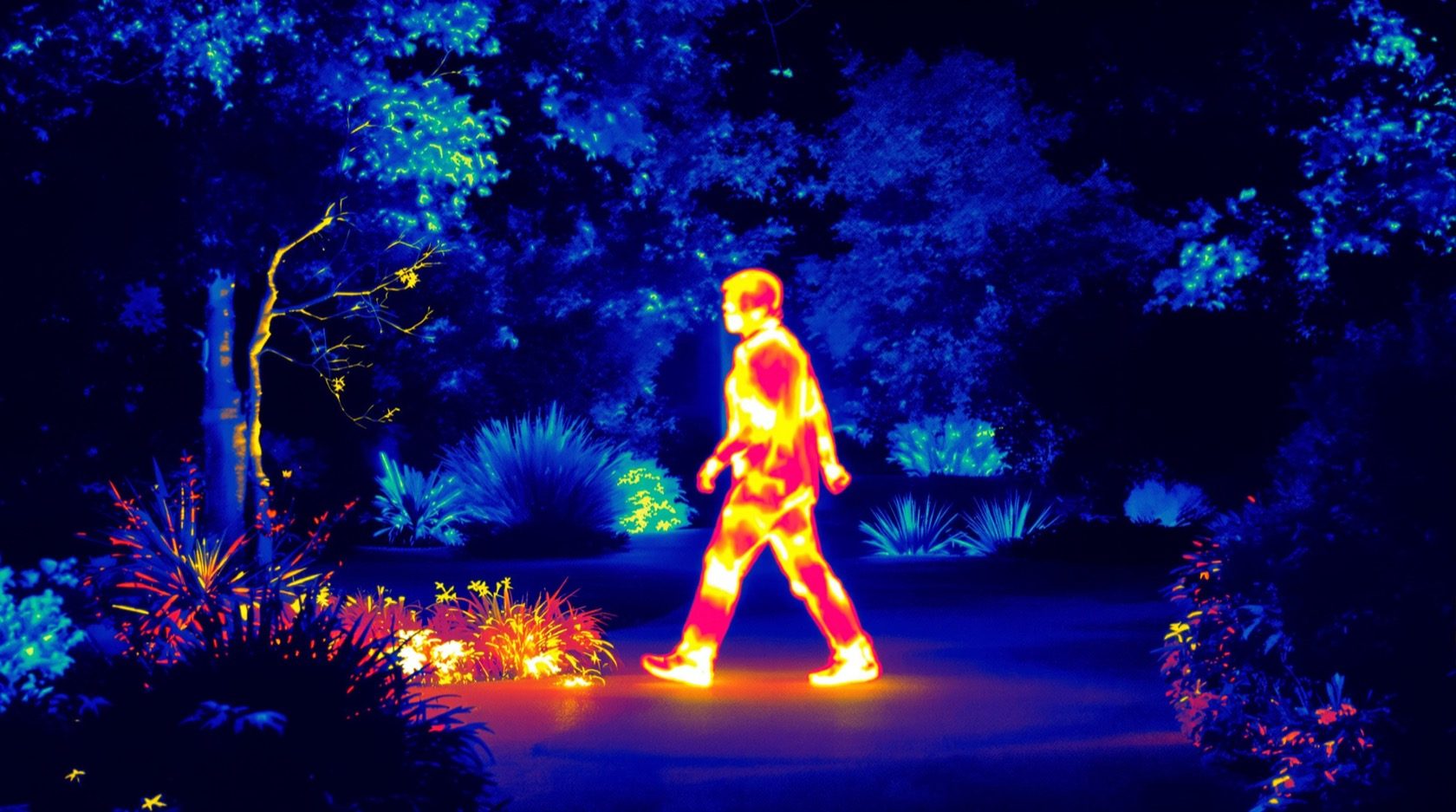
Most cameras need light. A thermal camera does not. Instead of gathering visible light or infrared reflected off a scene, it reads the heat every object gives off — and because a living body runs far warmer than the ground, wall or hedge around it, a person, an animal or a running vehicle glows against the background like a torch in the dark. That single difference is what makes thermal the camera you reach for when the job is spotting that something is there across a big, dark, poorly-lit stretch of land — and why, on its own, it is the wrong camera for almost everything else.
This is the focused explainer on thermal imaging in Studio Matrx's CCTV hub. It sits alongside the other night-seeing technologies — infrared night vision, low-light cameras and colour night vision — but it is a different animal from all of them, and this guide keeps to its lane: what heat imaging does brilliantly, the one limitation every homeowner must understand before spending on it, and the handful of Indian properties where it actually earns its high price.
Scope & safety. This guide helps you decide and plan. Mounting cameras at height, structured cabling and any mains-electrical work belong to licensed professionals — plan the positions here, have them installed by a qualified installer. A camera must never block a window, door or fire-escape route. Cameras belong only on your own land and shared areas — never bathrooms, bedrooms or changing areas, positioned to respect neighbours and the spirit of the DPDP Act, 2023. A thermal camera sees heat through darkness, so its privacy footprint over neighbouring land deserves extra care.
How a thermal camera actually works
Everything warmer than absolute zero radiates infrared heat energy. A thermal camera has no ordinary lens-and-sensor for visible light; instead it uses a special microbolometer sensor that measures how much heat reaches each point of the image, then paints that heat map onto a screen. Warmer things show brighter (or in a chosen colour palette — "white-hot", "black-hot" or an ironbow scheme); cooler things recede into the background.
The consequences follow directly from that:
- It needs no light at all. A thermal camera works in pitch black exactly as well as at noon — there is nothing to illuminate, because it is reading heat the scene emits on its own. No IR lamp, no street light, no moon.
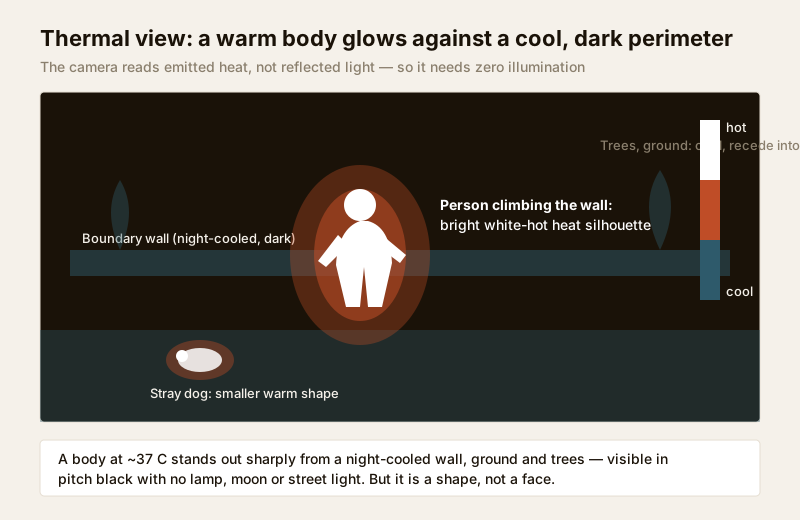
- A warm body stands out. A human at roughly 37 degrees C against a night-cooled wall, field or road is a strong, obvious bright shape. So is a buffalo, a stray dog, or a car with a hot engine and tyres.
- It sees through what blinds normal cameras. Light fog, thin smoke, dust haze and harsh glare scatter visible and near-infrared light, but affect heat far less. A pair of oncoming headlights or the low sun will white-out an ordinary camera; a thermal camera shrugs both off because it is not looking at that light in the first place.
The strengths — why thermal is unbeatable for detection
For one specific task — noticing that a person is present in a large, dark space — nothing beats thermal.
- Total darkness is no obstacle. On a big rural plot, a farm, or a factory boundary with no lighting and frequent power cuts, an ordinary camera is half-blind; a thermal camera does not care. This is its single biggest advantage in India, where perimeter lighting is often poor or absent.
- Very long detection range. A warm human shape is detectable far further away than a face is recognisable — often hundreds of metres with the right lens. One thermal camera can watch a long, dark boundary that would need a whole row of lit, ordinary cameras.
- Immune to glare and blinding light. Headlights sweeping across the gate, the rising or setting sun straight down a boundary, a security light flaring — all of these defeat ordinary cameras and none of them defeat thermal. It cannot be "blinded".
- Sees through light fog, smoke and haze. Monsoon mist, dust, and thin smoke that turn a normal night image to soup leave a heat image largely readable.
- Very low false alarms with analytics. This is the professional headline. Because a warm human shape is so distinct from the cool background, video analytics running on a thermal feed can reliably tell a person crossing a line from swaying branches, rain, headlight glare or shadows — the things that make ordinary night-time motion alerts cry wolf all night. A thermal camera paired with good analytics is the low-false-alarm way to guard a big perimeter.
For how a perimeter is assessed and layered in the first place, see the perimeter vulnerability assessment guide and the lighting and visibility assessment.
The one limitation you must understand: detect, not identify
Here is the sentence that decides whether thermal is right for you: a thermal camera shows a heat silhouette, not a face or a number plate. It tells you someone is there — with near-certainty, in the dark, at range. It cannot tell you who.
A heat image has no colour and little fine detail. You will see a bright human shape, its posture, that it is carrying something, which way it moves. You will not read a face, the colour of a shirt, a scar, a logo, or the digits on a licence plate — the heat of a number plate is nearly uniform. For evidence that identifies a person or vehicle, a thermal image is almost useless on its own.
This is not a fault; it is the physics. And it leads straight to the professional way thermal is deployed.
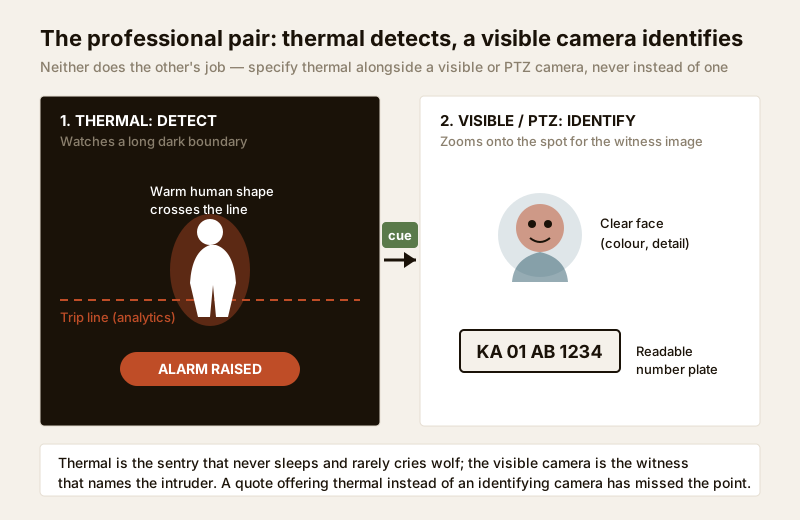
Detect with thermal, identify with a normal camera
The correct design is a pair:
1. A thermal camera watches the long, dark perimeter and, with analytics, raises a reliable alarm the instant a warm human shape crosses a line — day or night, fog or glare.
2. That alarm cues a visible / infrared camera — often a PTZ camera that pans and zooms, or a fixed bullet covering the likely approach — to swing onto the spot and capture the identifying image: the face, the clothing, the plate.
Thermal is the sentry that never sleeps and never cries wolf; the visible camera is the witness that names the intruder. Neither does the other's job. Any quote that offers thermal instead of an identifying camera, rather than alongside one, has misunderstood the tool.
Thermal pros, cons and best-fit
| Aspect | What a thermal camera gives you |
|---|---|
| Best strength | Detection — spotting a warm human shape in total darkness at long range |
| Darkness | Works in pitch black with zero illumination; no IR lamp or lighting needed |
| Range | Very long detection range — one camera can watch a long dark boundary |
| Weather / glare | Sees through light fog, smoke, dust and haze; cannot be blinded by headlights or sun |
| False alarms | Very low when paired with analytics — a warm body is unmistakable |
| Main weakness | Shows a heat silhouette only — no face, no colour, no number plate; cannot identify |
| Cost | Much higher than an ordinary camera — a premium detection tool |
| Best-fit | Large plots, farms, long dark boundaries, industrial and estate perimeters |
| Poor fit | A small home, a lit street frontage, or anywhere you need to identify who was there |
Thermal vs a visible / infrared camera — detect vs identify
The two are not competitors; they are partners with opposite strengths. Read this to see why you generally want both, not one.
| Factor | Thermal camera | Visible / IR camera |
|---|---|---|
| Sees | Emitted heat | Reflected visible or IR light |
| Needs light? | No — works in total darkness | Yes — ambient light or an IR illuminator |
| In pitch black | Full performance | Depends on IR range and quality |
| Detection range | Very long — a warm shape far off | Shorter; limited by illumination |
| Through fog / smoke / glare | Largely unaffected | Badly degraded; can be blinded |
| Shows a face? | No — heat silhouette only | Yes, within its usable range |
| Reads a number plate? | No | Yes, with the right camera and light |
| Primary job | Detect that someone is there | Identify who they are |
| Typical cost | Much higher | Ordinary / affordable |
| Best home role | Sentry on a long dark perimeter | Faces at gates, doors, plates at the drive |
For the ordinary night-seeing options that do the identifying half of the pair, compare the night vision overview, and see outdoor CCTV for how these sit in a whole outdoor scheme.
Cost, and where thermal actually fits in India
Thermal is a premium technology. A thermal security camera typically costs many times what a good ordinary IP camera does — often several tens of thousands of rupees and up, well before mounting, cabling, analytics and the paired visible cameras. Prices move with brand, resolution and lens, so treat any figure as a ballpark to sanity-check a quote.
| Setup | Indicative cost band (₹) | Notes |
|---|---|---|
| Ordinary 4MP IP night camera (for reference) | ₹2,500 – ₹8,000 | The identify half of the pair; affordable |
| Entry thermal security camera | ₹40,000 – ₹1,00,000+ | Detection only; a premium tool |
| Long-range thermal + analytics | ₹1,00,000 – ₹4,00,000+ | Estate / industrial perimeter scale |
| Paired visible / PTZ for identification | ₹8,000 – ₹60,000+ | Cues off the thermal alarm |
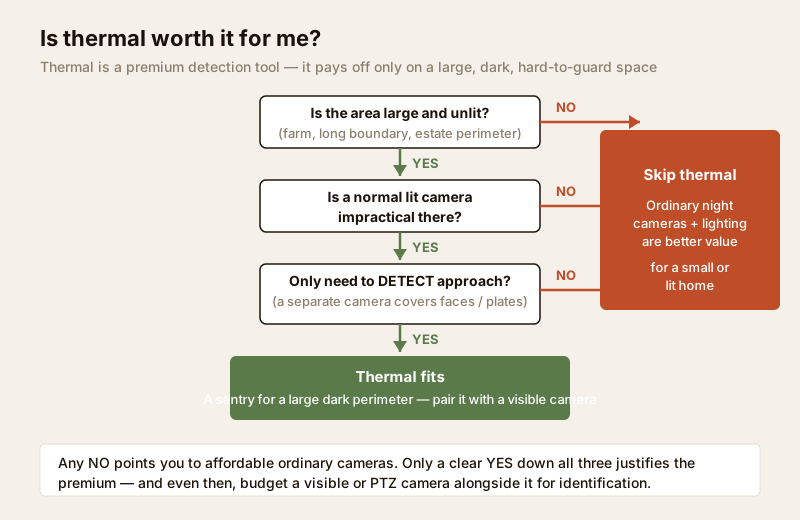
Because of that price, thermal is a fit for a few situations and overkill for most homes. It earns its cost where the space is large, dark and hard to guard any other way:
- Large rural or farm plots with long, unlit boundaries and open fields where an intruder could approach unseen for a long way.
- Industrial units, warehouses and estate perimeters with long fence lines, poor lighting, and a real need to detect approach early.
- Long dark boundary walls on a big property where lighting the whole run is impractical or defeated by power cuts.
- Farms and plots with wildlife or livestock pressure, where detecting movement across dark ground at range matters.
Where it is usually overkill: a normal urban or suburban home, an apartment, a lit street frontage, or a compact plot. There, well-placed ordinary cameras with good infrared night vision or colour night vision plus decent lighting will out-perform thermal for a fraction of the cost — and will actually show you a face. If you are unsure which side of that line your property falls on, the figure below and the camera type selector will help.
Getting a thermal setup right
If your property genuinely fits, a few things decide whether the spend pays off:
- Buy it for detection, and pair it. Specify the thermal camera as the perimeter sentry and budget a visible / IR or PTZ camera alongside for identification. One without the other is a half-system.
- Use the analytics. The low-false-alarm promise comes from line-crossing and intrusion analytics tuned on the thermal feed. Have the installer configure and test them against real conditions — a person walking, a dog, rain, headlights.
- Plan the field of view for range, not detail. A longer-range thermal lens watches more boundary but shows a smaller shape; match the lens to the length of the run you need to cover.
- Put the recorder and network on backup. A perimeter that goes dark with the power cut is no perimeter — plan a UPS for the recorder and network, as in the building security systems guide.
- Mind the neighbours. A thermal camera sees heat through darkness across a wide area; aim and mask it so it watches your boundary, not a neighbour's yard or windows.
When to bring in a professional. Decide whether thermal fits and where the sentry-and-witness pair should sit — then hand the mounting at height, structured cabling, weatherproof terminations, analytics configuration and recorder commissioning to a licensed installer. Anything at the mains board is a licensed electrician's job; see the electrical hub. Thermal is an expensive tool that is easy to waste on the wrong property or by skipping the paired identifying camera — get the design reviewed before you buy.
Key takeaways
- A thermal camera images heat, not light, so it spots a person, animal or vehicle by their warmth — in total darkness, through light fog, smoke and glare, and it cannot be blinded by headlights or the sun.
- Its superpower is detection at long range with very low false alarms when paired with analytics — ideal for a large, dark, poorly-lit perimeter.
- Its hard limit: it shows a heat silhouette, not a face or a number plate — it tells you someone is there, never who.
- The professional design pairs thermal for detection with a visible / IR or PTZ camera for identification — never one instead of the other.
- Thermal is a premium tool that fits large plots, farms and industrial or estate perimeters, and is overkill for a small or lit home — check the fit with the camera type selector and route mounting, cabling and mains work to a licensed professional.
References
- Digital Personal Data Protection Act, 2023 — position cameras to cover only your own property and shared areas with a legitimate purpose; a thermal camera's ability to see across darkness makes respecting neighbours' private spaces especially important.
- Ingress Protection (IP) ratings — verify a camera's weatherproofing (IP66 or higher for outdoors) on the manufacturer's specification sheet before ordering.
- National Building Code of India (SP 7), Bureau of Indian Standards, and local municipal bye-laws for any structural, electrical or life-safety aspect of an install; verify the current edition via the BIS catalogue: https://www.services.bis.gov.in/
This is an educational overview. Mounting at height, cabling and any electrical work are qualified professional tasks — engage licensed installers and verify any standard's current status via the BIS catalogue before relying on it.
Export this guide
Related Guides — Deep-dive reading
How to Choose a CCTV Camera (2026): The Homeowner's Decision Guide for India
Cut through the spec-sheet noise and choose the right CCTV camera for each spot around an Indian home. What actually matters — sensor and low-light performance, lens and field of view, form factor, IP and IK ratings, honest smart features — and the marketing claims to ignore.
SecurityHome Lighting and Visibility Security Assessment for Indian Homes
How to assess your home's security lighting after dark — checking every entry, path and boundary for coverage, uniformity and glare, testing what each camera can actually see at night, and turning the findings into a simple lighting plan.
SecurityPerimeter CCTV in India (2026): Watching the Boundary and Verifying the Alarm
How cameras earn their place on the perimeter — watching along the fence and wall line, and letting a human confirm a real intruder before response — designed for Indian darkness, weather and neighbour privacy.
SecurityRelated Tools — Try Free
CCTV Night-Vision Selector
Answer five questions and get the right night technology — infrared, low-light, colour night vision or thermal — with reasons.
Night-VisionCCTV Identification-Distance Calculator
How far a camera can still identify a face or number plate (DORI 250 px/m), from resolution, lens and sensor.
Identify DistanceCCTV Night-Vision Range Planner
A realistic infrared night range versus the datasheet claim, and whether it covers your target for identification.
IR Range