

Fence Vibration Sensors in India (2026): Detecting a Cut or Climb on the Fence Itself
How fence-mounted vibration, sensor-cable, fibre-optic and taut-wire detection turns an ordinary boundary fence into a detecting fence that flags a cut, climb or forcing attempt while the intruder is still on the line.
A fence is a barrier, and a barrier only ever buys time — a determined intruder can cut the mesh, scale the fabric or force a panel given a few unwatched seconds. Fence vibration sensors close that gap by making the fence report on itself: they pick up the shock, rattle and strain of someone cutting, climbing or forcing the fence fabric, and raise an alarm on the exact stretch of line being attacked, while the intruder is still on the boundary and has not yet crossed it. In effect they turn an ordinary security fence into a detecting fence — the detect layer of a complete perimeter security design, where a barrier that only delays is paired with something that also warns.
This guide is the fence-mounted-detection lens on a topic Studio Matrx covers more broadly elsewhere. For the fence as a physical barrier, see security fencing and anti-climb fencing; for the wider family of fence detection approaches, see fence intrusion detection; and for the sensing principle itself across applications, see vibration sensors. Here we stay tight on the fence-mounted vibration technologies — point sensors, sensor cable, fibre-optic and taut-wire — how they zone and tune, where they belong on a long perimeter, and the outdoor false-alarm reality that decides whether the system earns its keep or gets switched off.
Scope, verification & response. This guide helps you plan, specify and coordinate fence detection, strictly as a way to see an attack on the fence — never to defeat one. Hold two truths. First, a fence sensor detects a disturbance; it does not stop anyone, so it is worthless without verification and response — a fence zone alarm must pull up perimeter CCTV so a human confirms a genuine climb versus a gust of wind, then a guard, monitoring station or neighbour acts. In India most perimeters are self- or guard-monitored, not police-dispatched (see perimeter alarm systems). Second, mains power, mounting and any monitored-service contract are licensed-professional work. This is educational guidance, not legal advice.
What "fence-mounted vibration" actually means
Perimeter detection splits broadly into two families: free-standing sensors that watch the space near the boundary (beam barriers, buried cable, ground radar — the boundary intrusion detection umbrella covers these) and fence-mounted sensors that are fixed to the fence and sense the fence itself moving. This guide is entirely about the second family.
The common physics is simple: cutting a wire, climbing the fabric or levering a panel all put mechanical energy into the fence — a sharp transient from a cut, a rhythmic knocking from a climb, a sustained strain from forcing. A fence-mounted sensor converts that mechanical energy into an electrical signal, and a controller decides whether the signal's signature looks like an attack or like the weather. Because the sensor is bonded to the line the attacker must physically touch, the detection is tightly located — you learn not just that the fence was disturbed but where, which is what makes response possible on a perimeter that may run for hundreds of metres.
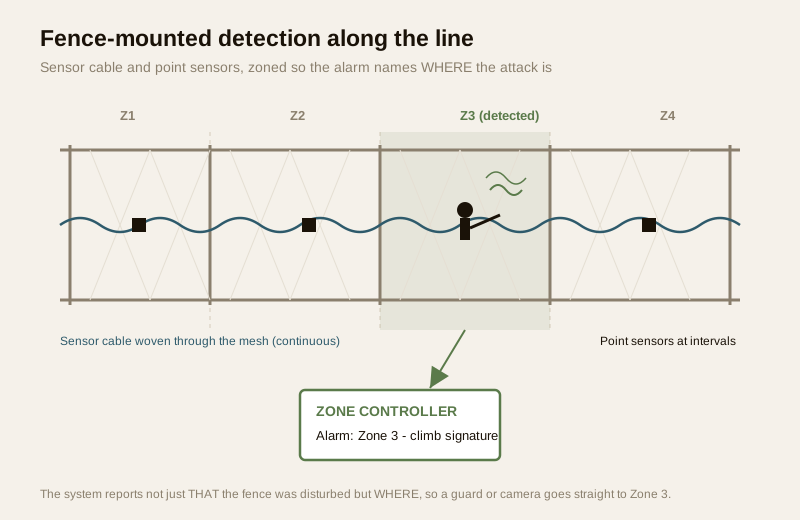
Three things separate a fence sensor that works from one that cries wolf, and every technology below is judged on them: how well it rejects weather and wildlife, how precisely it locates an attack (zoning), and how much maintenance the fence and sensor demand to stay honest. Keep those three in mind as we go through the options.
The four fence-mounted technologies
Point vibration / shock sensors
The simplest approach: discrete vibration or shock sensors (an accelerometer or a piezo/electromechanical element in a small housing) clamped to the fence fabric at intervals and wired back to a zone controller. Each senses the fence in its immediate neighbourhood; a cluster of them defines a zone. Point sensors are inexpensive per unit, easy to understand and easy to replace one at a time. Their weakness is coverage: gaps between sensors can be quieter spots, and on a long run the cabling and the number of devices add up. They suit shorter, well-defined runs — a yard, a substation compound wall-top, a rooftop plant enclosure — more than kilometres of farm boundary.
Sensor cable along the fence line (microphonic / triboelectric)
Instead of discrete points, a single sensor cable is woven through or clamped along the whole fence, so the entire fabric becomes one continuous microphone. Two common principles:
- Microphonic cable contains an element that converts fence vibration into an audio-like electrical signal; the controller "listens" to the fence and recognises the acoustic signature of cutting or climbing.
- Triboelectric cable generates a small charge when the cable is flexed or the fence moves it, producing a signal directly from the disturbance.
Sensor cable gives continuous, gap-free coverage along the run and is well suited to standard chain-link and welded-mesh fencing. Its performance depends heavily on the fence being taut and rigid — a loose, rattly fence feeds the cable constant noise. Zoning is done by dividing the cable into segments each served by a processor, or by using signal-timing to estimate location.
Fibre-optic sensing cable
A fibre-optic cable run along the fence senses the micro-bending and vibration of the fabric as changes in the light travelling through the fibre. Because the sensing medium is glass carrying light, fibre is immune to lightning, electromagnetic interference and electrical surge, carries no voltage on the fence, and can run very long distances from a single controller with few or no field electronics along the line. That combination makes fibre the usual choice for long, exposed or electrically hostile perimeters — substations, industrial estates, airports-style long runs, sites with overhead HT lines or heavy machinery nearby. Some fibre systems locate a disturbance to a point along the cable rather than only to a zone, which sharpens the response. The trade-off is higher system cost and the need for skilled splicing and commissioning.
Tension / taut-wire systems
A taut-wire system is different in feel: rows of horizontal wires are strung along the fence line under carefully set tension, anchored to sensor posts. Displacing a wire — spreading them to climb through, or cutting one so its tension drops — trips a mechanical or strain sensor at the post. Taut-wire is inherently good at rejecting wind and small animals because it responds to a genuine change in wire tension, not to every flutter, which historically made it a favourite for high-security government and defence perimeters. It is more of a purpose-built fence system than a retrofit onto existing mesh, and it demands disciplined installation and periodic re-tensioning.
| Technology | How it senses | Coverage / zoning | Stands out for | Watch-outs |
|---|---|---|---|---|
| Point vibration / shock | Discrete accelerometer or piezo units on the fabric | Per-sensor / small zones; gaps possible | Low cost, simple, easy part-swap | Coverage gaps; cabling grows on long runs |
| Sensor cable (microphonic) | Continuous cable "listens" to fence acoustics | Gap-free; zoned by cable segment | Continuous cover, retrofits standard mesh | Needs a taut fence; loose fence = noise |
| Sensor cable (triboelectric) | Cable generates charge when flexed | Gap-free; zoned by segment | Continuous cover, robust, low-power | Sensitive to fence slack and fixings |
| Fibre-optic sensing | Light in glass fibre reads micro-bending | Very long runs; some locate to a point | Lightning/EMI immune, no voltage, long haul | Higher cost; skilled splicing/commissioning |
| Taut-wire | Change in tension of strung wires | Zoned by sensor post | Excellent wind/animal rejection, high security | Purpose-built; installation and re-tensioning |
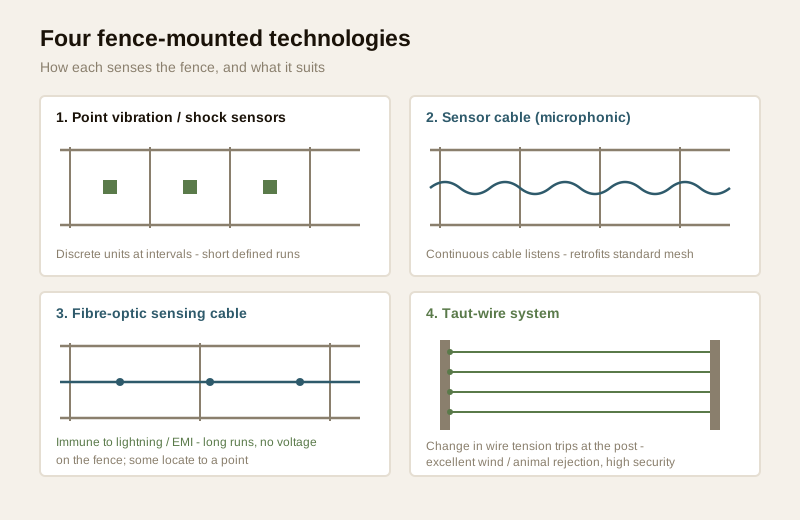
There is no universal winner. A short, defined enclosure near heavy machinery may want fibre for its EMI immunity; a kilometre of factory chain-link may want continuous sensor cable; a high-security government line may specify taut-wire; a small yard may be fine with a handful of point sensors feeding the perimeter alarm panel. Match the technology to the run length, the electrical environment and the false-alarm setting — not to a brochure.
Zoning: knowing WHERE the attack is
A single "the fence was disturbed somewhere" alarm is almost useless on a long perimeter — a guard cannot search two kilometres of line before the intruder is over and gone. Zoning divides the fence into addressable stretches (Z1, Z2, Z3…) so the alarm names the segment, and the response — a guard, a camera preset, a floodlight — goes straight there. Zone length is a design decision: shorter zones locate faster and let you tune each stretch to its local conditions (the windward side, the stretch near a road, the corner where a tree overhangs), but they cost more processors and cabling. Fibre systems that locate to a point along the cable take this further, but even they are usually mapped to named zones for the response plan. Zoning is also what lets fence detection hand off to CCTV: each zone is tied to a camera preset so that a Z3 alarm swings or selects the camera covering Z3, ready for a human to verify.
Tuning and the outdoor false-alarm reality
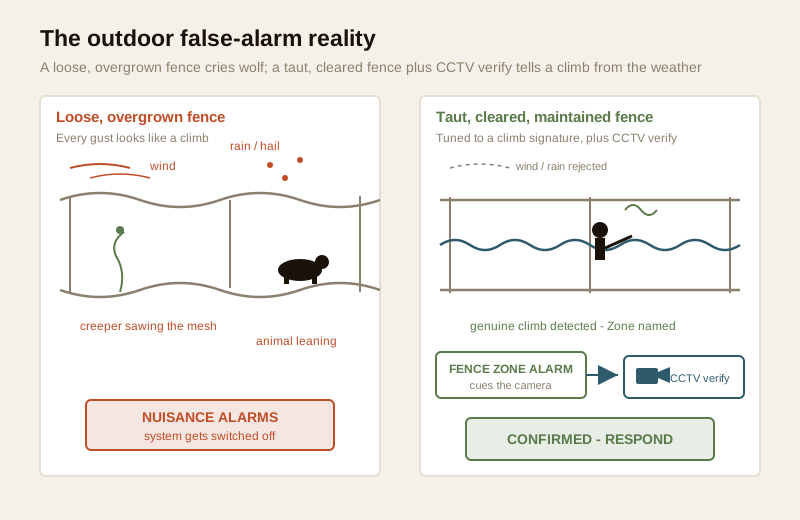
This is where fence detection lives or dies. A fence stands in wind, rain, hail, traffic vibration, animals and growing vegetation — and every one of those can rattle the fabric. In India specifically:
- Wind against a loose or poorly tensioned fence is the single biggest cause of nuisance alarms — a slack chain-link panel drums in a gust and looks, to the sensor, like a climb.
- Rain and especially hail hammer the fabric with broadband noise.
- Traffic and industrial vibration — a fence beside a busy road, a railway line or heavy plant picks up ground-borne shake.
- Animals — stray dogs and cattle leaning on a farm fence, monkeys on a compound line, birds landing on the top rail.
- Vegetation touching the fence — a creeper, a branch or tall grass sawing against the fabric in wind produces a constant low-level disturbance and can mask a real one.
The design responses are all about choosing, mounting and tuning — never about weakening detection or, ever, defeating it:
| Nuisance cause | Design / commissioning response |
|---|---|
| Wind on a loose fence | Tension and maintain the fence first — a taut, rigid fabric is the precondition for any fence sensor; re-tension after monsoon and settlement |
| Rain and hail | Choose a technology and signal-processing tuned to reject broadband weather noise; set an appropriate event threshold; verify on CCTV, never dispatch on the raw sensor alone |
| Traffic / plant vibration | Site-survey the ground-borne noise; tune the affected zones separately; prefer technologies with good signature discrimination on that stretch |
| Animals, birds | Tune thresholds and event-counting so a single light knock is not an alarm; taut-wire and good signature analysis reject these well; clear the line of things that attract perching |
| Vegetation on the fence | Keep a clear zone either side of the fence; trim creepers, branches and grass off the fabric each season |
| Any single event | Verify before response — a fence alarm cues a camera, a human confirms, then a guard acts; this is the real cure for false-alarm fatigue |
Two principles do the heavy lifting. First, the fence is part of the sensor — a fence vibration system can never be better than the fence it is fixed to. A taut, well-fixed, well-maintained fence with a clear zone either side is the foundation; a flapping, corroded, overgrown fence will defeat even a good sensor with noise. Second, verification is the answer to false alarms, not desensitising. The wrong fix is to keep turning the sensitivity down until the system stays quiet — because that is the same as turning off detection for a real climb. The right fix is to tune the signature discrimination and event thresholds so the system tells a climb from a gust, and to pair every zone with a camera so a person confirms the alarm before anyone is dispatched. Tuning is a commissioning task done on-site over days and revisited seasonally, not a one-time factory setting.
Where fence-mounted detection fits — and where it does not
Fence vibration systems earn their cost on long, fenced perimeters where the fence is the primary line and there is distance to defend: factories and warehouses, electrical substations, industrial estates, campuses and institutions, and large farms or agri-estates. These sites have hundreds of metres to kilometres of fence, real assets inside, and usually a guard or control room to receive and act on a zoned alarm. On such a run, continuous sensor cable or fibre gives early, located warning that no number of cameras alone would match, and it multiplies the value of a guard force by telling them exactly where to look.
For an ordinary home, a full fence-detection system is usually overkill and hard to keep false-alarm-free — a typical villa boundary is short, often a masonry compound wall rather than mesh, and better served by gate security, perimeter beam sensors across the gateway, outdoor motion sensors or dual-technology sensors in the yard, and good perimeter CCTV, all tied to the house alarm. A gated community or RWA with a long boundary fence, or an apartment estate with a large perimeter, sits in between — worth considering fence detection on the vulnerable stretches, treated as a shared, specified, maintained project. Assess your own boundary honestly with the site perimeter security assessment and the home security risk scorecard, and see how detection fits the whole building security system and smart security picture. Any mains power, mounting and outdoor cabling is a job for licensed trades — see the electrical hub — and the wider perimeter sub-hub and security hub place this guide among its siblings.
False alarms, neighbourliness & when to bring in a professional. A fence sensor that cries wolf gets switched off, and then it protects no one — so the honest measure of success is not sensitivity but the ratio of real detections to nuisance trips, kept low by a taut fence, careful tuning and CCTV verification. Be a good neighbour: a boundary line you share needs agreement, and any camera that verifies a fence zone and happens to overlook a public road or a neighbour's plot brings the Digital Personal Data Protection Act, 2023 into play — mind what it records and keep footage access controlled. Bring in a professional for the site survey (fence type, run length, electrical environment, ground-borne noise all decide the technology), the installation and commissioning (fibre splicing, taut-wire tensioning, zone mapping and days of on-site tuning are specialist work), and any monitored-service or mains contract, which belongs in writing with a reputable provider.
Key takeaways
- Fence vibration sensors make the fence report on itself — sensing the shock of a cut, the rhythm of a climb or the strain of forcing on the exact stretch of line under attack — turning a barrier that only delays into a boundary that also detects.
- Four technologies, matched to the site: point/shock sensors for short defined runs; microphonic or triboelectric sensor cable for continuous cover on standard mesh; fibre-optic for long, lightning/EMI-hostile runs with no voltage on the line; and taut-wire for high-security perimeters with excellent wind and animal rejection.
- Zoning is what makes response possible — dividing the run so the alarm names the segment (and cues the camera covering it) instead of reporting a disturbance somewhere along kilometres of fence.
- The fence is part of the sensor, and the outdoors is noisy: wind on a loose fence, rain, hail, traffic vibration, animals and vegetation on the fabric all cause nuisance alarms — beaten by a taut, cleared, maintained fence, on-site signature tuning and seasonal re-checks, never by desensitising.
- Detect, then verify, then respond: a fence alarm is worthless alone — pair every zone with perimeter CCTV so a human confirms a genuine climb before a guard, monitoring station or neighbour acts; it best suits long fenced perimeters (factories, substations, campuses, farms) with someone to respond, and is usually overkill for an ordinary home.
References
- The applicable BIS / IEC / EN intrusion-detection and perimeter-security standard for fence-mounted detection equipment — verify the current designation, classification and environmental (weather/EMC) requirements via the BIS catalogue before specifying: https://www.services.bis.gov.in/
- Digital Personal Data Protection Act, 2023 — where a fence-detection system cues cameras that record a public road, a neighbouring plot or shared boundary, the footage is personal data; control access, agree retention, and set any monitoring terms in writing with a reputable provider.
- National Building Code of India (SP 7), Bureau of Indian Standards, and local municipal bye-laws for the electrical, earthing/lightning-protection and boundary aspects of an outdoor fence-detection install; verify the current edition via the BIS catalogue: https://www.services.bis.gov.in/
This is an educational overview, not legal advice. It is strictly about detecting an attack on a fence, never defeating detection. Fence tensioning, mounting, outdoor cabling, mains-connected power, fibre splicing and taut-wire commissioning are qualified professional tasks — engage licensed installers, and verify any standard's current status via the BIS catalogue before relying on it.
Export this guide
Related Guides — Deep-dive reading
Fence Intrusion Detection in India (2026): Sensing an Attack on the Boundary
How fence-mounted sensors — vibration cable, taut-wire, microphonic and fibre-optic — detect someone climbing, cutting or lifting a boundary fence, how to zone a long perimeter, and how to design out the outdoor false alarms.
SecurityBoundary Intrusion Detection in India (2026): Choosing & Layering Perimeter Sensors
The umbrella guide to the perimeter intrusion-detection family — beam, fence-mounted, buried, microwave, outdoor PIR and video analytics — and how to match each to the boundary, reject false alarms, and layer two technologies you verify on camera.
SecurityPerimeter Alarm Systems in India (2026): Detect an Intruder at the Boundary
How an outer detection layer — outdoor motion sensors, beam barriers, fence and wall-top sensors and gate contacts — warns you the moment someone crosses your compound wall, and how to design it for Indian weather without endless false alarms.
SecurityRelated Tools — Try Free
Acoustic Privacy (STC) Visualizer
Indian healthcare acoustic visualizer — compare wall assemblies and noise sources, see received SPL after STC attenuation, and check FGI 2018 / IS 1950 / NABH speech-privacy compliance with live dual-canvas waveform.
Acoustic ToolHome Security Risk Scorecard
Score your home across six security layers — perimeter, entry points, lighting, detection, alarm and habits — and get a prioritised action plan.
Security ScorecardCCTV Camera Coverage & Count Calculator
Estimate how many CCTV cameras you need, the NVR channels, storage in TB for your retention period, and an indicative all-in cost with GST.
CCTV Calculator