
Night Vision CCTV Cameras in India: How Your Cameras See in the Dark
Most break-ins happen after dark, so night performance matters more than daytime megapixels. The four ways a camera sees at night — infrared, low-light, colour night vision and thermal — when each fits, and how to choose.
Most break-ins do not happen in daylight. They happen after dark, when a dim street and a shadowed gate give someone cover. That single fact should change how you shop for a camera: for a home, night vision cctv cameras — how well a camera sees in the dark — matter far more than the daytime megapixel number printed on the box. A 4K camera that goes blind at your unlit gate is worse than a modest one that holds a clear picture all night.
This guide is the overview in Studio Matrx's CCTV hub. Its job is to map the four different ways a camera can see at night, show how each renders the same dark scene, and route you to the deep-dive guide for whichever one fits — not to repeat all of them here. Read this to understand the landscape and make a shortlist; then follow the links for the detail.
Scope & safety. This guide helps you plan and choose. Mounting cameras at height, running cabling and any mains-electrical work belong to licensed professionals — decide the positions and night-vision approach here, then have them installed by a qualified installer. Cameras belong only on your own property and shared areas, never bathrooms, bedrooms or changing areas, and should be positioned to respect neighbours and the spirit of the DPDP Act, 2023.
Why "night vision" is not one thing
Walk into any shop and every camera claims "night vision". That word hides four genuinely different technologies, and the difference between a cheap one and a good one is enormous. Two cameras with the same "night vision" label can give you a crisp, identifiable face at the gate or a grey smear that proves nothing.
The four approaches, at a glance:
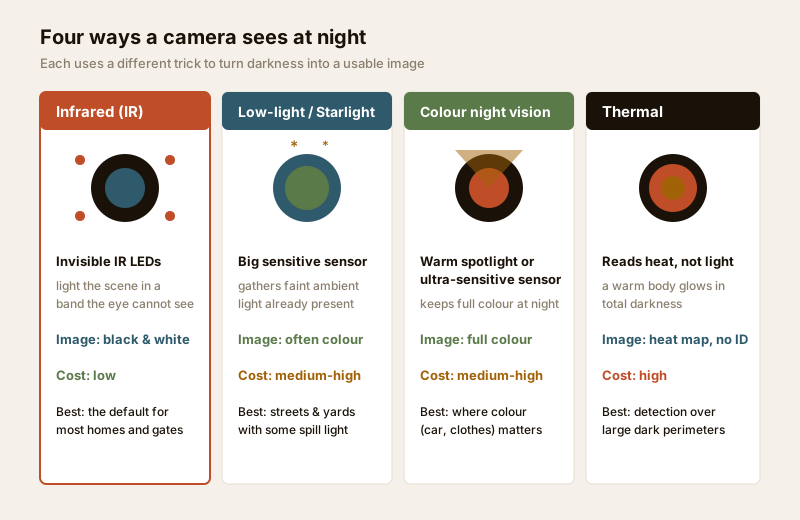
1. Infrared (IR) — the camera floods the scene with invisible infrared light from LEDs around the lens, then reads it back as a black-and-white image. Cheap, reliable, and the default on almost every home camera.
2. Low-light / starlight — a large, unusually sensitive sensor makes the most of whatever faint light is already there (a distant street lamp, moonlight, a porch bulb), often producing a natural colour image with no added light.
3. Colour night vision — keeps a full-colour picture at night, either by switching on a warm white spotlight or by pairing an ultra-sensitive sensor with a bright lens.
4. Thermal — ignores light entirely and reads heat, so a warm human body glows even in total darkness. Superb for detection, useless for identification — you cannot read a face or a number plate off a heat blob.
The same dark scene, four ways
The clearest way to feel the difference is to imagine one scene — a person standing at your gate at 2 a.m. — rendered by each technology.
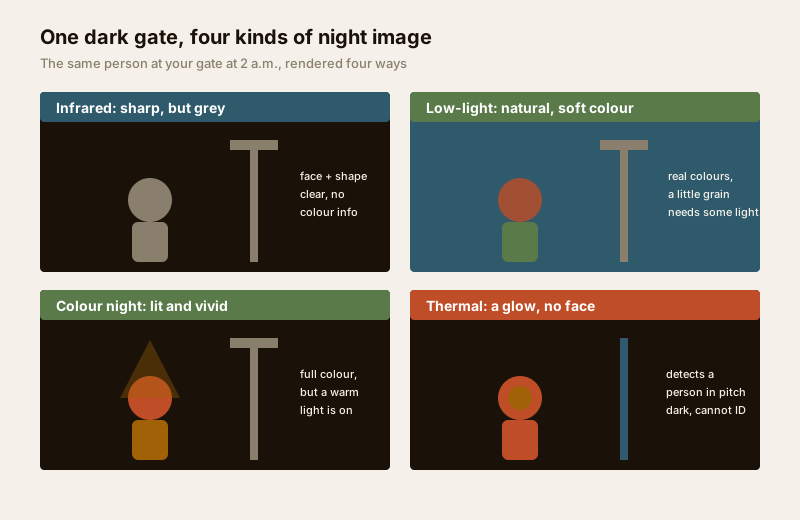
- Infrared gives you a sharp grey face and a clear outline. You can say "a person of that build, that height, wearing that kind of jacket" — but not the colour of anything.
- Low-light gives a natural, soft-colour image if there is even a little spill light, at the cost of some grain. In a lit society lane it can look almost like day.
- Colour night vision gives a bright, vivid colour picture — but usually because a warm light has switched on, which is a design decision with trade-offs (see below).
- Thermal shows a glowing shape. It will trip an alert the instant someone crosses a pitch-dark field, but it will never tell a court who they were.
For the courts-and-insurance reality of what each image can actually prove, the deep-dive guides below go much further than this overview.
The four approaches compared
| Approach | How it sees | Image at night | Best for | Typical cost |
|---|---|---|---|---|
| Infrared (IR) | Invisible IR LEDs light the scene | Black & white, sharp | The default for gates, doors, most homes | Low (built into most cameras) |
| Low-light / starlight | Big sensitive sensor uses ambient light | Natural, often colour, some grain | Streets, yards, lanes with some spill light | Medium–high |
| Colour night vision | Warm spotlight or ultra-sensitive sensor | Full colour, vivid | Spots where colour (car, clothes) matters | Medium–high |
| Thermal | Reads heat, not light | Heat map, no faces | Detection over large, dark perimeters | High |
A few honest caveats this table cannot hold:
- IR quality varies wildly. A cheap camera has a handful of weak LEDs that light only the first few metres and blow out anything close (a bright white blob where a face should be). A good one has stronger, well-diffused IR with a longer, even reach. The label is the same; the result is not. The infrared guide explains how to read IR range and avoid the cheap-LED trap.
- Low-light needs some light. "Starlight" sensors are wonderful on a lit street but still struggle in genuine pitch black — they amplify light, they do not create it. In a truly dark rural plot you are back to IR or a spotlight.
- Colour night vision usually means a light is on. Most affordable "colour night" cameras achieve it with a built-in warm floodlight. That is a real deterrent, but a light shining all night can annoy neighbours and, done badly, dazzles the very camera it feeds.
- Thermal detects, it does not identify. Treat it as a superb tripwire that pairs with an ordinary camera for the ID, not as a standalone.
Lighting is half the answer
Here is the point most buyers miss: the camera is only half of night vision. The lighting around it is the other half. The best low-light sensor in the world does nothing if your gate is pitch black, and even a modest camera looks superb under a well-placed light.
Before you spend on an exotic sensor, assess what light you already have and what you could add. A single well-aimed warm light at the gate often does more for night footage than upgrading the camera — and doubles as a deterrent. Do this properly with the lighting and visibility security assessment, which walks through mapping the dark spots on your plot. Pair it with the blind-spot identification guide so you are not lighting one corner while another stays invisible.
Two India-specific lighting realities to plan around:
- Power cuts. A camera and light that die with the evening load-shedding leave you blind at the worst hour. Plan a UPS for the recorder, network and any critical light — the resilience logic is in the building security systems guide.
- IR glare and reflection. This is the most common night-vision disappointment. IR light bounces off nearby walls, a glass door, a compound gate, monsoon rain, dust or spider webs on the lens — and washes the whole image into a foggy glare. The fixes are all about placement: keep the lens away from close reflective surfaces, do not point IR straight at a wall a metre away, and keep the housing clean.
Which night vision for which spot
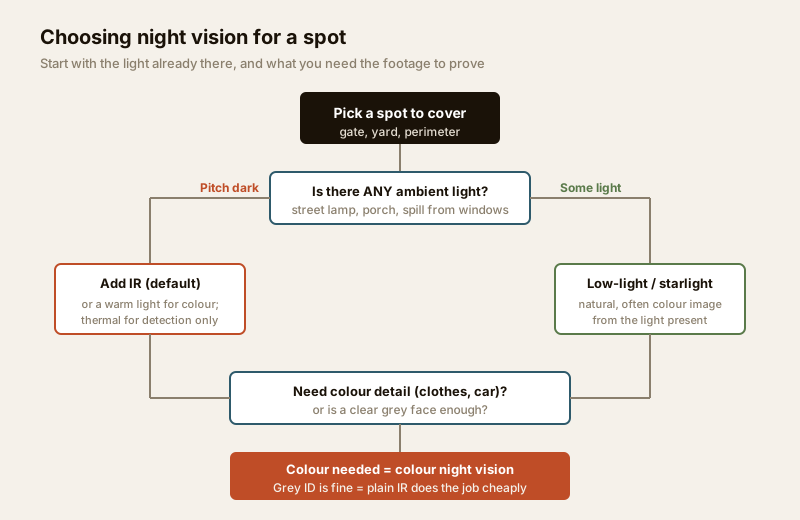
You will almost certainly mix approaches across a home — plain IR where grey is fine, colour where it is not, thermal only if you have a large dark boundary. Match the technology to what each spot needs the footage to prove.
| Spot | Light usually present | Recommended approach | Why |
|---|---|---|---|
| Main gate / front door | Some (street/porch) | Colour night vision or good IR | You want to identify faces; colour helps if there is a warm light |
| Driveway / car porch | Little | Colour night vision (with light) | Car colour and number plate matter |
| Boundary wall / side setback | Little to none | Good IR | Clear grey ID is enough; cheap and reliable |
| Large dark plot / farm perimeter | None | Thermal + IR camera | Thermal detects across the dark; IR camera identifies at the point of interest |
| Lit society lane / parking | Plenty | Low-light / starlight | Ambient light gives natural colour with no added glare |
| Covered stairwell / lift lobby | Artificial, steady | Standard IR or low-light | Consistent indoor light; no exotic sensor needed |
To turn this into a per-view shortlist for your own plot, run the CCTV night vision selector — it asks about the light at each spot and what you need to see, then points to the right technology. Pair it with the camera type selector for the camera shape (a bullet, dome or turret) and the lens field-of-view calculator so the night reach actually covers the zone you care about.
How to read a night-vision spec without being fooled
Marketing leans hard on night vision. A few things to check on the spec sheet before you trust a claim:
- IR range in metres. Treat the headline figure as optimistic. A stated "30 m IR" usually means detect a shape at 30 m, not identify a face. For identification, assume roughly a third of the quoted range.
- Lux rating. A lower minimum lux means the sensor works in dimmer light. "0.001 lux" (colour) is genuinely sensitive; "0.01 lux" with IR is ordinary. "0 lux" only means it has IR to make its own light.
- Sensor size, not just megapixels. A larger sensor gathers more light. Piling megapixels onto a tiny sensor makes night worse, not better, because each pixel gets less light. This is why night performance often beats a big megapixel number.
- Smart IR / IR balance. Good cameras dim the IR for close objects so a face at the gate is not blown white. Look for "smart IR" or similar.
- Weatherproofing. For India, IP66 or better outdoors, so dust and monsoon rain do not fog the lens and ruin every night image. See the outdoor CCTV guide.
Cost a full night-ready scheme — cameras, any added lights, storage and a UPS — with the security system cost estimator, and remember that a modest camera under good light usually beats an expensive one in the dark.
When to bring in a professional
When to bring in a professional. Decide the night-vision approach, the spots and the count yourself using this guide and the selector — then hand the mounting at height, cable pulling, weatherproof terminations, any added security lighting and recorder commissioning to a licensed installer. Any work at the mains board or a new lighting circuit is a licensed electrician's job; see the electrical hub. Ask the installer to check the actual night image on site after dark, not just the daytime picture — that is where good and bad installs separate.
Key takeaways
- For a home, night performance matters more than daytime megapixels — most break-ins happen after dark.
- "Night vision" is four different technologies: infrared (cheap, grey, the default), low-light / starlight (natural colour from ambient light), colour night vision (full colour, usually with a light), and thermal (heat detection, no ID).
- Quality between cheap and good cameras varies enormously — read IR range, lux and sensor size, and watch for IR glare off nearby walls, glass, rain and dust.
- Lighting is half the answer: assess it with the lighting and visibility assessment before buying an exotic sensor.
- Most homes mix approaches; shortlist each view with the CCTV night vision selector, then route mounting, cabling and electrical work to a licensed professional.
References
- Digital Personal Data Protection Act, 2023 — position cameras and any added lighting to cover only your own property and shared areas with a legitimate purpose; avoid capturing neighbours' private spaces.
- Ingress Protection (IP) ratings — verify a camera's weatherproofing (IP66 or higher for outdoors) on the manufacturer's specification sheet, and check IR range, minimum lux and sensor size before ordering.
- National Building Code of India (SP 7), Bureau of Indian Standards, and local municipal bye-laws for any structural, electrical or life-safety aspect of an install; verify the current edition via the BIS catalogue: https://www.services.bis.gov.in/
This is an educational overview. Mounting at height, cabling and any electrical work are qualified professional tasks — engage licensed installers and verify any standard's current status via the BIS catalogue before relying on it.
Export this guide
Related Guides — Deep-dive reading
How to Choose a CCTV Camera (2026): The Homeowner's Decision Guide for India
Cut through the spec-sheet noise and choose the right CCTV camera for each spot around an Indian home. What actually matters — sensor and low-light performance, lens and field of view, form factor, IP and IK ratings, honest smart features — and the marketing claims to ignore.
SecurityInfrared vs Colour Night Vision CCTV in India (2026): Which Sees Better in the Dark?
A homeowner's head-to-head between traditional infrared (IR) night vision, which lights the scene invisibly and shows a black-and-white image, and colour night vision, which keeps the picture in colour at night using a very sensitive sensor and a little white light — with an honest verdict on when each wins and why a hybrid camera is usually the smartest buy.
SecurityColour Night-Vision CCTV Cameras in India: Full-Colour Footage After Dark, Explained
The two ways a camera keeps colour at night — a built-in warm spotlight, or an ultra-sensitive low-light sensor — why colour beats black-and-white for describing clothing and vehicles, and how to choose for an Indian home or shop.
SecurityRelated Tools — Try Free
CCTV Night-Vision Selector
Answer five questions and get the right night technology — infrared, low-light, colour night vision or thermal — with reasons.
Night-VisionCCTV Camera Type Selector
Answer five questions and get the right camera form factor — dome, vandal dome, bullet, turret or PTZ — with reasons.
Camera SelectorCCTV Camera Coverage & Count Calculator
Estimate how many CCTV cameras you need, the NVR channels, storage in TB for your retention period, and an indicative all-in cost with GST.
CCTV Calculator