
Lighting Safety & IP Ratings: Choose the Right Fixture for the Spot (2026)
The homeowner's safety-literacy guide to lighting — how to read the two-digit IP rating, pick the correctly-rated fixture for bathrooms, gardens and wet zones, and know exactly where selecting a light ends and a licensed electrician's wiring begins.
A light fixture is one of the few things in your home that runs on mains electricity, sits where you can touch it, and — in a bathroom or garden — lives next to water. Get the wrong one for the spot and it is not just a fitting that fails early; it is a shock or fire risk in a room you use every day. The good news is that the whole safety question you can control as a homeowner comes down to one habit: read the label, match the rating to the location, and stop at the point where a wire needs connecting.
This guide is the safety-literacy layer for the Lighting hub. It is about selecting the right-rated fixture for a location and knowing where the safety line falls. It does not teach wiring — the deep electrical, earthing and emergency-supply work lives in the Electrical hub, which we cross-link at every hand-off. When you have a shortlist, the IP-rating selector turns a room and zone into a minimum rating in seconds.
Scope & how to read this. Every rating, zone and clearance here is a selection and safety-literacy aid to help you buy the correct fixture and brief a professional — confirm against the relevant IS/IEC codes and your product's marked rating. Anything involving a wire, a circuit, an earth connection, an RCD/ELCB or a mains connection is life-safety work that only a licensed electrician does, designs and certifies — that line is absolute in wet and outdoor areas, where water plus electricity kills. Costs are indicative bands only; get local quotes.
What an IP rating actually tells you
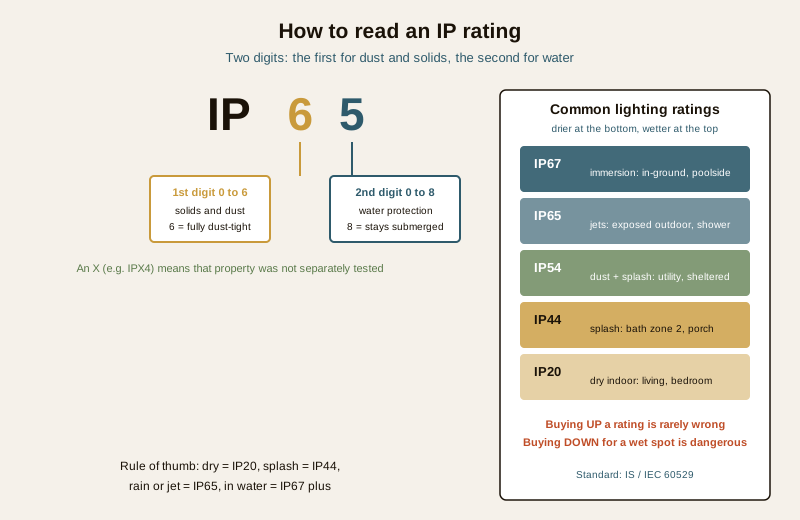
"IP" stands for Ingress Protection, defined under IS/IEC 60529. It is the single most useful two-digit code on any light fixture, and once you can read it you can shop safely for every room. The format is always IP followed by two numbers — for example IP65.
- First digit (0–6): protection against solids and dust. Higher is more sealed. 2 keeps out fingers and large objects; 5 is dust-protected; 6 is fully dust-tight.
- Second digit (0–8): protection against water. This is the one that matters most for safety. 0 is none; 4 resists splashes from any direction; 5 resists low-pressure jets; 6 resists powerful jets; 7 survives temporary immersion; 8 survives continuous immersion.
An "X" sometimes appears in place of a digit (say IPX4) — it means that property was not separately tested, not that it scores zero. When in doubt for a wet or outdoor spot, treat an X in the first position as "assume low" and choose a fixture with two real numbers.
The common lighting ratings, and where each belongs
You do not need all 63 combinations. For home lighting, six ratings cover almost everything.
| IP rating | Protection | Where it belongs |
|---|---|---|
| IP20 | Touch-safe, no water protection | Dry indoor rooms — living, bedroom, dry ceilings, most pendants and chandeliers |
| IP23 | Limited spray | Sheltered semi-outdoor spots like a covered verandah ceiling |
| IP44 | Splash from any direction | Bathroom zone 2, sheltered porch and balcony, covered outdoor walls |
| IP54 | Dust-protected + splash | Utility areas, dusty or partly exposed sheltered outdoor spots |
| IP65 | Dust-tight + water jets | Exposed outdoor walls, garden bollards, shower zone (zone 1), facade wash |
| IP66 | Dust-tight + powerful jets | Coastal or highly exposed facades, sites hosed down for cleaning |
| IP67 | Dust-tight + temporary immersion | In-ground uplights, deck lights, poolside surrounds, spots that flood in monsoon |
| IP68 | Continuous immersion | Fully submerged pool and water-feature lights (specialist, electrician-installed) |
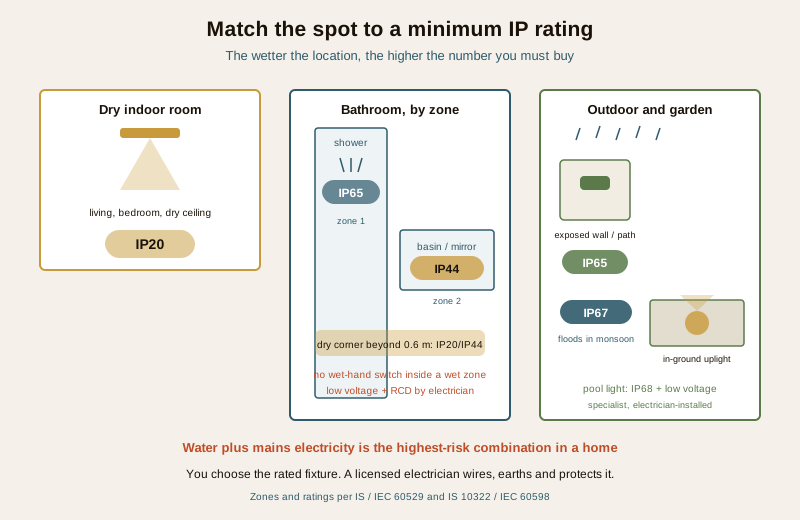
A simple rule of thumb: indoors dry = IP20; splash zone = IP44; anything rain, jet or hose can reach = IP65; anything that sits in or under water = IP67 or IP68. Buying "up" a rating is rarely wrong; buying "down" for a wet spot is dangerous. For the fixture-type choices behind these — outdoor bollards, facade washers, in-ground uplights — see outdoor and landscape lighting and facade and exterior lighting.
Wet and outdoor zones — the part to take seriously
This is the section that prevents accidents. Water and electricity together are the highest-risk combination in a home, so bathrooms and gardens have minimum ratings and extra protection that are not optional.
Bathroom zones
Indian bathrooms are wet rooms, and lighting is mapped by distance from water into zones. Match the fixture rating to the zone — and remember that in and around water many fittings also run at low voltage (12V/24V via a remote driver) and must sit on a circuit protected by an RCD/ELCB, all of which a licensed electrician sets up.
| Bathroom zone | What it covers | Minimum IP | Typical fixtures |
|---|---|---|---|
| Zone 0 | Inside the tub or shower tray itself | IP67 + low voltage | Specialist sealed fittings only, electrician-installed |
| Zone 1 | Above the tub/shower up to ~2.25 m | IP65 (IP44 if never jet-sprayed) | Sealed downlights, shower-rated fixtures |
| Zone 2 | ~0.6 m around the bath/basin, and the WC area | IP44 | Wall lights, mirror lights, splash-rated downlights |
| Outside zones | Beyond 0.6 m, the dry part of the room | IP20 acceptable, IP44 safer | General ceiling lights, decorative fittings |
Two habits keep a bathroom safe: never put a switch you touch with wet hands inside a wet zone (use a pull-cord or an outside switch), and treat the mirror/vanity area as zone 2 minimum. The full design of shaving-shadow-free vanity light sits in bathroom lighting; this guide only sets the safety floor.
Outdoor and garden
Outdoors, everything faces rain, dust, monsoon flooding and — near the coast — salt. The baseline is high:
- Exposed walls, gates, garden paths: IP65 minimum.
- In-ground uplights, deck lights, spots that flood: IP67.
- Pool and water-feature lights: IP68, always low voltage, always electrician-installed.
- Sheltered porches and covered balconies: IP44 can be enough, but IP54/IP65 ages better in Indian dust and monsoon.
Two safety layers are non-negotiable outdoors: low-voltage garden systems (12V/24V) that are inherently safer around people and plants, and an RCD/ELCB on any outdoor lighting circuit so a fault trips the supply in milliseconds. Both are the electrician's job. The design side — throw, glare, dark-sky courtesy — is covered in outdoor and landscape lighting.
Electrical safety basics every homeowner should know
You are not the electrician — but you should be a literate client who can spot a shortcut and insist it be fixed. These are the fundamentals to look for and ask about.
- Earthing. Every metal-bodied fixture must be properly earthed so a fault has a safe path away from you. A metal light on a two-wire, un-earthed connection is a shock waiting to happen. This is checked and connected by the electrician — never assume it is done.
- RCD / ELCB protection. A residual-current device trips the circuit the instant it senses current leaking to earth (through a person, or damp). It is the single most important life-saver on bathroom and outdoor lighting circuits. The deep how-and-why lives in the Electrical hub; your job is to insist wet and outdoor circuits have it.
- Correct load, no overloading. Every circuit and fixture has a rated capacity. Overloading a circuit with too many high-draw fittings, or daisy-chaining strip lights past a driver's rating, causes overheating. Load calculation is the electrician's domain — see the modular switches and sockets guide for the accessory side.
- Quality drivers and gear. A cheap LED driver is the commonest cause of flicker, early failure and heat. Buy fittings with reputable, replaceable drivers; the lighting buying guide covers what to check on the box.
- BIS / ISI-marked fittings. Buy fixtures and LEDs carrying the ISI mark (IS 10322 / IEC 60598 for luminaire safety, IS 16107 for LED performance) and, where relevant, a BEE star rating. The mark is your evidence the product met a safety standard. Unmarked grey-market fittings are the ones that fail dangerously.
- Heat clearance. Fixtures shed heat. Keep recessed and enclosed fittings clear of thermal insulation, timber, paper and fabric, and honour the maker's clearance — more on this below.
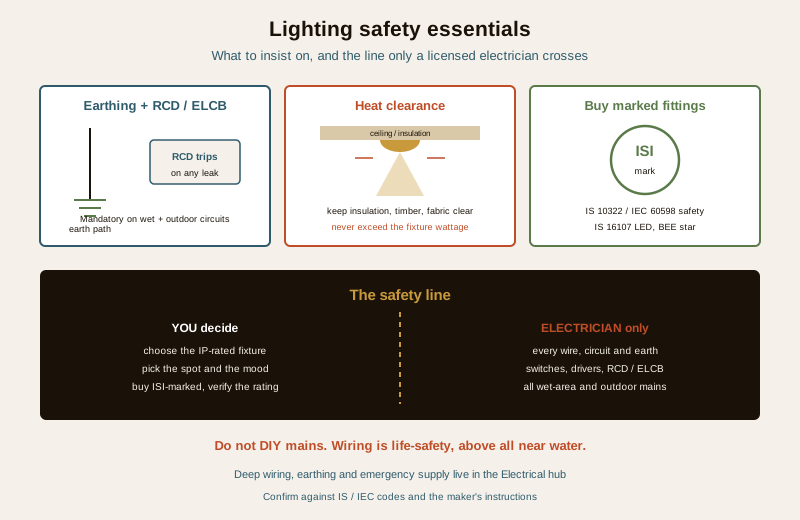
And the line that runs through all of it: do not DIY mains. Selecting a fixture, choosing its rating, deciding where light should fall — that is yours. Connecting it to the supply, extending a circuit, fitting a switch, wiring a bathroom or garden point — that is a licensed electrician's work, and in wet and outdoor areas it is strictly life-safety. Water plus mains electricity is the combination that turns a small mistake into a fatal one.
Heat and fire — the risk people forget
Water gets the attention, but heat causes more quiet damage. Even efficient LEDs, and certainly older halogens, run warm, and a fixture starved of airflow or pressed against something flammable is a slow fire risk.
- Recessed fixture clearance. A downlight buried in a false ceiling needs air around it and a gap from insulation, timber joists and stored items above. Fire-rated or IC-rated (insulation-contact) fittings exist for tight ceilings — ask for them. See the false ceiling guide for the cavity side.
- Halogen and high-wattage heat. Old halogen downlights and display spots get genuinely hot. If you still run any, keep them well clear of curtains and shelving, and prefer swapping them for cool-running LED — the energy-efficient lighting guide covers the switch.
- Fabric, paper and wood shades. Keep cloth lampshades, paper lanterns (a real festival-season hazard around diyas and Diwali decor), and timber fittings clear of hot bulbs. Use LED lamps inside decorative shades so the shade never gets hot.
- Never exceed the fixture's wattage. Every fitting states a maximum lamp wattage. Fitting a bulb above it — common when swapping lamps yourself — overheats the holder and wiring. With LED this is rarely an issue, but check when reusing old fixtures.
Emergency lighting and power-cut safety
Power cuts are a fact of Indian life, and a home that goes fully dark on a staircase or in a bathroom is a fall risk. A few safety-focused choices help: keep a rechargeable or inverter-backed light on stairs, landings and at least one bathroom; place a small night light on the path from bedroom to toilet; and know where your torch and inverter switch are. The full treatment — battery-backup fittings, inverter circuits, and any regulatory emergency-lighting duty — is a wiring subject covered in the emergency lighting guide; an electrician sets up any backed-up circuit.
Child and elderly safety
Lighting choices quietly protect the most vulnerable people in the house.
- No trailing cords. Floor lamps and plug-in fittings with cords across walkways are a trip hazard for elders and a pull hazard for toddlers. Route cords along walls, and prefer fixed wall or ceiling fittings in high-traffic areas. The lamps and portable lighting guide covers safe placement.
- Reachable hot fixtures. Keep hot fittings — table lamps, uplighters, any halogen — out of a small child's reach, and prefer cool-touch LED where little hands roam.
- Night lighting against falls. Low-level, motion-sensor or always-on night lights on stairs, corridors and the bathroom route dramatically cut night-time falls for elderly residents. See staircase and corridor lighting for the layout, and note the accessibility intent behind the RPwD Act 2016.
Outdoor corrosion and weatherproofing
An outdoor fitting can carry a fine IP rating and still fail if the body corrodes. India's monsoon, coastal salt and dust attack the fixture as much as the water does.
- Body material. Choose die-cast aluminium with a good powder-coat, marine-grade stainless steel near the coast, or quality UV-stable polymer. Avoid thin painted steel that rusts at the first scratch.
- Gaskets and glass. The IP seal lives in the gasket and gland. Cracked gaskets and loose covers are how a "waterproof" light lets water in — check them at each service.
- Mounting and drainage. Fittings should shed water, not pond it; in-ground lights need working drainage so they are not sitting in a puddle. This ties into routine lighting maintenance — outdoor fittings need checking every season.
How to verify a rating or mark when buying
A rating only protects you if it is real. Before you buy, especially online or from an unbranded seller:
- Find the IP figure on the fixture or its box, not just the listing text — reputable makers print it on the body or a moulded label.
- Look for the ISI mark and the maker's name; genuine fittings cite IS 10322 / IEC 60598 (safety) and, for LED, IS 16107 (performance) and a BEE star where applicable.
- Be sceptical of "waterproof" with no number. A real outdoor light states IP65 or higher; a listing that only says "waterproof" often means IP44 or less.
- Match the driver rating too — an IP65 fixture on an IP20 driver mounted outside is only as good as its weakest part.
- Keep the box and warranty. Marked, warranted product is your recourse if a fitting fails.
When you have a spot in mind, run it through the IP-rating selector to confirm the minimum, then shortlist with the lighting buying guide.
How it connects
- Start at the complete guide to lighting, then use this safety layer alongside the lighting buying guide and the homeowner's guide to lighting.
- Match ratings to rooms with bathroom lighting, facade and exterior lighting and outdoor and landscape lighting.
- Keep the ratings honest over time with the lighting maintenance guide; confirm minimum ratings with the IP-rating selector.
- Hand every wire, circuit, earth and RCD to the Electrical hub and the emergency lighting guide; the modular switches and sockets guide covers switch accessories.
- For the heat-and-cavity side of recessed fittings, see the false ceiling guide and the energy-efficient lighting guide.
Key takeaways
- Read the two-digit IP rating: first digit is dust/solids (0–6), second is water (0–8). Indoors dry = IP20; splash = IP44; rain or jet = IP65; in or under water = IP67/IP68.
- Wet and outdoor zones have minimum ratings that are not optional — bathroom zone 1 = IP65, zone 2 = IP44, exposed garden = IP65, in-ground = IP67 — plus low voltage and RCD/ELCB protection.
- Selecting the fixture is yours; every wire, circuit, earth, switch and RCD is a licensed electrician's job — absolutely so in wet and outdoor areas, where water plus mains is life-threatening.
- Buy BIS/ISI-marked fittings (IS 10322 / IEC 60598, IS 16107, BEE star) and verify the IP number on the product, not just the listing.
- Heat is the forgotten risk — keep recessed fittings clear of insulation and timber, keep fabric and paper shades off hot lamps, and never exceed a fixture's rated wattage.
- Protect the vulnerable — no trailing cords, cool-touch fittings within reach, and night lighting on stairs and the bathroom route against falls.
- Every rating and clearance here is indicative; confirm against IS/IEC codes and your product's mark, and get a licensed electrician for all wiring.
References
- IS/IEC 60529 — degrees of protection provided by enclosures (the IP code); named generally.
- IS 10322 / IEC 60598 — luminaire safety, general requirements for light fittings; named generally.
- IS 16107 — performance requirements for LED luminaires; named generally.
- National Building Code of India, NBC (SP 7:2026), and IS 3646 — general illumination and interior lighting provisions.
- Bureau of Energy Efficiency (BEE) star rating for LED lighting; Energy Conservation Building Code (ECBC) lighting power density provisions.
- Rights of Persons with Disabilities Act, 2016 (RPwD Act) — accessibility and safe illumination intent.
- A licensed electrician and the manufacturer's installation instructions — all wiring, earthing, RCD/ELCB protection, load and mains connection.
All IP ratings, zones, clearances and cost bands here are indicative selection and safety-literacy aids only; confirm the governing values against IS/IEC codes and your product's marked rating, get local quotes for cost, and have a licensed electrician design, wire, earth and certify every mains, wet-area and outdoor connection.
Export this guide
Related Guides — Deep-dive reading
Bathroom Electrical Safety India: 30 mA RCD/RCBO, IP Ratings & Waterproof Switches
Wet skin plus mains voltage is the deadliest combination in an Indian home. This is a practical safety guide — why the 30 mA RCD/RCBO that trips in milliseconds is non-negotiable, the IP44/IP54/IP65 rating your fittings need by zone, waterproof switches and sockets (or better, switches outside the door), proper earthing and bonding, avoiding the classic geyser-shock scenario, how to test the RCD, and what to fix in an old bathroom — all per IS 732 and IS 3043.
BathroomsWaterproof Bathroom Lights India: IP Ratings, Zones 0/1/2 & Which Fitting Goes Where
A safety-first guide to waterproof bathroom light fittings for Indian homes — what IP44, IP54, IP65 and IP67 actually mean, the bathroom zones (0/1/2) that decide which rating goes where per NBC 2016 and IS 732, sealed downlights, shower- and steam-rated fittings, LED strip in wet areas, RCBO protection and a rupee cost guide.
BathroomsElectrical Safety for Security Systems in India (2026): Powering It Without Peril
A homeowner's guide to the power side of home and RWA security systems, CCTV, alarms, gates, access control and NVRs, done so it protects you instead of quietly becoming a shock or fire hazard. What makes a supply safe, what to insist on, and why the mains work belongs to a licensed electrician.
SecurityRelated Tools — Try Free
Electrical Safety & Load Audit
Home electrical audit — 10 categories, 65+ checkpoints across earthing, RCCB, MCB, wiring, switchboards, appliance circuits, DG/inverter backup.
Safety AuditFalse Ceiling Cost Estimator
Live ₹/sqft across 8 ceiling types — POP, gypsum, designer, metal, PVC, wooden — with cove and spot lighting for 20 Indian cities.
Cost CalculatorMonsoon-Readiness Checklist
Pre-rain home audit across 9 categories — terrace, drains, waterproofing, electrical, HVAC, pest, vehicles, documents.
Seasonal Audit