
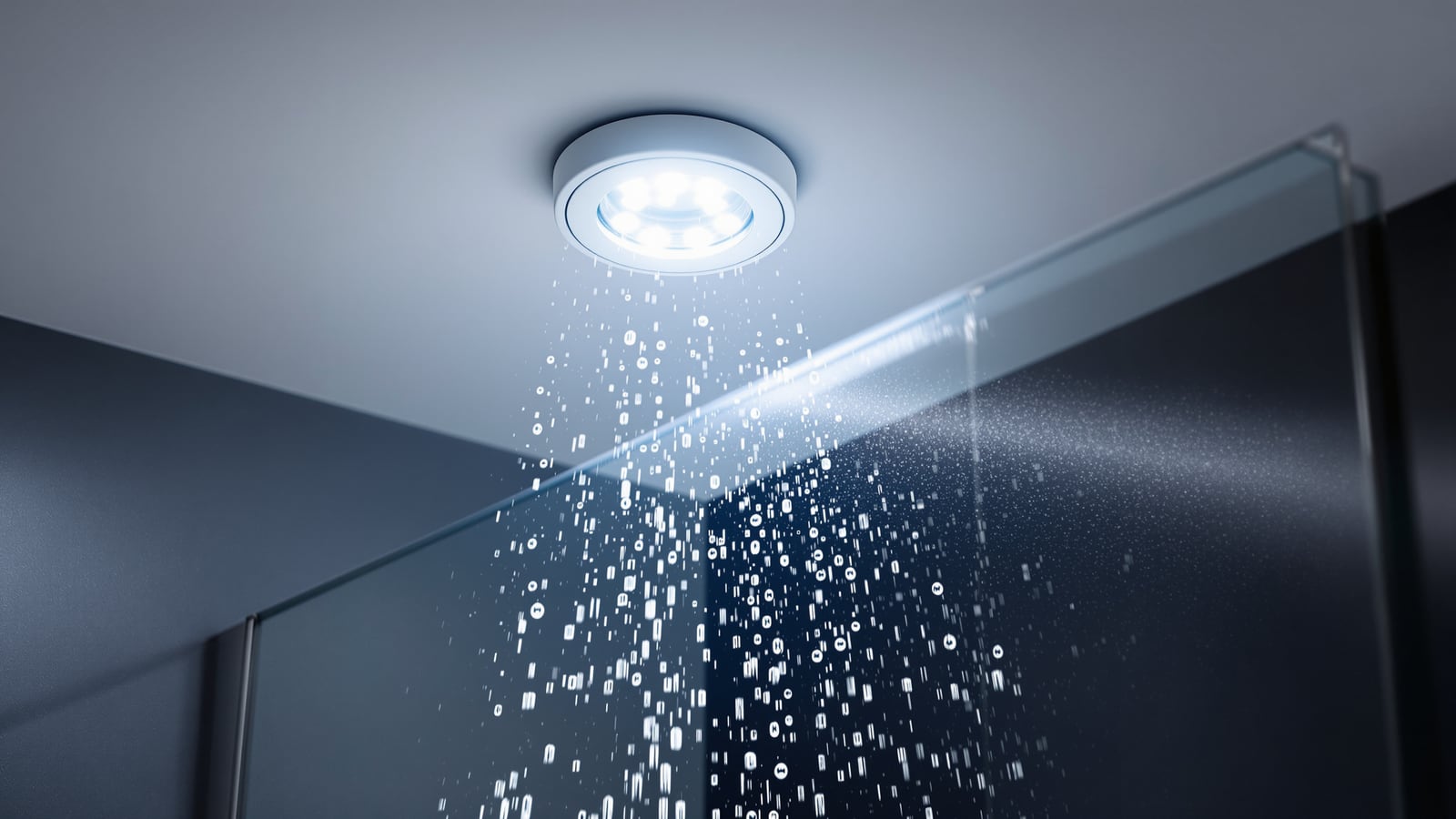
Waterproof Bathroom Lights India: IP Ratings, Zones 0/1/2 & Which Fitting Goes Where
A safety-first guide to waterproof bathroom light fittings for Indian homes — what IP44, IP54, IP65 and IP67 actually mean, the bathroom zones (0/1/2) that decide which rating goes where per NBC 2016 and IS 732, sealed downlights, shower- and steam-rated fittings, LED strip in wet areas, RCBO protection and a rupee cost guide.
A bathroom is the one room in an Indian home where water and electricity share the same air. Steam from a hot shower, splashback from a health faucet, condensation on the ceiling on a humid Chennai afternoon — all of it lands on light fittings that were, in too many homes, bought off the same shelf as the bedroom downlights. Within a couple of monsoons the reflector spots with rust, the driver corrodes, and one morning the fitting either dies or, worse, trips the board with water inside it. The fix is not a fancier light. It is the right waterproof bathroom light — the correct IP rating in the correct zone, protected by the correct breaker.
This is the waterproofing-of-lighting guide in the Studio Matrx bathroom hub. Read it alongside the bathroom lighting guide for India for layers, colour temperature and layout, and the bathroom electrical guide for circuits, earthing and RCBOs. For the room fundamentals, keep the complete bathroom design guide open. If you have a steam shower or a wet-room layout, the zone rules below matter even more, because the whole room becomes a wet zone.
A bathroom light is not chosen for its look first. It is chosen for the zone it sits in — pick the IP rating for the water it will meet, then choose the style that comes in that rating.
What an IP rating actually means
Every serious light fitting carries an IP (Ingress Protection) rating — two digits defined by IS/IEC 60529. The first digit is protection against solids (dust, fingers); the second is protection against water. For bathrooms, the second digit is the one that keeps you safe.
| IP rating | Second digit means | Real-world protection | Where it belongs |
|---|---|---|---|
| IP20 | Not water protected | Dry indoor only | Never in a bathroom wet area |
| IP44 | Splash from any direction | Handles spray and splashback | Zone 2 — near the basin, mirror lights, general ceiling |
| IP54 | Splash + dust protected | Splash-proof, dust-tight-ish | Zone 2 and humid ceilings; a safe general default |
| IP65 | Low-pressure water jets | Withstands direct spray and jets | Zone 1 — over and inside the shower |
| IP67 | Temporary immersion | Survives being briefly submerged | Zone 0 — inside the tub/shower tray, steam units |
The rule of thumb is simple: the wetter the location, the higher the second digit must be. IP44 is the practical minimum for anything in a bathroom wet area; IP65 is the standard for the shower; IP67 is for the rare fitting that sits where standing water can reach it. A common and safe simplification is to run IP54 or IP65 everywhere in a compact Indian bathroom and stop worrying about the boundaries — the small price premium buys years of extra life.
The bathroom zones — where each fitting is allowed
The zones are a way of mapping the room by how much water each spot meets. They come from wiring-regulation practice and are the framework a good electrician in India already works to, alongside NBC 2016 and IS 732. Four bands cover every bathroom:
- Zone 0 — inside the bath tub or the shower tray. The wettest place in the room; a fitting here can sit in standing water. It must be IP67, run on extra-low voltage (typically 12 V SELV through a remote transformer), and is only ever a purpose-made sealed fitting. Most homes simply have no light here.
- Zone 1 — above the tub or inside the shower, up to 2.25 m from the floor. This is directly in the spray and steam. Use a minimum of IP65 — a sealed shower downlight or a steam-rated fitting. This is the single most-abused zone in Indian bathrooms, where an ordinary downlight is dropped straight over the rain shower.
- Zone 2 — the 0.6 m band just outside Zone 1, and around the basin. Splash and mist reach here. Minimum IP44. Mirror lights, vanity lights and the general bathroom ceiling light usually live in Zone 2.
- Outer / dry zone — everything beyond. Away from the water. In theory an ordinary IP20 indoor fitting is tolerated here, but in a humid Indian bathroom IP44 is the sensible floor for anything on the ceiling, because steam does not respect boundary lines.
If you take one thing from this guide: never put an ordinary indoor downlight in Zone 1 over the shower. It is the most common — and most dangerous — bathroom lighting mistake in Indian homes. Zone 1 wants IP65, full stop.
Sealed downlights, shower- and steam-rated fittings
The workhorse of the modern Indian bathroom ceiling is the recessed LED downlight. For wet areas you want the sealed, fire-rated, IP-rated version — not the open-back builder's downlight:
- Sealed downlights (IP65). A gasket seals the trim against the ceiling and the LED module is fully enclosed, so steam cannot reach the driver. These are the correct fitting for Zone 1 and the safe default across the whole ceiling.
- Shower-rated fittings. Purpose-made for directly over the shower — IP65 or better, with a toughened glass or polycarbonate lens and a corrosion-proof (often marine-grade or fully plastic) housing. The exposed ring should be plastic, coated, or 316-grade steel, never bare chrome-on-mild-steel that rusts.
- Steam-rated fittings. A steam shower or hammam is a special case: the whole enclosure fills with hot vapour, so fittings must be rated for high humidity and temperature and run on 12 V SELV. If you are building a steam shower, specify steam-rated luminaires from the start and mount the transformer outside the enclosure.
- Vanity and mirror lights (IP44). Over the basin, IP44 is enough. Backlit mirrors and demister mirror lights should still carry a clear IP44+ rating and a proper driver location — the LED strip inside a mirror still lives in a splash zone.
LED strip and cove lighting in wet areas
Concealed LED strip in a niche, under a floating vanity or in a shower recess looks stunning and is one of the most requested details in Indian bathrooms — but ordinary strip fails fast in wet areas.
- Use IP65 or IP67 encapsulated strip — the silicone-sleeved or resin-filled type — never bare adhesive strip, in any location that sees splash, steam or condensation.
- Keep the driver/transformer out of the wet zone. Mount it in the false-ceiling void, a dry cupboard or outside the bathroom, and run only the low-voltage output to the strip. Never bury a 230 V driver above a wet shower niche.
- Prefer low-voltage (12 V / 24 V) strip for anything inside or near the shower, so even a fault sits at extra-low voltage.
- Seal the cut ends and solder joints — this is where water gets in first. Use the manufacturer's end caps and sealant, not tape.
Why ordinary fittings corrode and short
It helps to know exactly how a cheap fitting fails, because it explains every rule above.
| Failure | What actually happens | Consequence |
|---|---|---|
| Steam ingress | Vapour condenses inside an unsealed housing onto the PCB and driver | Corroded tracks, flickering, early death |
| Rusting housing | Chrome-plated mild-steel rings and springs oxidise in humidity | Brown streaks, seized trim, staining the ceiling |
| Driver corrosion | Electrolytic capacitors and connectors corrode | Driver failure, sometimes a dead short |
| Earth-leakage short | Water bridges live parts to the housing | Leakage current — a real shock risk if the earth or RCBO is weak |
| Terminal creep | Damp gets into a non-sealed junction box | Tracking, tripping, burnt terminals |
None of this is exotic. It is simply what happens when a fitting built for a dry bedroom is asked to live in a steam room. The IP rating is the manufacturer's promise that the housing, gasket and driver are built to keep that water out.
RCBO protection — the safety net behind the IP rating
The IP rating keeps water out of the fitting. The RCBO (or RCD) is what protects the person if water ever gets in anyway. It is the non-negotiable other half of a safe bathroom.
- Every bathroom lighting and power circuit in an Indian home should sit behind a 30 mA RCBO or RCD. It senses earth-leakage current — the tiny current that flows when water bridges live to earth — and disconnects in milliseconds, before it can harm you.
- An RCBO combines earth-leakage and overcurrent protection in one device, so each bathroom circuit gets its own dedicated trip; it is the cleaner choice for new work.
- Pair it with a proper earth — every metal-bodied fitting and the supplementary bonding of metal parts must be earthed to IS 732. An RCBO with no earth is only half a system.
- Keep the switch and any socket out of the wet zones. Light switches belong outside the bathroom or in the dry zone; use a pull-cord or an external switch, and only shaver-type sockets on an isolating transformer inside.
The full circuit design, cable sizing, earthing and RCBO selection sit in the bathroom electrical guide. Treat this lighting guide and that one as a pair — IP rating plus RCBO is the two-part safety promise.
What it costs
Indicative 2026 metro supply prices for the fitting only (a competent electrician's wiring and RCBO are extra). Brand, finish and dimming change these; treat them as planning figures.
| Fitting | Typical IP | Price each (₹) | Where it goes |
|---|---|---|---|
| Ordinary open downlight | IP20 | ₹150 – ₹500 | Not for wet areas — avoid in a bathroom |
| Sealed IP44 downlight | IP44 | ₹450 – ₹1,200 | Zone 2, general humid ceiling |
| IP65 sealed shower downlight | IP65 | ₹800 – ₹2,500 | Zone 1, over the shower |
| Steam-rated / marine luminaire | IP65 – IP67 | ₹2,000 – ₹6,000 | Steam shower, Zone 0/1 |
| IP65/IP67 encapsulated LED strip | IP65 – IP67 | ₹250 – ₹700 / metre | Niches, cove, under-vanity in wet areas |
| Mirror / vanity light | IP44 | ₹1,500 – ₹8,000 | Zone 2, over the basin |
| 30 mA RCBO (per circuit) | — | ₹700 – ₹2,000 | The consumer unit |
The premium for doing it right is small — often a few hundred rupees per fitting — against the cost and hazard of a light that rusts, trips, or shocks. Spend it. Match the IP rating to the zone, protect every circuit with a 30 mA RCBO, keep the drivers dry and the switches outside, and a bathroom lighting layout will run safely for the fitting's full life. For the design side — how many lights, how warm, and where the layers go — read the bathroom lighting guide next, and if you are planning an open wet room remember the whole floor becomes a wet zone, so raise the IP floor accordingly.
References
- National Building Code of India (NBC) 2016, Part 8 (Building Services), Section 2 (Electrical and Allied Installations) — electrical safety, earthing and installations in wet locations.
- IS 732: Code of practice for electrical wiring installations — bathroom circuits, earthing, supplementary bonding and residual-current protection.
- IS/IEC 60529: Degrees of protection provided by enclosures (IP Code) — the definition of the two-digit IP rating for solids and water ingress.
- IS 3043: Code of practice for earthing — earthing of metal-bodied fittings and supplementary equipotential bonding in bathrooms.
- Bureau of Indian Standards (BIS) — the authoritative source for the current text and revision of all IS codes; verify before specifying.
- IGBC / GRIHA green-building references — energy-efficient LED lighting and durable wet-area fittings for sustainable homes.
Export this guide
Related Guides — Deep-dive reading
Bathroom Electrical Safety India: 30 mA RCD/RCBO, IP Ratings & Waterproof Switches
Wet skin plus mains voltage is the deadliest combination in an Indian home. This is a practical safety guide — why the 30 mA RCD/RCBO that trips in milliseconds is non-negotiable, the IP44/IP54/IP65 rating your fittings need by zone, waterproof switches and sockets (or better, switches outside the door), proper earthing and bonding, avoiding the classic geyser-shock scenario, how to test the RCD, and what to fix in an old bathroom — all per IS 732 and IS 3043.
BathroomsLighting Safety & IP Ratings: Choose the Right Fixture for the Spot (2026)
The homeowner's safety-literacy guide to lighting — how to read the two-digit IP rating, pick the correctly-rated fixture for bathrooms, gardens and wet zones, and know exactly where selecting a light ends and a licensed electrician's wiring begins.
LightingBathroom Electrical India: Loads, IP Zones, RCD Protection & the Complete Wiring Plan
The complete guide to bathroom electrical planning for Indian homes — the loads and points (geyser on a dedicated 16 A circuit, exhaust, mirror and lights, shaver socket, smart WC), the IP zones 0/1/2 that fix where fittings can sit near water, mandatory 30 mA RCD/RCBO earth-leakage protection, earthing, keeping switches outside the wet zone, cable sizing and getting conduits right before plastering — all per IS 732 and NBC 2016.
BathroomsRelated Tools — Try Free
Electrical Safety & Load Audit
Home electrical audit — 10 categories, 65+ checkpoints across earthing, RCCB, MCB, wiring, switchboards, appliance circuits, DG/inverter backup.
Safety AuditBathroom Sealant Calculator
How many tubes of silicone sealant a bathroom needs and the cost — by joints to seal, lengths and bead size, with an anti-fungal note.
Bathroom CalculatorFalse Ceiling Cost Estimator
Live ₹/sqft across 8 ceiling types — POP, gypsum, designer, metal, PVC, wooden — with cove and spot lighting for 20 Indian cities.
Cost Calculator