
Modular Switches & Sockets: The Complete Buyer's Guide
The switches and sockets you actually touch every day — how the modular system works, the module sizes and plate system, the socket types and ratings, what the IS standards require, and how to choose a range that is safe, convenient and built to last.
Switches and sockets are the only part of a home's electrical system you touch every day — and the only part most people ever choose by look alone. But behind the finish sits a sensible modular system with real safety and convenience decisions: how many modules a plate holds, what current a socket is rated for, whether it has the right safety features, and whether the range is built to survive a decade of daily use. This guide explains how modular switches and sockets work and how to choose them well.
It sits under the home electrical wiring guide and pairs with the distribution board guide. For automation, see smart switches.
The safety line. Choosing switches and sockets is the homeowner's job; wiring them into a live circuit is the electrician's. Accessories must conform to the Indian Standards — IS 3854 : 2023 for switches and IS 1293 : 2019 for plugs and socket-outlets — and be installed by a licensed electrician. Insist on ISI-marked accessories; the mark is a genuine safety signal.
The modular system
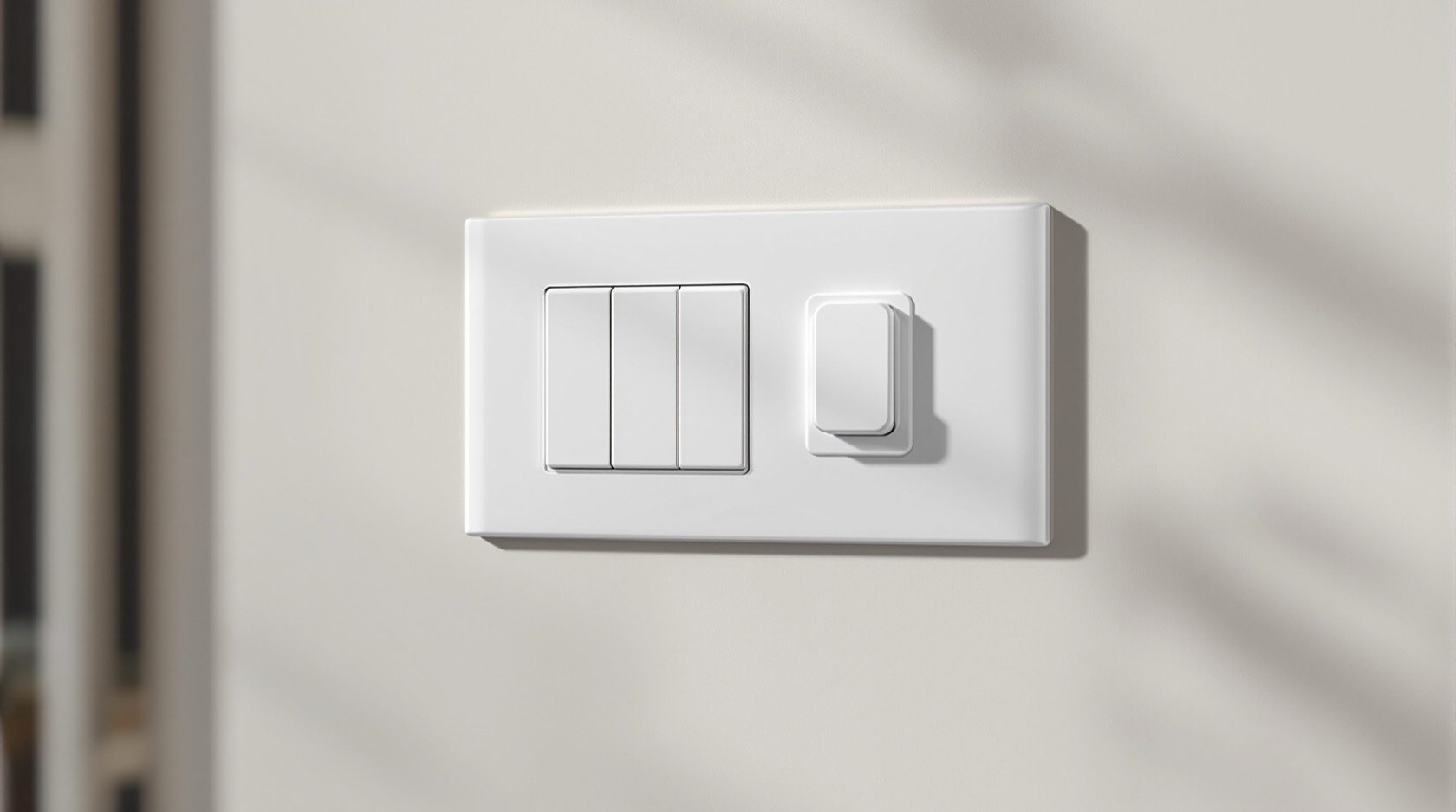
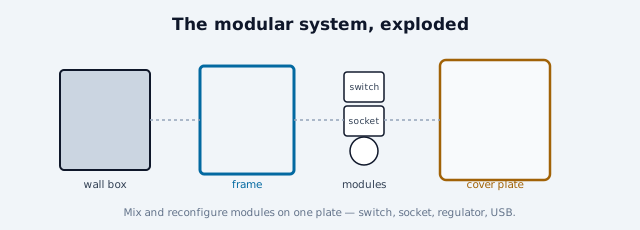
Modern Indian switches and sockets use a modular system: individual functional units — a switch, a socket, a fan regulator, a USB charger, an indicator — each a standard module width that clips into a mounting frame, which is then covered by a decorative plate. This is what lets you mix and match: a single plate might hold two switches, a socket and a regulator, or eight switches, simply by choosing frames and plates of the right size.
- Module widths are counted in units (often "1M", "2M", "3M"…). A plate is sized by how many modules it holds — commonly 2, 3, 4, 6, 8, 12, 18 modules.
- The frame fixes to the wall box; the plate snaps over it for the finished look; the modules do the work.
- This modularity means you can reconfigure a plate later — swap a switch for a socket, add a USB module — without rewiring, as long as the box and circuit suit it.
Switches: types and where they go
The everyday switch is a simple one-way switch that turns a point on or off. Beyond it:
- Two-way switches control one light from two places — essential on staircases, in long rooms and bedrooms (door and bedside). Plan these at the design stage.
- Bell push for doorbells; indicator modules to show a point is live (a geyser, for instance).
- Fan regulators — modern electronic step regulators fit as a module and control fan speed.
- Dimmers for adjustable lighting.
Switch current rating matters: a common lighting switch is rated for small loads, while a heavy point (a geyser, an AC isolator) needs a higher-rated switch (16 A or 20 A) or a dedicated control. Never run a heavy load through an under-rated switch.
Sockets: the ratings that matter
Sockets are where under-rating causes real trouble, so understand the ratings:
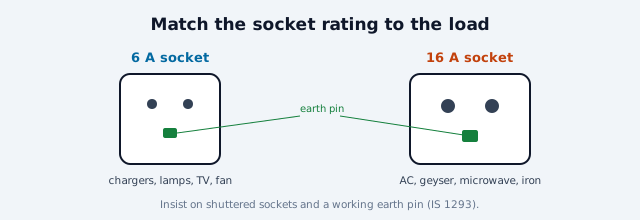
- 6 A sockets — for small plug loads: phone chargers, lamps, a TV, a fan.
- 16 A sockets — for heavy appliances: air-conditioners, geysers, microwaves, irons.
- Universal / combination sockets accept both small (2/3-pin) and large plugs — convenient, but confirm the current rating and that the shutter and earthing suit the appliance.
Two safety features worth insisting on, both reflected in IS 1293:
- Shuttered sockets — spring-loaded shutters that block the live pins until a proper plug is inserted, protecting curious children.
- Proper three-pin earthing — every socket that feeds a metal-bodied appliance must have a working earth pin, connected to the home's earthing.
How to choose a range
Beyond looks, judge a switch-and-socket range on:
- ISI mark and standards — conforms to IS 3854 (switches) and IS 1293 (sockets). Non-negotiable.
- Current ratings that match your loads — enough 16 A points where heavy appliances live.
- Build quality — a switch is operated tens of thousands of times; good contacts and mechanisms last, cheap ones arc, loosen and fail. This is where a reputable brand earns its price.
- Safety features — shutters, proper earthing, and (for wet areas) appropriate protection.
- Enough modules and sockets — the planning guide makes the case: count what you need, then add more, especially in the kitchen and study.
- Consistency — one range throughout looks and works better than a patchwork.
The finish and colour are a pure aesthetics-and-budget choice; the ratings, standards and build quality are the safety-and-durability choice. Decide both consciously.
The one-line answer
Modular switches and sockets clip standard-width modules into a frame and plate, letting you mix switches, sockets, regulators and chargers on one plate and reconfigure later. Choose them on more than looks: insist on ISI-marked accessories to IS 3854 (switches) and IS 1293 (sockets), match socket ratings to your loads (6 A for small plugs, 16 A for heavy appliances), demand shuttered sockets and proper earthing, and pay for build quality on the switches you will operate thousands of times — while a licensed electrician wires them in.
Where to go next
- Automate them: Smart Switches Guide.
- Where the circuits start: Distribution Board Guide.
- Plan the points: Home Electrical Planning.
- The wiring behind them: Home Electrical Wiring Guide.
References
- IS 3854 : 2023, Switches for Domestic and Similar Purposes — Specification, Bureau of Indian Standards.
- IS 1293 : 2019, Plugs and Socket-Outlets for Household and Similar Purposes up to 250 V and 16 A (Fourth Revision), BIS.
- IS 732 : 2019, Code of Practice for Electrical Wiring Installations, BIS.
- National Electrical Code of India, SP 30 : 2023, BIS: https://www.bis.gov.in/
Ratings and features are indicative for typical Indian homes. Accessories must be ISI-marked and installed by a licensed electrician. Verify any standard's status via the BIS catalogue before relying on it.
Export this guide
Related Guides — Deep-dive reading
Residential Electrical Systems: The Complete Guide for Indian Homes
How the electricity in an Indian home actually works — from the utility supply and meter through the distribution board, circuits, wiring, earthing and protection, to lighting, safety, energy efficiency, smart controls, solar and backup — written so a homeowner can understand, plan and judge it, and know exactly where a licensed electrician must take over.
Electrical & WiringKitchen Electrical: Wiring, Circuits & Points for an Indian Kitchen
The highest-load, highest-risk room in the home — how to plan a kitchen's electrics: enough 16A socket points at counter height, dedicated circuits for heavy appliances, RCCB protection near water, and the layout that makes a modular kitchen work, all specified before the tiles go up.
Electrical & WiringLighting Controls & Dimming Design: Zones, Scenes & Switches (2026)
How to plan lighting control so an Indian home's light is flexible — split each room's layers onto separate switches, choose dimmers that actually work with LEDs, add two-way switching where you need it, and layer scenes on top. The design decisions you must settle before the electrician wires.
LightingRelated Tools — Try Free
Electrical Safety & Load Audit
Home electrical audit — 10 categories, 65+ checkpoints across earthing, RCCB, MCB, wiring, switchboards, appliance circuits, DG/inverter backup.
Safety AuditEarth Conductor Size Calculator
Find the minimum protective (earth) conductor size for a circuit from its phase conductor size, using the standard IS 732 / IEC 60364 rule.
ElectricalElectrical Load Calculator
Estimate a home's connected load and realistic maximum demand from its appliances, whether it needs single or three-phase supply, and a suggested main switch rating.
Electrical