
Electrical Safety for Security Systems in India (2026): Powering It Without Peril
A homeowner's guide to the power side of home and RWA security systems, CCTV, alarms, gates, access control and NVRs, done so it protects you instead of quietly becoming a shock or fire hazard. What makes a supply safe, what to insist on, and why the mains work belongs to a licensed electrician.
A security system is only as safe as the power feeding it. The cameras, the alarm panel, the gate motor, the access reader and the recorder all run on electricity, and that electricity has to be delivered by wiring that is sized right, protected right and earthed right. Do that well and the system sits quietly in the background for years. Do it with a tangle of extension boards, loose joints and "it works, leave it" wiring, and the very system meant to keep your family safe becomes a source of shocks, tripped power and, at worst, an electrical fire.
This guide is about that power side, not the cameras themselves. It explains, in plain language, what a safe supply for home and Resident Welfare Association (RWA) security gear looks like, what to insist your installer and electrician provide, and the handful of ideas, protection, earthing, surge defence and clean battery backup, that keep the whole thing safe. It is written for a homeowner who wants to know what good looks like and what to refuse. The mains work here is not a do-it-yourself job, and the guide says so plainly and often.
Scope and how to read this. This is practical electrical-safety literacy for the power side of a security system, not legal advice, an electrician's manual or authoritative code. Wiring rules, ratings and approvals are set under the Electricity Act and the Central Electricity Authority (CEA) safety regulations and are enforced locally, and they vary by state and change over time, so always confirm the current position with a licensed electrical contractor, the electrical inspectorate or the Authority Having Jurisdiction before you act. Mains work belongs to a licensed electrician, full stop.
Why the power side deserves its own attention
When people buy a security system they compare cameras, resolution and app features. Almost nobody asks how it will be powered, and that is exactly where the avoidable dangers hide. A camera can be excellent and still be wired off a daisy chain of extension boards. An alarm panel can be top of the range and still sit on a socket with no earth. The recorder can be fine and still cook itself because its supply shares an overloaded circuit with the geyser.
The failures show up in two ways. The first is the system simply dying, tripping the power, browning out, or corroding at an outdoor joint until the camera goes dark, usually on the night you needed it. The second is the dangerous kind: a live surface you can touch, an overheating cable inside a wall, or a fire that starts at a bad joint. Both come from the same root, treating the power feed as an afterthought rather than as the foundation the rest of the system stands on.
The fundamentals of a safe supply
A safe power feed for a security system is not exotic. It is ordinary good wiring practice applied properly, and it comes down to a few things you can ask for by name and check are present.
A properly wired, ideally dedicated supply
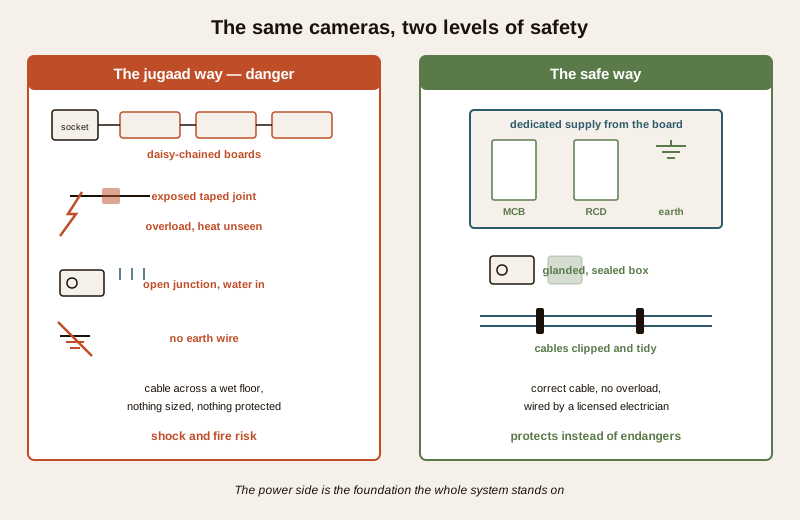
The security load, especially the recorder and any always-on gear, is happiest on a clean, properly wired supply rather than sharing a socket with heavy appliances. For anything beyond a single plug-in camera, a dedicated circuit run by an electrician is the right approach, so a tripping geyser or a failing motor elsewhere in the house does not take your cameras down with it. What you should never accept is the opposite extreme: a stack of plug-in extension boards feeding one another, or bare "jugaad" wiring twisted together and taped. That is how overloads, loose contacts and heat build up out of sight.
Correct protection: MCB and RCD
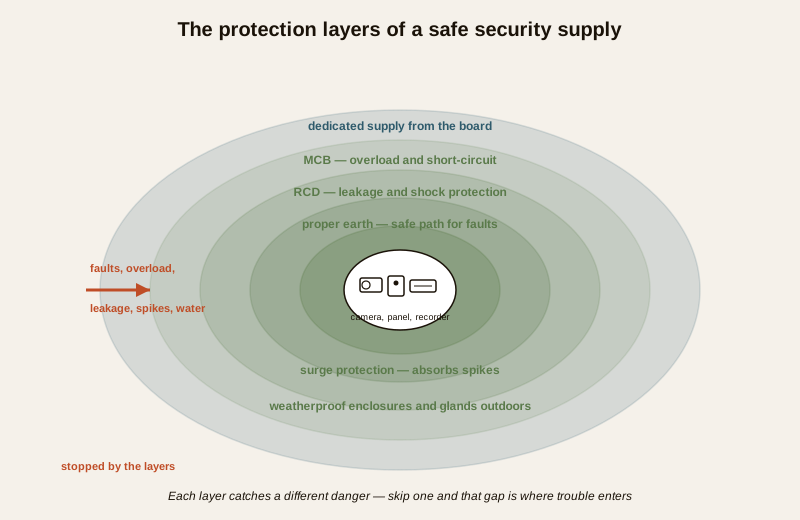
Every circuit needs the right protective devices. A Miniature Circuit Breaker (MCB) protects the cable against overload and short circuit, cutting power before a fault overheats the wire. A Residual Current Device (RCD), also called an RCCB, watches for current leaking to earth, the signature of a shock path or an insulation failure, and disconnects fast enough to protect a person. For a security supply that includes outdoor equipment exposed to weather, that leakage protection matters a great deal. The exact ratings and arrangement are for your electrician to select for your installation, not for you to guess, but you can and should confirm that both overload protection and residual-current protection are present rather than absent.
Correct cable, correctly rated, no overload
Cable must be sized and rated for the load it carries and the environment it runs through, and outdoor runs need cable suited to sun, heat and moisture. Undersized or unsuitable cable run hard is a classic hidden fire risk. The right size for your run is a decision for the electrician against the actual load and length, so this guide will not hand you a number to copy, because a wrong number is worse than none. The principle you can hold onto is simple: never keep adding devices to a circuit that was not designed for them, and never assume a thin flex is fine because it happens to fit.
A licensed electrician does the mains work
This is the non-negotiable one. Connecting to the mains, adding a circuit, working in the distribution board, running fixed wiring, all of it belongs to a licensed electrician working to the CEA safety regulations and using ISI or BIS-marked electrical products. It is not a weekend project, and a security installer who is not a licensed electrician should not be improvising mains connections either. You can mount a camera bracket; you should not be wiring a new circuit. If in doubt, the honest answer is always to bring in a licensed electrical contractor.
The concepts that keep it safe
Beyond a sound supply, a few protective ideas turn "it works today" into "it stays safe for years." These are worth understanding because they are exactly what a cut-price installation quietly skips.
Earthing
A proper earth is the invisible safety net under everything electrical. It gives fault current a safe path and lets the protective devices do their job, and without it a metal camera housing or gate motor casing can become live and dangerous. Earthing is central enough that it has its own guide: see earthing for CCTV and security equipment for what good earthing looks like and why a system without it is a system waiting to bite.
Surge and spike protection
India's supply brings voltage spikes, from switching, from the grid and from lightning nearby, and electronic security gear is sensitive to them. A surge can fry a recorder or a camera line in an instant, and it tends to strike the whole system at once. Coordinated surge protection, chosen and fitted by a professional, is cheap insurance against an expensive, sudden loss. The surge protection for CCTV guide covers how this layer works and where it belongs.
Keep low-voltage signal away from mains
A security system mixes mains power with low-voltage signal and data, camera cabling, alarm loops, network cable for Power over Ethernet (PoE). Running signal cable alongside or bundled with mains invites interference and, if insulation is damaged, danger. Good practice keeps the two separated and routed sensibly. The security cabling requirements guide sets out how the cabling side should be run so it stays both reliable and safe.
Weatherproofing outdoors
Anything outdoors, a camera, a gate reader, a junction, lives in dust, heat and monsoon. Every outdoor connection belongs in a weatherproof enclosure, with cables entering through proper glands so water cannot track in. An open junction box or an unsealed cable entry is how a working outdoor camera becomes a corroded, tripping hazard after one wet season. Match the enclosure and glands to the exposure, and never leave a joint bare to the sky.
Never overload
Overload is the quiet cause behind a lot of electrical trouble: too many devices on one circuit, too many boards on one socket, a supply asked to carry more than it was built for. Heat builds where you cannot see it. The cure is design, size the supply for the load and add capacity properly rather than piggybacking, and the discipline to stop adding to a circuit that was never meant to grow.
Battery backup and UPS, done safely
Security gear usually needs to ride through a power cut, so a UPS or battery backup is normal and sensible. It is also where a few safety points get overlooked. Batteries give off heat and, in some types, gas, so they need ventilation and must never be boxed into an airless cupboard or buried behind furniture where heat cannot escape. Use quality cells and a proper unit rather than the cheapest available, keep the area clear and dry, and do not let the backup become a fire risk in the name of uptime. The CCTV power supply and UPS guide covers sizing and running battery backup safely, including why ventilation and cell quality are not optional.
The regulatory backdrop, by name
You do not need to master the rulebook, but it helps to know it exists and who owns it. Electrical work in India sits under the Electricity Act and the safety regulations of the Central Electricity Authority (CEA), and electrical products should carry the appropriate ISI or BIS mark. Fixed wiring is generally expected to be done by a licensed electrical contractor, and for larger installations, an RWA-scale or commercial system rather than a couple of home cameras, an electrical inspection or approval may come into play. The exact thresholds, licences and approvals vary by state and change, so treat this as a prompt to ask, not a checklist to rely on. Confirm what applies to your installation with a licensed electrical contractor or the electrical inspectorate. For the wider compliance picture around security and fire systems, the security regulations overview is the place to start.
This is not legal or electrical-code advice. Wiring standards, product requirements and approval thresholds are set under the Electricity Act and CEA regulations and enforced locally, they vary by state and city, and they change. Nothing here is a substitute for a licensed electrical contractor and the local authority. Verify the current requirements for your situation before you act.
Where electrical safety and life safety overlap
A security system must never make the building less safe. Two overlaps matter most. First, the security installation must not compromise the building's electrical safety, no defeated earths, no removed protection, no overloaded boards left behind because the security load was crammed in. Second, and critically, security equipment and its wiring must not block, disable or obstruct fire-safety systems: do not run cables across a fire panel, do not sit a recorder or UPS where it blocks access to fire equipment, and do not let a security retrofit interfere with detection, alarms or escape. If a choice ever pits system uptime against life safety, life safety wins. The electrical fire safety guide covers how bad electrical work turns into fire risk, and it applies squarely to a security system's power side.
The safe-power checklist, and the never-do list
Run these two lists past any security installation, existing or proposed. The first is what a safe power side should have; the second is what should stop the job.
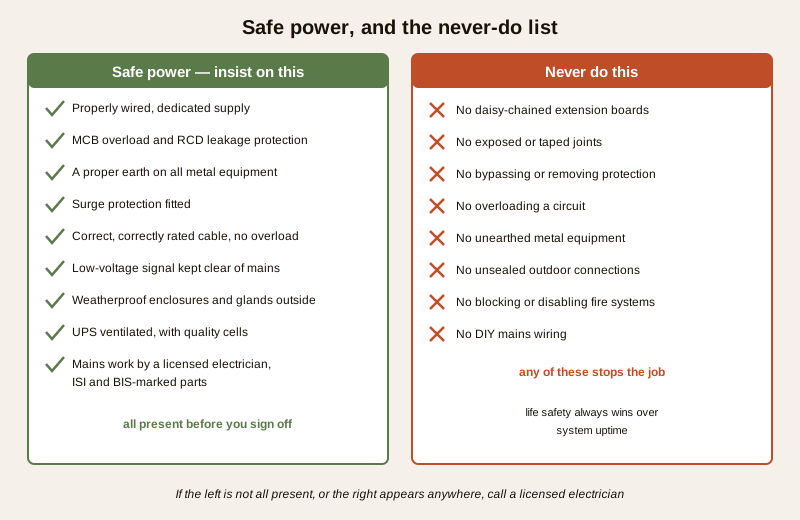
Safe power, insist on this. A properly wired, ideally dedicated supply for the security load. Both overload protection (MCB) and leakage protection (RCD) present. A proper earth on all metal equipment. Surge protection fitted. Cable that is correct and correctly rated for its load and environment, with no overload. Low-voltage signal and data kept clear of mains. Weatherproof enclosures and glands on every outdoor connection. A UPS that is ventilated, unobstructed and built from quality cells. And all mains work done by a licensed electrician using ISI or BIS-marked products.
Never do this. No daisy-chained extension boards feeding the system. No exposed, twisted or taped joints. No bypassing or removing protective devices. No overloading a circuit past what it was designed for. No unearthed metal equipment. No unsealed outdoor connections. No security wiring that blocks or disables a fire system. And no do-it-yourself mains wiring, that connection is a licensed electrician's job every time.
Key takeaways
- The power side is the foundation, not an afterthought. Excellent cameras on a bad supply are still a shock and fire risk. Ask how the system will be powered before you admire what it can see.
- Insist on the basics: dedicated supply, MCB and RCD, correct cable, no overload. These are ordinary good practice, and their absence is exactly what a cheap installation hides.
- Earthing, surge protection, signal separation and weatherproofing are the safety layers that last. Each catches a different danger, so skipping one leaves a real gap. Link through to the earthing and surge guides for the detail.
- Back-up power must be safe too. Ventilate the UPS, use quality cells, keep it clear, and never trade fire safety for uptime.
- Mains work belongs to a licensed electrician. The Electricity Act and CEA safety regulations, ISI and BIS-marked products, and local approvals all point the same way. This is not a DIY job, and life safety always wins.
Where to go next
- Earthing for CCTV and security equipment — the safety net under everything electrical in your system.
- Surge protection for CCTV — defending sensitive gear against India's spikes.
- CCTV power supply and UPS — sizing and running battery backup safely.
- Security cabling requirements — running signal and power so both stay safe and reliable.
- Electrical fire safety — how bad electrical work becomes fire, and how to avoid it.
- Security regulations overview — the wider compliance picture this power-side safety sits inside.
References
- The Electricity Act and the Central Electricity Authority (CEA) safety regulations — the framework under which electrical installation and safety are governed in India; fixed wiring is generally to be carried out by a licensed electrical contractor and, for larger installations, electrical inspection or approval may apply. Requirements are enforced locally and change; verify the current position with a licensed electrical contractor or the electrical inspectorate.
- Bureau of Indian Standards (BIS) and the ISI mark — electrical products used in an installation should carry the appropriate ISI or BIS mark; confirm a specific mark and licence via the BIS portal: https://www.services.bis.gov.in/
- National Building Code of India (SP 7) and the local fire authority — govern the fire-safety systems a security installation must never obstruct or compromise; where security and fire installations overlap, life safety takes precedence, and the fire officer signs off the fire installation.
This is an educational guide to the electrical-safety side of home and RWA security systems, not legal advice, an electrical-code manual or a substitute for a licensed electrician. Wiring rules, product requirements and approvals vary by state and city and change over time; always engage a licensed electrical contractor for mains work and confirm the current requirements with the electrical inspectorate or Authority Having Jurisdiction before you act.
Export this guide
Related Guides — Deep-dive reading
Electrical Fire Safety in India (2026): Overloads, Wiring and the Right Protection
Why electrical faults cause so many Indian building fires, and the fix: correct cable sizing and a properly designed board by a licensed electrician, MCB plus RCCB protection, no overloading, and never water on a live fire.
SecuritySecurity and Fire Regulations Guide for India (2026): Know the Rules and How to Navigate Them
There is no single national rulebook you can read off. This is the map of the whole regulatory landscape for home, housing-society and commercial security and fire systems in India, and a calm way to navigate it: who sets the rules, who approves what, and how to stay on the right side of them.
SecurityEarthing for CCTV and Security Equipment in India (2026): The Ground Truth
Why proper earthing quietly keeps your security system safe, alive and clear, what a good earth actually is in plain language, the tell-tale signs of a bad one, and why the earth itself is a job for a licensed electrician, never a do-it-yourself improvisation.
SecurityRelated Tools — Try Free
Electrical Safety & Load Audit
Home electrical audit — 10 categories, 65+ checkpoints across earthing, RCCB, MCB, wiring, switchboards, appliance circuits, DG/inverter backup.
Safety AuditSecurity Cabling & PoE Planner
Estimate cable length, drops, PoE power budget, the right switch, conduit and cost for a CCTV/security cabling plan.
Cabling PlannerSecurity Backup Power Calculator
Size a UPS/inverter and battery to keep CCTV, NVR, router and alarm running through a power cut — load, Ah, VA and cost.
Backup Power