
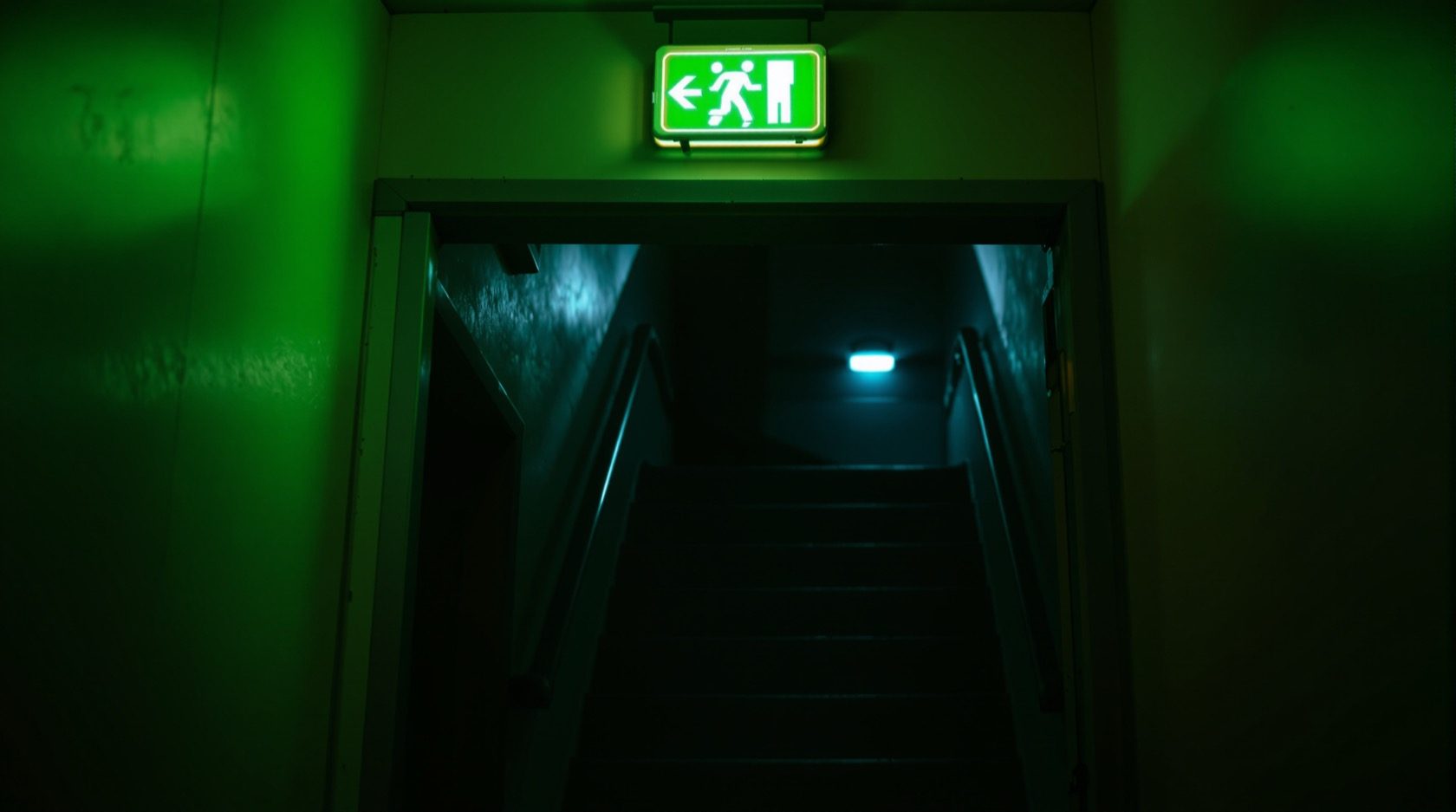
Emergency Lighting: Staying Safe When the Power Fails
The lighting that switches on automatically when normal power fails — why escape routes must stay lit, the difference between maintained and non-maintained fittings, where it is required in buildings, and the simpler options that keep a home safe during an outage.
When the power fails, an ordinary building goes instantly, completely dark — and if that failure coincides with a fire or an emergency, darkness turns a manageable evacuation into a dangerous one. Emergency lighting is the layer that prevents this: fittings that switch on automatically the moment normal power is lost, keeping escape routes, stairs and exits visible long enough for people to get out safely. This guide explains how it works, where it is required, and the simpler measures that keep a home safe during the routine power cuts common across India.
It complements the layers of protection guide and, for larger buildings, the building electrical services guide.
The safety line. Emergency and fire-safety lighting in any building beyond a simple home is a regulated, professionally-designed system — installed and certified by qualified people to the fire and building codes. This guide is an orientation; it does not replace a fire-safety design. For a home, the "emergency lighting" that matters is mostly about a sensible backup for outages.
What emergency lighting does
Emergency lighting is any lighting that operates automatically on failure of the normal supply, powered by a battery (in the fitting or a central system) or a generator. Its job is not to light the building normally, but to provide enough light, fast enough, for long enough, to:
- Keep escape routes, corridors and stairs visible so people can evacuate.
- Illuminate exit signs so people can find the way out.
- Light points of emphasis — fire equipment, changes of level, exit doors.
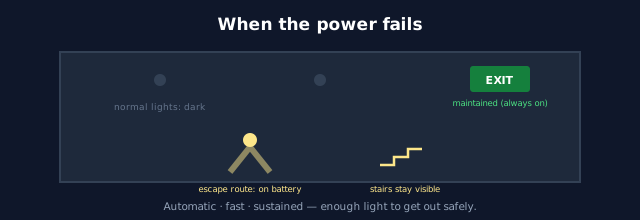
The key qualities are automatic (no one has to switch it on — it senses the power loss), fast (it comes on within a second or so), and sustained (it runs for a defined duration, commonly measured in hours, on its battery).
Maintained vs non-maintained
Two configurations, and the distinction is worth knowing:
- Non-maintained — the emergency fitting is off during normal power and only lights up when the mains fails. Common for escape-route lighting where normal lighting already lights the area.
- Maintained — the fitting is always on (on mains normally, on battery when the mains fails). Used for exit signs and areas that must stay lit continuously, like assembly spaces.
Exit signs are typically maintained (always visible); escape-route lights are often non-maintained (appear when needed). A complete system uses both appropriately.
Where it is required
Emergency and exit lighting is a fire-and-life-safety requirement for a wide range of buildings — apartments and housing societies, offices, shops, schools, hospitals, hotels, assembly buildings and anywhere numbers of people must evacuate. The requirements come from the National Building Code of India (Part 4, Fire & Life Safety) and the local fire service rules. An important honesty note: the widely-quoted NBC 2016 (SP 7 : 2016) edition has been withdrawn and superseded by SP 7 : 2026 — much of practice still cites the 2016 edition, so confirm the current provisions against SP 7 : 2026 and your local fire rules. Compliance, design and certification for these buildings are the domain of fire-safety professionals and the authorities.
For a standalone home, formal emergency lighting is generally not mandated the way it is for multi-occupancy and public buildings — but the principle still helps, especially given India's power cuts.
Emergency light for an Indian home
For a home, "emergency lighting" mostly means not being left in the dark during an outage, and there are simple, effective options:
- Rechargeable emergency lamps / LED emergency bulbs — bulbs and lanterns with a built-in battery that light up automatically (or on a switch) when the power fails. Cheap, effective, and worth having at the stairs, kitchen and a couple of key rooms.
- Inverter-backed lighting — if the home has an inverter and battery, wiring the essential lights (stairs, a few rooms) to the backed-up circuit keeps them on through an outage automatically. This is the cleanest home solution.
- A well-placed torch / lantern at known spots — low-tech but reliable.
- Two-way switched, backed-up stair lighting — stairs are where darkness is most dangerous; make sure they can be lit during an outage.
For a home, the practical goals are simple: the stairs never go pitch dark, and you can always find light when the power drops.
The one-line answer
Emergency lighting switches on automatically when normal power fails, keeping escape routes, stairs and exit signs visible long enough to evacuate safely — with "maintained" fittings (always on, like exit signs) and "non-maintained" fittings (appear only on failure) used appropriately. For apartments, offices and public buildings it is a fire-and-life-safety requirement under the National Building Code (Part 4) — note the widely-cited NBC 2016 is withdrawn, superseded by SP 7 : 2026 — designed and certified by professionals. For a standalone home it is mostly about sensible backup: rechargeable emergency lamps, inverter-backed essential lights, and never letting the stairs go pitch dark.
Where to go next
- The whole safety picture: Layers of Electrical Protection.
- Backup power for the home: Residential Electrical Systems.
- Larger-building systems: Building Electrical Services.
- The lighting design: Home Lighting Design Guide.
References
- National Building Code of India, Part 4 (Fire & Life Safety) — note SP 7 : 2016 (NBC 2016) is withdrawn, superseded by SP 7 : 2026; verify current provisions via the BIS catalogue.
- IS 16102 (Parts 1 & 2), Self-Ballasted LED Lamps for General Lighting Services, Bureau of Indian Standards.
- IS 3646 : Part 1 : 2025, Interior Illumination — Code of Practice, BIS.
- National Electrical Code of India, SP 30 : 2023, BIS: https://www.bis.gov.in/
Emergency-lighting requirements for buildings are set by the fire and building codes and local authorities and must be designed and certified by professionals. Home guidance here is general. Verify any standard's status via the BIS catalogue before relying on it.
Export this guide
Related Guides — Deep-dive reading
Emergency Lighting in India (2026): Seeing Your Way Out When the Power Fails
The battery-backed luminaires that keep escape routes, stairs and exit doors visible when a fire or an ordinary power cut kills the mains - how they work, the duration the code demands, and why so many are dead when needed.
SecurityEmergency Lighting Testing in India (2026): The Function Test, the Duration Test and the Battery That Quietly Dies
Emergency lighting is what gets people out of a building in a power cut or a fire — and it is useless if its batteries have silently gone flat. This professional guide covers what emergency lighting is, the two tests that keep it honest (the short frequent function test and the longer periodic duration test that catches dying batteries), what to test across escape routes, stairs and exit signs, the statutory test log, and the safe split of who does what.
SecurityLift and Fire Safety Planning (India): What Home Lifts Must Do When There's a Fire
Why your home lift is never the escape route, how fire recall works, when a fireman's lift is required, and the local fire NOC and bye-law checks every Indian homeowner should make.
Home Lifts & AccessibilityRelated Tools — Try Free
Inverter & Battery Calculator
Size a home inverter (VA) and battery (Ah) for the load you want to back up and the hours of backup you need.
Backup PowerRoom Lighting Calculator
Estimate the target lux, total lumens and number of LED fixtures a room needs, from its type and size — a general-illumination planning guide.
LightingSecurity Backup Power Calculator
Size a UPS/inverter and battery to keep CCTV, NVR, router and alarm running through a power cut — load, Ah, VA and cost.
Backup Power