
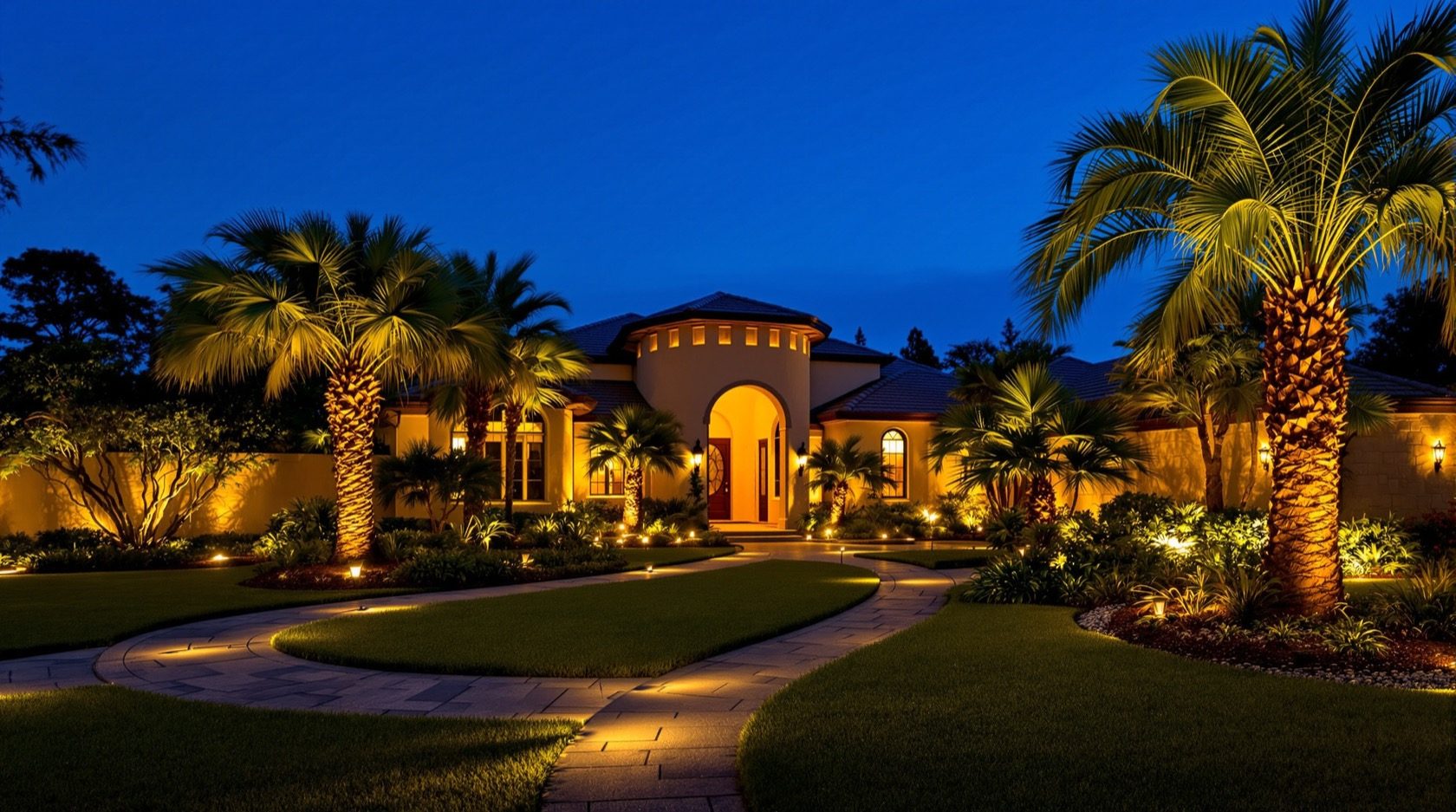
Outdoor, Landscape & Security Lighting: A Practical Guide
Lighting the garden, façade, path and entrance — the weatherproofing that outdoor fittings must have (the IP rating explained), the techniques that make a landscape beautiful, how security lighting actually deters, and the wiring and safety that outdoor light demands.
Outdoor lighting does three jobs at once — it makes a home beautiful after dark, it keeps paths and steps safe, and it deters intruders — and it does them in the harshest environment any home fitting faces: rain, dust, heat, humidity and monsoon. Get the weatherproofing wrong and fittings fail within a season; get the technique wrong and you flood the garden with glare instead of shaping it with light. This guide covers both, plus the safety that outdoor electricity demands.
It extends the home lighting design guide to the outdoors.
The safety line. Outdoor electrical work is higher-risk — water and electricity — and is strictly a licensed electrician's job, with proper weatherproof fittings, RCCB protection and correct earthing. Outdoor fittings must have the right IP rating and be installed to IS 732 and the National Electrical Code. This guide helps you plan and specify; never run outdoor wiring yourself.
The IP rating: the number that keeps outdoor lights alive
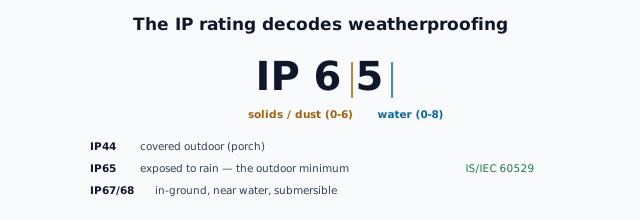
The single most important spec for any outdoor fitting is its IP rating (Ingress Protection), defined by IS/IEC 60529. It is two digits: the first is protection against solids/dust (0–6), the second against water (0–8).
| IP rating | Means | Suitable for |
|---|---|---|
| IP20 | Indoor only | Not for outdoors |
| IP44 | Splash-resistant | Covered outdoor areas (porch, balcony) |
| IP54 | Dust-protected, splash | Sheltered exterior |
| IP65 | Dust-tight, water jets | General outdoor, exposed to rain |
| IP66 | Dust-tight, powerful jets | Exposed, wind-driven rain |
| IP67 / IP68 | Immersion | Ground-recessed, near water features, submersible |
For India's monsoon and dust, the practical rule is: IP65 as the minimum for anything exposed to rain, IP66 for very exposed positions, and IP67/IP68 for in-ground uplights or anything near water. A pretty fitting with a low IP rating outdoors is money thrown away — it will fill with water and die.
Landscape lighting techniques
Beautiful outdoor lighting is about technique, not brightness. A few core moves:
- Uplighting — a light at the base of a tree, column or textured wall, throwing light upward for drama.
- Downlighting / moonlighting — fittings high in a tree or on a wall casting soft, dappled light down, mimicking moonlight.
- Path lighting — low, shielded fittings that light the ground, not your eyes, for safe walkways.
- Grazing — light close to and across a textured surface (stone, bark) to emphasise texture.
- Silhouetting — lighting a wall behind a plant so it reads as a dark shape.
- Accent / spotlighting — a focused beam on a feature, a sculpture, a specimen plant.
The golden rule of landscape lighting: light the object, hide the source. Glare from an exposed bulb ruins the effect; shielded, aimed fittings create it. Warm-to-neutral colour temperatures usually flatter planting and stone; avoid harsh blue-white except for security.
Security lighting that actually works
Security lighting deters best when it is purposeful, not just bright:
- Motion-sensor floodlights at entry points, the driveway and dark corners — the sudden change when someone approaches is a stronger deterrent than a light that is always on (which an intruder simply gets used to).
- Well-lit entrances and no dark hiding spots near doors and windows.
- Consistent perimeter light at a sensible level — you want to see, not to blind yourself and your neighbours with glare.
- Path and step lighting for safe movement.
- Pair with any smart lighting schedules that simulate occupancy while you're away.
Aim security light where it's useful and shield it so it doesn't spill as glare or light-pollute — bright and badly-aimed is worse than moderate and well-aimed.
Wiring and safety outdoors
Outdoor lighting demands more than indoor:
- RCCB protection on outdoor circuits is essential — water and electricity make earth-leakage protection life-critical.
- Weatherproof fittings, glands and junction boxes rated for the position; connections sealed against water.
- Proper earthing of metal fittings.
- Buried cables at safe depth in conduit, or suitable armoured/outdoor-rated cable, on routes that won't be dug into.
- Low-voltage (e.g. 12 V) systems are an option for some landscape lighting, reducing shock risk in wet garden settings — an electrician can advise.
All of this is exactly why outdoor lighting is a licensed electrician's job, not a weekend project.
The one-line answer
Outdoor lighting must survive rain and dust, so the first spec is the IP rating (IS/IEC 60529) — IP65 minimum for anything exposed to rain, IP67/68 for in-ground or near water. Light beautifully by technique, not brightness — uplight, downlight, path-light and accent, always "lighting the object and hiding the source". Make security lighting purposeful with motion sensors at entry points rather than permanent glare. And because water and electricity meet outdoors, insist on RCCB protection, weatherproof fittings, proper earthing and a licensed electrician for every bit of it.
Where to go next
- The indoor design: Home Lighting Design Guide.
- Automating outdoor light: Smart Lighting Guide.
- The shock protection outdoors needs: RCCB, RCBO & ELCB Guide.
- Colour choices: Colour Temperature & CRI.
References
- IS/IEC 60529 : 2001, Degrees of Protection Provided by Enclosures (IP Code), Bureau of Indian Standards.
- IS 16102 (Parts 1 & 2), Self-Ballasted LED Lamps for General Lighting Services, BIS.
- IS 3646 : Part 1 : 2025, Interior Illumination — Code of Practice (general lighting practice), BIS.
- IS 732 : 2019, Code of Practice for Electrical Wiring Installations; National Electrical Code SP 30 : 2023, BIS: https://www.bis.gov.in/
IP-rating guidance and techniques are indicative; the fittings, ratings, wiring, RCCB protection and earthing for outdoor lighting must be specified and installed by a licensed electrician. Verify any standard's status via the BIS catalogue before relying on it.
Export this guide
Related Guides — Deep-dive reading
Lighting Safety & IP Ratings: Choose the Right Fixture for the Spot (2026)
The homeowner's safety-literacy guide to lighting — how to read the two-digit IP rating, pick the correctly-rated fixture for bathrooms, gardens and wet zones, and know exactly where selecting a light ends and a licensed electrician's wiring begins.
LightingSmart Outdoor & Landscape Lighting for Indian Homes: Weatherproof, Automated, Safe
Facade, pathway, garden and security lighting done right for Indian conditions — IP65/IP66 weatherproofing for the monsoon, low-voltage vs mains outdoor wiring and earthing, motion and dusk-to-dawn automation, RGB festive facades, solar options, and brands with real prices.
Smart HomeElectrical Safety for Security Systems in India (2026): Powering It Without Peril
A homeowner's guide to the power side of home and RWA security systems, CCTV, alarms, gates, access control and NVRs, done so it protects you instead of quietly becoming a shock or fire hazard. What makes a supply safe, what to insist on, and why the mains work belongs to a licensed electrician.
SecurityRelated Tools — Try Free
Electrical Safety & Load Audit
Home electrical audit — 10 categories, 65+ checkpoints across earthing, RCCB, MCB, wiring, switchboards, appliance circuits, DG/inverter backup.
Safety AuditCCTV IP & IK Rating Decoder
Decode weatherproof (IP) and vandal-proof (IK) ratings and get the minimum you need for each mounting spot in Indian weather.
IP & IK RatingsEarth Conductor Size Calculator
Find the minimum protective (earth) conductor size for a circuit from its phase conductor size, using the standard IS 732 / IEC 60364 rule.
Electrical