
Bathroom Electrical Safety India: 30 mA RCD/RCBO, IP Ratings & Waterproof Switches
Wet skin plus mains voltage is the deadliest combination in an Indian home. This is a practical safety guide — why the 30 mA RCD/RCBO that trips in milliseconds is non-negotiable, the IP44/IP54/IP65 rating your fittings need by zone, waterproof switches and sockets (or better, switches outside the door), proper earthing and bonding, avoiding the classic geyser-shock scenario, how to test the RCD, and what to fix in an old bathroom — all per IS 732 and IS 3043.
More people are killed by electricity in the bathroom than in any other room of an Indian home, and it is almost never a freak accident. It is a predictable collision of three things: mains voltage, water, and a body whose skin resistance has collapsed because it is wet. Get the protection right and a fault becomes a harmless click as a breaker trips. Get it wrong — a leaky geyser element, a missing earth, a switch a wet hand can reach — and the same fault becomes fatal. This guide is deliberately blunt about the physics, then completely practical about the fixes: the one device that saves lives, the ratings your fittings actually need, and the checklist for an old bathroom that was wired before any of this was taken seriously.
This is the safety companion to our bathroom electrical guide. Read that for the full wiring layout; read this for the specific job of not getting electrocuted.
Why wet + electric is uniquely deadly
Electricity does not kill you with voltage; it kills you with current through the heart. What decides that current is your body's resistance, and water destroys it.
- Dry skin offers roughly 10,000–100,000 ohms. On 230 V that is a small, survivable current.
- Wet skin — soaked from a bath, standing in a puddle, gripping a wet tap — drops to around 1,000 ohms or less. The same 230 V now pushes well over 200 mA through you.
- It takes only about 30 mA (0.03 A) across the chest to cause ventricular fibrillation — the heart quivers instead of pumping, and without immediate defibrillation, death follows in minutes.
So the wet bather is not "a bit more exposed." They are operating with a hundredth of their normal protection, at a current level that is lethal, in a room where they are also barefoot on a conductive wet floor and often touching earthed metal (a tap, a shower arm, a drain grating). A fault that would give a dry person in the living room a sharp jolt can kill the same person in the bathroom.
The single most important sentence in this guide: every bathroom circuit must be protected by a 30 mA residual current device. Nothing else on this page matters as much.
The one device that saves your life: the 30 mA RCD/RCBO
An RCD (Residual Current Device) continuously compares the current flowing out on the live with the current returning on the neutral. In a healthy circuit they are equal. The instant some current "leaks" a different way — through a cracked geyser element, through a wet wall, or through you to earth — the two no longer match, and the RCD cuts power.
- The threshold for personal protection is 30 mA. That is not a random number; it is set below the fibrillation level so the supply disconnects before your heart is stopped.
- It acts in milliseconds — a 30 mA RCD must disconnect within 300 ms at rated current, and typically trips in under 40 ms at higher fault currents. You feel a jolt, not a killing shock.
- Indian terminology can confuse buyers, so be precise:
| Device | What it does | Use in the bathroom |
|---|---|---|
| MCB (Miniature Circuit Breaker) | Trips on overload/short circuit only. Rated in amps. | Protects the wire from fire. Does not protect you from shock. |
| RCCB (Residual Current Circuit Breaker) | Trips on earth leakage only (e.g. 30 mA). No overload protection. | Life-saving; usually one RCCB guarding several circuits. |
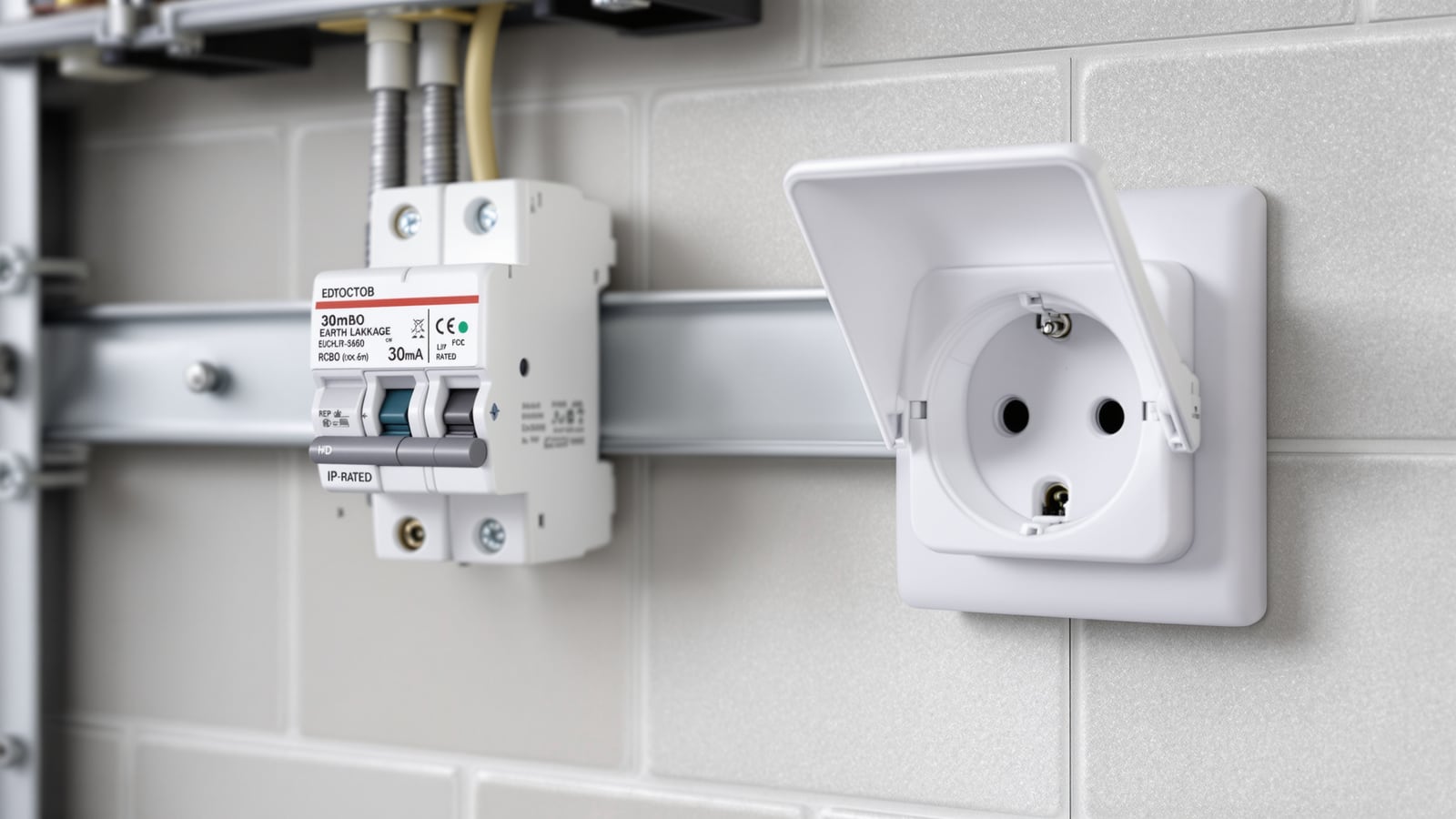
| RCBO (RCB with Overload) | Combines a 30 mA RCD and an MCB in one module. | Best choice — one dedicated RCBO per bathroom/geyser circuit. |
| GFCI | American name for the same earth-leakage concept, sometimes built into a socket. | Same protection; the term you will see on imported fittings. |
The practical rule: put a dedicated 30 mA RCBO on the geyser circuit and a 30 mA RCD covering the bathroom lighting and socket circuits. A single RCCB shared with the whole house is legal but inferior — one nuisance trip in the kitchen plunges the bathroom into darkness, and people are tempted to bypass it. IS 732 (the Indian wiring code, harmonised with IEC 60364) requires 30 mA additional protection for socket-outlets and for circuits serving bathroom locations.
IP ratings: which fitting can live where
Every electrical accessory in a bathroom carries an IP (Ingress Protection) code — two digits. The first is protection against solids/dust (0–6); the second, and the one that matters here, is protection against water (0–8). NBC 2016 and IS 732 divide the bathroom into zones by how much water each location sees, and each zone demands a minimum IP rating.
| Zone | Where it is | Minimum IP | Typical fittings |
|---|---|---|---|
| Zone 0 | Inside the tub or shower tray | IP67 | Only 12 V SELV, fully immersible fittings — usually nothing |
| Zone 1 | Above tub/shower to 2.25 m | IP65 (jet/spray proof) | Sealed shower downlight, geyser directly overhead |
| Zone 2 | 0.6 m beyond Zone 1; around basin | IP44 min (IP54–IP65 better) | Mirror light, exhaust fan, shaver socket |
| Outside zones | Dry wall away from splashes | IP20–IP44 | General switch (ideally outside the door) |
Reading the second digit in plain terms: IP44 resists splashing water from any direction; IP54 adds dust protection and heavier splashing; IP65 is dust-tight and withstands low-pressure water jets — the health-faucet reality of Indian bathrooms, where people hose the walls down. For anything a shower spray or a jet spray can reach, specify IP65 and stop worrying. Our companion guide on waterproof bathroom lights works through fitting choices zone by zone.
Switches and sockets: keep the finger away from the water
The best waterproof switch is the one a wet hand never reaches. Wherever possible, put the light and geyser switches on the wall outside the bathroom door, or on the dry side well away from the shower. This is standard good practice and is why so many older Indian homes have the "bathroom switchboard in the passage."
When accessories must be inside:
- Use IP-rated, splash-proof accessories. A plate switch with a gasketed cover (IP54–IP65) for anything within reach of spray; a standard modular switch is only acceptable in a dry corner outside the zones.
- Ordinary 6 A/16 A sockets do not belong in the wet zone at all. If you need a socket for a trimmer or hair dryer, use a shaver socket (isolating transformer type) near the mirror, in Zone 2, at least 0.6 m horizontally from the basin edge, and mount it above 1,300 mm.
- Pull-cord (ceiling) switches are the traditional wet-safe way to switch a geyser inside a bathroom — the operator touches only an insulated cord.
- Never run an extension board into the bathroom. Never charge a phone on the washbasin.
Earthing and bonding: the safety net under the RCD
An RCD needs a fault current to detect. Proper earthing (IS 3043) is what turns a live-to-metal fault into that detectable current instead of leaving a shower arm quietly live at 230 V waiting for you.
- Every metal-bodied appliance — the geyser above all — must have a dedicated earth conductor back to the earth bar, sized per IS 3043. A geyser wired without earth is the single most common lethal setup in Indian bathrooms.
- Supplementary (equipotential) bonding ties all the exposed and extraneous metal in the bathroom — geyser body, metal pipes, taps, shower mixer, metal drain, any structural steel — together with a green/yellow conductor so they all sit at the same potential. If nothing can be at a different voltage from anything else, you cannot become the bridge between them. IS 732 calls for this local supplementary bonding in bathroom locations.
- Never rely on the neutral as an earth and never earth to a water pipe alone — modern CPVC/PVC plumbing is an insulator and breaks the path.
The geyser-shock scenario, and how to kill it
The classic tragedy: a storage geyser's heating element develops a pinhole; water inside the tank becomes electrically live; the tank body, if unearthed, goes to mains potential; a bather reaches up to adjust the shower and completes the circuit to the wet floor. Every year this kills people who assumed "the geyser is off" — but the element leaks whether the geyser switch is on or not if the fault is upstream, and many people leave geysers switched on.
Break every link in that chain:
- 30 mA RCBO on the geyser circuit — trips the instant the element leaks, before you touch anything.
- Solid, tested earth on the geyser body — gives the leakage somewhere to go.
- Switch the geyser off before bathing — cheap, old habit, still worth it.
- Replace geysers over 8–10 years old and any with visible rust or tripping issues; a corroded element is a countdown.
- ISI-marked (IS 302) geyser with a working thermal cut-out and a functioning safety valve.
Our dedicated geyser and water-heater guide covers sizing, installation height and maintenance in full.
Test the RCD — it is not fit-and-forget
An RCD has moving parts and can seize, especially in humid coastal air. A dead RCD gives you a false sense of safety far worse than none.
- Press the "T" (Test) button every month. It injects a small artificial leakage; the device must trip and drop the switch instantly. If it does not, the RCD is faulty — replace it, do not tape the button down.
- Reset it after testing. If it will not stay reset, you have a genuine earth-leakage fault on the line — call an electrician, do not force it.
- Every few years, have an electrician confirm the trip current (≤30 mA) and trip time with an RCD tester, not just the button.
Fixing an old bathroom: the upgrade checklist
Most Indian bathrooms built before roughly 2010 predate any of this. If yours has ceramic-fuse boards, a geyser on a plain MCB, and switches by the shower, treat it as a priority retrofit — usually a half-day job. Do it alongside any renovation, and it is essential for an elderly-friendly bathroom where reaction times are slower.
| Problem in old bathrooms | Risk | Fix | Indicative cost (₹) |
|---|---|---|---|
| No RCD / RCCB anywhere | No shock protection at all | Add 30 mA RCCB at the DB, or per-circuit RCBOs | 1,200–4,500 |
| Geyser on plain MCB, no earth | Live tank, lethal | Dedicated earthed circuit + 30 mA RCBO | 2,000–5,000 |
| Two-pin, unearthed wiring | No fault path | Rewire in 3-core with proper earth | 6,000–18,000/room |
| Switch within shower reach | Wet-hand contact | Relocate outside door or fit IP-rated pull cord | 800–2,500 |
| No supplementary bonding | Potential difference across metal | Bond geyser, pipes, taps together | 1,000–3,000 |
| Ordinary socket in wet zone | Splash into live pins | Remove, or replace with shaver socket | 1,200–3,500 |
Prices are indicative for metros in 2026 and vary with brand, cable runs and whether walls must be chased.
If you do only one thing after reading this: confirm there is a 30 mA RCD protecting your geyser and bathroom sockets, and press its test button. That one check is worth more than every other upgrade combined.
Electrical safety is the invisible layer under a good bathroom — you never see it working, and that is exactly the point. Specify it once, correctly, and the room simply stops being dangerous. For the broader picture, tie this back to the bathroom electrical guide.
References
- National Building Code of India (NBC) 2016, Part 8 Building Services, Section 2 Electrical and Allied Installations — BIS.
- IS 732: Code of Practice for Electrical Wiring Installations (harmonised with IEC 60364) — additional protection by 30 mA RCD, bathroom zones and supplementary bonding — BIS.
- IS 3043: Code of Practice for Earthing — earthing and equipotential bonding of appliances and services — BIS.
- IS 302 / IS 2082: Safety and construction requirements for household electrical appliances and storage water heaters — BIS.
- IEC 60364-7-701: Requirements for special installations — locations containing a bath or shower (basis for the Indian zoning approach).
- Central Electricity Authority (CEA) Regulations, 2010 — Measures relating to Safety and Electric Supply, Government of India.
Export this guide
Related Guides — Deep-dive reading
Bathroom Electrical India: Loads, IP Zones, RCD Protection & the Complete Wiring Plan
The complete guide to bathroom electrical planning for Indian homes — the loads and points (geyser on a dedicated 16 A circuit, exhaust, mirror and lights, shaver socket, smart WC), the IP zones 0/1/2 that fix where fittings can sit near water, mandatory 30 mA RCD/RCBO earth-leakage protection, earthing, keeping switches outside the wet zone, cable sizing and getting conduits right before plastering — all per IS 732 and NBC 2016.
BathroomsBathroom Fire Safety India: NBC 2016 Part 4, Fire-Rated Materials & Electrical Ignition
The bathroom is rarely thought of as a fire risk, yet it hides several: a leaky geyser element, an over-run exhaust-fan motor, cheap flammable PVC panels overhead, and aerosol cans stored beside a heat source. This is an honest, practical reference to fire and life safety in the Indian bathroom — the NBC 2016 Part 4 context that actually applies to homes, the real ignition sources, self-extinguishing false-ceiling and PVC materials, earth-leakage protection as fire prevention, escape considerations, and the carbon-monoxide danger of gas geysers.
BathroomsWaterproof Bathroom Lights India: IP Ratings, Zones 0/1/2 & Which Fitting Goes Where
A safety-first guide to waterproof bathroom light fittings for Indian homes — what IP44, IP54, IP65 and IP67 actually mean, the bathroom zones (0/1/2) that decide which rating goes where per NBC 2016 and IS 732, sealed downlights, shower- and steam-rated fittings, LED strip in wet areas, RCBO protection and a rupee cost guide.
BathroomsRelated Tools — Try Free
Electrical Safety & Load Audit
Home electrical audit — 10 categories, 65+ checkpoints across earthing, RCCB, MCB, wiring, switchboards, appliance circuits, DG/inverter backup.
Safety AuditFalse Ceiling Cost Estimator
Live ₹/sqft across 8 ceiling types — POP, gypsum, designer, metal, PVC, wooden — with cove and spot lighting for 20 Indian cities.
Cost CalculatorRainwater Tank Sizer
How big should your rainwater tank be? Computes annual harvest, recommended tank capacity in litres, water-bill savings, and payback — for 10 Indian cities.
RWH Calculator